Over the last few weeks we have highlighted our concerns that English Heritage might have failed to discharge their obligations in relation to the planning conditions imposed on them by Wiltshire Council, in allowing the construction of the new visitor's centre at Stonehenge, which opened in December 2013.
Suspicion is one thing, having evidence is something else entirely. Consequently, we submitted a FOIA request to Wiltshire Council using the What Do They Know website to make life easier. Basically, in granting planning consent, Wiltshire Council had imposed 27 separate conditions that English Heritage were required to adhere to, covering a wide variety of topics associated with the new buldings, the environment and the A344. It would have been unreasonable for us to have asked about them all given our interests, so we restricted ourselves to those conditions that dealt directly with the use of the A344 by pedestrians and other users.
Wiltshire Council had told English Heritage to provide detailed plans for how they were going to ensure the planning conditions were met. Wiltshire Council would then approve these proposals before they were instituted. All very sensible and logical.
The information we got back from Wiltshire Council was a bit of revelation. You can download it and study it yourself from here. Wiltshire Council also indicated that they would put the same information on their website to aid its easy retrieval in the future. So here, in a nutshell, is what we discovered.
In early 2012, CBA Associates, acting for English Heritage, proposed to Wiltshire Council that the outstanding planning conditions be discharged. In reply, in two separate letters on 13th and 25th June 2012, Adam Madge of Wiltshire Council Planning Department responded to this proposal, agreeing to the measures English Heritage had put forward to comply with these obligations and in both letters stating:
"I would confirm that the details sent to us in relation to these conditions are acceptable to the local planning authority. The conditions will have been fully discharged when the development is carried out in accordance with these details as submitted.”
In other words, providing English Heritage complied with what they themselves had proposed, they would have satisfied Wiltshire Council.
So let's take a look at a few of the details, using English Heritage's own timetable:
PHASE 1 – STONEHENGE BOTTOM – MARCH 2013 – JUNE 2013
A new permissible route for pedestrians and cyclists is to be installed with the section that crosses the A344 being reinforced with a plastic ground reinforcement grid and defined by a low barrier, such as a rope barrier to stop visitors walking on the establishing areas of grass.
FAILED: Although the ground reinforcement was installed as planned, no route was marked until late summer 2014. Even now, the route marking is all a bit half-hearted and may be incorrect.
PHASE 2B – ENTRANCE CONFIGURATION – LATE SEPTEMBER 2013
On the A344 west of Byway 12 a section of the A344 is removed and reinforced hardwearing turf established. Site hording, such as Heras fencing is erected prior to the works beginning and is replaced by a temporary barrier/fence on its completion. These areas of hardwearing grass will be released in Sumer 2016.
New gates, Kent carriage gap and fences are to be installed at the intersection of Byway 12 and the A344.
FAILED: The following diagram shows what EH said they would install - Kent Carriage Gaps of the dimensions we have harped on about several times:
This is a bit hard to see, so here is the detail:
The design of the Kent Carriage Gaps, proposed by EH and accepted by Wiltshire Council, was:
You may also note in the plan above, that EH were supposed to provide cycle racking by certain deadlines they themselves had proposed:
Cycle Parking and Storage Provision at the Western End of the retained A344
10
no. bicycle racks to accommodate the parking/storage of 20 cycles will
be provided in the location shown on drawing 10110301-T-GA003. These
will be installed during works to the A344 in a 12 week construction
period currently scheduled to commence on 06/03/2013 and complete on
05/06/2013.
FAILED
Cycle Parking Provision at the Eastern End of the retained A344
5
no. bicycle racks to accommodate the parking of 10 cycles will be
provided in the location shown on drawing 10110301-T-GA005. These will
be installed during the construction of the Hub Building and Visitor
Transit System Drop-Off/Pick Up area in a 24 week construction period
currently scheduled to commence on 09/10/2013 and complete on
08/04/2014.
FAILED
Work should have also been carried out last year at the intersection of Byway 12 with the A344
The intersection of the A344 and Byway 12 and road surfaces of both the north and south approaches of Byway 12 will be planed and resurfaced with tarmac. A traffic management programme will be carried out while these works are being completed to allow traffic along the A344 as needed.
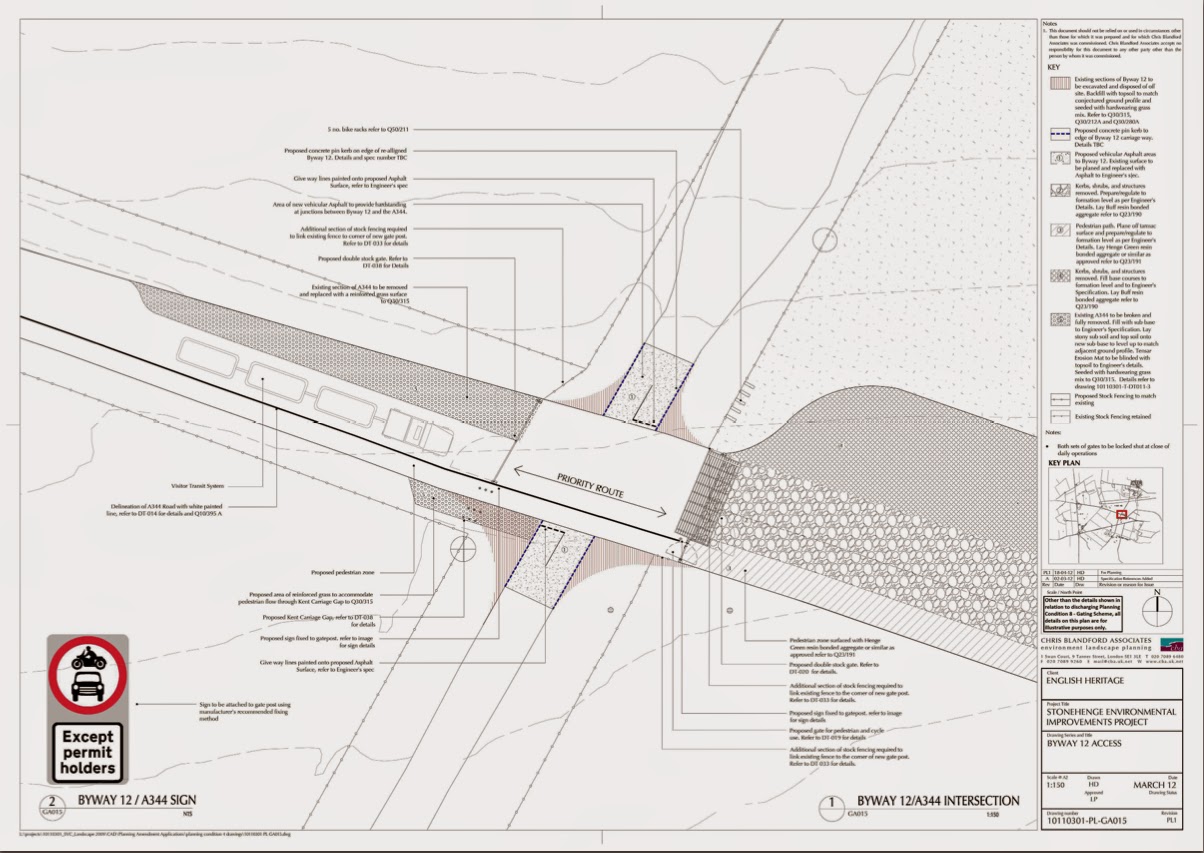
FAILED: EH have failed to install Kent Carriage Gaps, gates and cattle grids at the intersection. Anyone would think they were holding back in case Byway 12 was closed!
Where things get really confusing is in relation to the permissive path for cyclists and pedestrians between Byway 12 and Stonehenge Bottom. English Heritage, in proposing to discharge planning condition 11 noted to Wiltshire Council in a general statement:
A permissive path (for pedestrians and cyclists) will be available on
National Trust land immediately north of the Stonehenge monument running
along the line of the former A344 between Byway 12 and Stonehenge
Bottom.
Completely unambiguous, what was reported by the Press at the time, completely reasonable, but NOT what English Heritage actually intended. Between now and 2016, the temporary permissive route will follow its current course:
It follows the northern side of the stopped-up A344 to a new gate in the northern stock fence, crosses through the stock fence into the National Trust open access land. Now here is the idiocy. Once you are through the gate, you don't need to stick to the path and indeed one of the points the National Trust often make about this type of open access land is that they prefer people didn't all keep to one path, as it does less damage to the terrain. So having permission to use a path over land over which you have permission to roam does seem a wee bit superfluous. But it is, allegedly, only a temporary arrangement.
PHASE 4 – STONEHENGE BOTTOM – SUMMER 2016
The existing/temporary stock fence and gates to the north of the original A344 are to be removed and turf used to patch any resulting disturbances in the grass surface. The areas of the permissible route that are formed using the ground reinforcement system are to be removed and patched using turf grown off site.
The permissible route is now along the northern edge of the re-vegetated A344.
PARTIAL FAIL: The unambiguous brief answer provided by EH was highly misleading. The detailed answer may turn out to be correct, but we wont know until 2016.
We said at the outset that we had only asked about a few of the planning conditions that were imposed by Wiltshire Council, but our findings are worrying as it suggests there may be a systematic problem with the way these have been dealt with by English Heritage. It also highlights what some might perceive as a lack of diligence on the part of Wiltshire Council's Planning Department. The question has to be asked as to why they haven't been closely monitoring work at what must be one of Wiltshire Council's most prestigious locations and one of national and international importance.
We've now fed this back to Wiltshire Council. They need to put their house in order - and do it quickly. Only then might we see the quality of development at Stonehenge that English Heritage promised and that so farm they have singularly failed to deliver.
For far too long Winterbourne Stoke and other villages in the area have been blighted by the A303 traffic problems. Now a bypass seems imminent and the emphasis has shifted to make sure we get the best route preference the village.
Showing posts with label Department of Culture. Show all posts
Thursday, 25 September 2014
Monday, 12 May 2014
Just What Is The Truth About English Heritage and Byway 12?
Janice Hassett has published a most interesting post on the STAG Stonehenge Traffic Action Group blog.
It is raising some interesting questions about the truth about English Heritage's position, locally and nationally, on Byway 12. Anyone with an interest in the vexatious question of Byway 12 and the fate of the A303 would be well advised to read it all and start asking some very awkward questions.
Sunday, 13 April 2014
The Stonehenge Effect - Why Not All Traffic Jams Are Equal - A Soliton For the Masses
This weekend was set to be the first sunny weekend of 2014 - and only a week away from Easter. We were expecting problems with the volume of traffic and jams westbound on Friday and Saturday morning and we anticipate more heading eastbound this evening. However, the jams have been a little odd, to say the least. On Friday afternoon, we had the anticipated westbound tailbacks at the Countess roundabout in Amesbury, but traffic through Winterbourne Stoke was steady and not excessively heavy. Strangely, the Highways Agency camera that is located near to the Solstice Park in Amesbury was out of action. Strange that; it seems to happen an awful lot when the A303 is busy. "Conspiracy " you cry! Well, you might be right, the Highways Agency can't always be allowed to get away with the excuse of coincidental equipment failure or incompetence. Perhaps they really are switching off cameras that might cause them embarrassment?
Expecting heavy westbound traffic, SWMBO left Winterbourne Stoke at 4:00pm on Friday - often a peak jam time - and drove to Barnstaple in North Devon. She later reported that the drive was easy and traffic was very light. Odd, given the massive tailbacks east of here
Eastbound traffic wasn't playing ball either. From late morning to late afternoon, the eastbound traffic was virtually at a standstill; tailing back as far as the A36 interchange at Deptford.
Spire FM, our local radio station was expressing a degree of surprise as no-one appeared to know what was causing the jam. Curiouser and curiouser.
On Saturday morning, we held a STAG meeting to discuss activities in the run-up to Easter; a period we expect to be hellish as it is going to be the first potentially warm and sunny Bank Holiday since the new Stonehenge Visitor's Centre opened and the half-baked changes to the Longbarrow Roundabout completed. We agreed to take a look at the A303 at Stonehenge Bottom and in Winterbourne Stoke and leaflet the standing traffic if the opportunity arose.
When we got back to Winterbourne Stoke from Shrewton, we were staggered to see that there was so little traffic to be seen on the A303. We really though there had been an accident and we checked all our usual sources of information. No, nothing. Puzzled, we fired a text message to Stagman and Watch Bustard to tell them that traffic was light.
Seconds later, we got a somewhat incredulous reply from Stagman who was by the side of the westbound A303 opposite Stonhenge Cottages - just to the east of Stonehenge Bottom. Stagman pointed out that he was, as we exchanged text messages, wandering between two lanes of standing traffic distributing STAG leaflets. Good to see that he was purposeful in this activity as otherwise he might have been accused of ganderflanking - we can't be having any of that can we?
Compare what was going on at Winterbourne Stoke above to the situation at Stonehenge Bottom at exactly the same time:
The view back towards Amesbury looked like this:
Don't worry, Stagman's sign is double-sided, so the westbound travellers could see it and passengers could snap the QR code on their mobile phones and get linked to the STAG petition.
We were so STAGgered by the contrast that we recorded 30 minutes of westbound A303 traffic as a video. We've either speeded it up a wee bit or most of the traffic was travelling at over 400mph. Either way, the clip only last about 18 seconds!
Clearly, something odd has been happening. Despite it being a fine and sunny weekend, it seems the level of traffic on the A303 has been surprisingly light; certainly much less than we had anticipated. We expect that we are going to see that sort of traffic density from mid-Maundy Thursday into next weekend. So this odd phenomenon over the weekend seems to be the first confirmed case of the "Stonehenge Effect".
So what is the Stonehenge Effect? Well, it seems that the closure of the A344 and the "visit Stonehenge by timed appointment (preferred) policy" has driven the majority of those who used to stop on the A344 for a few minutes, or those who might pop in for a 30 minute look-see, to do something else.
Those of you who regularly use the A303 know exactly what they do. They get parallel with the stones, just west of Stonehenge Bottom, they slow, or even come to a complete stop, then a passenger or even the driver will whip out a smart-phone or camera and take a snap - or even a selfie! "It's only a second or ten," they would plead if stopped by Wiltshire Police's finest. "What harm can it possibly do?
Well, dear traveller. It seems that you have been the victim of something called a soliton - a self-reinforcing solitary wave. It's a well recognised phenomenon on roads and motorways that is also called a traffic wave, a stop wave, or a traffic shock. It's usually created when some muppet brakes hard in traffic for no apparent reason, or changes lane without indicating, forcing traffic behind to brake as well. Now cars can join a queue of standing traffic faster than they can leave the queue, so normally the soliton travels back down the road in the opposite direction to the normal traffic flow as shown in the diagram below. The blue bulge represents the volume of traffic on a "normal" road. Here the traffic is trying to go from right to left. The big red arrow shows that when the soliton forms, it moves against the traffic - once the event that caused. it in the first place has ended.
However, at Stonehenge Bottom, we have a nightmare situation. Lots of similar soliton-generating events are happening at exactly the same point on the A303 - by Stonehenge. In this case, once the soliton has formed, the start point stays exactly where it was and the end keeps on travelling back against the traffic flow. It should be fairly obvious that a major jam is going to form even with relatively light traffic and that is why we have been having problems all winter.
Soliton's also form when sheer volume of traffic blocks the A303 at choke points or turnings - such as the ends of each dual-carriageway section of the road where traffic is compressed back into a single carriageway. When the westbound traffic is really busy on the A303, a second soliton is often formed west of Winterbourne Stoke near Deptford and the rear of the soliton moves back east towards Winterbourne Stoke and collides with the leading edge of the Stonehenge soliton. The result is a massive and persistent jam - such as the ones that will begin next weekend.
What can be done about it and how can we stop the soliton's forming before the A303 is dualled? Fairly simply, maybe. Traffic management, pure and simple. The best way to achieve this is probably counter-intuitive, but it would simply to be to turn the A303 back into a single carriageway road, on all the dualled sections, from Thursday lunchtime to Monday lunchtime. That would get rid of all the 2-into-1 soliton's. The Stonehenge soliton can be prevented if the traffic is kept moving continuously through the World Heritage site. The best way to do this would be to prevent cars from seeing the stones. If this can't be done, because it conflicts with World Heritage Site aspirations, etc., then the section of road must be policed effectively with the full economic costs of doing this falling to the Department of Culture, Media and Sport.
So, we now have another meaning for our SH2 symbol - in addition to parasitising HS2 with its meaning of "Stonehenge Dual-carriageway" it now can also mean "Soliton Here As Well!"
Expecting heavy westbound traffic, SWMBO left Winterbourne Stoke at 4:00pm on Friday - often a peak jam time - and drove to Barnstaple in North Devon. She later reported that the drive was easy and traffic was very light. Odd, given the massive tailbacks east of here
Eastbound traffic wasn't playing ball either. From late morning to late afternoon, the eastbound traffic was virtually at a standstill; tailing back as far as the A36 interchange at Deptford.
![]() | |
| Eastbound traffic at Winterbourne Stoke |
On Saturday morning, we held a STAG meeting to discuss activities in the run-up to Easter; a period we expect to be hellish as it is going to be the first potentially warm and sunny Bank Holiday since the new Stonehenge Visitor's Centre opened and the half-baked changes to the Longbarrow Roundabout completed. We agreed to take a look at the A303 at Stonehenge Bottom and in Winterbourne Stoke and leaflet the standing traffic if the opportunity arose.
When we got back to Winterbourne Stoke from Shrewton, we were staggered to see that there was so little traffic to be seen on the A303. We really though there had been an accident and we checked all our usual sources of information. No, nothing. Puzzled, we fired a text message to Stagman and Watch Bustard to tell them that traffic was light.
![]() | |
| Saturday Afternoon in Winterbourne Stoke - Where's the traffic? |
Compare what was going on at Winterbourne Stoke above to the situation at Stonehenge Bottom at exactly the same time:
![]() |
| Westbound A303 - Stonehenge Hoves Into View |
![]() |
| Westbound Traffic and the Stagmobile |
We were so STAGgered by the contrast that we recorded 30 minutes of westbound A303 traffic as a video. We've either speeded it up a wee bit or most of the traffic was travelling at over 400mph. Either way, the clip only last about 18 seconds!
Clearly, something odd has been happening. Despite it being a fine and sunny weekend, it seems the level of traffic on the A303 has been surprisingly light; certainly much less than we had anticipated. We expect that we are going to see that sort of traffic density from mid-Maundy Thursday into next weekend. So this odd phenomenon over the weekend seems to be the first confirmed case of the "Stonehenge Effect".
So what is the Stonehenge Effect? Well, it seems that the closure of the A344 and the "visit Stonehenge by timed appointment (preferred) policy" has driven the majority of those who used to stop on the A344 for a few minutes, or those who might pop in for a 30 minute look-see, to do something else.
Those of you who regularly use the A303 know exactly what they do. They get parallel with the stones, just west of Stonehenge Bottom, they slow, or even come to a complete stop, then a passenger or even the driver will whip out a smart-phone or camera and take a snap - or even a selfie! "It's only a second or ten," they would plead if stopped by Wiltshire Police's finest. "What harm can it possibly do?
Well, dear traveller. It seems that you have been the victim of something called a soliton - a self-reinforcing solitary wave. It's a well recognised phenomenon on roads and motorways that is also called a traffic wave, a stop wave, or a traffic shock. It's usually created when some muppet brakes hard in traffic for no apparent reason, or changes lane without indicating, forcing traffic behind to brake as well. Now cars can join a queue of standing traffic faster than they can leave the queue, so normally the soliton travels back down the road in the opposite direction to the normal traffic flow as shown in the diagram below. The blue bulge represents the volume of traffic on a "normal" road. Here the traffic is trying to go from right to left. The big red arrow shows that when the soliton forms, it moves against the traffic - once the event that caused. it in the first place has ended.
However, at Stonehenge Bottom, we have a nightmare situation. Lots of similar soliton-generating events are happening at exactly the same point on the A303 - by Stonehenge. In this case, once the soliton has formed, the start point stays exactly where it was and the end keeps on travelling back against the traffic flow. It should be fairly obvious that a major jam is going to form even with relatively light traffic and that is why we have been having problems all winter.
Soliton's also form when sheer volume of traffic blocks the A303 at choke points or turnings - such as the ends of each dual-carriageway section of the road where traffic is compressed back into a single carriageway. When the westbound traffic is really busy on the A303, a second soliton is often formed west of Winterbourne Stoke near Deptford and the rear of the soliton moves back east towards Winterbourne Stoke and collides with the leading edge of the Stonehenge soliton. The result is a massive and persistent jam - such as the ones that will begin next weekend.
What can be done about it and how can we stop the soliton's forming before the A303 is dualled? Fairly simply, maybe. Traffic management, pure and simple. The best way to achieve this is probably counter-intuitive, but it would simply to be to turn the A303 back into a single carriageway road, on all the dualled sections, from Thursday lunchtime to Monday lunchtime. That would get rid of all the 2-into-1 soliton's. The Stonehenge soliton can be prevented if the traffic is kept moving continuously through the World Heritage site. The best way to do this would be to prevent cars from seeing the stones. If this can't be done, because it conflicts with World Heritage Site aspirations, etc., then the section of road must be policed effectively with the full economic costs of doing this falling to the Department of Culture, Media and Sport.
So, we now have another meaning for our SH2 symbol - in addition to parasitising HS2 with its meaning of "Stonehenge Dual-carriageway" it now can also mean "Soliton Here As Well!"
Subscribe to:
Posts (Atom)


