We predicted, some time ago, that the announcement that the Government wished to push ahead with improving the A303/A30/A358 corridor to the West Country would flush out every failed and ill-considered proposal that has ever seen the light of day over the last half century or so. Sadly, but all too predictably, we have not been disappointed.
We've said, all along, that our goal is to dual the A303, bypass the beleaguered village of Winterbourne Stoke and improve the traffic situation on local roads, particularly those in and around Shrewton to our north. However, in achieving our goal, our second aim is to ensure the best possible environment for the whole of the World Heritage Site; much of which lies within our Parish boundaries - almost certainly making us the most visited village in England, on a per capita basis, as English Heritage's Stonehenge Visitor's Centre lies within our boundaries. Also lying within our perimeter lies what is arguably the most important feature of the World Heritage Site - not Stonehenge, which is something of a "Jonny Come Lately", but the Longbarrow which pre-dates even the earliest phase of Stonehenge by half a millennium.
Actually, only the left hand side of the Longbarrow lies within the parish of Winterbourne Stoke, the right hand (south eastern) side lies in the parish of Wilsford Cum Lake.
You'd have thought that there would be a common view, locally, to enhance this landscape. Not a bit of it, it seems. Though to be fair, no-one has yet, in recent times, sought the views of the locals in any consistent way. That said, there seem to be several favoured alternatives locally:
A - Any solution that gets rid of the traffic jams;
B - A tunnel of 2.9km;
C - An even longer tunnel;
D - Dualling along the existing route, but sinking it in a ditch;
E - Putting the road way to the north, across the southern edge of the Salisbury Plain training area - to the north of Larkhill;
F - Putting the road south of Amesbury on any one of half a dozen routes.
The first solution (A) is borne of desperation by those who live along the A303 - understandable, but it may not help preserve our heritage. (B) and (C) achieve the aims of dualling the A303 and taking the road out of the World Heritage Site. The longer the tunnel the better, in environmental and heritage terms, but it comes at a cost. Perhaps the biggest advantage is that it would enable ALL vehicles, including most of the coaches used by English Heritage and the risible Land Train, to be excluded from the environment. Of course, you would need to provide some mechanised transport for the disabled and elderly, but every other bugger could walk into the landscape from the Visitor's Centre, Larkhill, Amesbury, etc. The route of the A303 could be returned to a green Bridleway throughout the WHS
(E) is an interesting option. The Armed Forces would kick and scream, but even with the current re-basing exercise, it's hard to justify still needing as much space to exercise our much diminished Forces as we did at the height of WWI and WWII. It would be an inexpensive route, with few landowners to deal with and would remove the A303 from the WHS. Far too sensible an option to be considered.
(F) looks superficially promising, until you get stuck into the detail. There are way too many vested interests that would help kill it off. It may have been a viable option 50 years ago when the idea of improving things was first mooted, but the world has moved on - unlike many of the proponents of this schemes.
Finally, we have option (D). About the only positive thing that can be said about this option is that it is cheap and cheerful. It does nothing to enhance the environment of the World Heritage site - and here it is important to stress one thing - whether or not the landscape around Stonehenge remains as a World Heritage site is immaterial to the argument of how the area is crossed. It comes down to whether WE as a region, WE as a nation, want to leave something valuable to posterity - or simply want to bung in a cheap and nasty road and to hell with the consequences. Those that are pushing for this option are doing so on the basis of simple cost (certainly not cost in the broader sense, or else they would soon realise how utterly indefensible their position is).
So, do they have a point when it comes to pounds shillings and pence? Lets look at just a couple of hard facts. Even the 2.9 km tunnel is going to cost at least £2billion. Now that is a big number and I can't imagine what it would look like as a pile of fivers, but is it really excessive in the greater scheme of things? Well let's compare it with something else equally controversial.
Now I could choose the cost of membership of the EU as the comparator, but the booklet of facts on staying in the EU, or leaving, dropped through the door the other day and when I opened this piece of Tory propaganda, I found all the facts were missing from my copy - and the same was true in every other copy I've looked at, so that isn't going to be overly helpful. What else might be a good comparator? Something else that is expensive and controversial - like the UK's Foreign Aid budget.
In 2013, the UK spent 0.7% of GDP, £11.4bn on foreign aid - money spent that does not benefit the UK directly and some would argue is often misspent, maladministered and way to much. We can point the finger of blame at the Lib-Dems for pushing the 0.7% of GDP target in Parliament. The Tories and Labour seem happy with the spend, through the Greens would like to increase it to 1% of GDP. UKIP on the other hand, want to reduce the Foreign Aid budget to 0.2% of GDP and spend the rest within the UK. In a time of austerity, it's hard to justify spending anything not of direct benefit to UK citizens, but I digress...
Back to a fact or two. Back in 2014, we gave India £279 million in Foreign Aid and that was 40% down on 2011. India has its own space program, it has a planned mission to Mars, and the whole program costs £500 million to run per year. So, in bald terms, the money we put into the Indian economy was equivalent to more than 50% of the cost of their entire space program or could have funded 7-8 missions to Mars. We may have been funding it entirely prior to 2011.
Now DfID will argue that the money was targeted on things the Indian's wouldn't have spent their own money on anyway, but the bottom line was that India had a choice on how to spend its money and chose a space program over health and education. I'm sure a little digging would uncover even more egregious examples, but this one will do for the moment.
So, the 2.9 km Stonehenge tunnel option might cost £2bn at December 2014 prices, but over the 40 years (more like 50, but lets be conservative) that there has been talk of improving the A303, we've probably ploughed a demonstrably un-needed £11.6 billion into Indian Foreign Aid. During the same period, we've probably ploughed close to half a trillion pounds into Foreign Aid in total.
Well, there you have it. A one-off spend of £2bn on a tunnel for Stonehenge is peanuts in the greater scheme of things and can easily be afforded by cutting the Foreign Aid budget from those countries, like India, that can well-afford to look after their own population's interests, but choose to ignore them. Of course, digressing again, there are real emergencies and situations that call for Foreign Aid and I wouldn't want to stop that, but we need to spend more wisely.
We have those that walk amongst us who believe a £2 billion tunnel is an extravagance, whilst their political bed-fellows were responsible for the concept of blowing 0.7% of GDP on Foreign Aid without any clear demonstration of need. I would beg you to treat these people gently; their sanity is surely in question.
For far too long Winterbourne Stoke and other villages in the area have been blighted by the A303 traffic problems. Now a bypass seems imminent and the emphasis has shifted to make sure we get the best route preference the village.
Showing posts with label English Heritage. Show all posts
Wednesday, 13 April 2016
Monday, 1 December 2014
Breakfast With Nick Clegg at Stonehenge
Well, not exactly. It's a bit of hyperbole to say that I actually had breakfast with the Deputy Prime Minister - I was up at Stonehenge this morning for the BIG announcement, as was Nick Clegg, and I was stood fairly close to him with a cup of coffee, which might pass for breakfast, but I never actually got to speak with him. Never mind, we were all around for a common purpose - to give interviews to the Press.
Before getting up to Stonehenge, I had an assignation with a lovely lady called Rebecca Rooney from BBC Wiltshire, for an interview on the A303 funding announcement. We met up on the forecourt of the Bell Inn, Winterbourne Stoke, with the fast-moving, early morning, commuter traffic providing an "interesting" backdrop. We had the usual mix of large HGVs travelling at well over the 40 mph limit to help them get up the hills on either side of the village. We had school kids using the light-controlled crossing with fast moving vehicles bearing down on them with seemingly little realisation that there was a crossing there at all. Then we had the usual nightmare of villagers trying to get out of the village onto the A303 - with one taking almost 10 minutes to find a nearly safe gap into which to pull out.
I'll even forgive Rebecca for calling me Mr Churchill - perhaps I should go into politics after all and give John Glenn MP a run for his money?
So what's the big deal? Well, the Government announced that it was going to be earmarking some £15 billion for important road projects across the UK. Its worth contrasting that sum with the £17 billion earmarked (so far) for the HS2 - and bear in mind that only 10% of goods traffic and a fraction of passenger traffic is shipped by rail.
Of the £15 billion, some £2 billion has been ear-marked for the A303 and £1.3 billion earmarked for a tunnel under Stonehenge - though it isn't clear if the £1.3 billion is separate from the £2 billion, or the major part of it. It sounds a lot of money, but how far will it go? Well lets have some facts and figures:
- dual carriageway cost between £20 million/mile to £25 million/mile to build on average - so £2 billion would buy 80-100 milesof dual carriageway - much more than is needed for the A303. £0.7 billion gets you 28-35 miles - probably about right.
- tunnels cost a darned site more to build than dual carriageway, though I'm not sure £1.3 billion is necessarily realistic.
-to put things in perspective, the A3 Hindhead tunnel at 1.9km long cot the bulk of the £371 million spent on the whole 4km project. However, the "Big Dig" project in Boston (US) cost in excess of £12.5 billion for a tunnel twice the length of the one proposed for Stonehenge.
So, we welcome the news - but with a healthy scepticism. After all, we'vee been here before. Back in the late 1980s, Maggie Thatcher promised A303 widening as a package of road building measures that were claimed to be the biggest since Roman times - they failed to deliver. More recently, the last Labour government promised to do the job, but killed the project on cost grounds. So in some ways, here we go again.
However, there are a few differences this time. Firstly, English Heritage and the National Trust appear to be singing from the same song-sheet and have agreed a plan that minimises impact on the World Heritage Site. Pragmatism is being shown by many other parties too, recognising that the A303 is a strategic route and it has to be dealt with sooner rather than later.
Pragmatism will also be needed here in Winterbourne Stoke - clearly we will benefit from the removal of traffic from the centre of the village, but there are risks - noise from a dual carriageway situated to the north of the village being an obvious issue. So we will need to fight hard to ensure the environmental issues are addressed to our satisfaction and benefit. I am sure there will be other issues.
The best news is the fact that they plan to tie the funding into the Infrastructure Bill that is currently going through parliament. It's all tied into making the Highways Agency a company and ensuring funding certainty in 5-year tranches. It doesn't mean that a future government couldn't stop things going ahead, but they would have to change legislation as well as changing their minds.
So - a healthy scepticism. As I write, Rebecca Rooney is reporting a similar healthy scepticism from Larkhill and other villagers
Up at Stonehenge, lots of positive vibes about the plan. STAGs Janice Hassett seemed to be more in demand from interviewers than did Nick Clegg - but then she is a bit of a straight-talking, fire-brand who calls a spade, a spade.
It was a good opportunity to buttonhole people like the regional head of the Highways Agency to ask about what happens in the meantime about the A303 nightmare. Specifically, we raised the issue of the dangers of Longbarrow Roundabout - as did other STAG members. We'll see if this has any effect.
So - lets see what happens when all the fuss about today's news dies down and the economic realities hit home.
Before getting up to Stonehenge, I had an assignation with a lovely lady called Rebecca Rooney from BBC Wiltshire, for an interview on the A303 funding announcement. We met up on the forecourt of the Bell Inn, Winterbourne Stoke, with the fast-moving, early morning, commuter traffic providing an "interesting" backdrop. We had the usual mix of large HGVs travelling at well over the 40 mph limit to help them get up the hills on either side of the village. We had school kids using the light-controlled crossing with fast moving vehicles bearing down on them with seemingly little realisation that there was a crossing there at all. Then we had the usual nightmare of villagers trying to get out of the village onto the A303 - with one taking almost 10 minutes to find a nearly safe gap into which to pull out.
I'll even forgive Rebecca for calling me Mr Churchill - perhaps I should go into politics after all and give John Glenn MP a run for his money?
So what's the big deal? Well, the Government announced that it was going to be earmarking some £15 billion for important road projects across the UK. Its worth contrasting that sum with the £17 billion earmarked (so far) for the HS2 - and bear in mind that only 10% of goods traffic and a fraction of passenger traffic is shipped by rail.
Of the £15 billion, some £2 billion has been ear-marked for the A303 and £1.3 billion earmarked for a tunnel under Stonehenge - though it isn't clear if the £1.3 billion is separate from the £2 billion, or the major part of it. It sounds a lot of money, but how far will it go? Well lets have some facts and figures:
- dual carriageway cost between £20 million/mile to £25 million/mile to build on average - so £2 billion would buy 80-100 milesof dual carriageway - much more than is needed for the A303. £0.7 billion gets you 28-35 miles - probably about right.
- tunnels cost a darned site more to build than dual carriageway, though I'm not sure £1.3 billion is necessarily realistic.
-to put things in perspective, the A3 Hindhead tunnel at 1.9km long cot the bulk of the £371 million spent on the whole 4km project. However, the "Big Dig" project in Boston (US) cost in excess of £12.5 billion for a tunnel twice the length of the one proposed for Stonehenge.
So, we welcome the news - but with a healthy scepticism. After all, we'vee been here before. Back in the late 1980s, Maggie Thatcher promised A303 widening as a package of road building measures that were claimed to be the biggest since Roman times - they failed to deliver. More recently, the last Labour government promised to do the job, but killed the project on cost grounds. So in some ways, here we go again.
However, there are a few differences this time. Firstly, English Heritage and the National Trust appear to be singing from the same song-sheet and have agreed a plan that minimises impact on the World Heritage Site. Pragmatism is being shown by many other parties too, recognising that the A303 is a strategic route and it has to be dealt with sooner rather than later.
Pragmatism will also be needed here in Winterbourne Stoke - clearly we will benefit from the removal of traffic from the centre of the village, but there are risks - noise from a dual carriageway situated to the north of the village being an obvious issue. So we will need to fight hard to ensure the environmental issues are addressed to our satisfaction and benefit. I am sure there will be other issues.
The best news is the fact that they plan to tie the funding into the Infrastructure Bill that is currently going through parliament. It's all tied into making the Highways Agency a company and ensuring funding certainty in 5-year tranches. It doesn't mean that a future government couldn't stop things going ahead, but they would have to change legislation as well as changing their minds.
So - a healthy scepticism. As I write, Rebecca Rooney is reporting a similar healthy scepticism from Larkhill and other villagers
Up at Stonehenge, lots of positive vibes about the plan. STAGs Janice Hassett seemed to be more in demand from interviewers than did Nick Clegg - but then she is a bit of a straight-talking, fire-brand who calls a spade, a spade.
It was a good opportunity to buttonhole people like the regional head of the Highways Agency to ask about what happens in the meantime about the A303 nightmare. Specifically, we raised the issue of the dangers of Longbarrow Roundabout - as did other STAG members. We'll see if this has any effect.
So - lets see what happens when all the fuss about today's news dies down and the economic realities hit home.
Thursday, 25 September 2014
Stonehenge: What English Heritage Told Wiltshire Council They Would Do To Discharge Planning Conditions - Then What They Failed To Do!
Over the last few weeks we have highlighted our concerns that English Heritage might have failed to discharge their obligations in relation to the planning conditions imposed on them by Wiltshire Council, in allowing the construction of the new visitor's centre at Stonehenge, which opened in December 2013.
Suspicion is one thing, having evidence is something else entirely. Consequently, we submitted a FOIA request to Wiltshire Council using the What Do They Know website to make life easier. Basically, in granting planning consent, Wiltshire Council had imposed 27 separate conditions that English Heritage were required to adhere to, covering a wide variety of topics associated with the new buldings, the environment and the A344. It would have been unreasonable for us to have asked about them all given our interests, so we restricted ourselves to those conditions that dealt directly with the use of the A344 by pedestrians and other users.
Wiltshire Council had told English Heritage to provide detailed plans for how they were going to ensure the planning conditions were met. Wiltshire Council would then approve these proposals before they were instituted. All very sensible and logical.
The information we got back from Wiltshire Council was a bit of revelation. You can download it and study it yourself from here. Wiltshire Council also indicated that they would put the same information on their website to aid its easy retrieval in the future. So here, in a nutshell, is what we discovered.
In early 2012, CBA Associates, acting for English Heritage, proposed to Wiltshire Council that the outstanding planning conditions be discharged. In reply, in two separate letters on 13th and 25th June 2012, Adam Madge of Wiltshire Council Planning Department responded to this proposal, agreeing to the measures English Heritage had put forward to comply with these obligations and in both letters stating:
"I would confirm that the details sent to us in relation to these conditions are acceptable to the local planning authority. The conditions will have been fully discharged when the development is carried out in accordance with these details as submitted.”
In other words, providing English Heritage complied with what they themselves had proposed, they would have satisfied Wiltshire Council.
So let's take a look at a few of the details, using English Heritage's own timetable:
PHASE 1 – STONEHENGE BOTTOM – MARCH 2013 – JUNE 2013
A new permissible route for pedestrians and cyclists is to be installed with the section that crosses the A344 being reinforced with a plastic ground reinforcement grid and defined by a low barrier, such as a rope barrier to stop visitors walking on the establishing areas of grass.
FAILED: Although the ground reinforcement was installed as planned, no route was marked until late summer 2014. Even now, the route marking is all a bit half-hearted and may be incorrect.
PHASE 2B – ENTRANCE CONFIGURATION – LATE SEPTEMBER 2013
On the A344 west of Byway 12 a section of the A344 is removed and reinforced hardwearing turf established. Site hording, such as Heras fencing is erected prior to the works beginning and is replaced by a temporary barrier/fence on its completion. These areas of hardwearing grass will be released in Sumer 2016.
New gates, Kent carriage gap and fences are to be installed at the intersection of Byway 12 and the A344.
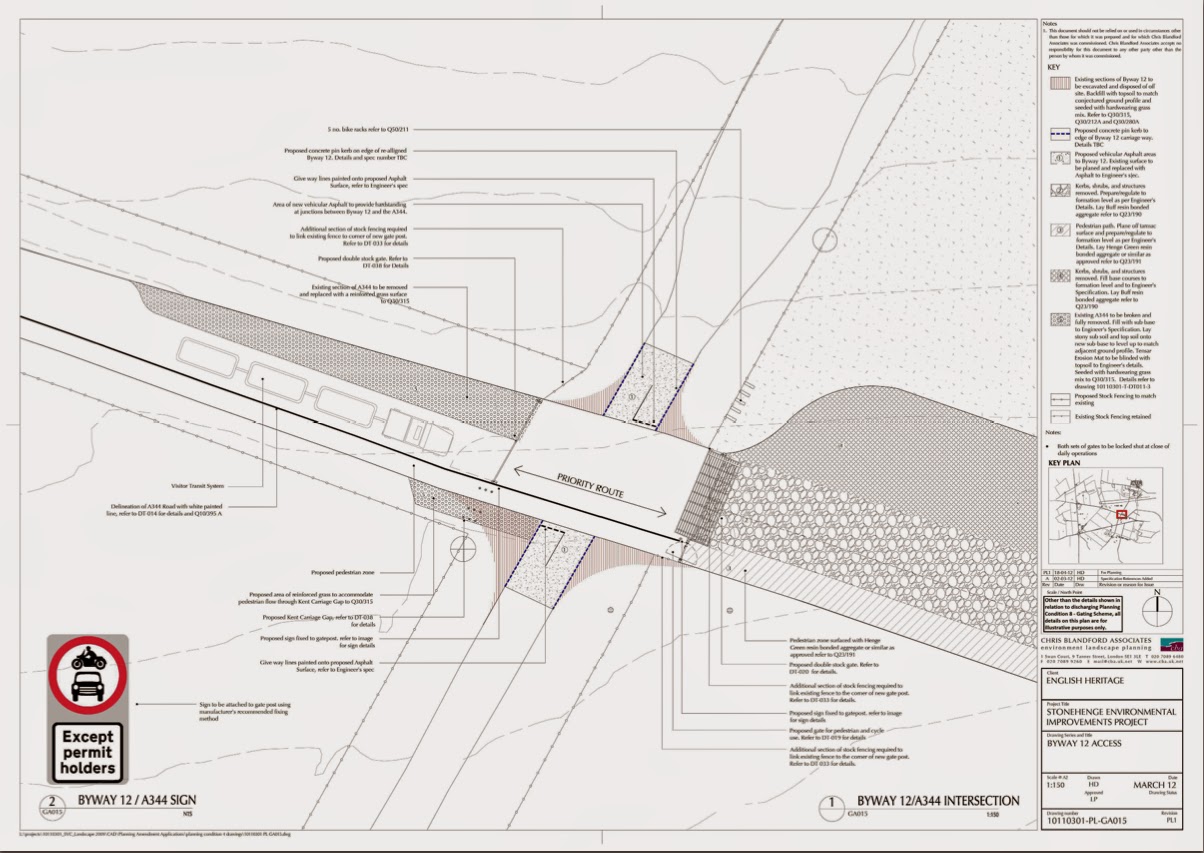
FAILED: The following diagram shows what EH said they would install - Kent Carriage Gaps of the dimensions we have harped on about several times:
This is a bit hard to see, so here is the detail:
The design of the Kent Carriage Gaps, proposed by EH and accepted by Wiltshire Council, was:
You may also note in the plan above, that EH were supposed to provide cycle racking by certain deadlines they themselves had proposed:
Cycle Parking and Storage Provision at the Western End of the retained A344
10 no. bicycle racks to accommodate the parking/storage of 20 cycles will be provided in the location shown on drawing 10110301-T-GA003. These will be installed during works to the A344 in a 12 week construction period currently scheduled to commence on 06/03/2013 and complete on 05/06/2013.
FAILED
Cycle Parking Provision at the Eastern End of the retained A344
5 no. bicycle racks to accommodate the parking of 10 cycles will be provided in the location shown on drawing 10110301-T-GA005. These will be installed during the construction of the Hub Building and Visitor Transit System Drop-Off/Pick Up area in a 24 week construction period currently scheduled to commence on 09/10/2013 and complete on 08/04/2014.
FAILED
Work should have also been carried out last year at the intersection of Byway 12 with the A344
The intersection of the A344 and Byway 12 and road surfaces of both the north and south approaches of Byway 12 will be planed and resurfaced with tarmac. A traffic management programme will be carried out while these works are being completed to allow traffic along the A344 as needed.
FAILED: EH have failed to install Kent Carriage Gaps, gates and cattle grids at the intersection. Anyone would think they were holding back in case Byway 12 was closed!
Where things get really confusing is in relation to the permissive path for cyclists and pedestrians between Byway 12 and Stonehenge Bottom. English Heritage, in proposing to discharge planning condition 11 noted to Wiltshire Council in a general statement:
A permissive path (for pedestrians and cyclists) will be available on National Trust land immediately north of the Stonehenge monument running along the line of the former A344 between Byway 12 and Stonehenge Bottom.
Completely unambiguous, what was reported by the Press at the time, completely reasonable, but NOT what English Heritage actually intended. Between now and 2016, the temporary permissive route will follow its current course:
It follows the northern side of the stopped-up A344 to a new gate in the northern stock fence, crosses through the stock fence into the National Trust open access land. Now here is the idiocy. Once you are through the gate, you don't need to stick to the path and indeed one of the points the National Trust often make about this type of open access land is that they prefer people didn't all keep to one path, as it does less damage to the terrain. So having permission to use a path over land over which you have permission to roam does seem a wee bit superfluous. But it is, allegedly, only a temporary arrangement.
PHASE 4 – STONEHENGE BOTTOM – SUMMER 2016
The existing/temporary stock fence and gates to the north of the original A344 are to be removed and turf used to patch any resulting disturbances in the grass surface. The areas of the permissible route that are formed using the ground reinforcement system are to be removed and patched using turf grown off site.
The permissible route is now along the northern edge of the re-vegetated A344.
PARTIAL FAIL: The unambiguous brief answer provided by EH was highly misleading. The detailed answer may turn out to be correct, but we wont know until 2016.
We said at the outset that we had only asked about a few of the planning conditions that were imposed by Wiltshire Council, but our findings are worrying as it suggests there may be a systematic problem with the way these have been dealt with by English Heritage. It also highlights what some might perceive as a lack of diligence on the part of Wiltshire Council's Planning Department. The question has to be asked as to why they haven't been closely monitoring work at what must be one of Wiltshire Council's most prestigious locations and one of national and international importance.
We've now fed this back to Wiltshire Council. They need to put their house in order - and do it quickly. Only then might we see the quality of development at Stonehenge that English Heritage promised and that so farm they have singularly failed to deliver.
Suspicion is one thing, having evidence is something else entirely. Consequently, we submitted a FOIA request to Wiltshire Council using the What Do They Know website to make life easier. Basically, in granting planning consent, Wiltshire Council had imposed 27 separate conditions that English Heritage were required to adhere to, covering a wide variety of topics associated with the new buldings, the environment and the A344. It would have been unreasonable for us to have asked about them all given our interests, so we restricted ourselves to those conditions that dealt directly with the use of the A344 by pedestrians and other users.
Wiltshire Council had told English Heritage to provide detailed plans for how they were going to ensure the planning conditions were met. Wiltshire Council would then approve these proposals before they were instituted. All very sensible and logical.
The information we got back from Wiltshire Council was a bit of revelation. You can download it and study it yourself from here. Wiltshire Council also indicated that they would put the same information on their website to aid its easy retrieval in the future. So here, in a nutshell, is what we discovered.
In early 2012, CBA Associates, acting for English Heritage, proposed to Wiltshire Council that the outstanding planning conditions be discharged. In reply, in two separate letters on 13th and 25th June 2012, Adam Madge of Wiltshire Council Planning Department responded to this proposal, agreeing to the measures English Heritage had put forward to comply with these obligations and in both letters stating:
"I would confirm that the details sent to us in relation to these conditions are acceptable to the local planning authority. The conditions will have been fully discharged when the development is carried out in accordance with these details as submitted.”
In other words, providing English Heritage complied with what they themselves had proposed, they would have satisfied Wiltshire Council.
So let's take a look at a few of the details, using English Heritage's own timetable:
PHASE 1 – STONEHENGE BOTTOM – MARCH 2013 – JUNE 2013
A new permissible route for pedestrians and cyclists is to be installed with the section that crosses the A344 being reinforced with a plastic ground reinforcement grid and defined by a low barrier, such as a rope barrier to stop visitors walking on the establishing areas of grass.
FAILED: Although the ground reinforcement was installed as planned, no route was marked until late summer 2014. Even now, the route marking is all a bit half-hearted and may be incorrect.
PHASE 2B – ENTRANCE CONFIGURATION – LATE SEPTEMBER 2013
On the A344 west of Byway 12 a section of the A344 is removed and reinforced hardwearing turf established. Site hording, such as Heras fencing is erected prior to the works beginning and is replaced by a temporary barrier/fence on its completion. These areas of hardwearing grass will be released in Sumer 2016.
New gates, Kent carriage gap and fences are to be installed at the intersection of Byway 12 and the A344.
FAILED: The following diagram shows what EH said they would install - Kent Carriage Gaps of the dimensions we have harped on about several times:
This is a bit hard to see, so here is the detail:
The design of the Kent Carriage Gaps, proposed by EH and accepted by Wiltshire Council, was:
You may also note in the plan above, that EH were supposed to provide cycle racking by certain deadlines they themselves had proposed:
Cycle Parking and Storage Provision at the Western End of the retained A344
10 no. bicycle racks to accommodate the parking/storage of 20 cycles will be provided in the location shown on drawing 10110301-T-GA003. These will be installed during works to the A344 in a 12 week construction period currently scheduled to commence on 06/03/2013 and complete on 05/06/2013.
FAILED
Cycle Parking Provision at the Eastern End of the retained A344
5 no. bicycle racks to accommodate the parking of 10 cycles will be provided in the location shown on drawing 10110301-T-GA005. These will be installed during the construction of the Hub Building and Visitor Transit System Drop-Off/Pick Up area in a 24 week construction period currently scheduled to commence on 09/10/2013 and complete on 08/04/2014.
FAILED
Work should have also been carried out last year at the intersection of Byway 12 with the A344
The intersection of the A344 and Byway 12 and road surfaces of both the north and south approaches of Byway 12 will be planed and resurfaced with tarmac. A traffic management programme will be carried out while these works are being completed to allow traffic along the A344 as needed.
FAILED: EH have failed to install Kent Carriage Gaps, gates and cattle grids at the intersection. Anyone would think they were holding back in case Byway 12 was closed!
Where things get really confusing is in relation to the permissive path for cyclists and pedestrians between Byway 12 and Stonehenge Bottom. English Heritage, in proposing to discharge planning condition 11 noted to Wiltshire Council in a general statement:
A permissive path (for pedestrians and cyclists) will be available on National Trust land immediately north of the Stonehenge monument running along the line of the former A344 between Byway 12 and Stonehenge Bottom.
Completely unambiguous, what was reported by the Press at the time, completely reasonable, but NOT what English Heritage actually intended. Between now and 2016, the temporary permissive route will follow its current course:
It follows the northern side of the stopped-up A344 to a new gate in the northern stock fence, crosses through the stock fence into the National Trust open access land. Now here is the idiocy. Once you are through the gate, you don't need to stick to the path and indeed one of the points the National Trust often make about this type of open access land is that they prefer people didn't all keep to one path, as it does less damage to the terrain. So having permission to use a path over land over which you have permission to roam does seem a wee bit superfluous. But it is, allegedly, only a temporary arrangement.
PHASE 4 – STONEHENGE BOTTOM – SUMMER 2016
The existing/temporary stock fence and gates to the north of the original A344 are to be removed and turf used to patch any resulting disturbances in the grass surface. The areas of the permissible route that are formed using the ground reinforcement system are to be removed and patched using turf grown off site.
The permissible route is now along the northern edge of the re-vegetated A344.
PARTIAL FAIL: The unambiguous brief answer provided by EH was highly misleading. The detailed answer may turn out to be correct, but we wont know until 2016.
We said at the outset that we had only asked about a few of the planning conditions that were imposed by Wiltshire Council, but our findings are worrying as it suggests there may be a systematic problem with the way these have been dealt with by English Heritage. It also highlights what some might perceive as a lack of diligence on the part of Wiltshire Council's Planning Department. The question has to be asked as to why they haven't been closely monitoring work at what must be one of Wiltshire Council's most prestigious locations and one of national and international importance.
We've now fed this back to Wiltshire Council. They need to put their house in order - and do it quickly. Only then might we see the quality of development at Stonehenge that English Heritage promised and that so farm they have singularly failed to deliver.
Saturday, 13 September 2014
More Mistakes By English Heritage, Or Is It Intentional Rather Than Merely Incompetent?
Purely by chance, there was a veritable rangale of STAGs up at Stonehenge on Thursday 11 September.
It all started first thing in the morning when we received a phone call from Watch Bustard, who had been up at sparrows (for the benefit of our foreign readers, sparrows is a contraction of sparrow-farts, a north of England term for the crack of dawn) and had noticed an unusual amount of activity around the Kent Carriage Gap at the western end of the A344. He promptly called us here at WiSBAng and his good lady, to let us know something was afoot.
As we had promised to go and measure a few things, we cycled up to Stonehenge, armed with a tape-measure and notebook to take a look see. Here is what we found. A week ago, the first gap looked like this.
This week (Courtesy of Watch Bustard) it looked like this.
As far as we can see, the only changes are the removal of the safety fencing and the possible laying down of a few scalpings on the surface - but this may just be a trick of the light. Any progress has been minimal.
UPDATE: The ever-watchful Watch Bustard noted on Monday 15 September that tarmac appeared to be in the process of being laid around these carriage gaps. A good way to compound the errors that are highlighted in the following paragraphs.
We really wanted to check to see if the dimensions of the gates were compliant with the Kent Carriage Gap (KCG) standard that we illustrated in an earlier post. The idea is to have two sets of posts, the shorter pair in the centre being just wide enough to allow small carriages to pass between them and the outer ones allowing larger ones, with greater axle heights, to pass over the inner posts.
So, what have English Heritage achieved. Well, the posts are 0.24 metres tall instead of the 0.33 metres tall for a KCG. The separation of the inner posts is 1.83 metres instead of the KCG standard of 1.52 metres (6 ft in real money) and the distance between the inner post and the kerb edge in the photo above is 36cm and between the inner post and the gate post 41 cm. This dimension should be 0.6 metres for a KCG. We won't even mention the suggested second and third rows of posts ).45 metres from the first as EH haven't bothered with at all.
The second KCG on the A344 is somewhat similar to the first. The gap between the inner posts is 180cm, with a hefty 2.17 metres to the left and a few cm to the right of the inner posts
This all looks a bit amateurish and half-hearted on English Heritage's part. Almost as if they didn't want to have these here in the first place and that anything will do as a sop to those who might raise the issue.
To cheer ourselves up, we rode down to the stones and then proceeded eastward on the temporary permissive path over National Trust open-access land (isn't a path a contradiction in terms here?). Typically, the first sign to tell you what the path is, is only found when you are on the path. Surely, it would make sense to signpost it from the A344?
On we went, down towards Stonehenge Bottom to see how things were progressing here. Readers may recall that another planning condition imposed on English Heritage was that a permissive byway be instituted along the course of the stopped-up section of the A344, back to Byway 12. A few months ago, English Heritage claimed that the reason the permissive byway hadn't been opened was because of bad weather over the winter and it would take over a year for the grass to grow. Needless to say, the byway should have been opened on the A344 route before the Visitors Centre was opened and the bad weather of winter 2013-24 only struck a few weeks after this point. Not ones to let facts ruin a tall tale are English Heritage.
Here is the view eastwards from where the diversion meets the intended route towards Stonehenge Bottom. Another failed planning condition as well - a safe pedestrian route over the A303.
As you will see, the growth of vegetation here has been pretty poor. Superficially, this might support English Heritage's contention that the climate was responsible for the time that was going to be needed to allow grass, etc to become established. Here again, as with any statement regarding the A344 by English Heritage, it's always worth taking a closer look.
Now on the left of the picture above, there is a plastic mesh sunk into the ground to prevent heavy traffic from destroying the grass and rutting the surface:
You will see that this is pretty typical soil for this neck of the woods, with large numbers of chalk and flint fragments on the surface. Between a quarter and half of each segment is taken up by surface rocks and so there isn't a great deal of space for plants to take root and grow - and they haven't.
The right hand side of the byway-to-be is even worse, with even less plant growth - and most of this is made up of weed species.
Here, a hessian mesh has been used to cover the surface. Whoever dreamt this one up had either not understood the nature of the soil here, or was actively trying to prevent plant growth. Basically, the holes in the mesh are smaller than the bits of flint and chalk on the surface, so large numbers of the holes are unavailable for even the most persistent plants to grow through as they are blocked by rock. You can see the consequences. Nice one, English Heritage!
They couldn't get things even more wrong, could they? Well, we are talking English Heritage aren't we. Returning to Byway 12, we noticed this, close to the Heel Stone.
It all looks, well, a bit, yellow. Our first thought was that the dry weather had killed off the growth, but as before, it pays to look closer.
Stunning, they have covered the surface in sand and, surprise, surprise, nothing much is growing. Nothing much is likely to grow for a long time either. Yet again, English Heritage appear to have done everything they can to fail to comply with Wiltshire Council's planning requirements and ensure that as few people as possible approach Stonehenge in any way other than going via the Visitor's Centre.
UPDATE: We wonder if this other bit of English Heritage idiocy is an attempt to lay down a strata to indicate to future archaeologists that everything below the sand is natural and that everything above it is 2013 vintage or later. If that is the case, then why not seal in the sand layer with a layer of earth, so it won't get disturbed and plants can grow above it.
This is where WiSBAng met STAG in the shape of Janice Hassett, who had also wandered down to the eastern end of the site to see what was going on. You can read her account here: http://staga303.blogspot.co.uk/2014/09/eh-letting-us-down-againcontinued.html
There is a worrying and confusing series of signs on the fence as you pass the henge:
Perhaps they have a plan to fit a roof to keep their paying visitors dry in inclement weather?
It was a lovely afternoon and the STAGs met some smashing folk at both ends of the A344. From the young French couple who had turned up without booking, parked their car at Larkhill and walked in (good to see that someone these days can actually read a map!), to the Welsh primary school kids who were so well-behaved and a credit to their teachers, to the daughter of an archaeologist who had left her to go for a walk around Stonehenge, whilst he went to a Wessex Archeology meeting at Old Sarum. A good afternoon to get a few more signatories for the STAG petition!
It all started first thing in the morning when we received a phone call from Watch Bustard, who had been up at sparrows (for the benefit of our foreign readers, sparrows is a contraction of sparrow-farts, a north of England term for the crack of dawn) and had noticed an unusual amount of activity around the Kent Carriage Gap at the western end of the A344. He promptly called us here at WiSBAng and his good lady, to let us know something was afoot.
As we had promised to go and measure a few things, we cycled up to Stonehenge, armed with a tape-measure and notebook to take a look see. Here is what we found. A week ago, the first gap looked like this.
This week (Courtesy of Watch Bustard) it looked like this.
As far as we can see, the only changes are the removal of the safety fencing and the possible laying down of a few scalpings on the surface - but this may just be a trick of the light. Any progress has been minimal.
UPDATE: The ever-watchful Watch Bustard noted on Monday 15 September that tarmac appeared to be in the process of being laid around these carriage gaps. A good way to compound the errors that are highlighted in the following paragraphs.
We really wanted to check to see if the dimensions of the gates were compliant with the Kent Carriage Gap (KCG) standard that we illustrated in an earlier post. The idea is to have two sets of posts, the shorter pair in the centre being just wide enough to allow small carriages to pass between them and the outer ones allowing larger ones, with greater axle heights, to pass over the inner posts.
So, what have English Heritage achieved. Well, the posts are 0.24 metres tall instead of the 0.33 metres tall for a KCG. The separation of the inner posts is 1.83 metres instead of the KCG standard of 1.52 metres (6 ft in real money) and the distance between the inner post and the kerb edge in the photo above is 36cm and between the inner post and the gate post 41 cm. This dimension should be 0.6 metres for a KCG. We won't even mention the suggested second and third rows of posts ).45 metres from the first as EH haven't bothered with at all.
The second KCG on the A344 is somewhat similar to the first. The gap between the inner posts is 180cm, with a hefty 2.17 metres to the left and a few cm to the right of the inner posts
This all looks a bit amateurish and half-hearted on English Heritage's part. Almost as if they didn't want to have these here in the first place and that anything will do as a sop to those who might raise the issue.
To cheer ourselves up, we rode down to the stones and then proceeded eastward on the temporary permissive path over National Trust open-access land (isn't a path a contradiction in terms here?). Typically, the first sign to tell you what the path is, is only found when you are on the path. Surely, it would make sense to signpost it from the A344?
On we went, down towards Stonehenge Bottom to see how things were progressing here. Readers may recall that another planning condition imposed on English Heritage was that a permissive byway be instituted along the course of the stopped-up section of the A344, back to Byway 12. A few months ago, English Heritage claimed that the reason the permissive byway hadn't been opened was because of bad weather over the winter and it would take over a year for the grass to grow. Needless to say, the byway should have been opened on the A344 route before the Visitors Centre was opened and the bad weather of winter 2013-24 only struck a few weeks after this point. Not ones to let facts ruin a tall tale are English Heritage.
Here is the view eastwards from where the diversion meets the intended route towards Stonehenge Bottom. Another failed planning condition as well - a safe pedestrian route over the A303.
As you will see, the growth of vegetation here has been pretty poor. Superficially, this might support English Heritage's contention that the climate was responsible for the time that was going to be needed to allow grass, etc to become established. Here again, as with any statement regarding the A344 by English Heritage, it's always worth taking a closer look.
Now on the left of the picture above, there is a plastic mesh sunk into the ground to prevent heavy traffic from destroying the grass and rutting the surface:
You will see that this is pretty typical soil for this neck of the woods, with large numbers of chalk and flint fragments on the surface. Between a quarter and half of each segment is taken up by surface rocks and so there isn't a great deal of space for plants to take root and grow - and they haven't.
The right hand side of the byway-to-be is even worse, with even less plant growth - and most of this is made up of weed species.
Here, a hessian mesh has been used to cover the surface. Whoever dreamt this one up had either not understood the nature of the soil here, or was actively trying to prevent plant growth. Basically, the holes in the mesh are smaller than the bits of flint and chalk on the surface, so large numbers of the holes are unavailable for even the most persistent plants to grow through as they are blocked by rock. You can see the consequences. Nice one, English Heritage!
They couldn't get things even more wrong, could they? Well, we are talking English Heritage aren't we. Returning to Byway 12, we noticed this, close to the Heel Stone.
It all looks, well, a bit, yellow. Our first thought was that the dry weather had killed off the growth, but as before, it pays to look closer.
Stunning, they have covered the surface in sand and, surprise, surprise, nothing much is growing. Nothing much is likely to grow for a long time either. Yet again, English Heritage appear to have done everything they can to fail to comply with Wiltshire Council's planning requirements and ensure that as few people as possible approach Stonehenge in any way other than going via the Visitor's Centre.
UPDATE: We wonder if this other bit of English Heritage idiocy is an attempt to lay down a strata to indicate to future archaeologists that everything below the sand is natural and that everything above it is 2013 vintage or later. If that is the case, then why not seal in the sand layer with a layer of earth, so it won't get disturbed and plants can grow above it.
This is where WiSBAng met STAG in the shape of Janice Hassett, who had also wandered down to the eastern end of the site to see what was going on. You can read her account here: http://staga303.blogspot.co.uk/2014/09/eh-letting-us-down-againcontinued.html
There is a worrying and confusing series of signs on the fence as you pass the henge:
Perhaps they have a plan to fit a roof to keep their paying visitors dry in inclement weather?
It was a lovely afternoon and the STAGs met some smashing folk at both ends of the A344. From the young French couple who had turned up without booking, parked their car at Larkhill and walked in (good to see that someone these days can actually read a map!), to the Welsh primary school kids who were so well-behaved and a credit to their teachers, to the daughter of an archaeologist who had left her to go for a walk around Stonehenge, whilst he went to a Wessex Archeology meeting at Old Sarum. A good afternoon to get a few more signatories for the STAG petition!
Tuesday, 9 September 2014
English Heritage Mess Up on the A344 - Yet Again
Last month we heard from Wiltshire Council, definitively they claim, that the A344 is still the A344 and a highway. As "A" roads have a legal definition in the UK and that involves joining population centres, carrying motorised traffic, etc, it is patently absurd to continue to list the A344 as an "A" road. Consequently, this is being taken up with the Secretary of State for resolution.
Meanwhile, on the A344, English Heritage continue to mess up. As a planning condition for the new visitor's centre, they were obliged to install Kent Carriage Gaps to allow all non-motorised traffic, not banned by the permanent Traffic Regulation Order, to use the A344, unhindered, 24/7. Like many of the planning conditions imposed on English heritage (around 23 of them) many were supposed to be put in place before the visitor's centre was opened to the public,; the management plan seems to suggest sometinme between October and December 2013. Yet again, this was a major fail by English Heritage. Wiltshire Council Planning Department seem to have done little to police these consents, which makes you wonder what they spend their time doing!
Now for those of you who don't know, a Kent Carriage Gap is one of the ways of enforcing a TRO of the sort imposed on the A344. This is how they should be designed:
Two sizes of post to allow carriages of different sizes to pass along the carriageway. The separation of the posts and their height is also defined.
The point of these gaps is to allow unhindered access along the carriageway - the operative word here being along. This is how they should be constructed.
Have English Heritage achieved this? No, of course not. Almost 9 months late, this is all they have been able to manage.
Between the new roundabout at Airman's Cross and the entrance to the visitor's centre carpark you have this attempt, photographed by Wiltshire Councillor and Chairman of Winterbourne Stoke Parish Council Ian West and friends, it certainly doesn't seem fit for purpose, doesn't meet the design of Kent Carriage Gap for which planning consent was given, and wouldn't appear to be able to be used as intended by all the types of carriage it is meant to permit.
Further along, we come to an even more egregious mess which we photographed last week in the run-up to the presidential visit!
Well, on the plus side, EH have lowered the kerb. But that is the only positive thing that can be said about it. The Gap is again to one side of the A344, not across it and there is no clear exit from it back onto the A344. It's worse than that, bearing in mind that the path running from left to right comes down from the coach park and is the main access for visitors being brought in from that direction. Now, given these pedestrians are about to cross an open highway, the A344, in very large numbers, you'd think English Heritage would have had the common sense to do a number of things. First, leading pedestrians onto and across a highway, without warning them they are crossing one is a fairly stupid thing to do; particularly given that many of them are foreign visitors.
Second, not warning those using the highway that there may be pedestrians about is also pretty lame, so you'd think there might be proper signage on the path and the road, "Look both ways" signs on the footpath, etc, etc, but no such luck. All in all, when we have our first visitor mown down by a horse rider, horse and carriage or even a cyclist, the negligence on English Heritage's part will be clear.
In writing this, we realise we never actually measured the height and separation of the posts that are there, so we might have to pop up and measure them to be sure.
Ian West and friends also looked at the state of the permissive byway at the other end of the old A344, beyond Byway 12 and towards Stonehenge Bottom. English Heritage, keen to foster the World Heritage Site's policy of encouraging visits by cyclists have signposted the route:
You've got to admire the lengths they have gone to over the last 9 months to do this! Of course, if you take the trouble to go down that way, avoiding the inevitable traffic jam at byway 12...
...you can get a really good view of Stonehenge, without having to pay the extortionate entry charge. Follow this up with a visit to the museums in Amesbury, Salisbury or Devizes and you will see the best of Wiltshire's archaeology - you don't even need a local resident's pass.
All we can say is that it is a good job President Obama didn't arrive by bike and that Raffles family of Amesbury decided to walk up to Stonehenge from the east, rather than go by car, or else the six of them would never have met and English Heritage couldn't have benefited, however undeservedly, from the global human interest story that broke following the president's visit.
Meanwhile, on the A344, English Heritage continue to mess up. As a planning condition for the new visitor's centre, they were obliged to install Kent Carriage Gaps to allow all non-motorised traffic, not banned by the permanent Traffic Regulation Order, to use the A344, unhindered, 24/7. Like many of the planning conditions imposed on English heritage (around 23 of them) many were supposed to be put in place before the visitor's centre was opened to the public,; the management plan seems to suggest sometinme between October and December 2013. Yet again, this was a major fail by English Heritage. Wiltshire Council Planning Department seem to have done little to police these consents, which makes you wonder what they spend their time doing!
Now for those of you who don't know, a Kent Carriage Gap is one of the ways of enforcing a TRO of the sort imposed on the A344. This is how they should be designed:
Two sizes of post to allow carriages of different sizes to pass along the carriageway. The separation of the posts and their height is also defined.
The point of these gaps is to allow unhindered access along the carriageway - the operative word here being along. This is how they should be constructed.
Have English Heritage achieved this? No, of course not. Almost 9 months late, this is all they have been able to manage.
Between the new roundabout at Airman's Cross and the entrance to the visitor's centre carpark you have this attempt, photographed by Wiltshire Councillor and Chairman of Winterbourne Stoke Parish Council Ian West and friends, it certainly doesn't seem fit for purpose, doesn't meet the design of Kent Carriage Gap for which planning consent was given, and wouldn't appear to be able to be used as intended by all the types of carriage it is meant to permit.
Further along, we come to an even more egregious mess which we photographed last week in the run-up to the presidential visit!
Well, on the plus side, EH have lowered the kerb. But that is the only positive thing that can be said about it. The Gap is again to one side of the A344, not across it and there is no clear exit from it back onto the A344. It's worse than that, bearing in mind that the path running from left to right comes down from the coach park and is the main access for visitors being brought in from that direction. Now, given these pedestrians are about to cross an open highway, the A344, in very large numbers, you'd think English Heritage would have had the common sense to do a number of things. First, leading pedestrians onto and across a highway, without warning them they are crossing one is a fairly stupid thing to do; particularly given that many of them are foreign visitors.
Second, not warning those using the highway that there may be pedestrians about is also pretty lame, so you'd think there might be proper signage on the path and the road, "Look both ways" signs on the footpath, etc, etc, but no such luck. All in all, when we have our first visitor mown down by a horse rider, horse and carriage or even a cyclist, the negligence on English Heritage's part will be clear.
In writing this, we realise we never actually measured the height and separation of the posts that are there, so we might have to pop up and measure them to be sure.
Ian West and friends also looked at the state of the permissive byway at the other end of the old A344, beyond Byway 12 and towards Stonehenge Bottom. English Heritage, keen to foster the World Heritage Site's policy of encouraging visits by cyclists have signposted the route:
You've got to admire the lengths they have gone to over the last 9 months to do this! Of course, if you take the trouble to go down that way, avoiding the inevitable traffic jam at byway 12...
...you can get a really good view of Stonehenge, without having to pay the extortionate entry charge. Follow this up with a visit to the museums in Amesbury, Salisbury or Devizes and you will see the best of Wiltshire's archaeology - you don't even need a local resident's pass.
All we can say is that it is a good job President Obama didn't arrive by bike and that Raffles family of Amesbury decided to walk up to Stonehenge from the east, rather than go by car, or else the six of them would never have met and English Heritage couldn't have benefited, however undeservedly, from the global human interest story that broke following the president's visit.
Saturday, 21 June 2014
Has the Highway Agency Lied To The Public on Twitter?
Back in May, we raised a Freedom of Information Act (FOIA) request with the Highways Agency on the "What Do They Know" website. As we've said before, we think this is the best way of raising FOIA requests as it usually acts as a spur to keeping the recipients honest and they usually take a bit more care in answering, as mistakes are in the public domain and they risk being humiliated by a public correction, or having downright lies exposed. This doesn't seem to work in the case of the Highways Agency.
We asked them to list the times and dates of apparent failures of the traffic camera on the A303 at Solstice Park, Amesbury, as it seemed that the camera was frequently out of service when the traffic levels on the A303 were greatest. Rather than raise this as an unfounded suspicion, we wanted to have factual information (as it turned out, our suspicions about camera failure were unfounded, but we haven't yet established if the camera is ever deliberately turned off!).
Imagine our surprise when we received the following response:
...I refer to your request under the above legislation for information about failure of traffic cameras on the A303.
I can confirm that we do not hold the information. We believe that, as this is a safety camera operated by Wiltshire Police, the information you require may be held by Wiltshire Police. If you have not already done so, you may wish to contact them...
Now, we knew that this was complete cock-and-bull, but we played the game and re-sent the FOIA request to Wiltshire Police, who responded as we expected, pointing out that the police unit responsible for static cameras closed in 2010. So, back to the Highways Agency we went and asked for an internal review of their original answer.
This time, we got the following response and somewhat half-hearted apology:
"...I am writing to confirm that I have now completed an internal review of our original response to you, which you requested on 30th May.
It appears that we were mistaken in our first response to you and that the Highways Agency has responsibility for the camera in question. Please accept my sincere apologies for the misinformation and any subsequent inconvenience this has caused..."
This isn't the first time that they have answered our FOIA's incorrectly - the level of incompetence for a Government Agency is simply astounding.
Over the last few days, in the run-up to Summer Solstice 2014, we at STAG have been monitoring traffic levels on the A303 and one of the strands of this is to monitor, when possible, the Solstice Park camera.
From midweek, the camera has been out of service and it was definitely out of service last night, showing the typical failure notice:
Imagine our surprise, when we awoke very early on Solstice morning, to see the following Twitter-feed from the Highways Agency:
Poetic, wonderful, atmospheric, the Amesbury webcam was clearly fixed in time for the Solstice dawn. We are sure the English Heretics would have been delighted by the plug.
Well, actually, no. The camera was still unavailable the second the tweet was published. So, are the Highways Agency lying through their teeth about watching the sunrise through the Amesbury webcam, or, are they are lying through their teeth about the camera being available and deliberately suppressing the feed?
Superficially, and in the greater scheme of things, if the Highways Agency are lying, this might seem a fairly trivial untruth. However, it is information, being put in the public domain on behalf of the Government. In effect, if true, it's the Government misleading the people. If they can't be trusted over something as trivial as a webcam feed, how can they be trusted when it comes to something more important regarding the A303 - the current feasibility study for improving it for instance?
Let's just say we are unhappy, a wee bit vexed.
Agencies like the Highways Agency should be answerable to the people and we hope that our MP, John Glen, will seek answers from the Highways Agency on our behalf.
We asked them to list the times and dates of apparent failures of the traffic camera on the A303 at Solstice Park, Amesbury, as it seemed that the camera was frequently out of service when the traffic levels on the A303 were greatest. Rather than raise this as an unfounded suspicion, we wanted to have factual information (as it turned out, our suspicions about camera failure were unfounded, but we haven't yet established if the camera is ever deliberately turned off!).
Imagine our surprise when we received the following response:
...I refer to your request under the above legislation for information about failure of traffic cameras on the A303.
I can confirm that we do not hold the information. We believe that, as this is a safety camera operated by Wiltshire Police, the information you require may be held by Wiltshire Police. If you have not already done so, you may wish to contact them...
Now, we knew that this was complete cock-and-bull, but we played the game and re-sent the FOIA request to Wiltshire Police, who responded as we expected, pointing out that the police unit responsible for static cameras closed in 2010. So, back to the Highways Agency we went and asked for an internal review of their original answer.
This time, we got the following response and somewhat half-hearted apology:
"...I am writing to confirm that I have now completed an internal review of our original response to you, which you requested on 30th May.
It appears that we were mistaken in our first response to you and that the Highways Agency has responsibility for the camera in question. Please accept my sincere apologies for the misinformation and any subsequent inconvenience this has caused..."
This isn't the first time that they have answered our FOIA's incorrectly - the level of incompetence for a Government Agency is simply astounding.
Over the last few days, in the run-up to Summer Solstice 2014, we at STAG have been monitoring traffic levels on the A303 and one of the strands of this is to monitor, when possible, the Solstice Park camera.
From midweek, the camera has been out of service and it was definitely out of service last night, showing the typical failure notice:
Imagine our surprise, when we awoke very early on Solstice morning, to see the following Twitter-feed from the Highways Agency:
Poetic, wonderful, atmospheric, the Amesbury webcam was clearly fixed in time for the Solstice dawn. We are sure the English Heretics would have been delighted by the plug.
Well, actually, no. The camera was still unavailable the second the tweet was published. So, are the Highways Agency lying through their teeth about watching the sunrise through the Amesbury webcam, or, are they are lying through their teeth about the camera being available and deliberately suppressing the feed?
Superficially, and in the greater scheme of things, if the Highways Agency are lying, this might seem a fairly trivial untruth. However, it is information, being put in the public domain on behalf of the Government. In effect, if true, it's the Government misleading the people. If they can't be trusted over something as trivial as a webcam feed, how can they be trusted when it comes to something more important regarding the A303 - the current feasibility study for improving it for instance?
Let's just say we are unhappy, a wee bit vexed.
Agencies like the Highways Agency should be answerable to the people and we hope that our MP, John Glen, will seek answers from the Highways Agency on our behalf.
Wednesday, 18 June 2014
One Law For English Heritage And Another For The Rest Of Us?
Here at WiSBAng we don't really like to keep having a go at English Heritage over the premature closure of the A344 and the consequent and oh-so-often predicted traffic chaos that has ensued. Not only has this crass act contributed to increased congestion on the A303, it has proved a nightmare for local villages and other minor routes for miles around. However, despite our intentions, English Heritage have an uncanny habit of opening their mouths and sticking both feet in!
This weekend sees the Summer Solstice and the weather forecast, for once, seems to be fairly reasonable. Last week, Wiltshire Police and English Heritage were predicting that the crowds might reach 30,000. Today, the Highways Agency were quoted by BBC South as saying that they expected and additional 35,000 vehicles on the roads around Stonehenge. Either someone is wrong or the Highways Agency have been misquoted, but I think it's safe to say it might be busy.
Today, I cycled up to Stonehenge to see what was going on in preparation for the Solstice. My main reason was to see if I was going to be challenged whilst riding along what used to be the A344, which, despite English Heritage's protestations, remains open throughout the Solstice period for anyone who wants to walk, ride a bike, ride a horse, drive a horse and cart, or drive an invalid carriage along it. I wasn't challenged today, but I suspect that might be a little different of Friday afternoon or Saturday morning.
There was lots of activity east of the visitor's centre where the Solstice carparks are being prepared - with an estimated capacity of 6,500 vehicles. Now, I was always a bit of a duffer at maths, but even I can work out that isn't going to make much of a dent in the extra 35,000 vehicles on the local roads.
I rode down to Byway 12 to see what was going on there and was, I have to say, impressed that the old visitor's centre has largely disappeared and that a proper turning circle has been built for the land train and coaches. I was even more impressed that the land trains were able to turn round in it, given they are not renowned for having a good turning circle.
Now, today was the day that Wiltshire Council's Traffic Regulation Order (TRO) for the Summer Solstice came into force.
It applies to ALL vehicles, except those of the emergency services. The restrictions imposed by the TRO includes vehicles owned and operated by English Heritage and their contractors - it is a blanket ban on the use of Byway 12. English Heritage, far from setting a good example and keeping off Byway 12, clearly feel that the law of the land doesn't apply to them.
Despite having a nice new turning area, some of the EH drivers can't be arsed to use it.
All our photos are date/time stamped should Wiltshire Council/Wiltshire Police choose to prosecute.
Some English Heritage drivers are playing the game, and using the new turning, as this photo shows:
The coach beyond the land-train is obviously doing the right thing. However, another coach pulls up on the right and...
...the driver leaps out for a crafty fag (a quick note to our US readers - a fag, in this context, is slang for a cigarette!). Unfortunately, he has his back turned to the prominently displayed TRO notice posted at the entrance to Byway 12. Of course, he could use the turning circle but no...
...he also drives onto Byway 12 in breach of the TRO to turn round.
If anyone is unfortunate enough to contravene the Wiltshire Council TRO, on foot, with an animal, or in any form of vehicle, during the Solstice period, then we will happily provide time-stamped copies to help them mount a defence - it doesn't seem right that anyone should be fined for doing something that English Heritage are doing multiple times an hour.
Alternatively, to a Wiltshire rate-payer, prosecuting English Heritage for each and every infraction of the TRO - that's twice in 6 minutes, 20 times an hour or 160 times during an 8 hour day at £1,000 a pop. That's a cool £160,000 a day, or £800,000 for the planned Solstice closure - could seem a very attractive proposition!
This weekend sees the Summer Solstice and the weather forecast, for once, seems to be fairly reasonable. Last week, Wiltshire Police and English Heritage were predicting that the crowds might reach 30,000. Today, the Highways Agency were quoted by BBC South as saying that they expected and additional 35,000 vehicles on the roads around Stonehenge. Either someone is wrong or the Highways Agency have been misquoted, but I think it's safe to say it might be busy.
Today, I cycled up to Stonehenge to see what was going on in preparation for the Solstice. My main reason was to see if I was going to be challenged whilst riding along what used to be the A344, which, despite English Heritage's protestations, remains open throughout the Solstice period for anyone who wants to walk, ride a bike, ride a horse, drive a horse and cart, or drive an invalid carriage along it. I wasn't challenged today, but I suspect that might be a little different of Friday afternoon or Saturday morning.
There was lots of activity east of the visitor's centre where the Solstice carparks are being prepared - with an estimated capacity of 6,500 vehicles. Now, I was always a bit of a duffer at maths, but even I can work out that isn't going to make much of a dent in the extra 35,000 vehicles on the local roads.
I rode down to Byway 12 to see what was going on there and was, I have to say, impressed that the old visitor's centre has largely disappeared and that a proper turning circle has been built for the land train and coaches. I was even more impressed that the land trains were able to turn round in it, given they are not renowned for having a good turning circle.
Now, today was the day that Wiltshire Council's Traffic Regulation Order (TRO) for the Summer Solstice came into force.
It applies to ALL vehicles, except those of the emergency services. The restrictions imposed by the TRO includes vehicles owned and operated by English Heritage and their contractors - it is a blanket ban on the use of Byway 12. English Heritage, far from setting a good example and keeping off Byway 12, clearly feel that the law of the land doesn't apply to them.
Despite having a nice new turning area, some of the EH drivers can't be arsed to use it.
All our photos are date/time stamped should Wiltshire Council/Wiltshire Police choose to prosecute.
Some English Heritage drivers are playing the game, and using the new turning, as this photo shows:
The coach beyond the land-train is obviously doing the right thing. However, another coach pulls up on the right and...
...the driver leaps out for a crafty fag (a quick note to our US readers - a fag, in this context, is slang for a cigarette!). Unfortunately, he has his back turned to the prominently displayed TRO notice posted at the entrance to Byway 12. Of course, he could use the turning circle but no...
...he also drives onto Byway 12 in breach of the TRO to turn round.
If anyone is unfortunate enough to contravene the Wiltshire Council TRO, on foot, with an animal, or in any form of vehicle, during the Solstice period, then we will happily provide time-stamped copies to help them mount a defence - it doesn't seem right that anyone should be fined for doing something that English Heritage are doing multiple times an hour.
Alternatively, to a Wiltshire rate-payer, prosecuting English Heritage for each and every infraction of the TRO - that's twice in 6 minutes, 20 times an hour or 160 times during an 8 hour day at £1,000 a pop. That's a cool £160,000 a day, or £800,000 for the planned Solstice closure - could seem a very attractive proposition!
Thursday, 12 June 2014
Stoned Again - Will Summer Solstice 2014 Cause Additional Chaos on the A303
Yesterday, English Heritage, Wiltshire Police and a host of local stakeholders got together in the Antrobus Hotel in Amesbury to hear the plans for traffic management over the summer solstice period.
For the first time since 2008, the summer Solstice falls on Saturday morning, which means that the crowds might be bigger than in years when the solstice falls during the working week. Last year, about 20,000 folks turned up to watch the sun rise. Back in June 2008, 30,000 people turned up to wait through a cold, wet and misty night for a dawn that proved equally cold, wet and misty. It's a bit early for a weather forecast for the solstice weekend and the Met Office have cocked up the weekend forecasts for this part of the world for the last two weekends running, so I guess the forecast is uncertain. We might expect a bigger crowd than we saw in 2008, simply on the basis that: "Summer 2014 has got to start at some point" and the Solstice weekend is as good a time as any.
The big difference this year is that it is the time the A344 has been closed for the summer Solstice, so the traffic problems that this might cause in the local area are a bit of an unknown, though we can speculate that it isn't going to be pretty. The biggest question of all for us here at WiSBAng is whether it will cause more problems for the A303, where the weekend traffic situation is already nightmarish, and in the surrounding villages where rat-runners are making life even more unpleasant.
The English Heritage and Wiltshire Police traffic management plan for the solstice period is shown on the map below - please click on it to enlarge.
Basically, EH plan to close access to Stonehenge itself at 14:30 on Friday 20th June and then the new Visitor's centre, arrowed in green on the map, will be closed from 15:00. The two Byways (Byway 11 and 12) that are close to the stones have been closed under a temporary Traffic Regulation Order to a point about 500 metres south of the A303.
Apart from a few of the byways, bridleways and footpaths on the MoD ranges which are closed for a live-firing exercise (look out for the red flags), ALL other byways, bridleways, footpaths and roads in the vicinity are open. That is a little contrary to to English Heritage's Summer Solstice 2014 Conditions of Entry and Information document which claims at the top of page 6 that the A344 is closed. That is untrue, the route is still open for walkers, cyclists, horse riders, carriage drivers and invalid carriages, but English Heritage would prefer people not to walk along the route of what once was the A344, as they have provided an off-road route to the stones just for the Solstice.
We expect that motor vehicles stopping and waiting on the A303, the A360 between Longbarrow Roundabout and Airman's Cross and on towards Shrewton will be prevented by the usual coning-off of all likely stopping places. So anyone wanting to stop in the area is going to have to move further afield.
People arriving at Stonehenge Visitor's Centre, after it closes and before the Solstice car parks are opened at 19:00 on Friday 20th of June, are going to be asked to wait on the B3086 that runs north from the new Visitor's Centre towards the Bustard Crossroads. So there is the potential here for a bit of chaos, as this section of road is a favourite part of the Friday evening rat-run when the A303 is jammed. Hopefully, no-one wanting to attend the solstice will turn up until after 19:00. If lots turn up early, then there is a potential for gridlock. At the very least, it's likely to see more traffic heading for Shrewton on the London Road (B3086), though where they might go from there is anyone's guess. They may strike out west on the B390, hoping to rejoin the A303 from the A36, or they could head south on the B3083, here to Winterbourne Stoke. Some, wanting to see Stonehenge, may head back east on the A360 towards Airman's Corner, adding to the confused, bemused and possibly bloody-minded, heading for the Solstice; let alone the locals just heading home for the weekend.
This is all going to happen during the Friday commute home and coinciding with the weekend peak traffic flow on the A303 (16:00 - 21:00). English Heritage are trying to persuade everyone wanting to attend the Solstice to go to Salisbury and take public transport up to the World Heritage site; it might persuade some, but again it's an unknown quantity. Roadside signs, from the M3 westwards, will warn people to stay away from Stonehenge if it gets too crowded. At 19:00, the two new Solstice carparks (marked in blue on the map) will be opened and then people will start to flood in, which has the potential to cause further chaos on all routes in to Airman's Cross as people rush for a parking space. We are told that these two car-parks have a similar capacity to the old Solstice car-park.
So, we have a fair degree of uncertainty about how things will unfold. On the one hand, it may be freezing cold and lashing down with rain. People travelling to the West Country may choose to avoid the Stonehenge area entirely, reducing the back-ground traffic flow on the A303. Solstice-goers may largely choose to take a bus to Stonehenge. Those few that decide to arrive under their own steam may choose to arrive after the evening peak traffic flow and those that arrive early may follow the advice to wait on the B3086. With luck, no one leaves the A303 in a desperate attempt to avoid traffic jams, as it is flowing freely. No-one stops to take a snap of the henge as they pass and no-one crashes their cars having been distracted by the herds of flying pigs, performing synchronised acrobatics overhead at the very thought of such a possibility.
Ah, bliss!
On the other hand, Friday 20th June 2014 may turn out to be a balmy night to be followed by a glorious sunny weekend. Tourist's flood to the West County in their usual droves and follow, lemming-like, their normal routes. Solstice-goers turn up as usual, on foot or in the usual mix of barely legal motor-vehicles and ignore/miss the exhortations on social media and in the Press to use public transport. The B3086 is soon blocked, so this leads to problems in both directions on the A360, which eventually spill out onto the Longbarrow Roundabout. Aging vehicles heading for Stonehenge overheat, blocking the westbound A303 near Stonehenge Bottom and the eastbound traffic just east of Winterbourne Stoke. Westbound, Eastbound and Northbound traffic on the A303 and A360 will converge and collide, probably literally, around the Longbarrow Roundabout as a result of impatience and short-tempers. Longbarrow Roundabout grinds to a standstill by mid afternoon and remains grid-locked for hours, and hours. The last of the broken down and crash-damaged vehicles can't be removed until sometime on Saturday - after the peak of the great slog home has passed. All those who are stuck on the A303 decide to cut their losses and visit Stonehenge as they aren't going anywhere else; the A303 becomes a large carpark.
Of course, it could get even worse. God forbid there is a serious accident on any of the surrounding roads, but it is a Friday, and they are such a regular occurrence...
...then we have the possibility that some of the visitor's decide to make a weekend of it, or an impromptu rave or free-festival kicks off.
The reality is likely to be somewhere between these two extremes, but it would be a brave person who is prepared to put hard cash on the outcome. We will, of course, see what happens in a few days time.
For the first time since 2008, the summer Solstice falls on Saturday morning, which means that the crowds might be bigger than in years when the solstice falls during the working week. Last year, about 20,000 folks turned up to watch the sun rise. Back in June 2008, 30,000 people turned up to wait through a cold, wet and misty night for a dawn that proved equally cold, wet and misty. It's a bit early for a weather forecast for the solstice weekend and the Met Office have cocked up the weekend forecasts for this part of the world for the last two weekends running, so I guess the forecast is uncertain. We might expect a bigger crowd than we saw in 2008, simply on the basis that: "Summer 2014 has got to start at some point" and the Solstice weekend is as good a time as any.
The big difference this year is that it is the time the A344 has been closed for the summer Solstice, so the traffic problems that this might cause in the local area are a bit of an unknown, though we can speculate that it isn't going to be pretty. The biggest question of all for us here at WiSBAng is whether it will cause more problems for the A303, where the weekend traffic situation is already nightmarish, and in the surrounding villages where rat-runners are making life even more unpleasant.
The English Heritage and Wiltshire Police traffic management plan for the solstice period is shown on the map below - please click on it to enlarge.
Basically, EH plan to close access to Stonehenge itself at 14:30 on Friday 20th June and then the new Visitor's centre, arrowed in green on the map, will be closed from 15:00. The two Byways (Byway 11 and 12) that are close to the stones have been closed under a temporary Traffic Regulation Order to a point about 500 metres south of the A303.
Apart from a few of the byways, bridleways and footpaths on the MoD ranges which are closed for a live-firing exercise (look out for the red flags), ALL other byways, bridleways, footpaths and roads in the vicinity are open. That is a little contrary to to English Heritage's Summer Solstice 2014 Conditions of Entry and Information document which claims at the top of page 6 that the A344 is closed. That is untrue, the route is still open for walkers, cyclists, horse riders, carriage drivers and invalid carriages, but English Heritage would prefer people not to walk along the route of what once was the A344, as they have provided an off-road route to the stones just for the Solstice.
We expect that motor vehicles stopping and waiting on the A303, the A360 between Longbarrow Roundabout and Airman's Cross and on towards Shrewton will be prevented by the usual coning-off of all likely stopping places. So anyone wanting to stop in the area is going to have to move further afield.
People arriving at Stonehenge Visitor's Centre, after it closes and before the Solstice car parks are opened at 19:00 on Friday 20th of June, are going to be asked to wait on the B3086 that runs north from the new Visitor's Centre towards the Bustard Crossroads. So there is the potential here for a bit of chaos, as this section of road is a favourite part of the Friday evening rat-run when the A303 is jammed. Hopefully, no-one wanting to attend the solstice will turn up until after 19:00. If lots turn up early, then there is a potential for gridlock. At the very least, it's likely to see more traffic heading for Shrewton on the London Road (B3086), though where they might go from there is anyone's guess. They may strike out west on the B390, hoping to rejoin the A303 from the A36, or they could head south on the B3083, here to Winterbourne Stoke. Some, wanting to see Stonehenge, may head back east on the A360 towards Airman's Corner, adding to the confused, bemused and possibly bloody-minded, heading for the Solstice; let alone the locals just heading home for the weekend.
This is all going to happen during the Friday commute home and coinciding with the weekend peak traffic flow on the A303 (16:00 - 21:00). English Heritage are trying to persuade everyone wanting to attend the Solstice to go to Salisbury and take public transport up to the World Heritage site; it might persuade some, but again it's an unknown quantity. Roadside signs, from the M3 westwards, will warn people to stay away from Stonehenge if it gets too crowded. At 19:00, the two new Solstice carparks (marked in blue on the map) will be opened and then people will start to flood in, which has the potential to cause further chaos on all routes in to Airman's Cross as people rush for a parking space. We are told that these two car-parks have a similar capacity to the old Solstice car-park.
So, we have a fair degree of uncertainty about how things will unfold. On the one hand, it may be freezing cold and lashing down with rain. People travelling to the West Country may choose to avoid the Stonehenge area entirely, reducing the back-ground traffic flow on the A303. Solstice-goers may largely choose to take a bus to Stonehenge. Those few that decide to arrive under their own steam may choose to arrive after the evening peak traffic flow and those that arrive early may follow the advice to wait on the B3086. With luck, no one leaves the A303 in a desperate attempt to avoid traffic jams, as it is flowing freely. No-one stops to take a snap of the henge as they pass and no-one crashes their cars having been distracted by the herds of flying pigs, performing synchronised acrobatics overhead at the very thought of such a possibility.
Ah, bliss!
On the other hand, Friday 20th June 2014 may turn out to be a balmy night to be followed by a glorious sunny weekend. Tourist's flood to the West County in their usual droves and follow, lemming-like, their normal routes. Solstice-goers turn up as usual, on foot or in the usual mix of barely legal motor-vehicles and ignore/miss the exhortations on social media and in the Press to use public transport. The B3086 is soon blocked, so this leads to problems in both directions on the A360, which eventually spill out onto the Longbarrow Roundabout. Aging vehicles heading for Stonehenge overheat, blocking the westbound A303 near Stonehenge Bottom and the eastbound traffic just east of Winterbourne Stoke. Westbound, Eastbound and Northbound traffic on the A303 and A360 will converge and collide, probably literally, around the Longbarrow Roundabout as a result of impatience and short-tempers. Longbarrow Roundabout grinds to a standstill by mid afternoon and remains grid-locked for hours, and hours. The last of the broken down and crash-damaged vehicles can't be removed until sometime on Saturday - after the peak of the great slog home has passed. All those who are stuck on the A303 decide to cut their losses and visit Stonehenge as they aren't going anywhere else; the A303 becomes a large carpark.
Of course, it could get even worse. God forbid there is a serious accident on any of the surrounding roads, but it is a Friday, and they are such a regular occurrence...
...then we have the possibility that some of the visitor's decide to make a weekend of it, or an impromptu rave or free-festival kicks off.
The reality is likely to be somewhere between these two extremes, but it would be a brave person who is prepared to put hard cash on the outcome. We will, of course, see what happens in a few days time.
Subscribe to:
Posts (Atom)