Yesterday was one of those days. First, some sort of post New Year
brainstorm had affected several people in relation to the A303. Back on
the 16th of December, Highways England had posted a Tweet on their A303 Twitter
feed showing that it was quicker to leave the A303 at Countess
Roundabout, travel north to the Packway, then west through Larkhill;
finally turning South at Rollestone Crossroads, over the Airnman's
Cross roundabout at the entrance to the Stonehenge visitor centre before
finally rejoining the A303 at Longbarrow Roundabout.
As far as we are aware, this
is a very long-standing diversionary route for when the A303 comes to a
standstill; particularly in the case of accidents. It's also a fact of life that most modern and up to date SatNavs would offer this alternative, when traffic delays on the A303 exceed a certain level.
In fact, this route
was the only possible route west a few days later on 23rd December,
following a dreadful fatal accident. So the reality is that Highways
England was, unwittingly perhaps, doing a great service by pointing out
the diversion. Moreover, the diversion offered goes through no local
villages, touching only the outskirts of Durrington and passing through
the military town of Larkhill. In particular, it goes nowhere near the
village of Shrewton
What happened next was rather
bizarre and surprising as BBC Wiltshire ran a story conflating the
Highways England Tweet, with the results of a traffic census run in
Shrewton a couple of months earlier. The clear thrust of this radio
news item and subsequent newspaper articles was that the Highways Agency
Tweet had driven traffic into and through Shrewton and other local
villages - utter baloney.
Only people leaving the A303 and disregarding
the Highways Agency alternative could have ended up in Shrewton - most
likely these were either folks relying on out of date SatNavs or locals
avoiding the A303.
So the articles have been
disingenuous in the extreme and by being so have actively detracted from
the real problem of rat-running in Shrewton - the need to re-engineer
Rollestone Crossroads to deter the majority of those now using the B3086
west of Rollestone from doing so, and to encourage them to follow the
route shown above. Traffic calming measures into Shrewton on the B3086 are also desperately needed. Now that really would reduce rat running in local villages and these measiures are needed NOW. If only Wiltshire Council would de-digitate!
Second, after all this idiocy we did get a bit of real news at a STAG meeting yesterday evening. The A303 consultation is about to begin.
For far too long Winterbourne Stoke and other villages in the area have been blighted by the A303 traffic problems. Now a bypass seems imminent and the emphasis has shifted to make sure we get the best route preference the village.
Showing posts with label Wiltshire Council. Show all posts
Friday, 6 January 2017
Thursday, 14 January 2016
Contract awarded for the A303 between Amesbury and Berwick Down (Stonehenge)
There hasn't been a great deal of new information to write about on the A303 improvement scheme in recent months. That isn't to say that nothing has been going, far from it. It's a bit like watching swans on a dark, glassy pool. They move gently and with supreme grace, but you don't see the furious paddling underneath. So it has been with the A303, with much work and consultation going on in the background. So it is a great pleasure to be able to record another step forward in the shape of an annoncement from Highways England:
"As part of the £15 billion five year Road Investment Strategy the government has pledged to improve this section of the A303, including a tunnel near Stonehenge and a bypass of the village of Winterbourne Stoke.
Highways England today announced that a package of work with an estimated value of £17.5m has been awarded to Atkins/Arup joint venture to develop options to take to public consultation and ultimately a preferred route announcement. Subject to statutory procedures, the proposed scheme is on target for construction work to start by April 2020.
Project Manager, Andrew Alcorn, leading the A303 Amesbury to Berwick Down scheme, said:
The A303 trunk road links London with the South West and is a key route for long distance commercial and holiday traffic. The scheme will unlock a pinch-point that has restricted the economy of the South West while enhancing the world heritage site at Stonehenge. This scheme is an integral part for creating a A303 ‘expressway’ to the South West region."
We will await further developments with great interest and report them as and when they arise.
"As part of the £15 billion five year Road Investment Strategy the government has pledged to improve this section of the A303, including a tunnel near Stonehenge and a bypass of the village of Winterbourne Stoke.
Highways England today announced that a package of work with an estimated value of £17.5m has been awarded to Atkins/Arup joint venture to develop options to take to public consultation and ultimately a preferred route announcement. Subject to statutory procedures, the proposed scheme is on target for construction work to start by April 2020.
Project Manager, Andrew Alcorn, leading the A303 Amesbury to Berwick Down scheme, said:
This award takes us another step closer to our commitment to deliver the A303 Amesbury to Berwick Down Improvement Scheme.Tony Marshall, Global Highways Business Leader, Arup said:
Now we have Atkins/Arup on board to help with developing options for the scheme and pre-construction planning, we will be able to take the next step towards making this scheme a reality.
Lesley Waud, Strategic Highways Market Director, Atkins added:We are delighted to be a part of the team tasked with helping to relieve congestion and improving the setting of a world renowned heritage site. By working collaboratively we can produce a transport solution that is sensitive to an area that is of immense cultural and environmental importance.
The contract has been awarded under Highways England’s Collaborative Delivery Framework (CDF). Following the preferred route announcement Highways England will draw up a development consent order application, which will be examined in public by the Planning Inspectorate, before a final decision by the Transport Secretary.This is a much needed scheme that will play a pivotal role in relieving congestion and improving journey times. We are delighted to work in partnership with Arup in delivering this vital project that will not only generate major benefits to better meet the needs of the travelling public, but will also support local economic growth in the long term.
The A303 trunk road links London with the South West and is a key route for long distance commercial and holiday traffic. The scheme will unlock a pinch-point that has restricted the economy of the South West while enhancing the world heritage site at Stonehenge. This scheme is an integral part for creating a A303 ‘expressway’ to the South West region."
We will await further developments with great interest and report them as and when they arise.
Tuesday, 2 December 2014
Banish Bypass Bullshit
One of the things we have always been aware of is just how emotive the whole issue of the A303 and the World Heritage Site is. The positive news (to us) of funding being found for the A303 and a tunnel to get it through the World Heritage Site, as well as the bypass for Winterbourne Stoke and all the other beleaguered communities along its route is seen as an announcement about the end of the world by a few.
Some of them are genuinely concerned but ill-informed, others appear to be one slice short of a sandwich and some appear to be simply malicious. The one thing that many of them have in common is their propensity to spout nonsense and live in a world where financial constraints, employment, health, public opinion and the laws of nature have no meaning.
From the moment we started this blog, our stated intention was to challenge factual inaccuracies, cant or hyperbole when it came to all issues relating to the A303. We've done so without fear, or favour, and have regularly taken to task English Heritage, the Highways Agency and Wiltshire Council.
Given some of the comments that we and other STAG members have received over the last 24 hours it is clear that this sort of effort is going to be needed more than ever now there seems to be a fairly strong possibility of the work going ahead. So today, we announce the start of our "Banish Bypass Bullshit" campaign.
So, every time our attention is drawn to those seeking to halt the A303 improvements by use of bullshit, we will seek out those experts who can provide the facts and hard evidence that will rebut their specious claims and publish it. What we want is evidence and fact, not ill-informed opinion or outright bigotry. Of course, we have a heart and when we come across those who are, quite clearly, in need of professional help of a type we cannot provide, we promise to gently help steer them towards the arms of those who can.
Already we have seen some odd statements from the sort of folk who were against digging the channel tunnel in case the roof caved in and southern England got flooded, or against driving at all because such speeds would stop us breathing. If you qualify as one of these people or organisations, we are on your case!
Some of them are genuinely concerned but ill-informed, others appear to be one slice short of a sandwich and some appear to be simply malicious. The one thing that many of them have in common is their propensity to spout nonsense and live in a world where financial constraints, employment, health, public opinion and the laws of nature have no meaning.
From the moment we started this blog, our stated intention was to challenge factual inaccuracies, cant or hyperbole when it came to all issues relating to the A303. We've done so without fear, or favour, and have regularly taken to task English Heritage, the Highways Agency and Wiltshire Council.
Given some of the comments that we and other STAG members have received over the last 24 hours it is clear that this sort of effort is going to be needed more than ever now there seems to be a fairly strong possibility of the work going ahead. So today, we announce the start of our "Banish Bypass Bullshit" campaign.
So, every time our attention is drawn to those seeking to halt the A303 improvements by use of bullshit, we will seek out those experts who can provide the facts and hard evidence that will rebut their specious claims and publish it. What we want is evidence and fact, not ill-informed opinion or outright bigotry. Of course, we have a heart and when we come across those who are, quite clearly, in need of professional help of a type we cannot provide, we promise to gently help steer them towards the arms of those who can.
Already we have seen some odd statements from the sort of folk who were against digging the channel tunnel in case the roof caved in and southern England got flooded, or against driving at all because such speeds would stop us breathing. If you qualify as one of these people or organisations, we are on your case!
Wednesday, 1 October 2014
Stonehenge: A Few Scary Moments On The A303 At Stonehenge Bottom
Earlier today, I went for a bike ride to clear my head and for the last part, I rode north-eastwards along Byway 12, to the A303. Crossing the A303 is never easy and you need to have your wits about you. Putting it bluntly, when you cross the A303 here, you have to remember that the great travelling public aren't really thinking that they might encounter people by the roadside. Why on earth would there be people close to one of the wonders of the World; I ask you?
As a consequence of this, anyone attempting to cross the A303 at Byway 12, Byway 11 or Stonehenge Bottom has to regard themselves as a slice of ham about to be sandwiched between two pieces of steel-reinforced "bread" with a closing speed in excess of 120 mph. Get it wrong and it is going to hurt - briefly, bloodily and almost certainly, finally.
At Byway 12, you have to wait until you can't see vehicles in either direction to have enough time to stroll, not run, across the A303. Running isn't advised, as if you were to fall, you simply wouldn't have time to pick yourself up before the Grim Sandwich Maker appeared. On quiet days, you might have to wait a couple of minutes for a safe gap - there aren't many quiet days any more! On a bad day, you might have to wait 10-15 minutes or even longer to cross in reasonable safety, or simply give it up as a bad job and back track. Too many lose patience and take silly risks...
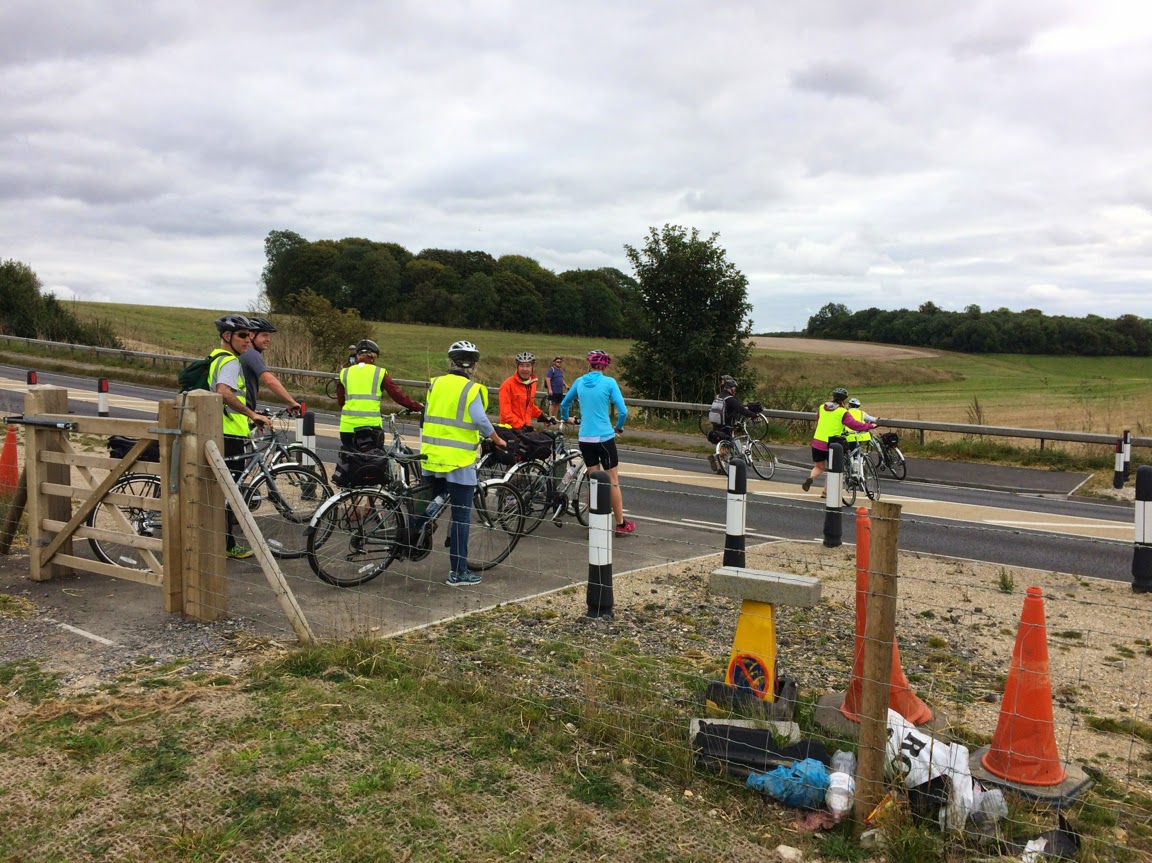
Today wasn't too bad and I was safely across in under a minute. I rode up to the A344 then onto the temporary permissive path between Byway 12 and Stonehenge Bottom. As I crested the ridge down to Stonehenge Bottom I was confronted by a veritable gaggle of cyclists heading down towards the A303.
They were a nice friendly bunch and I explained that I was part of STAG and what we were about and please could I take photos of them if they were trying to cross. They were happy for me to do so, so here is a short vignette of what happened next.
The thought of them all trying to cross made my blood run a bit cold as the traffic here is gravity-assisted in both directions and the westbound traffic is still trying to settle scores with other drivers from the 2 lanes into 1 section of the A303, a few hundred meters to the east.
A few cyclists at the front of the group spotted a small gap and either ran or rode across.
Most of them didn't get the opportunity and there was steady stream of fast-moving traffic in both directions on what is, at this point a Clearway, not that anyone gives a tuppeny-damn about the Highway Code these days!
They waited, and waited, and waited.
When a westbound gap appeared they moved forward, then back again as it disappeared.
One of them made it to the central strip and an eastbound driver in a grey car slowed and stopped. Remember, it is a Clearway - no stopping.
The cyclists, not quite sure what to do now, all started to move off the verge towards the centre of the A303, but did so very hesitantly. The westbound traffic was still thundering past them with mere inches to spare. It couldn't have been a very pleasant experience.
White van man from Black Hole Storage Removals clearly didn't give a damn and went roaring through and this carried on for a while until another grey car stopped on the westbound carriageway.
and finally, the whole group got across safely.
It could so easily have been very different. But why are things so dangerous?
Well, the people who control the World Heritage Site have a policy of making Stonehenge a more bike (and horse and pedestrian) friendly place. This seemed to be borne-out in the plans for the new visitor's centre submitted by English Heritage. However, despite their intentions and despite planning conditions that mandated a whole raft of measures that would have improved things for cyclists, English Heritage have singularly failed to deliver.
One of the few things that was largely outside the control of English Heritage was an improved crossing at Stonehenge Bottom. On the one hand, increased usage of the crossing point was anticipated by all parties after the closure of the A344, hence the planning requiremnt. However, a spoke was put in the works by the Highways Agency who produced a report - in the way Government Agencies do when they don't want to take action. The conclusion of this report reads as follows:
As a consequence of this, anyone attempting to cross the A303 at Byway 12, Byway 11 or Stonehenge Bottom has to regard themselves as a slice of ham about to be sandwiched between two pieces of steel-reinforced "bread" with a closing speed in excess of 120 mph. Get it wrong and it is going to hurt - briefly, bloodily and almost certainly, finally.
At Byway 12, you have to wait until you can't see vehicles in either direction to have enough time to stroll, not run, across the A303. Running isn't advised, as if you were to fall, you simply wouldn't have time to pick yourself up before the Grim Sandwich Maker appeared. On quiet days, you might have to wait a couple of minutes for a safe gap - there aren't many quiet days any more! On a bad day, you might have to wait 10-15 minutes or even longer to cross in reasonable safety, or simply give it up as a bad job and back track. Too many lose patience and take silly risks...
Today wasn't too bad and I was safely across in under a minute. I rode up to the A344 then onto the temporary permissive path between Byway 12 and Stonehenge Bottom. As I crested the ridge down to Stonehenge Bottom I was confronted by a veritable gaggle of cyclists heading down towards the A303.
The thought of them all trying to cross made my blood run a bit cold as the traffic here is gravity-assisted in both directions and the westbound traffic is still trying to settle scores with other drivers from the 2 lanes into 1 section of the A303, a few hundred meters to the east.
A few cyclists at the front of the group spotted a small gap and either ran or rode across.
Most of them didn't get the opportunity and there was steady stream of fast-moving traffic in both directions on what is, at this point a Clearway, not that anyone gives a tuppeny-damn about the Highway Code these days!
They waited, and waited, and waited.
When a westbound gap appeared they moved forward, then back again as it disappeared.
One of them made it to the central strip and an eastbound driver in a grey car slowed and stopped. Remember, it is a Clearway - no stopping.
The cyclists, not quite sure what to do now, all started to move off the verge towards the centre of the A303, but did so very hesitantly. The westbound traffic was still thundering past them with mere inches to spare. It couldn't have been a very pleasant experience.
White van man from Black Hole Storage Removals clearly didn't give a damn and went roaring through and this carried on for a while until another grey car stopped on the westbound carriageway.
and finally, the whole group got across safely.
It could so easily have been very different. But why are things so dangerous?
Well, the people who control the World Heritage Site have a policy of making Stonehenge a more bike (and horse and pedestrian) friendly place. This seemed to be borne-out in the plans for the new visitor's centre submitted by English Heritage. However, despite their intentions and despite planning conditions that mandated a whole raft of measures that would have improved things for cyclists, English Heritage have singularly failed to deliver.
One of the few things that was largely outside the control of English Heritage was an improved crossing at Stonehenge Bottom. On the one hand, increased usage of the crossing point was anticipated by all parties after the closure of the A344, hence the planning requiremnt. However, a spoke was put in the works by the Highways Agency who produced a report - in the way Government Agencies do when they don't want to take action. The conclusion of this report reads as follows:
"It is the designer’s view that the current usage of this crossing by pedestrians or by cyclists, on either the
A303 or the A344 routes, does not justify the increased risk to motorised users on the A303 of providing
refuge islands for this crossing. However it is felt that the opportunity to relocate the crossing to the best
location position for NMU visibility and to reduce the crossing width is justified and should be taken.
In taking this view, the designer is taking note of RSA team preference, based on pedestrian rather than cycle use of the crossing, of the do minimum crossing type. The designer is also influenced by the fact that this is far from being the only single carriageway rural at grade crossing of the A303 with no specific NMU facilities, including equestrian crossings.
The proximity of this crossing to the Stonehenge World Heritage site does not currently attract to it significant NMU usage. It is therefore felt that neither the existing usage of the crossing or the last five year’s accident records warrant a different approach here to that taken at other similar crossing locations where the balance of risks between NMU and Motorised Users, and hence the actual overall risk, dictates the level of provision made.
It is therefore recommended that the measures in Option 4 proposals, with the refuge islands removed but all the other measures retained is adopted.
A future scheme for reviewing the crossing arrangements needs to be submitted and approved. The scheme shall have regard to Design Manual for Roads and Bridges HD 19/03 Stage 4 Safety Audit 12 and 36 month post scheme recommendations for any remedial action.
It is felt that the extensive investigation already under taken into the examination of the safety of and the changes to the crossing here proposed satisfies the requirements of the planning condition."
Just for the record, NMUs are non-motorised units - pedestrians, cyclists and horse riders. Cutting out all the crap, what they are actually saying is that the body-count at Stonehenge Bottom is too low to warrant making anything more than superficial changes. However, they go on to suggest that a safety audit at 12 and 36 months might change things if the body count increases.
I don't suppose the contribution by Wiltshire Council helped much either:
Did you spot it? Yes, that's right. Most pedestrians, cyclists and horse riders arriving at Stonehenge don't pitch up at the visitor's centre, as there is (still) no provision for them. They may arrive from east or west, north or south, but we suspect that few, if any, will be invited to take part in the annual visitor survey, conducted for English Heritage by TNS.
In taking this view, the designer is taking note of RSA team preference, based on pedestrian rather than cycle use of the crossing, of the do minimum crossing type. The designer is also influenced by the fact that this is far from being the only single carriageway rural at grade crossing of the A303 with no specific NMU facilities, including equestrian crossings.
The proximity of this crossing to the Stonehenge World Heritage site does not currently attract to it significant NMU usage. It is therefore felt that neither the existing usage of the crossing or the last five year’s accident records warrant a different approach here to that taken at other similar crossing locations where the balance of risks between NMU and Motorised Users, and hence the actual overall risk, dictates the level of provision made.
It is therefore recommended that the measures in Option 4 proposals, with the refuge islands removed but all the other measures retained is adopted.
A future scheme for reviewing the crossing arrangements needs to be submitted and approved. The scheme shall have regard to Design Manual for Roads and Bridges HD 19/03 Stage 4 Safety Audit 12 and 36 month post scheme recommendations for any remedial action.
It is felt that the extensive investigation already under taken into the examination of the safety of and the changes to the crossing here proposed satisfies the requirements of the planning condition."
Just for the record, NMUs are non-motorised units - pedestrians, cyclists and horse riders. Cutting out all the crap, what they are actually saying is that the body-count at Stonehenge Bottom is too low to warrant making anything more than superficial changes. However, they go on to suggest that a safety audit at 12 and 36 months might change things if the body count increases.
I don't suppose the contribution by Wiltshire Council helped much either:
"...that in relation to cycle usage their
preferred route between the A344 to the north and Amesbury for cyclists was via the countess roundabout
underpass crossing of the A303 and than via Lark Hill." (all the typos and grammatical errors are courtesy of the Highways Agency!)
As usual with Wiltshire Council when it comes to anything in the south of the county - thumbs up bums and brains in neutral all the way. No-one in their right minds, who knew about the local area, would ever choose to get from the centre of Amesbury to Stonehenge by heading north, through the scrofulous Countess Roundabout underpass (on foot - as cycling is forbidden on this bit of the cycle route), up Countess Road, being harassed by rat-running motorists, then head west to Larkhill along the rat-run of choice for coaches and HGVs, before eventually getting to the northern end of Byway 12.
Most sensible folk will simply head out to West Amesbury, up to the A303 and then to Stonehenge Bottom and the A344 - no need to ride with high speed traffic at all - just dice with death crossing the A303. That's what they've always done, that's what they were doing today and that's what they will do until the A303 issue is resolved once and for all.
Of course, there was a fall-back plan to monitor the situation. Here it is. Read it carefully and spot the flaw:
As usual with Wiltshire Council when it comes to anything in the south of the county - thumbs up bums and brains in neutral all the way. No-one in their right minds, who knew about the local area, would ever choose to get from the centre of Amesbury to Stonehenge by heading north, through the scrofulous Countess Roundabout underpass (on foot - as cycling is forbidden on this bit of the cycle route), up Countess Road, being harassed by rat-running motorists, then head west to Larkhill along the rat-run of choice for coaches and HGVs, before eventually getting to the northern end of Byway 12.
Most sensible folk will simply head out to West Amesbury, up to the A303 and then to Stonehenge Bottom and the A344 - no need to ride with high speed traffic at all - just dice with death crossing the A303. That's what they've always done, that's what they were doing today and that's what they will do until the A303 issue is resolved once and for all.
Of course, there was a fall-back plan to monitor the situation. Here it is. Read it carefully and spot the flaw:
STONEHENGE ENVIRONMENTAL IMPROVEMENTS PROJECT
Planning Application Reference S/2009/1527
Scheme required under planning condition 27 for reviewing pedestrian and cycle route access arrangements along the whole of the A344, and crossing arrangements at the A303 (Stonehenge Bottom)
Following approval of the details of the pedestrian and cycle route access arrangements along the whole of the A344 and crossing arrangements at the A303 (Stonehenge Bottom), English Heritage will co-operate with the Local Highways Authority, Highways Agency and the Local Planning Authority in reviewing the arrangements. In particular, should a formal Stage 4 Safety Audit be carried out, and any recommendations for remedial action be made in the 12 and 36 month Stage 4 Reports submitted to English Heritage and the other organisations, then any required remedial works, and arrangements for their implementation and funding, will be considered and agreed between English Heritage, the Local Highways Authority, the Local Planning Authority and the Highways Agency, as appropriate.
In addition, English Heritage will carry out the following:
Scheme required under planning condition 27 for reviewing pedestrian and cycle route access arrangements along the whole of the A344, and crossing arrangements at the A303 (Stonehenge Bottom)
Following approval of the details of the pedestrian and cycle route access arrangements along the whole of the A344 and crossing arrangements at the A303 (Stonehenge Bottom), English Heritage will co-operate with the Local Highways Authority, Highways Agency and the Local Planning Authority in reviewing the arrangements. In particular, should a formal Stage 4 Safety Audit be carried out, and any recommendations for remedial action be made in the 12 and 36 month Stage 4 Reports submitted to English Heritage and the other organisations, then any required remedial works, and arrangements for their implementation and funding, will be considered and agreed between English Heritage, the Local Highways Authority, the Local Planning Authority and the Highways Agency, as appropriate.
In addition, English Heritage will carry out the following:
-
- Incorporate questions about the pedestrian and cycle access into the annual
visitor survey conducted by the travel and tourism department of market
research company TNS. This will comprise face to face interviews with 180
individuals during the months of July, August and September. Likely questions
include: whether people have accessed the site on foot or on bicycle, and, if so,
where they have travelled from, how satisfactory they have found the route and
where they are travelling onto.
-
- As part of the ongoing operational management of the site English Heritage staff
will, as a matter of course, record, report to the relevant authorities and, if
appropriate, take any necessary action in respect of any incidents or accidents
along the route of the A344 between Airman's Corner and Stonehenge Bottom.
English Heritage 26th April 2012
During my many visits to the WHS this July August and September I've never seen anyone with a clipboard interviewing pedestrians, cyclists and the two riders I have seen, nor have I ever been approached. Now that's interesting, if true because this safety audit is meant to be looking at the safety of crossing the A303 by any and all users, not just English Heritage's paying customers.
As I say, we don't know for certain that this is the case, but I feel an FOIA request ,or two, coming on!
Thursday, 25 September 2014
Stonehenge: What English Heritage Told Wiltshire Council They Would Do To Discharge Planning Conditions - Then What They Failed To Do!
Over the last few weeks we have highlighted our concerns that English Heritage might have failed to discharge their obligations in relation to the planning conditions imposed on them by Wiltshire Council, in allowing the construction of the new visitor's centre at Stonehenge, which opened in December 2013.
Suspicion is one thing, having evidence is something else entirely. Consequently, we submitted a FOIA request to Wiltshire Council using the What Do They Know website to make life easier. Basically, in granting planning consent, Wiltshire Council had imposed 27 separate conditions that English Heritage were required to adhere to, covering a wide variety of topics associated with the new buldings, the environment and the A344. It would have been unreasonable for us to have asked about them all given our interests, so we restricted ourselves to those conditions that dealt directly with the use of the A344 by pedestrians and other users.
Wiltshire Council had told English Heritage to provide detailed plans for how they were going to ensure the planning conditions were met. Wiltshire Council would then approve these proposals before they were instituted. All very sensible and logical.
The information we got back from Wiltshire Council was a bit of revelation. You can download it and study it yourself from here. Wiltshire Council also indicated that they would put the same information on their website to aid its easy retrieval in the future. So here, in a nutshell, is what we discovered.
In early 2012, CBA Associates, acting for English Heritage, proposed to Wiltshire Council that the outstanding planning conditions be discharged. In reply, in two separate letters on 13th and 25th June 2012, Adam Madge of Wiltshire Council Planning Department responded to this proposal, agreeing to the measures English Heritage had put forward to comply with these obligations and in both letters stating:
"I would confirm that the details sent to us in relation to these conditions are acceptable to the local planning authority. The conditions will have been fully discharged when the development is carried out in accordance with these details as submitted.”
In other words, providing English Heritage complied with what they themselves had proposed, they would have satisfied Wiltshire Council.
So let's take a look at a few of the details, using English Heritage's own timetable:
PHASE 1 – STONEHENGE BOTTOM – MARCH 2013 – JUNE 2013
A new permissible route for pedestrians and cyclists is to be installed with the section that crosses the A344 being reinforced with a plastic ground reinforcement grid and defined by a low barrier, such as a rope barrier to stop visitors walking on the establishing areas of grass.
FAILED: Although the ground reinforcement was installed as planned, no route was marked until late summer 2014. Even now, the route marking is all a bit half-hearted and may be incorrect.
PHASE 2B – ENTRANCE CONFIGURATION – LATE SEPTEMBER 2013
On the A344 west of Byway 12 a section of the A344 is removed and reinforced hardwearing turf established. Site hording, such as Heras fencing is erected prior to the works beginning and is replaced by a temporary barrier/fence on its completion. These areas of hardwearing grass will be released in Sumer 2016.
New gates, Kent carriage gap and fences are to be installed at the intersection of Byway 12 and the A344.
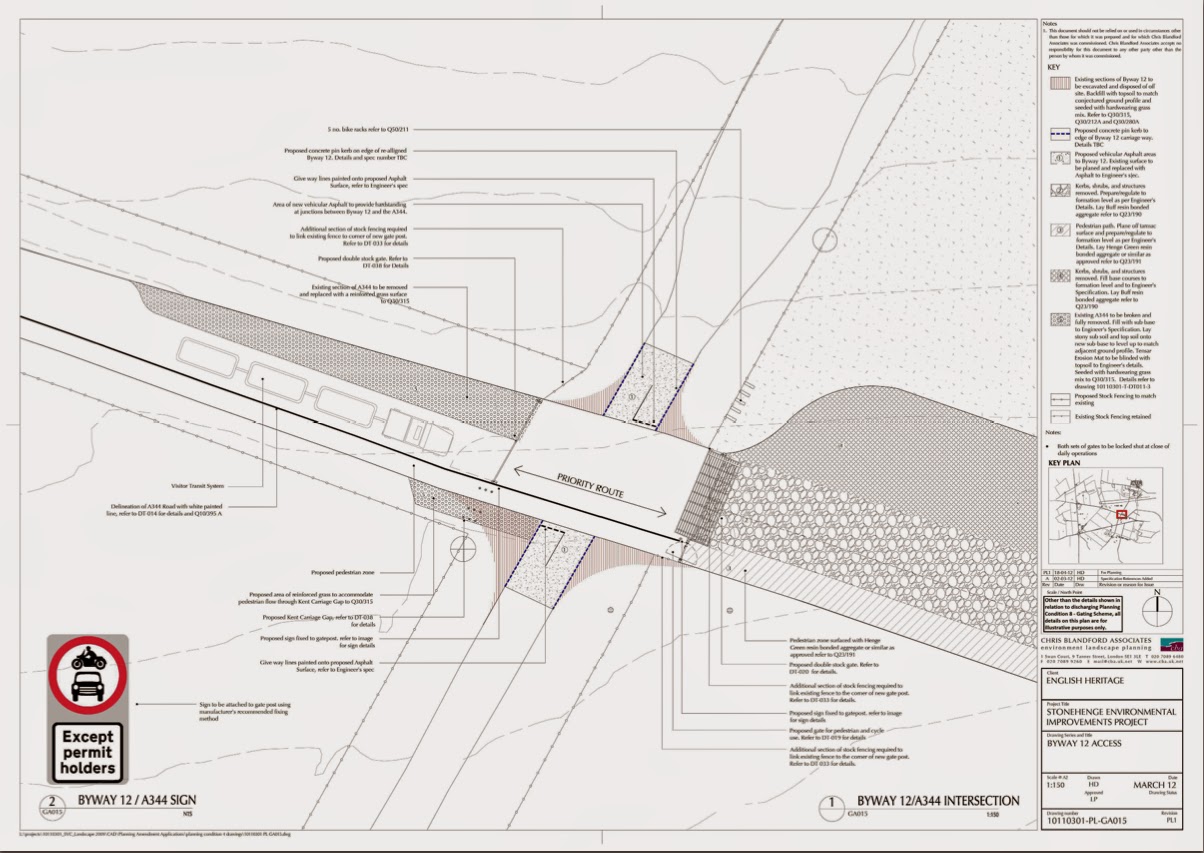
FAILED: The following diagram shows what EH said they would install - Kent Carriage Gaps of the dimensions we have harped on about several times:
This is a bit hard to see, so here is the detail:
The design of the Kent Carriage Gaps, proposed by EH and accepted by Wiltshire Council, was:
You may also note in the plan above, that EH were supposed to provide cycle racking by certain deadlines they themselves had proposed:
Cycle Parking and Storage Provision at the Western End of the retained A344
10 no. bicycle racks to accommodate the parking/storage of 20 cycles will be provided in the location shown on drawing 10110301-T-GA003. These will be installed during works to the A344 in a 12 week construction period currently scheduled to commence on 06/03/2013 and complete on 05/06/2013.
FAILED
Cycle Parking Provision at the Eastern End of the retained A344
5 no. bicycle racks to accommodate the parking of 10 cycles will be provided in the location shown on drawing 10110301-T-GA005. These will be installed during the construction of the Hub Building and Visitor Transit System Drop-Off/Pick Up area in a 24 week construction period currently scheduled to commence on 09/10/2013 and complete on 08/04/2014.
FAILED
Work should have also been carried out last year at the intersection of Byway 12 with the A344
The intersection of the A344 and Byway 12 and road surfaces of both the north and south approaches of Byway 12 will be planed and resurfaced with tarmac. A traffic management programme will be carried out while these works are being completed to allow traffic along the A344 as needed.
FAILED: EH have failed to install Kent Carriage Gaps, gates and cattle grids at the intersection. Anyone would think they were holding back in case Byway 12 was closed!
Where things get really confusing is in relation to the permissive path for cyclists and pedestrians between Byway 12 and Stonehenge Bottom. English Heritage, in proposing to discharge planning condition 11 noted to Wiltshire Council in a general statement:
A permissive path (for pedestrians and cyclists) will be available on National Trust land immediately north of the Stonehenge monument running along the line of the former A344 between Byway 12 and Stonehenge Bottom.
Completely unambiguous, what was reported by the Press at the time, completely reasonable, but NOT what English Heritage actually intended. Between now and 2016, the temporary permissive route will follow its current course:
It follows the northern side of the stopped-up A344 to a new gate in the northern stock fence, crosses through the stock fence into the National Trust open access land. Now here is the idiocy. Once you are through the gate, you don't need to stick to the path and indeed one of the points the National Trust often make about this type of open access land is that they prefer people didn't all keep to one path, as it does less damage to the terrain. So having permission to use a path over land over which you have permission to roam does seem a wee bit superfluous. But it is, allegedly, only a temporary arrangement.
PHASE 4 – STONEHENGE BOTTOM – SUMMER 2016
The existing/temporary stock fence and gates to the north of the original A344 are to be removed and turf used to patch any resulting disturbances in the grass surface. The areas of the permissible route that are formed using the ground reinforcement system are to be removed and patched using turf grown off site.
The permissible route is now along the northern edge of the re-vegetated A344.
PARTIAL FAIL: The unambiguous brief answer provided by EH was highly misleading. The detailed answer may turn out to be correct, but we wont know until 2016.
We said at the outset that we had only asked about a few of the planning conditions that were imposed by Wiltshire Council, but our findings are worrying as it suggests there may be a systematic problem with the way these have been dealt with by English Heritage. It also highlights what some might perceive as a lack of diligence on the part of Wiltshire Council's Planning Department. The question has to be asked as to why they haven't been closely monitoring work at what must be one of Wiltshire Council's most prestigious locations and one of national and international importance.
We've now fed this back to Wiltshire Council. They need to put their house in order - and do it quickly. Only then might we see the quality of development at Stonehenge that English Heritage promised and that so farm they have singularly failed to deliver.
Suspicion is one thing, having evidence is something else entirely. Consequently, we submitted a FOIA request to Wiltshire Council using the What Do They Know website to make life easier. Basically, in granting planning consent, Wiltshire Council had imposed 27 separate conditions that English Heritage were required to adhere to, covering a wide variety of topics associated with the new buldings, the environment and the A344. It would have been unreasonable for us to have asked about them all given our interests, so we restricted ourselves to those conditions that dealt directly with the use of the A344 by pedestrians and other users.
Wiltshire Council had told English Heritage to provide detailed plans for how they were going to ensure the planning conditions were met. Wiltshire Council would then approve these proposals before they were instituted. All very sensible and logical.
The information we got back from Wiltshire Council was a bit of revelation. You can download it and study it yourself from here. Wiltshire Council also indicated that they would put the same information on their website to aid its easy retrieval in the future. So here, in a nutshell, is what we discovered.
In early 2012, CBA Associates, acting for English Heritage, proposed to Wiltshire Council that the outstanding planning conditions be discharged. In reply, in two separate letters on 13th and 25th June 2012, Adam Madge of Wiltshire Council Planning Department responded to this proposal, agreeing to the measures English Heritage had put forward to comply with these obligations and in both letters stating:
"I would confirm that the details sent to us in relation to these conditions are acceptable to the local planning authority. The conditions will have been fully discharged when the development is carried out in accordance with these details as submitted.”
In other words, providing English Heritage complied with what they themselves had proposed, they would have satisfied Wiltshire Council.
So let's take a look at a few of the details, using English Heritage's own timetable:
PHASE 1 – STONEHENGE BOTTOM – MARCH 2013 – JUNE 2013
A new permissible route for pedestrians and cyclists is to be installed with the section that crosses the A344 being reinforced with a plastic ground reinforcement grid and defined by a low barrier, such as a rope barrier to stop visitors walking on the establishing areas of grass.
FAILED: Although the ground reinforcement was installed as planned, no route was marked until late summer 2014. Even now, the route marking is all a bit half-hearted and may be incorrect.
PHASE 2B – ENTRANCE CONFIGURATION – LATE SEPTEMBER 2013
On the A344 west of Byway 12 a section of the A344 is removed and reinforced hardwearing turf established. Site hording, such as Heras fencing is erected prior to the works beginning and is replaced by a temporary barrier/fence on its completion. These areas of hardwearing grass will be released in Sumer 2016.
New gates, Kent carriage gap and fences are to be installed at the intersection of Byway 12 and the A344.
FAILED: The following diagram shows what EH said they would install - Kent Carriage Gaps of the dimensions we have harped on about several times:
This is a bit hard to see, so here is the detail:
The design of the Kent Carriage Gaps, proposed by EH and accepted by Wiltshire Council, was:
You may also note in the plan above, that EH were supposed to provide cycle racking by certain deadlines they themselves had proposed:
Cycle Parking and Storage Provision at the Western End of the retained A344
10 no. bicycle racks to accommodate the parking/storage of 20 cycles will be provided in the location shown on drawing 10110301-T-GA003. These will be installed during works to the A344 in a 12 week construction period currently scheduled to commence on 06/03/2013 and complete on 05/06/2013.
FAILED
Cycle Parking Provision at the Eastern End of the retained A344
5 no. bicycle racks to accommodate the parking of 10 cycles will be provided in the location shown on drawing 10110301-T-GA005. These will be installed during the construction of the Hub Building and Visitor Transit System Drop-Off/Pick Up area in a 24 week construction period currently scheduled to commence on 09/10/2013 and complete on 08/04/2014.
FAILED
Work should have also been carried out last year at the intersection of Byway 12 with the A344
The intersection of the A344 and Byway 12 and road surfaces of both the north and south approaches of Byway 12 will be planed and resurfaced with tarmac. A traffic management programme will be carried out while these works are being completed to allow traffic along the A344 as needed.
FAILED: EH have failed to install Kent Carriage Gaps, gates and cattle grids at the intersection. Anyone would think they were holding back in case Byway 12 was closed!
Where things get really confusing is in relation to the permissive path for cyclists and pedestrians between Byway 12 and Stonehenge Bottom. English Heritage, in proposing to discharge planning condition 11 noted to Wiltshire Council in a general statement:
A permissive path (for pedestrians and cyclists) will be available on National Trust land immediately north of the Stonehenge monument running along the line of the former A344 between Byway 12 and Stonehenge Bottom.
Completely unambiguous, what was reported by the Press at the time, completely reasonable, but NOT what English Heritage actually intended. Between now and 2016, the temporary permissive route will follow its current course:
It follows the northern side of the stopped-up A344 to a new gate in the northern stock fence, crosses through the stock fence into the National Trust open access land. Now here is the idiocy. Once you are through the gate, you don't need to stick to the path and indeed one of the points the National Trust often make about this type of open access land is that they prefer people didn't all keep to one path, as it does less damage to the terrain. So having permission to use a path over land over which you have permission to roam does seem a wee bit superfluous. But it is, allegedly, only a temporary arrangement.
PHASE 4 – STONEHENGE BOTTOM – SUMMER 2016
The existing/temporary stock fence and gates to the north of the original A344 are to be removed and turf used to patch any resulting disturbances in the grass surface. The areas of the permissible route that are formed using the ground reinforcement system are to be removed and patched using turf grown off site.
The permissible route is now along the northern edge of the re-vegetated A344.
PARTIAL FAIL: The unambiguous brief answer provided by EH was highly misleading. The detailed answer may turn out to be correct, but we wont know until 2016.
We said at the outset that we had only asked about a few of the planning conditions that were imposed by Wiltshire Council, but our findings are worrying as it suggests there may be a systematic problem with the way these have been dealt with by English Heritage. It also highlights what some might perceive as a lack of diligence on the part of Wiltshire Council's Planning Department. The question has to be asked as to why they haven't been closely monitoring work at what must be one of Wiltshire Council's most prestigious locations and one of national and international importance.
We've now fed this back to Wiltshire Council. They need to put their house in order - and do it quickly. Only then might we see the quality of development at Stonehenge that English Heritage promised and that so farm they have singularly failed to deliver.
Friday, 25 July 2014
Four Thousand Holes in Blackburn Lancashire, Four Hundred Cameras Around Shrewton, Wiltshire
I do have to apologise to the memory of the late and great John Lennon for abusing the lyrics of "A Day in the Life" but I simply couldn't resist drawing the analogy.
Yesterday, the Salisbury Journal published a very interesting article on the A303 entitled simply: "A303 traffic survey to be carried out"
Basically, the story explains that Atkins, the traffic management consultancy will be placing number plate recognition cameras along the A303 and on surrounding roads as part of a scheme to track vehicle movements on the traffic-choked highway.The Journal article claims that there will be hundreds of these cameras on the surrounding roads, but we suspect that this might be something of an exaggeration and that perhaps 10-20 NPR cameras might be closer to the mark.
Winterbourne Stoke resident, Chairman of the parish council and Wiltshire councillor Ian West observed: "Residents of Shrewton believe the speed and volume of traffic in Shrewton has been made worse by the closure of the A344.
One of the main concerns expressed by local residents is the speed and volume of traffic, it is quoted as one of the main safety factors which people see as a barrier to travelling around their communities on foot or by bicycle or to letting children travel independently. This has very much affected the quality of life in Shrewton.
We very much look forward to the results of the Atkins survey because the increase in traffic is becoming unbearable in Shrewton and the surrounding villages both sides of the A303.”
Of course, it isn't just Shrewton or indeed the residents here in Winterbourne Stoke who are suffering as a result of the A344 closure. We (WiSBAng) and the Stonhenge Traffic Action Group (STAG), regularly hear of problems being caused as far afield as Berwick St James, Larkhill, Durrington, Bulford and Amesbury.
Although we wholeheartedly welcome this new initiative and data-gathering exercise, we feel duty-bound to point out something that some might think verges on negligence on the part of Wiltshire Council. Over the last two decades and more, every bit of traffic modelling undertaken on the A303 corridor, some of it commissioned by Wiltshire Council, predicted that there would be traffic chaos in the surrounding villages if the A344 were to be closed BEFORE the A303 was upgraded. For years, Wiltshire Council resisted the closure of the A344 on those grounds, then in 2010/2011 they did an about face and sided with English Heritage in pushing for the closure.
Surprise, surprise. The A344 was closed and all the traffic models were proved correct.
Now any competent authority would have undertaken a survey such as that being carried out by Atkins between Monday, August 4th and Sunday, August 10th prior to closing the A344, then do the same again after the closure to ensure the changes had had no adverse effects and to be able to quantify the changes with hard data. That would have been far too sensible and of course it might have run the risk of exposing, in irrefutable terms, that a mistake had been made in closing the A344 prematurely. That would never do, would it?
As it is, when Atkins report their findings we will know how bad the situation on all these local roads is, but in the absence of knowing what they were like in quantitative terms before the A344 closure, it is impossible to say how much worse they have become. We can make some estimates based on earlier surveys, but on fewer roads, using somewhat different methodologies; that's far from ideal.
Yesterday, the Salisbury Journal published a very interesting article on the A303 entitled simply: "A303 traffic survey to be carried out"
Basically, the story explains that Atkins, the traffic management consultancy will be placing number plate recognition cameras along the A303 and on surrounding roads as part of a scheme to track vehicle movements on the traffic-choked highway.The Journal article claims that there will be hundreds of these cameras on the surrounding roads, but we suspect that this might be something of an exaggeration and that perhaps 10-20 NPR cameras might be closer to the mark.
Winterbourne Stoke resident, Chairman of the parish council and Wiltshire councillor Ian West observed: "Residents of Shrewton believe the speed and volume of traffic in Shrewton has been made worse by the closure of the A344.
One of the main concerns expressed by local residents is the speed and volume of traffic, it is quoted as one of the main safety factors which people see as a barrier to travelling around their communities on foot or by bicycle or to letting children travel independently. This has very much affected the quality of life in Shrewton.
We very much look forward to the results of the Atkins survey because the increase in traffic is becoming unbearable in Shrewton and the surrounding villages both sides of the A303.”
Of course, it isn't just Shrewton or indeed the residents here in Winterbourne Stoke who are suffering as a result of the A344 closure. We (WiSBAng) and the Stonhenge Traffic Action Group (STAG), regularly hear of problems being caused as far afield as Berwick St James, Larkhill, Durrington, Bulford and Amesbury.
Although we wholeheartedly welcome this new initiative and data-gathering exercise, we feel duty-bound to point out something that some might think verges on negligence on the part of Wiltshire Council. Over the last two decades and more, every bit of traffic modelling undertaken on the A303 corridor, some of it commissioned by Wiltshire Council, predicted that there would be traffic chaos in the surrounding villages if the A344 were to be closed BEFORE the A303 was upgraded. For years, Wiltshire Council resisted the closure of the A344 on those grounds, then in 2010/2011 they did an about face and sided with English Heritage in pushing for the closure.
Surprise, surprise. The A344 was closed and all the traffic models were proved correct.
Now any competent authority would have undertaken a survey such as that being carried out by Atkins between Monday, August 4th and Sunday, August 10th prior to closing the A344, then do the same again after the closure to ensure the changes had had no adverse effects and to be able to quantify the changes with hard data. That would have been far too sensible and of course it might have run the risk of exposing, in irrefutable terms, that a mistake had been made in closing the A344 prematurely. That would never do, would it?
As it is, when Atkins report their findings we will know how bad the situation on all these local roads is, but in the absence of knowing what they were like in quantitative terms before the A344 closure, it is impossible to say how much worse they have become. We can make some estimates based on earlier surveys, but on fewer roads, using somewhat different methodologies; that's far from ideal.
Labels:
A303,
A344,
Amesbury,
Atkins,
Bulford,
Durrington,
Highways Agency,
Larkhill,
Salisbury Journal,
Shrewton,
Shrewton Traffic Action Group,
Wiltshire Council,
Winterbourne Stoke,
WiSBAng
Thursday, 24 July 2014
Was That the TDF Peloton Arriving in Winterbourne Stoke?
Since the summer solstice there has been precious little to report on the A303. Stories of any substance have been hard to find and we had resorted to searching the internet for anything interesting. We wondered just how many stories on the A303 had been initiated by Wiltshire Council since the start of the year, sitting in all their pontificatorial splendour in Trowbridge? Given that the A303 is the major east-west trunk road in the south of the county, given its importance to the local economy and especially given the fact HMG are currently looking at the feasibility of improving the A303 through the county, you might expect some fairly regular stories to emerge. Stories saying just how important this work was and how the county council was 100% behind it. You might expect such stories but you would be gravely disappointed, there's not been a single one, nada, nothing, bugger-all. Either Wiltshire Council, as some claim, are overly focussed on the north of the county, or they are determined to kowtow to central government when it comes to the A303. There was a time when Wiltshire Council and Wiltshire councillors had a bit of backbone. For whatever reason, they seem to be becoming invertebrates.
On Monday evening, the Winterbourne Stoke Parish Council held its regular meeting. Lots of things on the agenda and several of them related to the A303 and surrounding roads. As ever, the meeting was good humoured and purposeful and at the end of it, all the Parish Councillors were going wander down through the village to look at the playpark.
As we came to cross the A303, back into the village we saw a sight that made our blood run cold. There was a convoy of around 30 to 40 cyclists riding down the A303 from the direction of Longbarrow Roundabout and Stonehenge, all in high-visibility jackets and most riding line astern. It looked like the Tour de France peloton had taken a wrong turn and finished up in Wiltshire. Way too many yellow jerseys to work out which one was Vincenzo Nibali winning yet another mountain stage! As they got closer, there was a collective holding of breath as several vans passed them. Regular users of the A303 are only to well aware that the road is barely wide enough to allow vehicles to pass in opposite directions. It's way too narrow to allow overtaking. Thankfully, at 9:15pm on a Monday evening, traffic is light and the riders survived long-enough for some of them to pull off the road at the end of Church Street.
We crossed the road to see if we could help them as it was clear that they were lost. We couldn't work out their nationality, Japanese perhaps, but one of their number explained they were heading for the Stonehenge Campsite, about a mile away. Clearly, the A303 had not quite been the road they had been expecting and a few of them looked a wee bit shaken. We never did find out where they had cycled from.
It does raise another point about the A303 in this part of the West Country; it is a tourist area and people want to mover around the landscape on foot, on bikes and on horseback, as well as in and on motorised vehicles. We hope that the government have sufficient foresight to construct a byway for this type of user. One that runs alongside a dualled A303, but separated from it by barriers. It should run from Amesbury (and ideally well east of Amesbury in time) all the way to Devon and Cornwall. Such a facility would be welcomed by the many tourists, local, national and international, who flock to this area and put so much into the local economy.
It's interesting that such foresight was missing from the Wiltshire Council Local Transport Plan Cycling Strategy 2011-2026.
Another example of a missed opportunity by Wiltshire Council, where everyone matters, but where everything moves with slug-like velocity.
On Monday evening, the Winterbourne Stoke Parish Council held its regular meeting. Lots of things on the agenda and several of them related to the A303 and surrounding roads. As ever, the meeting was good humoured and purposeful and at the end of it, all the Parish Councillors were going wander down through the village to look at the playpark.
As we came to cross the A303, back into the village we saw a sight that made our blood run cold. There was a convoy of around 30 to 40 cyclists riding down the A303 from the direction of Longbarrow Roundabout and Stonehenge, all in high-visibility jackets and most riding line astern. It looked like the Tour de France peloton had taken a wrong turn and finished up in Wiltshire. Way too many yellow jerseys to work out which one was Vincenzo Nibali winning yet another mountain stage! As they got closer, there was a collective holding of breath as several vans passed them. Regular users of the A303 are only to well aware that the road is barely wide enough to allow vehicles to pass in opposite directions. It's way too narrow to allow overtaking. Thankfully, at 9:15pm on a Monday evening, traffic is light and the riders survived long-enough for some of them to pull off the road at the end of Church Street.
We crossed the road to see if we could help them as it was clear that they were lost. We couldn't work out their nationality, Japanese perhaps, but one of their number explained they were heading for the Stonehenge Campsite, about a mile away. Clearly, the A303 had not quite been the road they had been expecting and a few of them looked a wee bit shaken. We never did find out where they had cycled from.
It does raise another point about the A303 in this part of the West Country; it is a tourist area and people want to mover around the landscape on foot, on bikes and on horseback, as well as in and on motorised vehicles. We hope that the government have sufficient foresight to construct a byway for this type of user. One that runs alongside a dualled A303, but separated from it by barriers. It should run from Amesbury (and ideally well east of Amesbury in time) all the way to Devon and Cornwall. Such a facility would be welcomed by the many tourists, local, national and international, who flock to this area and put so much into the local economy.
It's interesting that such foresight was missing from the Wiltshire Council Local Transport Plan Cycling Strategy 2011-2026.
Another example of a missed opportunity by Wiltshire Council, where everyone matters, but where everything moves with slug-like velocity.
Monday, 12 May 2014
Just What Is The Truth About English Heritage and Byway 12?
Janice Hassett has published a most interesting post on the STAG Stonehenge Traffic Action Group blog.
It is raising some interesting questions about the truth about English Heritage's position, locally and nationally, on Byway 12. Anyone with an interest in the vexatious question of Byway 12 and the fate of the A303 would be well advised to read it all and start asking some very awkward questions.
Tuesday, 25 March 2014
On Trying To Make A Silk Purse From A Pig's Ear
It has been apparent, since the closure of the A344 last summer and the opening of English Heritage's new Stonehenge Visitor's Centre back in December 2013, that the summer of 2014 stood a great chance of becoming an annus horribilis; as far as the A303 is concerned. All in all, it's a bit of a pig's ear.
There are several factors that either together, or singly, could prove a nightmare:
1) Closure of the A344 has caused additional westbound traffic on the A303 to pass Stonehenge before having the opportunity to leave the A303 to go and see the stones. Whereas lots of people once stopped on the A344, or in the old Stonehenge carpark for a few minutes for a quick look at the stones before they continued their journey, they now don't have that opportunity. So now they slow down on the A303 as they pass Stonehenge to take a quick photo. All too often it is the driver doing this - dumb people on smart phones. Just take a look on Twitter to see the number of folks who do it.
Here is one taken on March 21st - though we've no idea if this one was taken by a driver or a passenger.
2) The design of Countess Roundabout at Amesbury is still a problem, as east-west traffic still stops on it at peak periods - blocking north-south movement.
3) Frustrated by the A344 closure and egged-on by insistent satnavs, some drivers have taken to turning off the A303, just west of Stonehenge Bottom, on to Byway 12. Signage has been used to discourage right turns, but blow-me-down, some 'enterprising' drivers (including local taxi drivers) have taken to turning left off the A303 and either turning round and crossing the A303, or even reversing across the A303 to comply with the turning restrictions.
4) The Highway Agency A303 diversionary sign on the westbound A303, just before Longbarrow roundabout, has already caused chaos on at least three occasions since Christmas, when the A303 was closed due to flood or accident. The signs take westbound travellers off the A303, onto the A360, towards the Stonehenge Visitor's centre - and there the "follow the black triangle" route vanishes. STAG have rescued a number of lost travellers on the infinite loop between Longbarrow and Airman's Cross in recent months.
5) The design of the new Longbarrow Roundabout is still contributing to westbound and eastbound tailbacks. Too many approach lanes and badly thought out approach and exit corridors. The Highway Agency is already on design 3 and it's still a mess.
6) When too many folks turn up at Stonehenge, traffic backs up onto the A360, blocking it in both directions. This effect could be exacerbated by the new Stonehenge booking system. If jams do occur, then people may miss their booked slots, face not being admitted, and adding to congestion on the A303 before sitting outside Stonehenge on the A360 - eager to vent their spleens in the direction of English Heritage.
7) People are people. Even though English Heritage have introduced a booking system, people are still going to turn up on spec - the English Heritage website even points this out as a possibility for those who haven't booked - so turn up they will. Not to mention the 30,000 locals who are entitled to free entrance and who certainly won't book. What will they all do and where will they go when they find they can't get on to the Stonehenge site? They'll roam the local roads to find anywhere they can dump their cars and walk - creating additional congestion and chaos. A lot of these opportunistic sites are closer to the stones than the Visitor's Centre - and they are free.
8) To avoid the jams on the A303, travellers are trying any and all alternative routes past Stonehenge, placing additional pressures on small country roads and villages never intended for such levels of use. If it continues, the chances are some poor innocent is going to be killed or injured as a result.
9) When we don't have the jams and congestion, we have speeding through the local villages - particularly Shrewton on the A360 and Winterbourne Stoke on the A303.
10) We didn't even mention the additional traffic the new distribution centre at Solstice Park and the Army re-basing exercise are going to throw into the equation - but it isn't going to make life any easier.
We all know the long-term answer - dual the A303 and somehow get it past Stonehenge. All well and good, but it isn't going to happen soon. We need to do something before the summer.
Recognising this, Inspector Christian Lange of Wiltshire Police called a meeting last night to bring together all the stakeholders: English Heritage, the Highways Agency, Wiltshire Council, local Parish Council's, the National Trust, English Nature, STAG and others (apologies to any we haven't mentioned) to try and identify any measures that might alleviate the situation.
A brave idea, given the depth of feeling and one that could have easily been rail-roaded, but Christian chaired a good meeting. At the end of the day though, it is trying to make something of a silk purse out of a pig's ear.
Once we had got beyond the "English Heritage created this mess and it's up to them to sort it out" mentality, we did get a few good ideas and some less good ones. Broadly they were:
Try signage from the A303 exit of the M3, through to Longbarrow, to warn when there are no parking slots at Stonehenge - but these would need to be reactive enough to allow for sudden changes in parking availability at Stonehenge.
Try and sort out the A360 issues as close to the Stonehenge as possible - with English Heritage looking into planning permission for additional overspill car-parking spaces, or renting adjacent fields. The Highways Agency were keen to not move the problem onto the roads, but to deal with it as close to the source - the Stonehenge Visitore's Centre - as possible.
There was a suggestion of using a TRO to close Byway 12. This could be done for up to 18 months. This is one we are dead against without a legal undertaking, by English Heritage and the WHS, to NOT pursue the permanent closure of Byway 12. We also proposed other measures to prevent most vehicular traffic from using the route. A compromise should be possible, but closure by diktat is a recipe for grief.
There was an idea to intentionally route westbound Stonehege traffic towards Durrington at Countess Roundabout and then through Larkhill along the Packway t- o approach Stonehenge from the Bustard junction. As you might imagine, this wasn't at all popular with local councillors. However, it does make you wonder if enough thought is being given to using Woodhenge and Durrington Walls as diversionary holding areas? As it is only intended as an interim measure, could there be compromise here as well?
There has been a suggestion that English Heritage puts up some sort earth bund or sight screen to prevent Stonehenge being seen from the A303 - which might keep the traffic on the A303 flowing a little better. English Heritage have rejected this idea as it conflicts with the World Heritage Site Management Plan to return the area to open downland. Of course, we aren't talking a permanent solution here, just interim measures to solve a short-term (hopefully) problem. Again, some lateral thinking is needed here. If EH aren't prepared to shield the road from Stonehenge, then the Highways Agency should erect sight screens on their side of the fence outside the World Heritage site to shield Stonehenge from the road - giving WHS a legally enforceable assurance that these would be removed, once the A303 issue is resolved. Another opportunity for compromise?
UPDATE 1: We've been advised that as the World Heritage Site encompasses both sides of the fence, unilateral action by the Highways Agency is out of the question.
UPDATE 2: Life, of course, is never simple. Ownership of the land that would need to be screened from the A303 is mainly English Heritage/DCMS. The National Trust would be involved if screening was needed east of Stonehenge Bottom. However, ownership of the A303 -and what constitutes the road, would seem to be the the real issue here. So whilst EH/DCMS own the subsoil under the northern side of the A303 and probably the air above it, the Highways Agency effectively owns the road bed and "the top two spits" down. That's enough to keep the road bed repaired, install drainage under it and signage and safety features (eg. Armco barriers) alongside it. What we are proposing here is another safety feature.
Regardless of the rights and wrongs, we still feel that EH and WHS should be encouraged to compromise on this temporary issue. They could still make an offer to do this before the Area Board meeting on 27th March.
We also looked at solutions for the other problem of slowing the traffic on the A303 - particularly through Winterbourne Stoke. Wiltshire Council and the Police have an initiative for local A roads, but it is the Highways Agency that will need to engage with us and the Police to sort it out on the A303. The Highways Agency insist the A303 at this point is in an "urban setting"' As such, there should be a 20mph max as it passes by the requisite number of dwellings to meet government guidelines for this. Another compromise perhaps - lower the speed limit to 30mph and introduce some traffic calming measures instead?
OK, if we are honest, none of these measures will solve the problem entirely on their own and even if they are all implemented, they are, at best, only going to ease things - and we have no idea by how much. We also need to be realistic about what measures Wiltshire Police has the legal basis, manpower, or even inclination to enforce. But if we don't at least try, at best the local villagers are going to have a horrendous summer. At worst, the road casualty figures may increase.
It's going to take some rapid action, an awful lot of co-operation and, inevitably, compromise by all parties including English Heritage and the World Heritage Site. That's short term compromise to solve immediate issues and compromises that might help provide a longer term solution to the long-term A303 problems and World Heritage Site aspirations.
The next few weeks are going to be very instructive indeed, particularly in view of the A303 feasibility study. If that compromise can be achieved, then Inspector Lange will have achieved a minor miracle. We wish him well.
There are several factors that either together, or singly, could prove a nightmare:
1) Closure of the A344 has caused additional westbound traffic on the A303 to pass Stonehenge before having the opportunity to leave the A303 to go and see the stones. Whereas lots of people once stopped on the A344, or in the old Stonehenge carpark for a few minutes for a quick look at the stones before they continued their journey, they now don't have that opportunity. So now they slow down on the A303 as they pass Stonehenge to take a quick photo. All too often it is the driver doing this - dumb people on smart phones. Just take a look on Twitter to see the number of folks who do it.
Here is one taken on March 21st - though we've no idea if this one was taken by a driver or a passenger.
2) The design of Countess Roundabout at Amesbury is still a problem, as east-west traffic still stops on it at peak periods - blocking north-south movement.
3) Frustrated by the A344 closure and egged-on by insistent satnavs, some drivers have taken to turning off the A303, just west of Stonehenge Bottom, on to Byway 12. Signage has been used to discourage right turns, but blow-me-down, some 'enterprising' drivers (including local taxi drivers) have taken to turning left off the A303 and either turning round and crossing the A303, or even reversing across the A303 to comply with the turning restrictions.
4) The Highway Agency A303 diversionary sign on the westbound A303, just before Longbarrow roundabout, has already caused chaos on at least three occasions since Christmas, when the A303 was closed due to flood or accident. The signs take westbound travellers off the A303, onto the A360, towards the Stonehenge Visitor's centre - and there the "follow the black triangle" route vanishes. STAG have rescued a number of lost travellers on the infinite loop between Longbarrow and Airman's Cross in recent months.
5) The design of the new Longbarrow Roundabout is still contributing to westbound and eastbound tailbacks. Too many approach lanes and badly thought out approach and exit corridors. The Highway Agency is already on design 3 and it's still a mess.
6) When too many folks turn up at Stonehenge, traffic backs up onto the A360, blocking it in both directions. This effect could be exacerbated by the new Stonehenge booking system. If jams do occur, then people may miss their booked slots, face not being admitted, and adding to congestion on the A303 before sitting outside Stonehenge on the A360 - eager to vent their spleens in the direction of English Heritage.
7) People are people. Even though English Heritage have introduced a booking system, people are still going to turn up on spec - the English Heritage website even points this out as a possibility for those who haven't booked - so turn up they will. Not to mention the 30,000 locals who are entitled to free entrance and who certainly won't book. What will they all do and where will they go when they find they can't get on to the Stonehenge site? They'll roam the local roads to find anywhere they can dump their cars and walk - creating additional congestion and chaos. A lot of these opportunistic sites are closer to the stones than the Visitor's Centre - and they are free.
8) To avoid the jams on the A303, travellers are trying any and all alternative routes past Stonehenge, placing additional pressures on small country roads and villages never intended for such levels of use. If it continues, the chances are some poor innocent is going to be killed or injured as a result.
9) When we don't have the jams and congestion, we have speeding through the local villages - particularly Shrewton on the A360 and Winterbourne Stoke on the A303.
10) We didn't even mention the additional traffic the new distribution centre at Solstice Park and the Army re-basing exercise are going to throw into the equation - but it isn't going to make life any easier.
We all know the long-term answer - dual the A303 and somehow get it past Stonehenge. All well and good, but it isn't going to happen soon. We need to do something before the summer.
Recognising this, Inspector Christian Lange of Wiltshire Police called a meeting last night to bring together all the stakeholders: English Heritage, the Highways Agency, Wiltshire Council, local Parish Council's, the National Trust, English Nature, STAG and others (apologies to any we haven't mentioned) to try and identify any measures that might alleviate the situation.
A brave idea, given the depth of feeling and one that could have easily been rail-roaded, but Christian chaired a good meeting. At the end of the day though, it is trying to make something of a silk purse out of a pig's ear.
Once we had got beyond the "English Heritage created this mess and it's up to them to sort it out" mentality, we did get a few good ideas and some less good ones. Broadly they were:
Try signage from the A303 exit of the M3, through to Longbarrow, to warn when there are no parking slots at Stonehenge - but these would need to be reactive enough to allow for sudden changes in parking availability at Stonehenge.
Try and sort out the A360 issues as close to the Stonehenge as possible - with English Heritage looking into planning permission for additional overspill car-parking spaces, or renting adjacent fields. The Highways Agency were keen to not move the problem onto the roads, but to deal with it as close to the source - the Stonehenge Visitore's Centre - as possible.
There was a suggestion of using a TRO to close Byway 12. This could be done for up to 18 months. This is one we are dead against without a legal undertaking, by English Heritage and the WHS, to NOT pursue the permanent closure of Byway 12. We also proposed other measures to prevent most vehicular traffic from using the route. A compromise should be possible, but closure by diktat is a recipe for grief.
There was an idea to intentionally route westbound Stonehege traffic towards Durrington at Countess Roundabout and then through Larkhill along the Packway t- o approach Stonehenge from the Bustard junction. As you might imagine, this wasn't at all popular with local councillors. However, it does make you wonder if enough thought is being given to using Woodhenge and Durrington Walls as diversionary holding areas? As it is only intended as an interim measure, could there be compromise here as well?
There has been a suggestion that English Heritage puts up some sort earth bund or sight screen to prevent Stonehenge being seen from the A303 - which might keep the traffic on the A303 flowing a little better. English Heritage have rejected this idea as it conflicts with the World Heritage Site Management Plan to return the area to open downland. Of course, we aren't talking a permanent solution here, just interim measures to solve a short-term (hopefully) problem. Again, some lateral thinking is needed here. If EH aren't prepared to shield the road from Stonehenge, then the Highways Agency should erect sight screens on their side of the fence outside the World Heritage site to shield Stonehenge from the road - giving WHS a legally enforceable assurance that these would be removed, once the A303 issue is resolved. Another opportunity for compromise?
UPDATE 1: We've been advised that as the World Heritage Site encompasses both sides of the fence, unilateral action by the Highways Agency is out of the question.
UPDATE 2: Life, of course, is never simple. Ownership of the land that would need to be screened from the A303 is mainly English Heritage/DCMS. The National Trust would be involved if screening was needed east of Stonehenge Bottom. However, ownership of the A303 -and what constitutes the road, would seem to be the the real issue here. So whilst EH/DCMS own the subsoil under the northern side of the A303 and probably the air above it, the Highways Agency effectively owns the road bed and "the top two spits" down. That's enough to keep the road bed repaired, install drainage under it and signage and safety features (eg. Armco barriers) alongside it. What we are proposing here is another safety feature.
Regardless of the rights and wrongs, we still feel that EH and WHS should be encouraged to compromise on this temporary issue. They could still make an offer to do this before the Area Board meeting on 27th March.
We also looked at solutions for the other problem of slowing the traffic on the A303 - particularly through Winterbourne Stoke. Wiltshire Council and the Police have an initiative for local A roads, but it is the Highways Agency that will need to engage with us and the Police to sort it out on the A303. The Highways Agency insist the A303 at this point is in an "urban setting"' As such, there should be a 20mph max as it passes by the requisite number of dwellings to meet government guidelines for this. Another compromise perhaps - lower the speed limit to 30mph and introduce some traffic calming measures instead?
OK, if we are honest, none of these measures will solve the problem entirely on their own and even if they are all implemented, they are, at best, only going to ease things - and we have no idea by how much. We also need to be realistic about what measures Wiltshire Police has the legal basis, manpower, or even inclination to enforce. But if we don't at least try, at best the local villagers are going to have a horrendous summer. At worst, the road casualty figures may increase.
It's going to take some rapid action, an awful lot of co-operation and, inevitably, compromise by all parties including English Heritage and the World Heritage Site. That's short term compromise to solve immediate issues and compromises that might help provide a longer term solution to the long-term A303 problems and World Heritage Site aspirations.
The next few weeks are going to be very instructive indeed, particularly in view of the A303 feasibility study. If that compromise can be achieved, then Inspector Lange will have achieved a minor miracle. We wish him well.
Saturday, 8 February 2014
English Heritage - Some Hope For The Future?
On Thursday evening (06/02/2014) , STAG met with representatives of English Heritage in Shrewton. The purpose of the meeting was twofold and in line with an earlier meeting we had held with the National Trust. Firstly, we wanted to speak to English Heritage about the forthcoming A303 feasibility study and our desire, if possible, to cooperate with them, in an effort to achieve a result that benefited all.
Second, we pointed out that the closure of the A344, English Heritage's somewhat disingenuous attempts to blame Wiltshire Council for the closure, the subsequent traffic chaos on the A303, the A360 and a raft of other local roads, their failure to comply with specific conditions of the planning permission granted for the construction of the new visitor's centre (including their failure to allow unfettered access to the A344, 24/7 , for everything other than motorized vehicles) and some other minor niggles meant there was a feeling of distrust of English Heritage in the local community. We also pointed out that this built on issues that had arisen from previous dealings with English Heritage on the A303 over a number of decades.
So, whilst we were being genuine in our desire to work with English Heritage in the future, there were some legacy issues that would need to be addressed before the local community could buy in to this engagement wholeheartedly.
Clearly, this was something of a mixed message and it would have been very easy for the meeting to have become overly acrimonious on our part, or for the English Heritage reps to simply walk away and refuse to engage.
Neither of those things happened - which was a measure of success in itself. We also got the feeling that English Heritage perhaps hadn't fully appreciated some of the issues that had so annoyed the local community. We suggested some short term measures that might be considered as ways of alleviating the traffic problems in the area, on the A303 and on the local roads around Stonehenge, and English Heritage also suggested other ideas. Collectively, all would be worth raising with other stakeholders like Wiltshire Council, the Highways Agency and Parish Councils.
All in all, from the STAG perspective, a helpful first meeting. I say first, because we hope it will not be the last - more meetings will be needed if much of the talk is to be translated into action.
Perhaps actions speak louder than words? We have heard just heard indirectly that changes have been made to the access to the A344 from the A360 and it now possible for pedestrians and cyclists to have unfettered access 24/7. That might sound trivial, but it's a good start. It is encouraging for the future and something on which we can build.
Second, we pointed out that the closure of the A344, English Heritage's somewhat disingenuous attempts to blame Wiltshire Council for the closure, the subsequent traffic chaos on the A303, the A360 and a raft of other local roads, their failure to comply with specific conditions of the planning permission granted for the construction of the new visitor's centre (including their failure to allow unfettered access to the A344, 24/7 , for everything other than motorized vehicles) and some other minor niggles meant there was a feeling of distrust of English Heritage in the local community. We also pointed out that this built on issues that had arisen from previous dealings with English Heritage on the A303 over a number of decades.
So, whilst we were being genuine in our desire to work with English Heritage in the future, there were some legacy issues that would need to be addressed before the local community could buy in to this engagement wholeheartedly.
Clearly, this was something of a mixed message and it would have been very easy for the meeting to have become overly acrimonious on our part, or for the English Heritage reps to simply walk away and refuse to engage.
Neither of those things happened - which was a measure of success in itself. We also got the feeling that English Heritage perhaps hadn't fully appreciated some of the issues that had so annoyed the local community. We suggested some short term measures that might be considered as ways of alleviating the traffic problems in the area, on the A303 and on the local roads around Stonehenge, and English Heritage also suggested other ideas. Collectively, all would be worth raising with other stakeholders like Wiltshire Council, the Highways Agency and Parish Councils.
All in all, from the STAG perspective, a helpful first meeting. I say first, because we hope it will not be the last - more meetings will be needed if much of the talk is to be translated into action.
Perhaps actions speak louder than words? We have heard just heard indirectly that changes have been made to the access to the A344 from the A360 and it now possible for pedestrians and cyclists to have unfettered access 24/7. That might sound trivial, but it's a good start. It is encouraging for the future and something on which we can build.
Thursday, 6 February 2014
Wiltshire Council Claim English Heritage are Breaking the Law!
Oh dear, Oh dear, Oh dear! Back at the end of the year we fired of an FOIA query to Wiltshire Council as we suspected that English Heritage were playing fast and loose with their authority - or abject lack of it - over the A344.
Today, we got a very helpful and yet totally unexpected reply from them. The first surprise was that the question was answered under the Environmental Information Regulations rather than FOIA - I need to look at that in more detail, there may be other ways we can use this legislation. The second and far bigger surprise lay in the contents of the response. Look at the bits in bold in particular:
Request for Information – reference RFI - ENQ00535-REQ001
Thank you for your request for information received 30 December 2013. I
apologise for the delay in responding,
Section 39 of the Freedom of Information Act 2000 requires us to respond
to requests for information about the environment under different
legislation: the Environmental Information Regulations 2004, rather than
under the Freedom of Information Act. The definition of “environment”
under this legislation is very wide. I consider that the information you
have requested relates to the environment and must therefore be dealt with
under the Environmental Information Regulations 2004.
In response to your request officers have provided the following:
The attached draft document outlines the arrangements under which English
Heritage should manage access through the gates for all users exempt from
the TRO restrictions. The document was drafted by EH, confirming they are
fully au fait with the implications of the TRO.
It has been brought to the attention of Wiltshire Council that the road
has been unavailable for use by authorised users at certain times of the
day, principally when the Visitor Centre is closed. English Heritage have
been advised accordingly. A response from EH has, to date, not been
received.
All gates, when works are complete, will be supplemented with a Kent
Carriage Gap, which will allow all non-motorised users to pass and repass.
These have not yet been provided or completed at all gates, and some
temporary barriers appear to have been placed so as to obstruct lawful
use.
The Council has not withheld any information in relation to this request
under the exceptions of the Environmental Information Regulations 2004.
The document drafted by English Heritage, all ten pages of it can be found here.
Wow -what an admission. If English Heritage are "obstructing lawful use", then it would seem to me that they were breaking the law. When STAG were planning our demo back in December, we were left in no doubt, by Wiltshire Police, that if we were to obstruct the highway unreasonably by our actions, then we WOULD be arrested for obstruction. It will be interesting to see if Wiltshire Police have (or will now) apply the same rigour to those responsible for this admitted breach of the law.
We also need to know if and when, knowing that an obstruction of lawful use had occurred, Wiltshire Council informed Wiltshire Police of this? If they didn't why not, Moreover, who knew and who decided not to inform the Police? How many were involved?
It may not be straightforward as English Heritage seem to be acting as agents of Wiltshire Council in controlling access to the A344, so it might be Jane Scott, leader of Wiltshire Council, who might carry ultimate responsibility, but obstruction may just be the tip of the iceberg..
Another question needs to be asked about whether Wiltshire Police themselves might have been mislead by English Heritage on the 17th and 18th of December and subsequently. What were they policing on those days? What were their orders in relation to people wanting to walk, ride bikes or horses along the A344? That's a question we will certainly be asking.
This all makes life very difficult indeed. If English Heritage can't be trusted to adhere to the law, how can they be trusted in any future dealings in relation to the A344 or Byway 12. Moreover, how can they be trusted when it comes to future plans for the A303? A public apology for their actions and an immediate removal of all obstructions would be a good start.
Today, we got a very helpful and yet totally unexpected reply from them. The first surprise was that the question was answered under the Environmental Information Regulations rather than FOIA - I need to look at that in more detail, there may be other ways we can use this legislation. The second and far bigger surprise lay in the contents of the response. Look at the bits in bold in particular:
Request for Information – reference RFI - ENQ00535-REQ001
Thank you for your request for information received 30 December 2013. I
apologise for the delay in responding,
Section 39 of the Freedom of Information Act 2000 requires us to respond
to requests for information about the environment under different
legislation: the Environmental Information Regulations 2004, rather than
under the Freedom of Information Act. The definition of “environment”
under this legislation is very wide. I consider that the information you
have requested relates to the environment and must therefore be dealt with
under the Environmental Information Regulations 2004.
In response to your request officers have provided the following:
The attached draft document outlines the arrangements under which English
Heritage should manage access through the gates for all users exempt from
the TRO restrictions. The document was drafted by EH, confirming they are
fully au fait with the implications of the TRO.
It has been brought to the attention of Wiltshire Council that the road
has been unavailable for use by authorised users at certain times of the
day, principally when the Visitor Centre is closed. English Heritage have
been advised accordingly. A response from EH has, to date, not been
received.
All gates, when works are complete, will be supplemented with a Kent
Carriage Gap, which will allow all non-motorised users to pass and repass.
These have not yet been provided or completed at all gates, and some
temporary barriers appear to have been placed so as to obstruct lawful
use.
The Council has not withheld any information in relation to this request
under the exceptions of the Environmental Information Regulations 2004.
The document drafted by English Heritage, all ten pages of it can be found here.
Wow -what an admission. If English Heritage are "obstructing lawful use", then it would seem to me that they were breaking the law. When STAG were planning our demo back in December, we were left in no doubt, by Wiltshire Police, that if we were to obstruct the highway unreasonably by our actions, then we WOULD be arrested for obstruction. It will be interesting to see if Wiltshire Police have (or will now) apply the same rigour to those responsible for this admitted breach of the law.
We also need to know if and when, knowing that an obstruction of lawful use had occurred, Wiltshire Council informed Wiltshire Police of this? If they didn't why not, Moreover, who knew and who decided not to inform the Police? How many were involved?
It may not be straightforward as English Heritage seem to be acting as agents of Wiltshire Council in controlling access to the A344, so it might be Jane Scott, leader of Wiltshire Council, who might carry ultimate responsibility, but obstruction may just be the tip of the iceberg..
Another question needs to be asked about whether Wiltshire Police themselves might have been mislead by English Heritage on the 17th and 18th of December and subsequently. What were they policing on those days? What were their orders in relation to people wanting to walk, ride bikes or horses along the A344? That's a question we will certainly be asking.
This all makes life very difficult indeed. If English Heritage can't be trusted to adhere to the law, how can they be trusted in any future dealings in relation to the A344 or Byway 12. Moreover, how can they be trusted when it comes to future plans for the A303? A public apology for their actions and an immediate removal of all obstructions would be a good start.
The Fragile Routes to the West of England - Wessex Sub Aqueanus
Over the last month, we have seen the fragility of the transport infrastructure through Wessex. First we had the closure of the A303 in Somerset A303 between the Podimore and Cartgate Roundabouts on Christmas Eve when the River Yeo burst its banks.
Then we had a second closure of the A303, at the Deptford Junction with the A36, caused by rising groundwater levels on the western edge of Salisbury Plain. Even after the initial flood subsided a wee bit, we still had a contraflow working for some time as it took some time for all carriageways and the slip roads to clear. Even this week, the A303 westbound has been closed at night to allow the damage caused by the flooding to be repaired.
The rain has continued at a lower intensity for the last couple of weeks, and the A303 seems to be safe for the moment. That said, groundwater levels haven't dropped at all on Salisbury Plain, even though the levels in the River Till, through Winterbourne Stoke have dropped around 5-10 cm. Today, the Tilshead borehole levels look like this:
Of course, yesterday, we had yet more rain and storm surges throughout the Wessex region. We had 14.7mm here in Winterbourne Stoke, but that was trivial compared to levels further West. The Somerset Levels, already suffering for over a month from the floods, exacerbated by the abject failure of the Environment Agency to effectively dredge blocked water channels, has water levels rising yet again. King Canute couldn't hold back the water and sadly, it seems, neither can Prince Charles - but at least he took the time to go, showed REAL understanding of the issues and concerned for those he met.
The rain and the spring tides and high winds wrought damage further west in Dawlish, tearing out the ballast under the main line from Exeter to Penzance, ripping out the adjacent road and threatening houses and businesses.
This morning on TV, a Network Rail spokesman was suggesting that it might take 6 weeks and tens of millions of pounds, if not one to two hundred million pounds, to put right the damage caused in an hour of nature at its most furious. And still more rain and high winds are predicted in the coming days - with rain levels on high ground predicted to be up to 20-40mm per day - higher than anything we have seen this winter by a good margin.
This all raises a number of very important questions for the Wessex transport infrastucture. We have lost the major rail line for a number of weeks - assuming there is no further damage. Passengers and freight are going to have to transfer to the roads - the A303 and the M4/M5 further north. With the additional predicted rain, there seems to be a possibility that further flooding of the A303 might occur this weekend or early next week - pushing all that traffic on to the northern route.
Engineers talk of a "single point of failure" (SPOF!), which is the part of a system, that if it fails, will cause the rest of the system to fail. With multiple means of transport through Wessex, there was no SPOF, but it is possible that within hours or days, there will only be one point in the transport infrastructure left and only one to fail - the M4/M5 corridor. A single minor incident on the motorway could stop traffic in any numbers getting through Wiltshire/Avon and in to Devon and Cornwall. Diversionary routes south through the Somerset levels are simply not viable.
I hope politicians locally and nationally are looking at this and thinking of the consequences. In our campaign to improve the A303 west from the Hampshire border, we are often told that it will be the economic case that decides whether the A303 is improved, rather than providing yet more roads/extra carriageways in urban areas. Somerset Council are pretty much on the ball and have made an excellent financial case for improving the A303/A358/A30 corridor. Wiltshire Council seem to be riding very much on their coat tails - or worse. Their level of engagement and activity has been described to me in very graphic terms: "Thumbs up bums - brains in neutral!" Certainly, trying to get a response from those with a transport brief on the Council is nigh on impossible - Wiltshire Council - where people mutter.
Perhaps Mother Nature has done us a major service by pointing out the real economic issues involved here. From Stonehenge westwards along the whole of the A303/A358/A30 corridor, tourism is the major industry - and to take advantage of tourism, there is one over-riding priority - to get the tourists to the places they want to visit. No means of the tourist getting there, no tourism. No tourism, no jobs. No jobs - no economy.
To support the tourism, goods need to be shipped in. No rail and no road, no goods shipped in. No goods, no tourists, no employment, no economy. And, of course, everything that goes in has to get out again - along the same. limited routes.
For the Wessex region, it really is that simple - the transport infrastructure is its life blood - and with so few alternatives, it really is a unique situation that must be addressed as such. Perhaps even Wiltshire Council can be encouraged to de-digitate and get on with it!
Then we had a second closure of the A303, at the Deptford Junction with the A36, caused by rising groundwater levels on the western edge of Salisbury Plain. Even after the initial flood subsided a wee bit, we still had a contraflow working for some time as it took some time for all carriageways and the slip roads to clear. Even this week, the A303 westbound has been closed at night to allow the damage caused by the flooding to be repaired.
The rain has continued at a lower intensity for the last couple of weeks, and the A303 seems to be safe for the moment. That said, groundwater levels haven't dropped at all on Salisbury Plain, even though the levels in the River Till, through Winterbourne Stoke have dropped around 5-10 cm. Today, the Tilshead borehole levels look like this:
Of course, yesterday, we had yet more rain and storm surges throughout the Wessex region. We had 14.7mm here in Winterbourne Stoke, but that was trivial compared to levels further West. The Somerset Levels, already suffering for over a month from the floods, exacerbated by the abject failure of the Environment Agency to effectively dredge blocked water channels, has water levels rising yet again. King Canute couldn't hold back the water and sadly, it seems, neither can Prince Charles - but at least he took the time to go, showed REAL understanding of the issues and concerned for those he met.
The rain and the spring tides and high winds wrought damage further west in Dawlish, tearing out the ballast under the main line from Exeter to Penzance, ripping out the adjacent road and threatening houses and businesses.
This morning on TV, a Network Rail spokesman was suggesting that it might take 6 weeks and tens of millions of pounds, if not one to two hundred million pounds, to put right the damage caused in an hour of nature at its most furious. And still more rain and high winds are predicted in the coming days - with rain levels on high ground predicted to be up to 20-40mm per day - higher than anything we have seen this winter by a good margin.
This all raises a number of very important questions for the Wessex transport infrastucture. We have lost the major rail line for a number of weeks - assuming there is no further damage. Passengers and freight are going to have to transfer to the roads - the A303 and the M4/M5 further north. With the additional predicted rain, there seems to be a possibility that further flooding of the A303 might occur this weekend or early next week - pushing all that traffic on to the northern route.
Engineers talk of a "single point of failure" (SPOF!), which is the part of a system, that if it fails, will cause the rest of the system to fail. With multiple means of transport through Wessex, there was no SPOF, but it is possible that within hours or days, there will only be one point in the transport infrastructure left and only one to fail - the M4/M5 corridor. A single minor incident on the motorway could stop traffic in any numbers getting through Wiltshire/Avon and in to Devon and Cornwall. Diversionary routes south through the Somerset levels are simply not viable.
I hope politicians locally and nationally are looking at this and thinking of the consequences. In our campaign to improve the A303 west from the Hampshire border, we are often told that it will be the economic case that decides whether the A303 is improved, rather than providing yet more roads/extra carriageways in urban areas. Somerset Council are pretty much on the ball and have made an excellent financial case for improving the A303/A358/A30 corridor. Wiltshire Council seem to be riding very much on their coat tails - or worse. Their level of engagement and activity has been described to me in very graphic terms: "Thumbs up bums - brains in neutral!" Certainly, trying to get a response from those with a transport brief on the Council is nigh on impossible - Wiltshire Council - where people mutter.
Perhaps Mother Nature has done us a major service by pointing out the real economic issues involved here. From Stonehenge westwards along the whole of the A303/A358/A30 corridor, tourism is the major industry - and to take advantage of tourism, there is one over-riding priority - to get the tourists to the places they want to visit. No means of the tourist getting there, no tourism. No tourism, no jobs. No jobs - no economy.
To support the tourism, goods need to be shipped in. No rail and no road, no goods shipped in. No goods, no tourists, no employment, no economy. And, of course, everything that goes in has to get out again - along the same. limited routes.
For the Wessex region, it really is that simple - the transport infrastructure is its life blood - and with so few alternatives, it really is a unique situation that must be addressed as such. Perhaps even Wiltshire Council can be encouraged to de-digitate and get on with it!
Tuesday, 28 January 2014
So What Is The Status of the Old A344?
Over the last few weeks I have heard several people complaining about heavy-handed English Heritage staff at Stonehenge attempting to prevent pedestrians and cyclists using the section of the A344 that runs from Airman's Cross to the Junction with Byway 12. Rather than argue the rights and wrongs, I thought I would simply publish a copy of the Traffic Regulation Order that was implemented by Wiltshire Council. Please click to enlarge and read it for yourselves. It makes quite clear that the restrictions ONLY apply to motor vehicles. There are NO restrictions on pedestrians, cyclists, horse riders and invalid carriage users and they should have the same rights of access to this stretch of highway/byway as they always had, prior to the TRO.
I would suggest that you take a copy of this with you, should you decide to have a walk, or a ride! Take a spare copy or two to give to any numpty's you encounter!
The situation between Byway 12 and Stonehenge Bottom on the A303 is a little less clear. The Stopping Up Order seems to have been intended to remove all highway rights, except for the likes of BT, to use the path of the A303, with the land on which the A344 stood returned to the relevant land owners. This means, I suppose, that English Heritage own the southern side of what was the A344 and the National Trust (with their policy of Open Access) the northern side. HOWEVER, English Heritage are well aware of the condition sof the planning consent for the new visitor's centre:
"We would note that the commitment to provide a permissive route between Stonehenge Bottom and Byway 12 is a requirement of the Section 106 legal agreement signed by the National Trust, DCMS, EH and Wiltshire Council."
This should have been constructed and commissioned before the visitor's centre was opened - see the previous post for more details.
Thursday, 23 January 2014
English Heritage: Give Them An Inch And They Take a Mile
You never quite know what is going to arrive in the post. Usually, it's just bills and the usual advertising rubbish that is of no interest and only serves to kill off a few more trees. Sometimes though, it can be a real pleasure. Today was one of those days.
I got a letter from a lovely chap, a long time opponent of the A344 closure and proponent of dualing the A303, who goes by the name of "Vexatious Alan". The epithet isn't because he really is vexatious - it's a bit of a badge of honour in Freedom of Information Act circles that he has got so far up some august body's nose, probably because he was close to exposing some sort of misdoing, they have decreed his FOIA requests are "vexatious" and so they don't need to answer them!
Receiving the letter was a real pleasure as I so rarely get them - letters written by real living and breathing human beings that is. I normally operate in cyberspace, grabbing information here there and everywhere - cutting and pasting it into new documents and blasting them back out into the ether. Having to deal with a typewritten letter was something of a novelty...
...anyway, let's cut to the chase and look at the information "Vexatious Alan" provided. Since November 2010 he has been pursuing English Heritage in relation to pedestrian and cycle access along the route of what has now become the former A344. Back on the 24th November 2010, Loraine Knowles of English Heritage wrote to "Vexatious Alan" to explain the rationale behind the Stopping Up Order for the section of the A344 from Stonehenge Bottom on the A303 and the intersection of the A344 with Wiltshire Byway 12. Loraine Knowles wrote the following on behalf of English Heritage:
"...there was a firm consensus that a stopping up order was more appropriate...
...in view of the clear intention to return the surface to grass. However, the need to provide access for non-motorised traffic had been recognised at that time, and for this reason it had been proposed that a permissive route be provided for pedestrians and cyclists between Stonehenge Bottom and Byway 12."
"We would note that the commitment to provide a permissive route between Stonehenge Bottom and Byway 12 is a requirement of the Section 106 legal agreement signed by the National Trust, DCMS, EH and Wiltshire Council."
Now that is both interesting and puzzling. I'm not a legal eagle but common sense dictates that if the right to drive a motorised vehicle along a stretch of road are removed through the implementation of a stopping up order and a TRO, as were used in the case of the A344, then the right to move along that route on foot, on a bike or on a horse still exist as they weren't specifically removed. So, in one sense, I don't see why a permissive byway was needed as a de-facto substantive byway already existed along the route and continues to exist. But, until someone comes along and can provide the legal view on all this, let's play the English Heritage game for the moment - they have a legal obligation to provide a permissive route between Stonehenge Bottom and Byway 12.
Wiltshire Council in the planning consent for the recently opened visitor's centre imposed a series of conditions that English Heritage were obliged to sign-up to. According to the information provided to me by Vexatious Alan, the last of these, Condition 27 reads as follows:
"No development shall commence until
(i) details of the pedestrian and cycle route along the whole of the A344, including the crossing
arrangements at the A303 (Stonehenge Bottom) and
(ii) a scheme for reviewing such access and crossing arrangements
have been submitted and approved (in consultation with the Highways Agency) in writing by the local planning authority".
"The development shall not be occupied until the agreed works have been completed".
"The scheme for reviewing the access and crossing arrangements...
...shall detail how recommended remedial action will be funded and implemented, including arrangements to provide for alternative crossing points on the A303 and associated access links."
Wiltshire Council recently provided "Vexatious Alan" with a map of what the A303 junction and paths at Stonehenge Bottom should have looked like, before the new visitor's centre was allowed to open. You WILL need to click on this to see it.
"Vexatious Alan" has helpfully highlighted the length of new path that English Heritage were supposed to install and a pre-existing path that English Heritage seem to have removed.
Anyone who has tried to cross the A303, use the new gate and ride a bike up to Byway 12 knows that English Heritage have not done what they were supposed to do.
UPDATE: Having read the original version of this post, an up-to-the-minute STAG member sent me a photo, taken only yesterday, looking back down the stopped up A344. Note the high quality footpath and cycle path - NOT! Interesting to see that the byway - permissive or substantive - with its steel fencing across it, gives the impression of not being a byway at all! Anyone would think that English Heritage were trying to convince people it didn't exist and deter them from trying.
I think that both English Heritage and Wiltshire Council Planning Department have a few questions that they need to answer pretty sharpish and as a matter of public interest. This isn't only important in the context of the A344, but also of considerable importance when it comes to what might happen with the A303 after the planned feasibility study reports.
It seems, if the information above is to be believed and I have no reason to doubt it, that English Heritage cannot be trusted to comply with legal agreements it has willingly signed up to and legal conditions to which it is subject by virtue of the planning process. Furthermore, Wiltshire Council seem to have failed to monitor compliance with the Conditions of the planning consent that THEY imposed.
None of this fills me with a sense that either organisation is to be trusted. With English Heritage it really does seem to be a case that if you give them an inch, they will take a mile. It actually makes me feel somewhat...
I got a letter from a lovely chap, a long time opponent of the A344 closure and proponent of dualing the A303, who goes by the name of "Vexatious Alan". The epithet isn't because he really is vexatious - it's a bit of a badge of honour in Freedom of Information Act circles that he has got so far up some august body's nose, probably because he was close to exposing some sort of misdoing, they have decreed his FOIA requests are "vexatious" and so they don't need to answer them!
Receiving the letter was a real pleasure as I so rarely get them - letters written by real living and breathing human beings that is. I normally operate in cyberspace, grabbing information here there and everywhere - cutting and pasting it into new documents and blasting them back out into the ether. Having to deal with a typewritten letter was something of a novelty...
...anyway, let's cut to the chase and look at the information "Vexatious Alan" provided. Since November 2010 he has been pursuing English Heritage in relation to pedestrian and cycle access along the route of what has now become the former A344. Back on the 24th November 2010, Loraine Knowles of English Heritage wrote to "Vexatious Alan" to explain the rationale behind the Stopping Up Order for the section of the A344 from Stonehenge Bottom on the A303 and the intersection of the A344 with Wiltshire Byway 12. Loraine Knowles wrote the following on behalf of English Heritage:
"...there was a firm consensus that a stopping up order was more appropriate...
...in view of the clear intention to return the surface to grass. However, the need to provide access for non-motorised traffic had been recognised at that time, and for this reason it had been proposed that a permissive route be provided for pedestrians and cyclists between Stonehenge Bottom and Byway 12."
"We would note that the commitment to provide a permissive route between Stonehenge Bottom and Byway 12 is a requirement of the Section 106 legal agreement signed by the National Trust, DCMS, EH and Wiltshire Council."
Now that is both interesting and puzzling. I'm not a legal eagle but common sense dictates that if the right to drive a motorised vehicle along a stretch of road are removed through the implementation of a stopping up order and a TRO, as were used in the case of the A344, then the right to move along that route on foot, on a bike or on a horse still exist as they weren't specifically removed. So, in one sense, I don't see why a permissive byway was needed as a de-facto substantive byway already existed along the route and continues to exist. But, until someone comes along and can provide the legal view on all this, let's play the English Heritage game for the moment - they have a legal obligation to provide a permissive route between Stonehenge Bottom and Byway 12.
Wiltshire Council in the planning consent for the recently opened visitor's centre imposed a series of conditions that English Heritage were obliged to sign-up to. According to the information provided to me by Vexatious Alan, the last of these, Condition 27 reads as follows:
"No development shall commence until
(i) details of the pedestrian and cycle route along the whole of the A344, including the crossing
arrangements at the A303 (Stonehenge Bottom) and
(ii) a scheme for reviewing such access and crossing arrangements
have been submitted and approved (in consultation with the Highways Agency) in writing by the local planning authority".
"The development shall not be occupied until the agreed works have been completed".
"The scheme for reviewing the access and crossing arrangements...
...shall detail how recommended remedial action will be funded and implemented, including arrangements to provide for alternative crossing points on the A303 and associated access links."
Wiltshire Council recently provided "Vexatious Alan" with a map of what the A303 junction and paths at Stonehenge Bottom should have looked like, before the new visitor's centre was allowed to open. You WILL need to click on this to see it.
"Vexatious Alan" has helpfully highlighted the length of new path that English Heritage were supposed to install and a pre-existing path that English Heritage seem to have removed.
Anyone who has tried to cross the A303, use the new gate and ride a bike up to Byway 12 knows that English Heritage have not done what they were supposed to do.
UPDATE: Having read the original version of this post, an up-to-the-minute STAG member sent me a photo, taken only yesterday, looking back down the stopped up A344. Note the high quality footpath and cycle path - NOT! Interesting to see that the byway - permissive or substantive - with its steel fencing across it, gives the impression of not being a byway at all! Anyone would think that English Heritage were trying to convince people it didn't exist and deter them from trying.
I think that both English Heritage and Wiltshire Council Planning Department have a few questions that they need to answer pretty sharpish and as a matter of public interest. This isn't only important in the context of the A344, but also of considerable importance when it comes to what might happen with the A303 after the planned feasibility study reports.
It seems, if the information above is to be believed and I have no reason to doubt it, that English Heritage cannot be trusted to comply with legal agreements it has willingly signed up to and legal conditions to which it is subject by virtue of the planning process. Furthermore, Wiltshire Council seem to have failed to monitor compliance with the Conditions of the planning consent that THEY imposed.
None of this fills me with a sense that either organisation is to be trusted. With English Heritage it really does seem to be a case that if you give them an inch, they will take a mile. It actually makes me feel somewhat...
Subscribe to:
Posts (Atom)