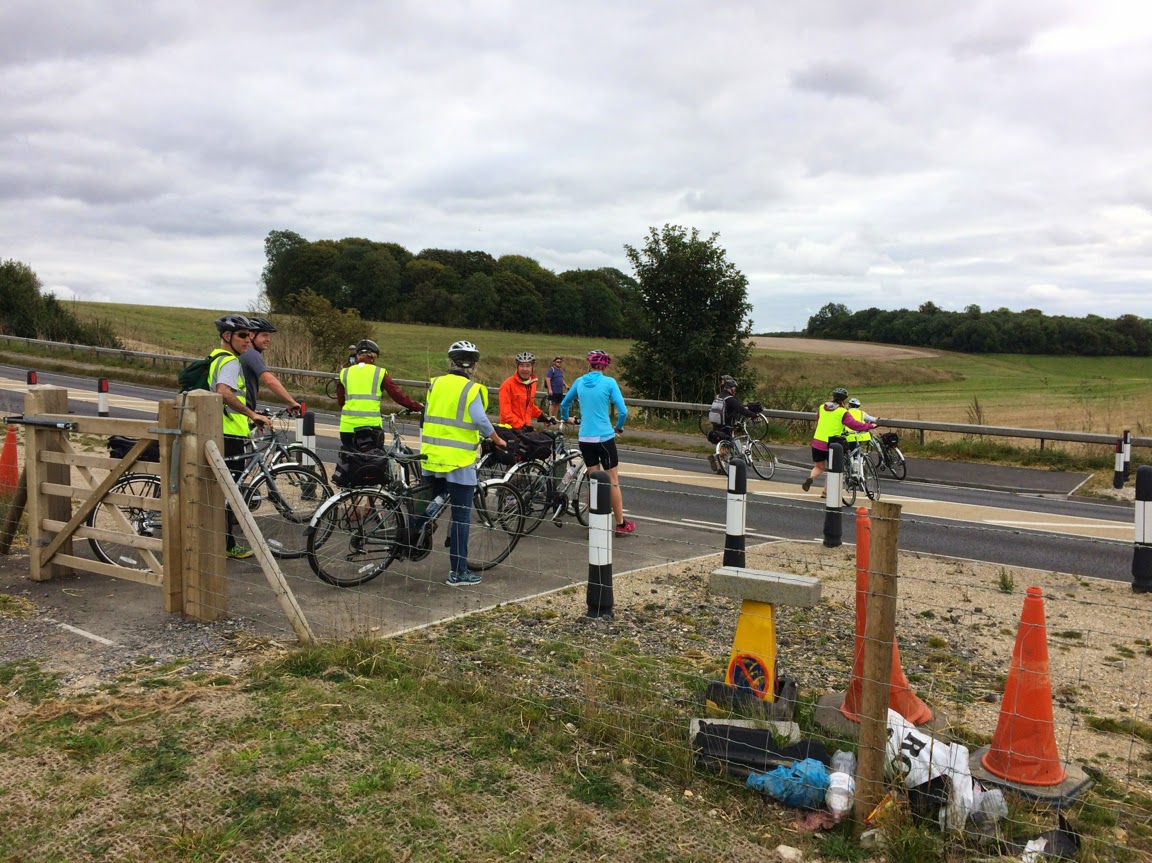
We've been wondering how HMG would fund the Stonehenge to Berwick Down Scheme for the A303. The reassurances that the money "would be found and ring-fenced" have always sounded a bit hollow and very fuzzy and it seems our concerns were justified.
Take a look on the Winterbourne Stoke Parish Council website at their latest story.
So, HMG are now looking to private finance to design, build fund and maintain this section of road. Given the record of PFI's in the past, this prospect fills us with a rising sense of dread. Worse still, the projected timescales will certainly be missed - leading to many more years of rat-running and congestion.
The alternative, of course, is to go for a lower cost above ground route...
For far too long Winterbourne Stoke and other villages in the area have been blighted by the A303 traffic problems. Now a bypass seems imminent and the emphasis has shifted to make sure we get the best route preference the village.
Showing posts with label Bypass. Show all posts
Wednesday, 19 July 2017
Tuesday, 6 June 2017
It's In Your Best Interests...
Whenever I hear someone tell me that: "It's in your best interests to do X, or Y," alarm bells ring very loudly indeed. In my experience, true philanthropy is a very rare quality and what these individuals really mean is: "It's in my best interests for you to do X or Y. Selfish self-interest is a powerful driver indeed.
When such a statement is made by a politician, then the alarm bells ring more loudly than ever. That's what is going on at the moment; a cacophony of alarm bells, whistles and sirens are sounding off. A great deal of effort is being made to persuade many of those with an interest in doing something about the untenable situation of the A303 to pull together to support the tunnel under Stonehenge and the northern bypass of Winterbourne Stoke and to put pressure on Highways England to adopt that solution.
Bearing in mind the opening to this post, whose best interests are served by this? It would certainly provide a solution to the traffic problems, but would it provide the best solution; particularly for Winterbourne Stoke? What would benefit Winterbourne Stoke the most? Forgetting for a moment the options on offer, I would suggest the denizens of Winterbourne Stoke want some or all of the following:
- a reduction in traffic volumes within the village;
- a reduction of traffic noise within the village;
- a reduction in traffic pollution across the village
- no more damage to the environment
- no more damage to the known and unknown archaeology of the area.
The best way to achieve that is to remove the A303 from the equation. Remove it entirely, absolutely and unequivocally from the equation. To do that there would seem only two alternatives. Dig a tunnel from east (NOT west) of Countess Roundabout and emerge, blinking into the daylight, having bankrupted the nation, somewhere between Yarnbury Castle and the A303 Deptford interchange, or simply re-route the A303 south of Amesbury past Boscombe Down, through the Woodford Valley on a couple of magnificent and architecturally inspiring viaducts, then rejoining the route of the current A36 towards the Deptford interchange. Whilst the super-long tunnel option is unaffordable in anyone's book, even Highways England admit the southern route would be a substantially cheaper than either of the tunnel-based proposals on the table.
Now given that many of the archaeological community, locally, nationally and internationally, are against the proposed tunnel option and bypasses for Winterbourne Stoke, would want to expand the boundaries of the current World Heritage Site to accommodate both known and suspected archaeology and want to remove the A303 from the entirety of the area, then clearly, we have something in common. Whilst we have never been natural bed-fellows in the past, perhaps now is the time for those immediately affected to cosy-up with each other? Our selfish self-interest is best served by removing the A303 in it's entirety. A tunnel with a northern bypass or a tunnel with a southern bypass are very much secondary and tertiary options which satisfy few, if any, of the desires and aspirations of Winterbourne Stoke.
Now the politicos will tell you that this isn't on the agenda. Accept what you are being offered and let us get on with it! They would, wouldn't they. Don't forget though, that when considering traffic issue, nothing has a better turning circle than a politician - especially ones trying to balance the books.
When such a statement is made by a politician, then the alarm bells ring more loudly than ever. That's what is going on at the moment; a cacophony of alarm bells, whistles and sirens are sounding off. A great deal of effort is being made to persuade many of those with an interest in doing something about the untenable situation of the A303 to pull together to support the tunnel under Stonehenge and the northern bypass of Winterbourne Stoke and to put pressure on Highways England to adopt that solution.
Bearing in mind the opening to this post, whose best interests are served by this? It would certainly provide a solution to the traffic problems, but would it provide the best solution; particularly for Winterbourne Stoke? What would benefit Winterbourne Stoke the most? Forgetting for a moment the options on offer, I would suggest the denizens of Winterbourne Stoke want some or all of the following:
- a reduction in traffic volumes within the village;
- a reduction of traffic noise within the village;
- a reduction in traffic pollution across the village
- no more damage to the environment
- no more damage to the known and unknown archaeology of the area.
The best way to achieve that is to remove the A303 from the equation. Remove it entirely, absolutely and unequivocally from the equation. To do that there would seem only two alternatives. Dig a tunnel from east (NOT west) of Countess Roundabout and emerge, blinking into the daylight, having bankrupted the nation, somewhere between Yarnbury Castle and the A303 Deptford interchange, or simply re-route the A303 south of Amesbury past Boscombe Down, through the Woodford Valley on a couple of magnificent and architecturally inspiring viaducts, then rejoining the route of the current A36 towards the Deptford interchange. Whilst the super-long tunnel option is unaffordable in anyone's book, even Highways England admit the southern route would be a substantially cheaper than either of the tunnel-based proposals on the table.
Now given that many of the archaeological community, locally, nationally and internationally, are against the proposed tunnel option and bypasses for Winterbourne Stoke, would want to expand the boundaries of the current World Heritage Site to accommodate both known and suspected archaeology and want to remove the A303 from the entirety of the area, then clearly, we have something in common. Whilst we have never been natural bed-fellows in the past, perhaps now is the time for those immediately affected to cosy-up with each other? Our selfish self-interest is best served by removing the A303 in it's entirety. A tunnel with a northern bypass or a tunnel with a southern bypass are very much secondary and tertiary options which satisfy few, if any, of the desires and aspirations of Winterbourne Stoke.
Now the politicos will tell you that this isn't on the agenda. Accept what you are being offered and let us get on with it! They would, wouldn't they. Don't forget though, that when considering traffic issue, nothing has a better turning circle than a politician - especially ones trying to balance the books.
Thursday, 2 February 2017
On Ignoring The Obvious and Pulling The Wool Over People's Eyes
The last couple of weeks have been rather surreal, ever since Highways England launched their plans for a tunnel under Stonehenge and a bypass for our beleaguered village of Winterbourne Stoke - and added a sting in the tail by offering a southern bypass route as an option. Although Highways England claim not to have a preference for either route, it is clear from their presentation material, from general reactions and to be honest, from verbal comments made by their own staff at several of the consultation events that there is a degree of bias towards the southern route.
Now we here at WiSBANG prefer the northern route for a couple of very simple reasons: lower levels of noise and pollution. Figure 1 below shows exactly why this is. The prevailing wind, as is easily confirmed by recourse to the UK Met Office is from the south west, at lower levels, within the village there are 5 years-worth of readings that show the wind at ground level comes from the south-south-east - there is a wind-rose in the bottom right hand corner of Fig 1 that shows this clearly.
Consequently, noise and pollution would be blown from the southern route into the heart of the village. Now, leaving aside those members of the community whose business interests would be best served by not having the northern route, you have to ask who in their right mind would opt for the southern route?
So, putting the bypass to the south of Winterbourne Stoke is quite simply, on environmental grounds alone, a crass idea for Winterbourne Stoke. The genius who had this brainstorm doubled the environmental impact by stuffing the route midway between Winterbourne Stoke and Berwick St James to the south; doubling the numbers of folk affected by additional road noise at a stroke.
In the case of the northern route, the noise and pollution is helped on its way by the prevailing wind, up into the Salisbury Plain Training Area where it might annoy the odd rabbit that isn't already stone deaf from listening to the Army AS-90s and whose sense of smell has been dulled by screening smokes.
Oddly, Highways England reckon, in the turgid depths of their Technical Appraisal Review that there is little to choose between these two routes on environmental grounds. Really? How can this be so?
Let's be charitable and call it "pulling the wool over people's eyes." This is how it seems to work. Rather than considering the impact of each route just from the A360 to Berwick Down and the people directly affected by it - say 80 or so households in Winterbourne Stoke and 70 or so in Berwick St James, why not consider the whole route from Amesbury to Berwick Down and aggregate all those affected in Amesbury as well (about a 1000) with the numbers from Winterbourne Stoke or Winterbourne Stoke + Berwick St James. Then apply a crude level of granularity, by considering only blocks of 100 houses in your evaluations.
So if you consider the first case and look at each route and those households directly affected within 1km of it, then the northern route affects around 80 households. On the other hand, the southern route affects 80 + 70 = 150 households. So again, no right thinking person would ever opt for the southern route - it affects nearly twice the number of households as does the northern route.
However, if you live in the brave new world of Highways England, the equation is like this: the northern route affects 1000 + 100 (because 80 is nearly 100) = 1100 households. On the other hand, the southern route affects 1000 + 100 (because 80 +70 = 150 which isn't near enough to 200 to be counted as 200) = 1100. QED!
Both routes have the same environmental impact? Well I'm blowed. Highways England have just proved black is white. Whoever came up with this way of 'selling' the bypass should hang their head(s) in shame.
Highways England would clearly like us to take their assessments as articles of faith. Getting any real information out of them is hideously painful and is following an all to predictable course. The rules of the game are simple, the more you already know, the more you will get. You first get a flat denial that information exists. When you apply a little pressure you are told that they wouldn't normally collect that sort of data at this stage . Some may falter now, but don't. Grab them by their metaphorical testicles and squeeze - please do not do so for real, no matter how tempting things get!
The third stage is confession and confession they say is good for the soul - it isn't quite as good for our blood pressure though. They admit to having got the data, but suggest that "you probably wouldn't understand it" and when you point out that "yes you would." the pantomime descends into its final stage of obfuscation. "The data is available, but you have to go through official channels to get it!" But this isn't a game! It is our future!
Well, the channels have been gone through and the silence from Highways England is positively deafening!
Call us cynical, but you get the feeling that the prime driver for route selection, at least as far as Highways England is concerned, is to pick the route that helps them get rid of all the spoil dug out from under Stonehenge for the tunnel and that happens to be the southern route That's the elephant in the room, the spoil. That might go some way to explain why Highways England are reluctant to share information with the public - they might spot the 2 million ton elephant.
Now don't get me wrong, we need a bypass, badly. But not a bypass at any price, not a bypass route that isn't the best option for the most households, not a bypass route that we have to accept as an article of faith. We want to be able to make our preference known on the basis of evidence and not the smoke and mirrors that sems to be the mainstay of the Highways England approach.
Now we here at WiSBANG prefer the northern route for a couple of very simple reasons: lower levels of noise and pollution. Figure 1 below shows exactly why this is. The prevailing wind, as is easily confirmed by recourse to the UK Met Office is from the south west, at lower levels, within the village there are 5 years-worth of readings that show the wind at ground level comes from the south-south-east - there is a wind-rose in the bottom right hand corner of Fig 1 that shows this clearly.
Consequently, noise and pollution would be blown from the southern route into the heart of the village. Now, leaving aside those members of the community whose business interests would be best served by not having the northern route, you have to ask who in their right mind would opt for the southern route?
So, putting the bypass to the south of Winterbourne Stoke is quite simply, on environmental grounds alone, a crass idea for Winterbourne Stoke. The genius who had this brainstorm doubled the environmental impact by stuffing the route midway between Winterbourne Stoke and Berwick St James to the south; doubling the numbers of folk affected by additional road noise at a stroke.
In the case of the northern route, the noise and pollution is helped on its way by the prevailing wind, up into the Salisbury Plain Training Area where it might annoy the odd rabbit that isn't already stone deaf from listening to the Army AS-90s and whose sense of smell has been dulled by screening smokes.
Oddly, Highways England reckon, in the turgid depths of their Technical Appraisal Review that there is little to choose between these two routes on environmental grounds. Really? How can this be so?
Let's be charitable and call it "pulling the wool over people's eyes." This is how it seems to work. Rather than considering the impact of each route just from the A360 to Berwick Down and the people directly affected by it - say 80 or so households in Winterbourne Stoke and 70 or so in Berwick St James, why not consider the whole route from Amesbury to Berwick Down and aggregate all those affected in Amesbury as well (about a 1000) with the numbers from Winterbourne Stoke or Winterbourne Stoke + Berwick St James. Then apply a crude level of granularity, by considering only blocks of 100 houses in your evaluations.
So if you consider the first case and look at each route and those households directly affected within 1km of it, then the northern route affects around 80 households. On the other hand, the southern route affects 80 + 70 = 150 households. So again, no right thinking person would ever opt for the southern route - it affects nearly twice the number of households as does the northern route.
However, if you live in the brave new world of Highways England, the equation is like this: the northern route affects 1000 + 100 (because 80 is nearly 100) = 1100 households. On the other hand, the southern route affects 1000 + 100 (because 80 +70 = 150 which isn't near enough to 200 to be counted as 200) = 1100. QED!
Both routes have the same environmental impact? Well I'm blowed. Highways England have just proved black is white. Whoever came up with this way of 'selling' the bypass should hang their head(s) in shame.
Highways England would clearly like us to take their assessments as articles of faith. Getting any real information out of them is hideously painful and is following an all to predictable course. The rules of the game are simple, the more you already know, the more you will get. You first get a flat denial that information exists. When you apply a little pressure you are told that they wouldn't normally collect that sort of data at this stage . Some may falter now, but don't. Grab them by their metaphorical testicles and squeeze - please do not do so for real, no matter how tempting things get!
The third stage is confession and confession they say is good for the soul - it isn't quite as good for our blood pressure though. They admit to having got the data, but suggest that "you probably wouldn't understand it" and when you point out that "yes you would." the pantomime descends into its final stage of obfuscation. "The data is available, but you have to go through official channels to get it!" But this isn't a game! It is our future!
Well, the channels have been gone through and the silence from Highways England is positively deafening!
Call us cynical, but you get the feeling that the prime driver for route selection, at least as far as Highways England is concerned, is to pick the route that helps them get rid of all the spoil dug out from under Stonehenge for the tunnel and that happens to be the southern route That's the elephant in the room, the spoil. That might go some way to explain why Highways England are reluctant to share information with the public - they might spot the 2 million ton elephant.
Now don't get me wrong, we need a bypass, badly. But not a bypass at any price, not a bypass route that isn't the best option for the most households, not a bypass route that we have to accept as an article of faith. We want to be able to make our preference known on the basis of evidence and not the smoke and mirrors that sems to be the mainstay of the Highways England approach.
Wednesday, 11 January 2017
Rumours and Little All Else
The announcement of the Public Consultation on the A303 Stonehenge Scheme is a long time coming. The Winterbourne Stoke Parish Council website is being helpful in publishing what factual information it can find, but there are increasing rumours circulating of what is, or what is not going to happen.
We are not certain that blame for the delay can be laid at the door of little green men, UFO's, or crop circles, the "go-to" scapegoat for most unexplained phenomena in Wiltshire. Nor do we accept that Brexit or Donald Trump are to blame - in the case of the latter, we think the suggestion is simply taking the p$££; but whatever turns the Donald on!
Winterbourne Stoke Parish Council website has just provided a link to a Highways England document that outlines the process that is being followed and its certainly worth taking a look before the public consultation kicks off.
We are not certain that blame for the delay can be laid at the door of little green men, UFO's, or crop circles, the "go-to" scapegoat for most unexplained phenomena in Wiltshire. Nor do we accept that Brexit or Donald Trump are to blame - in the case of the latter, we think the suggestion is simply taking the p$££; but whatever turns the Donald on!
Winterbourne Stoke Parish Council website has just provided a link to a Highways England document that outlines the process that is being followed and its certainly worth taking a look before the public consultation kicks off.
Saturday, 20 December 2014
Tutt Tutt - Blinkered Views and Lack of Academic Rigour
In the last post, we suggested that the fruit-loops were coming out to play, as indeed some did. This month has seen a bunch of academics and antiquarians pushing the most egregious example of illogical thinking I have seen in a long time.
Today, the Daily Telegraph carried an article about three such individuals, Mr David Jacques of the University of Buckingham, Prof Tim Darvill of Bournemouth University and Andy Rhind-Tutt of the Amesbury Museum and Heritage Trust spouting an awful lot of claptrap-dressed up as science regarding the discovery of the latest-dated Mesolithic encampment ever found in the UK at a site a mile and a half to the south of Stonehenge at a place called Blick Mead. Indeed, if I was a Vice Chancellor at either of these universities I would be asking some serious questions about the logical reasoning abilities and lack of academic rigour of some of my staff.
There is no doubt that the discovery at Blick Mead is interesting, it certainly is, but the arguments put forward by the academics are facile and disingenuous in the extreme. Firstly. they posit that the proposed A303 tunnel, a mile and half away, is going to have an instant and massive detrimental effect to the archaeology, whereas the 6,000 years of development much closer to the Blick Mead site, and also impacting on the local water table - such as construction and redevelopment of the town of Amesbury itself, the massive developments at Solstice Park the runway at Boscombe Down (to be fair, 2 miles from Blick Mead) and even the A303 itself - have had no discernible impact on the archaeology.
Second, even if a tunnel were to adversely impact on this new archaeology, does it matter? Well, only if the periods of history and pre-history favoured by Jacques, Darvill and Rhind-Tutt are the be-all-and-end-all of archaeology; which of course they are not. The reality is very different of course, as everything that happened prior to you reading this line, happened in the past - whether it it was 10,000 years ago or 10 femtoseconds ago - it is all worthy of study by archaeologists. All of it is important and all of it valuable, but to suggest one element is more important than another is arrogance in the extreme. Importance is purely a matter of opinion - not fact.
Third, as someone with an interest in more recent history, I could equally argue that the role of the World Heritage Site and its environs, from 1914 to the present day, is of much greater national and international importance because of its involvement in WWI and WWII and thus national survival and the preservation of the free-world, than are any other events or structures in the area. I could argue that, but my argument would be as irrelevant and ill-considered as the arguments of Jacques, Darvill and Rhind Tutt.
You could look at all this another way - and perhaps we should. Things that are planned and built today become the archaeological sites of tomorrow. That would, of course, include any tunnel to bypass Stonehenge. It's fame is already global and it isn't yet built. Picture a time several thousand years past when someone had the inspiration to build something unique in wood on a greenfield site north west of Amesbury. There were probably a bunch of naysayers complaining about loss of open-space amenities such as grazing or hunting, and their descendants millennia later were still bitching on about the evils of change when the wood was replaced with stone and the stones were re-arranged. Change never suits everyone.
However, if it wasn't for change, for man shaping his environment to meet his current and future needs, there would be no science of archaeology at all. Ironic that isn't it; the obsession with preserving the past prevents change and the creation of history.
It also means that, no matter where you were to stuff the A303 - along, its current line, or north, or south of it, it is going to affect some archaeology, all of it important to someone - unless it goes through somewhere that has never felt the touch of the hand of man. To be honest, the only place where this can be pretty much guaranteed in the WHS is - yes - underground. A tunnel of such magnificent proportions that it dwarfs its antecedents - a man-made wonder of the 21st century and piece of premier archaeology of the future. What better legacy for a World Heritage Site.
Now, how about the red algae, Hildenbrandia rivularis, found at Blick Mead that gives the flint a pink appearance. It's unusual in the UK, but it is found throughout Europe and beyond, most frequently, it would seem, in countries and regions with a high degree of forestation and little farming. That rather begs the question if the reason it is so unusual in the UK is simply down to the level of deforestation and agriculture. When you dig a little deeper into the story, yet again, there is a degree of selectivity in the facts that are presented. Yes, Hildenbrandia rivularis is very dependent on warmish hard water, but it is also very, very sensitive to phosphate levels in the water, phosphates that are applied to farmland all around Stonehenge, phosphates that arise from human and animal waste across the catchment area, phosphates that leach out of graveyards often located close to streams and rivers. Perhaps we should replant Salisbury Plain with trees, depopulate the whole area, disinter the dead and ban all forms of farming?
There is an even more bizarre possible explanation for Hildenbrandia rivularis being at Blick Mead - the building of Stonehenge itself. How is that possible? Well, when you look at the distribution of this algae round the UK, it is most common in Yorkshire and the east and west of Wales. The map below shows the distribution, though apologies for the small size of the dots. I'm sure you will note that the sites in west Wales are very close to Carn Goedog, the site of origin of Stonehenge's Blue stones. So, there is a chance that the Hildenbrandia rivularis hitched a ride on the stones as they made their way the 160 miles to Stonehenge. That would, of course, mean they are an introduced species and, some would say, ought to be exterminated.
As for Mr Rhind-Tutt and his tall tale of a "tunnel with one exit lane." It exists only in the convoluted recesses of his imagination. But if the government could construct the the tunnel 4 lanes in each direction instead of the proposed 2, for the same £1.3bn, most of the folks in the local area will be well-pleased.
Today, the Daily Telegraph carried an article about three such individuals, Mr David Jacques of the University of Buckingham, Prof Tim Darvill of Bournemouth University and Andy Rhind-Tutt of the Amesbury Museum and Heritage Trust spouting an awful lot of claptrap-dressed up as science regarding the discovery of the latest-dated Mesolithic encampment ever found in the UK at a site a mile and a half to the south of Stonehenge at a place called Blick Mead. Indeed, if I was a Vice Chancellor at either of these universities I would be asking some serious questions about the logical reasoning abilities and lack of academic rigour of some of my staff.
Second, even if a tunnel were to adversely impact on this new archaeology, does it matter? Well, only if the periods of history and pre-history favoured by Jacques, Darvill and Rhind-Tutt are the be-all-and-end-all of archaeology; which of course they are not. The reality is very different of course, as everything that happened prior to you reading this line, happened in the past - whether it it was 10,000 years ago or 10 femtoseconds ago - it is all worthy of study by archaeologists. All of it is important and all of it valuable, but to suggest one element is more important than another is arrogance in the extreme. Importance is purely a matter of opinion - not fact.
Third, as someone with an interest in more recent history, I could equally argue that the role of the World Heritage Site and its environs, from 1914 to the present day, is of much greater national and international importance because of its involvement in WWI and WWII and thus national survival and the preservation of the free-world, than are any other events or structures in the area. I could argue that, but my argument would be as irrelevant and ill-considered as the arguments of Jacques, Darvill and Rhind Tutt.
You could look at all this another way - and perhaps we should. Things that are planned and built today become the archaeological sites of tomorrow. That would, of course, include any tunnel to bypass Stonehenge. It's fame is already global and it isn't yet built. Picture a time several thousand years past when someone had the inspiration to build something unique in wood on a greenfield site north west of Amesbury. There were probably a bunch of naysayers complaining about loss of open-space amenities such as grazing or hunting, and their descendants millennia later were still bitching on about the evils of change when the wood was replaced with stone and the stones were re-arranged. Change never suits everyone.
However, if it wasn't for change, for man shaping his environment to meet his current and future needs, there would be no science of archaeology at all. Ironic that isn't it; the obsession with preserving the past prevents change and the creation of history.
It also means that, no matter where you were to stuff the A303 - along, its current line, or north, or south of it, it is going to affect some archaeology, all of it important to someone - unless it goes through somewhere that has never felt the touch of the hand of man. To be honest, the only place where this can be pretty much guaranteed in the WHS is - yes - underground. A tunnel of such magnificent proportions that it dwarfs its antecedents - a man-made wonder of the 21st century and piece of premier archaeology of the future. What better legacy for a World Heritage Site.
Now, how about the red algae, Hildenbrandia rivularis, found at Blick Mead that gives the flint a pink appearance. It's unusual in the UK, but it is found throughout Europe and beyond, most frequently, it would seem, in countries and regions with a high degree of forestation and little farming. That rather begs the question if the reason it is so unusual in the UK is simply down to the level of deforestation and agriculture. When you dig a little deeper into the story, yet again, there is a degree of selectivity in the facts that are presented. Yes, Hildenbrandia rivularis is very dependent on warmish hard water, but it is also very, very sensitive to phosphate levels in the water, phosphates that are applied to farmland all around Stonehenge, phosphates that arise from human and animal waste across the catchment area, phosphates that leach out of graveyards often located close to streams and rivers. Perhaps we should replant Salisbury Plain with trees, depopulate the whole area, disinter the dead and ban all forms of farming?
There is an even more bizarre possible explanation for Hildenbrandia rivularis being at Blick Mead - the building of Stonehenge itself. How is that possible? Well, when you look at the distribution of this algae round the UK, it is most common in Yorkshire and the east and west of Wales. The map below shows the distribution, though apologies for the small size of the dots. I'm sure you will note that the sites in west Wales are very close to Carn Goedog, the site of origin of Stonehenge's Blue stones. So, there is a chance that the Hildenbrandia rivularis hitched a ride on the stones as they made their way the 160 miles to Stonehenge. That would, of course, mean they are an introduced species and, some would say, ought to be exterminated.
As for Mr Rhind-Tutt and his tall tale of a "tunnel with one exit lane." It exists only in the convoluted recesses of his imagination. But if the government could construct the the tunnel 4 lanes in each direction instead of the proposed 2, for the same £1.3bn, most of the folks in the local area will be well-pleased.
Tuesday, 2 December 2014
Banish Bypass Bullshit
One of the things we have always been aware of is just how emotive the whole issue of the A303 and the World Heritage Site is. The positive news (to us) of funding being found for the A303 and a tunnel to get it through the World Heritage Site, as well as the bypass for Winterbourne Stoke and all the other beleaguered communities along its route is seen as an announcement about the end of the world by a few.
Some of them are genuinely concerned but ill-informed, others appear to be one slice short of a sandwich and some appear to be simply malicious. The one thing that many of them have in common is their propensity to spout nonsense and live in a world where financial constraints, employment, health, public opinion and the laws of nature have no meaning.
From the moment we started this blog, our stated intention was to challenge factual inaccuracies, cant or hyperbole when it came to all issues relating to the A303. We've done so without fear, or favour, and have regularly taken to task English Heritage, the Highways Agency and Wiltshire Council.
Given some of the comments that we and other STAG members have received over the last 24 hours it is clear that this sort of effort is going to be needed more than ever now there seems to be a fairly strong possibility of the work going ahead. So today, we announce the start of our "Banish Bypass Bullshit" campaign.
So, every time our attention is drawn to those seeking to halt the A303 improvements by use of bullshit, we will seek out those experts who can provide the facts and hard evidence that will rebut their specious claims and publish it. What we want is evidence and fact, not ill-informed opinion or outright bigotry. Of course, we have a heart and when we come across those who are, quite clearly, in need of professional help of a type we cannot provide, we promise to gently help steer them towards the arms of those who can.
Already we have seen some odd statements from the sort of folk who were against digging the channel tunnel in case the roof caved in and southern England got flooded, or against driving at all because such speeds would stop us breathing. If you qualify as one of these people or organisations, we are on your case!
Some of them are genuinely concerned but ill-informed, others appear to be one slice short of a sandwich and some appear to be simply malicious. The one thing that many of them have in common is their propensity to spout nonsense and live in a world where financial constraints, employment, health, public opinion and the laws of nature have no meaning.
From the moment we started this blog, our stated intention was to challenge factual inaccuracies, cant or hyperbole when it came to all issues relating to the A303. We've done so without fear, or favour, and have regularly taken to task English Heritage, the Highways Agency and Wiltshire Council.
Given some of the comments that we and other STAG members have received over the last 24 hours it is clear that this sort of effort is going to be needed more than ever now there seems to be a fairly strong possibility of the work going ahead. So today, we announce the start of our "Banish Bypass Bullshit" campaign.
So, every time our attention is drawn to those seeking to halt the A303 improvements by use of bullshit, we will seek out those experts who can provide the facts and hard evidence that will rebut their specious claims and publish it. What we want is evidence and fact, not ill-informed opinion or outright bigotry. Of course, we have a heart and when we come across those who are, quite clearly, in need of professional help of a type we cannot provide, we promise to gently help steer them towards the arms of those who can.
Already we have seen some odd statements from the sort of folk who were against digging the channel tunnel in case the roof caved in and southern England got flooded, or against driving at all because such speeds would stop us breathing. If you qualify as one of these people or organisations, we are on your case!
Wednesday, 1 October 2014
Stonehenge: A Few Scary Moments On The A303 At Stonehenge Bottom
Earlier today, I went for a bike ride to clear my head and for the last part, I rode north-eastwards along Byway 12, to the A303. Crossing the A303 is never easy and you need to have your wits about you. Putting it bluntly, when you cross the A303 here, you have to remember that the great travelling public aren't really thinking that they might encounter people by the roadside. Why on earth would there be people close to one of the wonders of the World; I ask you?
As a consequence of this, anyone attempting to cross the A303 at Byway 12, Byway 11 or Stonehenge Bottom has to regard themselves as a slice of ham about to be sandwiched between two pieces of steel-reinforced "bread" with a closing speed in excess of 120 mph. Get it wrong and it is going to hurt - briefly, bloodily and almost certainly, finally.
At Byway 12, you have to wait until you can't see vehicles in either direction to have enough time to stroll, not run, across the A303. Running isn't advised, as if you were to fall, you simply wouldn't have time to pick yourself up before the Grim Sandwich Maker appeared. On quiet days, you might have to wait a couple of minutes for a safe gap - there aren't many quiet days any more! On a bad day, you might have to wait 10-15 minutes or even longer to cross in reasonable safety, or simply give it up as a bad job and back track. Too many lose patience and take silly risks...
Today wasn't too bad and I was safely across in under a minute. I rode up to the A344 then onto the temporary permissive path between Byway 12 and Stonehenge Bottom. As I crested the ridge down to Stonehenge Bottom I was confronted by a veritable gaggle of cyclists heading down towards the A303.
They were a nice friendly bunch and I explained that I was part of STAG and what we were about and please could I take photos of them if they were trying to cross. They were happy for me to do so, so here is a short vignette of what happened next.
The thought of them all trying to cross made my blood run a bit cold as the traffic here is gravity-assisted in both directions and the westbound traffic is still trying to settle scores with other drivers from the 2 lanes into 1 section of the A303, a few hundred meters to the east.
A few cyclists at the front of the group spotted a small gap and either ran or rode across.
Most of them didn't get the opportunity and there was steady stream of fast-moving traffic in both directions on what is, at this point a Clearway, not that anyone gives a tuppeny-damn about the Highway Code these days!
They waited, and waited, and waited.
When a westbound gap appeared they moved forward, then back again as it disappeared.
One of them made it to the central strip and an eastbound driver in a grey car slowed and stopped. Remember, it is a Clearway - no stopping.
The cyclists, not quite sure what to do now, all started to move off the verge towards the centre of the A303, but did so very hesitantly. The westbound traffic was still thundering past them with mere inches to spare. It couldn't have been a very pleasant experience.
White van man from Black Hole Storage Removals clearly didn't give a damn and went roaring through and this carried on for a while until another grey car stopped on the westbound carriageway.
and finally, the whole group got across safely.
It could so easily have been very different. But why are things so dangerous?
Well, the people who control the World Heritage Site have a policy of making Stonehenge a more bike (and horse and pedestrian) friendly place. This seemed to be borne-out in the plans for the new visitor's centre submitted by English Heritage. However, despite their intentions and despite planning conditions that mandated a whole raft of measures that would have improved things for cyclists, English Heritage have singularly failed to deliver.
One of the few things that was largely outside the control of English Heritage was an improved crossing at Stonehenge Bottom. On the one hand, increased usage of the crossing point was anticipated by all parties after the closure of the A344, hence the planning requiremnt. However, a spoke was put in the works by the Highways Agency who produced a report - in the way Government Agencies do when they don't want to take action. The conclusion of this report reads as follows:
As a consequence of this, anyone attempting to cross the A303 at Byway 12, Byway 11 or Stonehenge Bottom has to regard themselves as a slice of ham about to be sandwiched between two pieces of steel-reinforced "bread" with a closing speed in excess of 120 mph. Get it wrong and it is going to hurt - briefly, bloodily and almost certainly, finally.
At Byway 12, you have to wait until you can't see vehicles in either direction to have enough time to stroll, not run, across the A303. Running isn't advised, as if you were to fall, you simply wouldn't have time to pick yourself up before the Grim Sandwich Maker appeared. On quiet days, you might have to wait a couple of minutes for a safe gap - there aren't many quiet days any more! On a bad day, you might have to wait 10-15 minutes or even longer to cross in reasonable safety, or simply give it up as a bad job and back track. Too many lose patience and take silly risks...
Today wasn't too bad and I was safely across in under a minute. I rode up to the A344 then onto the temporary permissive path between Byway 12 and Stonehenge Bottom. As I crested the ridge down to Stonehenge Bottom I was confronted by a veritable gaggle of cyclists heading down towards the A303.
The thought of them all trying to cross made my blood run a bit cold as the traffic here is gravity-assisted in both directions and the westbound traffic is still trying to settle scores with other drivers from the 2 lanes into 1 section of the A303, a few hundred meters to the east.
A few cyclists at the front of the group spotted a small gap and either ran or rode across.
Most of them didn't get the opportunity and there was steady stream of fast-moving traffic in both directions on what is, at this point a Clearway, not that anyone gives a tuppeny-damn about the Highway Code these days!
They waited, and waited, and waited.
When a westbound gap appeared they moved forward, then back again as it disappeared.
One of them made it to the central strip and an eastbound driver in a grey car slowed and stopped. Remember, it is a Clearway - no stopping.
The cyclists, not quite sure what to do now, all started to move off the verge towards the centre of the A303, but did so very hesitantly. The westbound traffic was still thundering past them with mere inches to spare. It couldn't have been a very pleasant experience.
White van man from Black Hole Storage Removals clearly didn't give a damn and went roaring through and this carried on for a while until another grey car stopped on the westbound carriageway.
and finally, the whole group got across safely.
It could so easily have been very different. But why are things so dangerous?
Well, the people who control the World Heritage Site have a policy of making Stonehenge a more bike (and horse and pedestrian) friendly place. This seemed to be borne-out in the plans for the new visitor's centre submitted by English Heritage. However, despite their intentions and despite planning conditions that mandated a whole raft of measures that would have improved things for cyclists, English Heritage have singularly failed to deliver.
One of the few things that was largely outside the control of English Heritage was an improved crossing at Stonehenge Bottom. On the one hand, increased usage of the crossing point was anticipated by all parties after the closure of the A344, hence the planning requiremnt. However, a spoke was put in the works by the Highways Agency who produced a report - in the way Government Agencies do when they don't want to take action. The conclusion of this report reads as follows:
"It is the designer’s view that the current usage of this crossing by pedestrians or by cyclists, on either the
A303 or the A344 routes, does not justify the increased risk to motorised users on the A303 of providing
refuge islands for this crossing. However it is felt that the opportunity to relocate the crossing to the best
location position for NMU visibility and to reduce the crossing width is justified and should be taken.
In taking this view, the designer is taking note of RSA team preference, based on pedestrian rather than cycle use of the crossing, of the do minimum crossing type. The designer is also influenced by the fact that this is far from being the only single carriageway rural at grade crossing of the A303 with no specific NMU facilities, including equestrian crossings.
The proximity of this crossing to the Stonehenge World Heritage site does not currently attract to it significant NMU usage. It is therefore felt that neither the existing usage of the crossing or the last five year’s accident records warrant a different approach here to that taken at other similar crossing locations where the balance of risks between NMU and Motorised Users, and hence the actual overall risk, dictates the level of provision made.
It is therefore recommended that the measures in Option 4 proposals, with the refuge islands removed but all the other measures retained is adopted.
A future scheme for reviewing the crossing arrangements needs to be submitted and approved. The scheme shall have regard to Design Manual for Roads and Bridges HD 19/03 Stage 4 Safety Audit 12 and 36 month post scheme recommendations for any remedial action.
It is felt that the extensive investigation already under taken into the examination of the safety of and the changes to the crossing here proposed satisfies the requirements of the planning condition."
Just for the record, NMUs are non-motorised units - pedestrians, cyclists and horse riders. Cutting out all the crap, what they are actually saying is that the body-count at Stonehenge Bottom is too low to warrant making anything more than superficial changes. However, they go on to suggest that a safety audit at 12 and 36 months might change things if the body count increases.
I don't suppose the contribution by Wiltshire Council helped much either:
Did you spot it? Yes, that's right. Most pedestrians, cyclists and horse riders arriving at Stonehenge don't pitch up at the visitor's centre, as there is (still) no provision for them. They may arrive from east or west, north or south, but we suspect that few, if any, will be invited to take part in the annual visitor survey, conducted for English Heritage by TNS.
In taking this view, the designer is taking note of RSA team preference, based on pedestrian rather than cycle use of the crossing, of the do minimum crossing type. The designer is also influenced by the fact that this is far from being the only single carriageway rural at grade crossing of the A303 with no specific NMU facilities, including equestrian crossings.
The proximity of this crossing to the Stonehenge World Heritage site does not currently attract to it significant NMU usage. It is therefore felt that neither the existing usage of the crossing or the last five year’s accident records warrant a different approach here to that taken at other similar crossing locations where the balance of risks between NMU and Motorised Users, and hence the actual overall risk, dictates the level of provision made.
It is therefore recommended that the measures in Option 4 proposals, with the refuge islands removed but all the other measures retained is adopted.
A future scheme for reviewing the crossing arrangements needs to be submitted and approved. The scheme shall have regard to Design Manual for Roads and Bridges HD 19/03 Stage 4 Safety Audit 12 and 36 month post scheme recommendations for any remedial action.
It is felt that the extensive investigation already under taken into the examination of the safety of and the changes to the crossing here proposed satisfies the requirements of the planning condition."
Just for the record, NMUs are non-motorised units - pedestrians, cyclists and horse riders. Cutting out all the crap, what they are actually saying is that the body-count at Stonehenge Bottom is too low to warrant making anything more than superficial changes. However, they go on to suggest that a safety audit at 12 and 36 months might change things if the body count increases.
I don't suppose the contribution by Wiltshire Council helped much either:
"...that in relation to cycle usage their
preferred route between the A344 to the north and Amesbury for cyclists was via the countess roundabout
underpass crossing of the A303 and than via Lark Hill." (all the typos and grammatical errors are courtesy of the Highways Agency!)
As usual with Wiltshire Council when it comes to anything in the south of the county - thumbs up bums and brains in neutral all the way. No-one in their right minds, who knew about the local area, would ever choose to get from the centre of Amesbury to Stonehenge by heading north, through the scrofulous Countess Roundabout underpass (on foot - as cycling is forbidden on this bit of the cycle route), up Countess Road, being harassed by rat-running motorists, then head west to Larkhill along the rat-run of choice for coaches and HGVs, before eventually getting to the northern end of Byway 12.
Most sensible folk will simply head out to West Amesbury, up to the A303 and then to Stonehenge Bottom and the A344 - no need to ride with high speed traffic at all - just dice with death crossing the A303. That's what they've always done, that's what they were doing today and that's what they will do until the A303 issue is resolved once and for all.
Of course, there was a fall-back plan to monitor the situation. Here it is. Read it carefully and spot the flaw:
As usual with Wiltshire Council when it comes to anything in the south of the county - thumbs up bums and brains in neutral all the way. No-one in their right minds, who knew about the local area, would ever choose to get from the centre of Amesbury to Stonehenge by heading north, through the scrofulous Countess Roundabout underpass (on foot - as cycling is forbidden on this bit of the cycle route), up Countess Road, being harassed by rat-running motorists, then head west to Larkhill along the rat-run of choice for coaches and HGVs, before eventually getting to the northern end of Byway 12.
Most sensible folk will simply head out to West Amesbury, up to the A303 and then to Stonehenge Bottom and the A344 - no need to ride with high speed traffic at all - just dice with death crossing the A303. That's what they've always done, that's what they were doing today and that's what they will do until the A303 issue is resolved once and for all.
Of course, there was a fall-back plan to monitor the situation. Here it is. Read it carefully and spot the flaw:
STONEHENGE ENVIRONMENTAL IMPROVEMENTS PROJECT
Planning Application Reference S/2009/1527
Scheme required under planning condition 27 for reviewing pedestrian and cycle route access arrangements along the whole of the A344, and crossing arrangements at the A303 (Stonehenge Bottom)
Following approval of the details of the pedestrian and cycle route access arrangements along the whole of the A344 and crossing arrangements at the A303 (Stonehenge Bottom), English Heritage will co-operate with the Local Highways Authority, Highways Agency and the Local Planning Authority in reviewing the arrangements. In particular, should a formal Stage 4 Safety Audit be carried out, and any recommendations for remedial action be made in the 12 and 36 month Stage 4 Reports submitted to English Heritage and the other organisations, then any required remedial works, and arrangements for their implementation and funding, will be considered and agreed between English Heritage, the Local Highways Authority, the Local Planning Authority and the Highways Agency, as appropriate.
In addition, English Heritage will carry out the following:
Scheme required under planning condition 27 for reviewing pedestrian and cycle route access arrangements along the whole of the A344, and crossing arrangements at the A303 (Stonehenge Bottom)
Following approval of the details of the pedestrian and cycle route access arrangements along the whole of the A344 and crossing arrangements at the A303 (Stonehenge Bottom), English Heritage will co-operate with the Local Highways Authority, Highways Agency and the Local Planning Authority in reviewing the arrangements. In particular, should a formal Stage 4 Safety Audit be carried out, and any recommendations for remedial action be made in the 12 and 36 month Stage 4 Reports submitted to English Heritage and the other organisations, then any required remedial works, and arrangements for their implementation and funding, will be considered and agreed between English Heritage, the Local Highways Authority, the Local Planning Authority and the Highways Agency, as appropriate.
In addition, English Heritage will carry out the following:
-
- Incorporate questions about the pedestrian and cycle access into the annual
visitor survey conducted by the travel and tourism department of market
research company TNS. This will comprise face to face interviews with 180
individuals during the months of July, August and September. Likely questions
include: whether people have accessed the site on foot or on bicycle, and, if so,
where they have travelled from, how satisfactory they have found the route and
where they are travelling onto.
-
- As part of the ongoing operational management of the site English Heritage staff
will, as a matter of course, record, report to the relevant authorities and, if
appropriate, take any necessary action in respect of any incidents or accidents
along the route of the A344 between Airman's Corner and Stonehenge Bottom.
English Heritage 26th April 2012
During my many visits to the WHS this July August and September I've never seen anyone with a clipboard interviewing pedestrians, cyclists and the two riders I have seen, nor have I ever been approached. Now that's interesting, if true because this safety audit is meant to be looking at the safety of crossing the A303 by any and all users, not just English Heritage's paying customers.
As I say, we don't know for certain that this is the case, but I feel an FOIA request ,or two, coming on!
Monday, 26 May 2014
The Measure of Misery - 4-5 Solitons Solitons Per Hour
Standing by the side of the A303 this Bank Holiday weekend, watching the traffic slow down and eventually grind to a halt, is a good excuse to contemplate the infinite, to ponder those deep philosophical questions that have troubled mankind for years.
I was going to suggest it was an opportunity to contemplate ones own navel, but it was a darned sight too cold for that and, in any event, it may be of uncertain legality and is definitely of dubious taste - at least in my case.
Anyway, the deep question I was pondering, watching all those grey and grim-set faces behind the windscreens was: "How do you measure misery?'
I think I now have an answer. It's 4-5 Solitons Per Hour.
A few weeks ago, I explained how people slowing at Stonehenge could create a soliton generator near Stonehenge and there were others at Longbarrow Roundabout and Stonehenge Bottom.
Basically, vehicles joins a queue of traffic faster than than they can leave it, so the point at which traffic stops on the road, moves backwards, against the direction of vehicle travel, until it meets another soliton and things jam solid, or it meets a stretch of traffic-free road and simply vanishes. Today, I was watching traffic in Winterbourne Stoke go east and the soliton travel west, from Longbarrow Roundabout back to Winterbourne Stoke and the dual carriageway at Berwick Down. People-watching is always fascinating, but even more so today as the traffic slowed to a stop.
I've noticed over the last few weeks that these solitons build and disappear in a fairly systematic way. The periodicity changes in response to traffic volume, so the more traffic, the shorter the interval between solitons. You can measure this periodicity in solitons per hour (SPH). Now the fun thing is that people's demeanour changes in response to this periodicity - the higher the SPH, the deeper the misery of the car occupants. It also changes their reaction to someone stood at the side of the road with a STAG sign and a video camera.
At 0 solitons per hour, the drivers see you, look sheepish as going 60 mph or more in a 40 mph zone is tearing the arse out of things a wee bit and they worry you might be a speed camera or something. This effect can be enhanced by wearing a yellow, high-vis, dayglo jacket. Passengers laugh at driver.
At 1 soliton per hour, the drivers sigh a bit, but they are travelling less than 10 mph over the speed limit, so aren't too worried you are a speed camera. Drivers sweat a bit when they fail to see stationary car ahead.
At 2 solitons per hour, the drivers know you aren't a speed camera and don't give a stuff about you, as they are being slowed on their way home. Passengers are busting for a pee and they should have stopped at the last place that had a toilet before Wylye. Still, it benefits the Bell Inn in Winterbourne Stoke with additional passing trade.
At 3 solitons per hour, drivers glare at you, make obscene gestures and frequently open the window and swear at you. They really do seem to blame you for the fact they are stuck in this traffic jam. Driver screams at passengers and they scream back. The A303 becomes a place of learning - that is if you want to learn some of the choicer ways to use expletives. Some drivers try to drive threateningly at the camera and then fail to notice the crossing lights are on red or a driver is turning in or out of the petrol station or pub - yet another near miss! Smiling at them doesn't seem to help their mood, though it is cathartic for the traffic-watcher. Waving is even more fun.
At 4 solitons per hour everything changes. Drivers are no longer angry and abusive. Instead they seemed resigned to their fate - like a condemned prisoner in a tumbrel, heading to the gallows, with passengers who seem to relish the prospect of joining them. They attempt to smile in a thin-lipped, dejected way and will sometimes wind their windows down and engage you in conversation.
As I packed up to go home, another soliton was forming and the drivers reaction seemed to be the same. On the basis of this, then I reckon the Measure of Misery is about 4-5 solitons per hour.
I trundled home to write this piece and then I had a flash of inspiration. I had finally understood the true meaning of the answer and thus had finally got to grips with the nature of the question. Hitchhikers Guide to the Galaxy fans will recall that "42" was the answer to life, the universe and everything and that, according to the book, the earth was created to determine what the ultimate question actually was.
Now, I'm beginning to think that the answer wasn't 42, as a numeral, but the first part of a statement "4 to" as in "4 to 5" or "4 to 400" or even "4 to Infinity" Of course, as infinity is big, really big, so it wouldn't all fit onto a computer screen. Consequently, it seems adamantly (even Douglas Adamantly) reasonable to output just the first bit - "4 to".
Now if that's the real answer, the question now becomes obvious. "What is the Measure of Misery".
Clearly, Stonehenge is simply the on-off switch for the computer created by the multi-dimensional creatures who resemble white mice. Experts in the field will see the problem here. Whilst we are pushing to get the A303 dualled as a means of eliminating traffic misery, the blasted Vogons are intent on eliminating us entirely to construct a new hyperspace bypass.
SWMBO reckons I've been out playing with the traffic for waaaaaaaaaay to long!
I was going to suggest it was an opportunity to contemplate ones own navel, but it was a darned sight too cold for that and, in any event, it may be of uncertain legality and is definitely of dubious taste - at least in my case.
Anyway, the deep question I was pondering, watching all those grey and grim-set faces behind the windscreens was: "How do you measure misery?'
I think I now have an answer. It's 4-5 Solitons Per Hour.
A few weeks ago, I explained how people slowing at Stonehenge could create a soliton generator near Stonehenge and there were others at Longbarrow Roundabout and Stonehenge Bottom.
![]() |
| Westbound traffic and eastbound soliton |
Basically, vehicles joins a queue of traffic faster than than they can leave it, so the point at which traffic stops on the road, moves backwards, against the direction of vehicle travel, until it meets another soliton and things jam solid, or it meets a stretch of traffic-free road and simply vanishes. Today, I was watching traffic in Winterbourne Stoke go east and the soliton travel west, from Longbarrow Roundabout back to Winterbourne Stoke and the dual carriageway at Berwick Down. People-watching is always fascinating, but even more so today as the traffic slowed to a stop.
I've noticed over the last few weeks that these solitons build and disappear in a fairly systematic way. The periodicity changes in response to traffic volume, so the more traffic, the shorter the interval between solitons. You can measure this periodicity in solitons per hour (SPH). Now the fun thing is that people's demeanour changes in response to this periodicity - the higher the SPH, the deeper the misery of the car occupants. It also changes their reaction to someone stood at the side of the road with a STAG sign and a video camera.
At 0 solitons per hour, the drivers see you, look sheepish as going 60 mph or more in a 40 mph zone is tearing the arse out of things a wee bit and they worry you might be a speed camera or something. This effect can be enhanced by wearing a yellow, high-vis, dayglo jacket. Passengers laugh at driver.
At 1 soliton per hour, the drivers sigh a bit, but they are travelling less than 10 mph over the speed limit, so aren't too worried you are a speed camera. Drivers sweat a bit when they fail to see stationary car ahead.
At 2 solitons per hour, the drivers know you aren't a speed camera and don't give a stuff about you, as they are being slowed on their way home. Passengers are busting for a pee and they should have stopped at the last place that had a toilet before Wylye. Still, it benefits the Bell Inn in Winterbourne Stoke with additional passing trade.
At 3 solitons per hour, drivers glare at you, make obscene gestures and frequently open the window and swear at you. They really do seem to blame you for the fact they are stuck in this traffic jam. Driver screams at passengers and they scream back. The A303 becomes a place of learning - that is if you want to learn some of the choicer ways to use expletives. Some drivers try to drive threateningly at the camera and then fail to notice the crossing lights are on red or a driver is turning in or out of the petrol station or pub - yet another near miss! Smiling at them doesn't seem to help their mood, though it is cathartic for the traffic-watcher. Waving is even more fun.
At 4 solitons per hour everything changes. Drivers are no longer angry and abusive. Instead they seemed resigned to their fate - like a condemned prisoner in a tumbrel, heading to the gallows, with passengers who seem to relish the prospect of joining them. They attempt to smile in a thin-lipped, dejected way and will sometimes wind their windows down and engage you in conversation.
As I packed up to go home, another soliton was forming and the drivers reaction seemed to be the same. On the basis of this, then I reckon the Measure of Misery is about 4-5 solitons per hour.
I trundled home to write this piece and then I had a flash of inspiration. I had finally understood the true meaning of the answer and thus had finally got to grips with the nature of the question. Hitchhikers Guide to the Galaxy fans will recall that "42" was the answer to life, the universe and everything and that, according to the book, the earth was created to determine what the ultimate question actually was.
Now, I'm beginning to think that the answer wasn't 42, as a numeral, but the first part of a statement "4 to" as in "4 to 5" or "4 to 400" or even "4 to Infinity" Of course, as infinity is big, really big, so it wouldn't all fit onto a computer screen. Consequently, it seems adamantly (even Douglas Adamantly) reasonable to output just the first bit - "4 to".
Now if that's the real answer, the question now becomes obvious. "What is the Measure of Misery".
Clearly, Stonehenge is simply the on-off switch for the computer created by the multi-dimensional creatures who resemble white mice. Experts in the field will see the problem here. Whilst we are pushing to get the A303 dualled as a means of eliminating traffic misery, the blasted Vogons are intent on eliminating us entirely to construct a new hyperspace bypass.
SWMBO reckons I've been out playing with the traffic for waaaaaaaaaay to long!
Tuesday, 13 May 2014
Showing Solidarity With Somerset And Making A Difference
From the outset, WISBAng has tried not to be overly parochial when it comes to the need to dual the A303 - we want to create the legacy of a viable southern route to the West Country - all the way, to the very tip of Cornwall. So while we do report on those issues closest to home in Wiltshire and around Stonehenge, we keep a weather eye open for other campaigning activities along the A303/A358/A30 corridor between the Hampshire border and Penzance.
We've also stressed, several times, the need to engage with other campaigns to improve the A303. We are not alone - and neither are the other campaigners. So when we heard that, as part of National
Newspaper week, the Somerset-based Western Gazette had been short-listed for the prestigious Making a Difference award.
Making a Difference aims to highlight the power of local newspapers to campaign for positive change in the communities they serve and judges have selected 30 of the strongest editorial campaigns across the UK.
So, why not help raise the profile of the A303 campaigns across the south west of England by voting for the Western Gazette and helping them to win!
Click here to register your vote.
We've also stressed, several times, the need to engage with other campaigns to improve the A303. We are not alone - and neither are the other campaigners. So when we heard that, as part of National
Newspaper week, the Somerset-based Western Gazette had been short-listed for the prestigious Making a Difference award.
Making a Difference aims to highlight the power of local newspapers to campaign for positive change in the communities they serve and judges have selected 30 of the strongest editorial campaigns across the UK.
So, why not help raise the profile of the A303 campaigns across the south west of England by voting for the Western Gazette and helping them to win!
Click here to register your vote.
Local
Newspaper Week, which starts today, Making a Difference aims to
highlight the power of local newspapers to campaign for positive change
in the communities they serve. Judges have selected 30 of the strongest
editorial campaigns across the UK.
Read more at http://www.westerngazette.co.uk/A303-campaign-Making-Difference-Western-Gazette/story-21085853-detail/story.html#XxpIFzsE5vG1z65w.99
Saturday, 26 April 2014
Byway 12 - Can Ed Vaizey and English Heritage Be Trusted?
On Wednesday last week Culture Minister Ed Vaizey visited the Stonehenge World Heritage Site to learn more about its traffic problems. According to the Salisbury Journal, the purpose of the meeting was to discuss the closure of Byway 12, or at least the section of it between the A303 and the old A344.
This gives us here at WiSBAng a bit of a headache, as since the closure of the A344, it seems more people have been taking vehicles onto Byway 12 and parking up for a picnic and a quick gawk at Stonehenge. All perfectly above board and legal and, indeed, stopping on a byway for an hour or so for a picnic is a nice thing to do. Although we can't prove Byway 12 existed before Stonehenge, it doesn't take a rocket scientist to realise the some tracks in and around the site of Stonehenge had to pre-date the stones and Byway 12 would be a pretty good contender. Consequently, tracks like Byway 12 are part and parcel of the World Heritage Site landscape and deserve the same level of permanent protection as any other part of that site. Moreover, they are the only feature of that landscape that can be used for their original purpose - transport!
The problem has been that to pull off the A303 onto Byway 12, the traffic has to slow down and that causes a soliton to develop in addition to a second one a few hundred yards east adjacent to the henge and a third soliton just east of Stonehenge Bottom. All of these solitons, contribute to the traffic jams that develop on the A303 near Stonehenge; even in the absence of large volumes of traffic. So, on the one hand, it would make sense to stop traffic turning off the A303 as it would remove one of the three solitons.
What has happened so far has been ill-conceived, disingenuous, and not particularly successful - trying to stop right turns into and out of Byway 12 - using the specious argument of safety. Just how specious the argument is can be demonstrated by a moments thought - how many other right turns are there - roads, tracks, field gates, byways, driveways and roads between Stonehenge Bottom and the start of the next section of dual carriageway west of Winterbourne Stoke?
The answer, if you care to count, might well surprise you. There are dozens and many have narrower entries and exits than Byway 12, with greater levels of vehicular usage. No one is suggesting closing these.
If logic doesn't appeal to you, then look at the Wiltshire Police accident figures for the A303 over the last 5 years.
Yes, that's right, although there have been two accidents close to Byway 12, that was no worse than at the old A344/A303 junction at Stonehenge Bottom. You would be better able to justify banning right turns onto and off the B3083, or even the A360 on safety grounds, than you can for Byway 12 as the accident rates adjacent to both these roads are significantly worse than at Byway 12.
So the argument that has been used to justify banning right turns, by the Highways Agency and Wiltshire Council just doesn't hold water and, rightly, reflects badly on the competence of both organisations and anyone else who supported these measures for the reasons stated. Just because it might have achieved the desired effect doesn't make it good use of the law.
That said, temporary closure of Byway 12 to vehicular traffic, for an honest reason - that it slows the traffic and causes jams - might be justifiable. But, there is a problems, a historic problem, a big problems. English Heritage.
English Heritage have lobbied hard in the past for the complete and permanent closure of Byway 12, and, whatever their stated reasons for doing so it is clear that it would give them pretty close to total control of access to the World Heritage site, by vehicles, cycles, horse riders and pedestrians. We think it is pretty safe to say that they are unlikely to have changed their views. So any request by English Heritage for closure of Byway 12 by English Heritage should call in to question their true motivation. It should be questioned even more closely given the restricted group who met with Ed Vaizey last week.
Back in November, when we met with other stakeholders to discuss measures to prevent traffic chaos on the A303 this summer, we raised our concerns about English Heritage's motives when the suggestion of closing the TRO was made. We also gave English Heritage a means by which they could demonstrate the integrity of their position and honesty of their motives for seeking closure of Byway 12 for vehicular traffic. We will repeat that here.
We at WiSBAng would reluctantly support the temporary closure of Byway 12 to vehicular traffic (not to cyclists, horse riders and pedestrians) until the A303 is improved; simply as an expedient means of improving traffic flow. We will do so ONLY if there is a legal undertaking, by Ed Vaizey, English Heritage and the WHS, to NOT pursue the permanent closure of Byway 12. We would expect that vehicular traffic is again given access to Byway 12, once improvements are made to the A303, or immediately should a decision be taken to NOT improve the A303.
We would suggest that if the parties above are not prepared to give such an undertaking, then even temporary closure of the A303 WILL be actively resisted.
This gives us here at WiSBAng a bit of a headache, as since the closure of the A344, it seems more people have been taking vehicles onto Byway 12 and parking up for a picnic and a quick gawk at Stonehenge. All perfectly above board and legal and, indeed, stopping on a byway for an hour or so for a picnic is a nice thing to do. Although we can't prove Byway 12 existed before Stonehenge, it doesn't take a rocket scientist to realise the some tracks in and around the site of Stonehenge had to pre-date the stones and Byway 12 would be a pretty good contender. Consequently, tracks like Byway 12 are part and parcel of the World Heritage Site landscape and deserve the same level of permanent protection as any other part of that site. Moreover, they are the only feature of that landscape that can be used for their original purpose - transport!
The problem has been that to pull off the A303 onto Byway 12, the traffic has to slow down and that causes a soliton to develop in addition to a second one a few hundred yards east adjacent to the henge and a third soliton just east of Stonehenge Bottom. All of these solitons, contribute to the traffic jams that develop on the A303 near Stonehenge; even in the absence of large volumes of traffic. So, on the one hand, it would make sense to stop traffic turning off the A303 as it would remove one of the three solitons.
What has happened so far has been ill-conceived, disingenuous, and not particularly successful - trying to stop right turns into and out of Byway 12 - using the specious argument of safety. Just how specious the argument is can be demonstrated by a moments thought - how many other right turns are there - roads, tracks, field gates, byways, driveways and roads between Stonehenge Bottom and the start of the next section of dual carriageway west of Winterbourne Stoke?
The answer, if you care to count, might well surprise you. There are dozens and many have narrower entries and exits than Byway 12, with greater levels of vehicular usage. No one is suggesting closing these.
If logic doesn't appeal to you, then look at the Wiltshire Police accident figures for the A303 over the last 5 years.
Yes, that's right, although there have been two accidents close to Byway 12, that was no worse than at the old A344/A303 junction at Stonehenge Bottom. You would be better able to justify banning right turns onto and off the B3083, or even the A360 on safety grounds, than you can for Byway 12 as the accident rates adjacent to both these roads are significantly worse than at Byway 12.
So the argument that has been used to justify banning right turns, by the Highways Agency and Wiltshire Council just doesn't hold water and, rightly, reflects badly on the competence of both organisations and anyone else who supported these measures for the reasons stated. Just because it might have achieved the desired effect doesn't make it good use of the law.
That said, temporary closure of Byway 12 to vehicular traffic, for an honest reason - that it slows the traffic and causes jams - might be justifiable. But, there is a problems, a historic problem, a big problems. English Heritage.
English Heritage have lobbied hard in the past for the complete and permanent closure of Byway 12, and, whatever their stated reasons for doing so it is clear that it would give them pretty close to total control of access to the World Heritage site, by vehicles, cycles, horse riders and pedestrians. We think it is pretty safe to say that they are unlikely to have changed their views. So any request by English Heritage for closure of Byway 12 by English Heritage should call in to question their true motivation. It should be questioned even more closely given the restricted group who met with Ed Vaizey last week.
Back in November, when we met with other stakeholders to discuss measures to prevent traffic chaos on the A303 this summer, we raised our concerns about English Heritage's motives when the suggestion of closing the TRO was made. We also gave English Heritage a means by which they could demonstrate the integrity of their position and honesty of their motives for seeking closure of Byway 12 for vehicular traffic. We will repeat that here.
We at WiSBAng would reluctantly support the temporary closure of Byway 12 to vehicular traffic (not to cyclists, horse riders and pedestrians) until the A303 is improved; simply as an expedient means of improving traffic flow. We will do so ONLY if there is a legal undertaking, by Ed Vaizey, English Heritage and the WHS, to NOT pursue the permanent closure of Byway 12. We would expect that vehicular traffic is again given access to Byway 12, once improvements are made to the A303, or immediately should a decision be taken to NOT improve the A303.
We would suggest that if the parties above are not prepared to give such an undertaking, then even temporary closure of the A303 WILL be actively resisted.
Saturday, 19 April 2014
No Plan Survives Contact With The Enemy...
...in this case, the "enemy" was the great British travelling public heading westbound for the West Country this Easter weekend. Clearly, they weren't the type of enemy that Field Marshal Helmuth Karl Bernhard Graf von Moltke (usually referred to as Moltke the Elder) had in mind when he first came out with the phrase: "No plan of operations extends with certainty beyond the first encounter
with the enemy's main strength" (more usually shortened to : "no plan survives contact with the
enemy,") Von Molke, generally regarded as the best military strategist of the late 19th century, the "inventor" of the terminology of red and blue forces in military wargaming, was also a master logistician who understood the issues involved in moving large numbers of men and machines around - hence his relevance to the A303.
Back on the 24th of March, at a meeting sponsored by Inspector Christian Lange of Wiltshire Police, most of the interested parties got round a table to try and sort out a few expedient measures to ease the anticipated traffic hell over the Easter weekend. Lots of ideas were put forward and people went off to beaver away to put things in place as quickly as possible.
Perhaps the organisation with the most to do was English Heritage. To their credit, having taken on board what was needed, Kate Davies, the General Manager at Stonehenge, got a lot done in a very short space of time. Here is what the folks at Stonehenge had implemented in time for the anticipated rush the is weekend and a few of the the things they have planned for the the longer term. The hope was that by improving the traffic situation on the A360 between the Stonehenge Visitors Centre entrance at Airman's Cross and the Longbarrow Roundabout on the A303, their would be less of an impact on both the local traffic on the A360 and the holidaymakers on the A303. In Kate Davies' own words, these are the measures they put in place and plan:
"Our overflow car par is now open and we have purchased tracking to cover main areas of wear in overflow car park (i.e. entrance and exit) to ensure use in all weathers.
We have car park attendants directing all cars on arrival, ensuring every space is utilised.
A £5 car parking charge will be in operation to non-ticket holders to deter people using the car park as a service station during busy times.
A large scale marketing campaign commenced in March to promote ‘pre-book essential’ message.
This marketing included national campaign and regional London and South-West campaign in a variety of different formats (film, poster, digital etc). Digital adverts include placements on AA Routeplanner (these are activated when any journey passes the Stonehenge area).
We also have a social media campaign to push pre-booking. As more people become aware of our timed-ticketing system, we’ll have less visitor bottlenecks. We have seen a month-on-month increase in the number of people booking in advance.
We have contact numbers for AA Road-watch, National and local radio traffic bulletins, FRIXO etc. ready to send out messages when we are approaching capacity.
We have also commissioned a feasibility study for variable message sign on the A303 via Highways Agency. Whilst we await this we have temporary AA yellow signs to alert people if the car park is full to place near to the visitor centre".
That takes us back to Moltke the Elder. Despite every traffic expert predicting that the volume of traffic on the A303 would be horrendous and there would be huge traffic jams, the volume of traffic has been much, much less than expected. The "enemy", the travelling public has done the unexpected. They didn't all head westwards on Thursday, nor on Friday. Here in Winterbourne Stoke, there were never more than 25-30 vehicles per minute and the traffic was really only stationary when someone used the pedestrian crossing. Here's a still from a video taken on Good Friday at a time we would normally expect stationary traffic nose-to-tail through the village.
Of course, those of you who were using the A303 on Maundy Thursday or Good Friday probably got stuck for long periods on the approach to Countess Roundabout in Amesbury and onwards, past Stonehenge, until you got tp the Longbarrow Roundabout. Here's a shot taken by the Highways Agency traffic camera at Solstice Park in Amesbury, a few minutes before the video above was shot:
Clearly, standing traffic down to the Countess Roundabout. Whatever is causing THIS jam has nothing to do with the volume of traffic, as this Easter weekend has been significantly quieter than your average Thursday of Friday.
It has everything to do with the behaviour of some motorists as they pass Stonehenge. In our previous post, we proposed an explanation for what is going on, how it affects the traffic and how it might be prevented.
However, it is achieved, the traffic past Stonehenge has to be prevented from stopping to get a better view of the stones, to take a snap...
or even, as in the case of one of Norbert Dentressangle's finest, slowing to a stop to pull off the A303 at Stonehenge Bottom to have a nap (there are proper lay-bys only a km or so east or west of this point)!
So, the grand plans to cope with large volumes of traffic didn't survive contact with the "enemy", because by and large, the "enemy" chose not to come to Wiltshire this Easter. However, what we have learned this weekend is that none of the measures that have been instituted, so far, survived contact with even the few westbound 'enemy" that did put in an appearance. That isn't good news and doesn't bode well for high summer.
Perhaps simply blocking the view of Stonehenge from the A303 - however incomplete and imperfect that would have to be, as a short-term, temporary, and expedient measure - might be the only realistic option.
Back on the 24th of March, at a meeting sponsored by Inspector Christian Lange of Wiltshire Police, most of the interested parties got round a table to try and sort out a few expedient measures to ease the anticipated traffic hell over the Easter weekend. Lots of ideas were put forward and people went off to beaver away to put things in place as quickly as possible.
Perhaps the organisation with the most to do was English Heritage. To their credit, having taken on board what was needed, Kate Davies, the General Manager at Stonehenge, got a lot done in a very short space of time. Here is what the folks at Stonehenge had implemented in time for the anticipated rush the is weekend and a few of the the things they have planned for the the longer term. The hope was that by improving the traffic situation on the A360 between the Stonehenge Visitors Centre entrance at Airman's Cross and the Longbarrow Roundabout on the A303, their would be less of an impact on both the local traffic on the A360 and the holidaymakers on the A303. In Kate Davies' own words, these are the measures they put in place and plan:
"Our overflow car par is now open and we have purchased tracking to cover main areas of wear in overflow car park (i.e. entrance and exit) to ensure use in all weathers.
We have car park attendants directing all cars on arrival, ensuring every space is utilised.
A £5 car parking charge will be in operation to non-ticket holders to deter people using the car park as a service station during busy times.
A large scale marketing campaign commenced in March to promote ‘pre-book essential’ message.
This marketing included national campaign and regional London and South-West campaign in a variety of different formats (film, poster, digital etc). Digital adverts include placements on AA Routeplanner (these are activated when any journey passes the Stonehenge area).
We also have a social media campaign to push pre-booking. As more people become aware of our timed-ticketing system, we’ll have less visitor bottlenecks. We have seen a month-on-month increase in the number of people booking in advance.
We have contact numbers for AA Road-watch, National and local radio traffic bulletins, FRIXO etc. ready to send out messages when we are approaching capacity.
We have also commissioned a feasibility study for variable message sign on the A303 via Highways Agency. Whilst we await this we have temporary AA yellow signs to alert people if the car park is full to place near to the visitor centre".
That takes us back to Moltke the Elder. Despite every traffic expert predicting that the volume of traffic on the A303 would be horrendous and there would be huge traffic jams, the volume of traffic has been much, much less than expected. The "enemy", the travelling public has done the unexpected. They didn't all head westwards on Thursday, nor on Friday. Here in Winterbourne Stoke, there were never more than 25-30 vehicles per minute and the traffic was really only stationary when someone used the pedestrian crossing. Here's a still from a video taken on Good Friday at a time we would normally expect stationary traffic nose-to-tail through the village.
Clearly, standing traffic down to the Countess Roundabout. Whatever is causing THIS jam has nothing to do with the volume of traffic, as this Easter weekend has been significantly quieter than your average Thursday of Friday.
It has everything to do with the behaviour of some motorists as they pass Stonehenge. In our previous post, we proposed an explanation for what is going on, how it affects the traffic and how it might be prevented.
However, it is achieved, the traffic past Stonehenge has to be prevented from stopping to get a better view of the stones, to take a snap...
or even, as in the case of one of Norbert Dentressangle's finest, slowing to a stop to pull off the A303 at Stonehenge Bottom to have a nap (there are proper lay-bys only a km or so east or west of this point)!
So, the grand plans to cope with large volumes of traffic didn't survive contact with the "enemy", because by and large, the "enemy" chose not to come to Wiltshire this Easter. However, what we have learned this weekend is that none of the measures that have been instituted, so far, survived contact with even the few westbound 'enemy" that did put in an appearance. That isn't good news and doesn't bode well for high summer.
Perhaps simply blocking the view of Stonehenge from the A303 - however incomplete and imperfect that would have to be, as a short-term, temporary, and expedient measure - might be the only realistic option.
Sunday, 13 April 2014
The Stonehenge Effect - Why Not All Traffic Jams Are Equal - A Soliton For the Masses
This weekend was set to be the first sunny weekend of 2014 - and only a week away from Easter. We were expecting problems with the volume of traffic and jams westbound on Friday and Saturday morning and we anticipate more heading eastbound this evening. However, the jams have been a little odd, to say the least. On Friday afternoon, we had the anticipated westbound tailbacks at the Countess roundabout in Amesbury, but traffic through Winterbourne Stoke was steady and not excessively heavy. Strangely, the Highways Agency camera that is located near to the Solstice Park in Amesbury was out of action. Strange that; it seems to happen an awful lot when the A303 is busy. "Conspiracy " you cry! Well, you might be right, the Highways Agency can't always be allowed to get away with the excuse of coincidental equipment failure or incompetence. Perhaps they really are switching off cameras that might cause them embarrassment?
Expecting heavy westbound traffic, SWMBO left Winterbourne Stoke at 4:00pm on Friday - often a peak jam time - and drove to Barnstaple in North Devon. She later reported that the drive was easy and traffic was very light. Odd, given the massive tailbacks east of here
Eastbound traffic wasn't playing ball either. From late morning to late afternoon, the eastbound traffic was virtually at a standstill; tailing back as far as the A36 interchange at Deptford.
Spire FM, our local radio station was expressing a degree of surprise as no-one appeared to know what was causing the jam. Curiouser and curiouser.
On Saturday morning, we held a STAG meeting to discuss activities in the run-up to Easter; a period we expect to be hellish as it is going to be the first potentially warm and sunny Bank Holiday since the new Stonehenge Visitor's Centre opened and the half-baked changes to the Longbarrow Roundabout completed. We agreed to take a look at the A303 at Stonehenge Bottom and in Winterbourne Stoke and leaflet the standing traffic if the opportunity arose.
When we got back to Winterbourne Stoke from Shrewton, we were staggered to see that there was so little traffic to be seen on the A303. We really though there had been an accident and we checked all our usual sources of information. No, nothing. Puzzled, we fired a text message to Stagman and Watch Bustard to tell them that traffic was light.
Seconds later, we got a somewhat incredulous reply from Stagman who was by the side of the westbound A303 opposite Stonhenge Cottages - just to the east of Stonehenge Bottom. Stagman pointed out that he was, as we exchanged text messages, wandering between two lanes of standing traffic distributing STAG leaflets. Good to see that he was purposeful in this activity as otherwise he might have been accused of ganderflanking - we can't be having any of that can we?
Compare what was going on at Winterbourne Stoke above to the situation at Stonehenge Bottom at exactly the same time:
The view back towards Amesbury looked like this:
Don't worry, Stagman's sign is double-sided, so the westbound travellers could see it and passengers could snap the QR code on their mobile phones and get linked to the STAG petition.
We were so STAGgered by the contrast that we recorded 30 minutes of westbound A303 traffic as a video. We've either speeded it up a wee bit or most of the traffic was travelling at over 400mph. Either way, the clip only last about 18 seconds!
Clearly, something odd has been happening. Despite it being a fine and sunny weekend, it seems the level of traffic on the A303 has been surprisingly light; certainly much less than we had anticipated. We expect that we are going to see that sort of traffic density from mid-Maundy Thursday into next weekend. So this odd phenomenon over the weekend seems to be the first confirmed case of the "Stonehenge Effect".
So what is the Stonehenge Effect? Well, it seems that the closure of the A344 and the "visit Stonehenge by timed appointment (preferred) policy" has driven the majority of those who used to stop on the A344 for a few minutes, or those who might pop in for a 30 minute look-see, to do something else.
Those of you who regularly use the A303 know exactly what they do. They get parallel with the stones, just west of Stonehenge Bottom, they slow, or even come to a complete stop, then a passenger or even the driver will whip out a smart-phone or camera and take a snap - or even a selfie! "It's only a second or ten," they would plead if stopped by Wiltshire Police's finest. "What harm can it possibly do?
Well, dear traveller. It seems that you have been the victim of something called a soliton - a self-reinforcing solitary wave. It's a well recognised phenomenon on roads and motorways that is also called a traffic wave, a stop wave, or a traffic shock. It's usually created when some muppet brakes hard in traffic for no apparent reason, or changes lane without indicating, forcing traffic behind to brake as well. Now cars can join a queue of standing traffic faster than they can leave the queue, so normally the soliton travels back down the road in the opposite direction to the normal traffic flow as shown in the diagram below. The blue bulge represents the volume of traffic on a "normal" road. Here the traffic is trying to go from right to left. The big red arrow shows that when the soliton forms, it moves against the traffic - once the event that caused. it in the first place has ended.
However, at Stonehenge Bottom, we have a nightmare situation. Lots of similar soliton-generating events are happening at exactly the same point on the A303 - by Stonehenge. In this case, once the soliton has formed, the start point stays exactly where it was and the end keeps on travelling back against the traffic flow. It should be fairly obvious that a major jam is going to form even with relatively light traffic and that is why we have been having problems all winter.
Soliton's also form when sheer volume of traffic blocks the A303 at choke points or turnings - such as the ends of each dual-carriageway section of the road where traffic is compressed back into a single carriageway. When the westbound traffic is really busy on the A303, a second soliton is often formed west of Winterbourne Stoke near Deptford and the rear of the soliton moves back east towards Winterbourne Stoke and collides with the leading edge of the Stonehenge soliton. The result is a massive and persistent jam - such as the ones that will begin next weekend.
What can be done about it and how can we stop the soliton's forming before the A303 is dualled? Fairly simply, maybe. Traffic management, pure and simple. The best way to achieve this is probably counter-intuitive, but it would simply to be to turn the A303 back into a single carriageway road, on all the dualled sections, from Thursday lunchtime to Monday lunchtime. That would get rid of all the 2-into-1 soliton's. The Stonehenge soliton can be prevented if the traffic is kept moving continuously through the World Heritage site. The best way to do this would be to prevent cars from seeing the stones. If this can't be done, because it conflicts with World Heritage Site aspirations, etc., then the section of road must be policed effectively with the full economic costs of doing this falling to the Department of Culture, Media and Sport.
So, we now have another meaning for our SH2 symbol - in addition to parasitising HS2 with its meaning of "Stonehenge Dual-carriageway" it now can also mean "Soliton Here As Well!"
Expecting heavy westbound traffic, SWMBO left Winterbourne Stoke at 4:00pm on Friday - often a peak jam time - and drove to Barnstaple in North Devon. She later reported that the drive was easy and traffic was very light. Odd, given the massive tailbacks east of here
Eastbound traffic wasn't playing ball either. From late morning to late afternoon, the eastbound traffic was virtually at a standstill; tailing back as far as the A36 interchange at Deptford.
![]() | |
| Eastbound traffic at Winterbourne Stoke |
On Saturday morning, we held a STAG meeting to discuss activities in the run-up to Easter; a period we expect to be hellish as it is going to be the first potentially warm and sunny Bank Holiday since the new Stonehenge Visitor's Centre opened and the half-baked changes to the Longbarrow Roundabout completed. We agreed to take a look at the A303 at Stonehenge Bottom and in Winterbourne Stoke and leaflet the standing traffic if the opportunity arose.
When we got back to Winterbourne Stoke from Shrewton, we were staggered to see that there was so little traffic to be seen on the A303. We really though there had been an accident and we checked all our usual sources of information. No, nothing. Puzzled, we fired a text message to Stagman and Watch Bustard to tell them that traffic was light.
![]() | |
| Saturday Afternoon in Winterbourne Stoke - Where's the traffic? |
Compare what was going on at Winterbourne Stoke above to the situation at Stonehenge Bottom at exactly the same time:
![]() |
| Westbound A303 - Stonehenge Hoves Into View |
![]() |
| Westbound Traffic and the Stagmobile |
We were so STAGgered by the contrast that we recorded 30 minutes of westbound A303 traffic as a video. We've either speeded it up a wee bit or most of the traffic was travelling at over 400mph. Either way, the clip only last about 18 seconds!
Clearly, something odd has been happening. Despite it being a fine and sunny weekend, it seems the level of traffic on the A303 has been surprisingly light; certainly much less than we had anticipated. We expect that we are going to see that sort of traffic density from mid-Maundy Thursday into next weekend. So this odd phenomenon over the weekend seems to be the first confirmed case of the "Stonehenge Effect".
So what is the Stonehenge Effect? Well, it seems that the closure of the A344 and the "visit Stonehenge by timed appointment (preferred) policy" has driven the majority of those who used to stop on the A344 for a few minutes, or those who might pop in for a 30 minute look-see, to do something else.
Those of you who regularly use the A303 know exactly what they do. They get parallel with the stones, just west of Stonehenge Bottom, they slow, or even come to a complete stop, then a passenger or even the driver will whip out a smart-phone or camera and take a snap - or even a selfie! "It's only a second or ten," they would plead if stopped by Wiltshire Police's finest. "What harm can it possibly do?
Well, dear traveller. It seems that you have been the victim of something called a soliton - a self-reinforcing solitary wave. It's a well recognised phenomenon on roads and motorways that is also called a traffic wave, a stop wave, or a traffic shock. It's usually created when some muppet brakes hard in traffic for no apparent reason, or changes lane without indicating, forcing traffic behind to brake as well. Now cars can join a queue of standing traffic faster than they can leave the queue, so normally the soliton travels back down the road in the opposite direction to the normal traffic flow as shown in the diagram below. The blue bulge represents the volume of traffic on a "normal" road. Here the traffic is trying to go from right to left. The big red arrow shows that when the soliton forms, it moves against the traffic - once the event that caused. it in the first place has ended.
However, at Stonehenge Bottom, we have a nightmare situation. Lots of similar soliton-generating events are happening at exactly the same point on the A303 - by Stonehenge. In this case, once the soliton has formed, the start point stays exactly where it was and the end keeps on travelling back against the traffic flow. It should be fairly obvious that a major jam is going to form even with relatively light traffic and that is why we have been having problems all winter.
Soliton's also form when sheer volume of traffic blocks the A303 at choke points or turnings - such as the ends of each dual-carriageway section of the road where traffic is compressed back into a single carriageway. When the westbound traffic is really busy on the A303, a second soliton is often formed west of Winterbourne Stoke near Deptford and the rear of the soliton moves back east towards Winterbourne Stoke and collides with the leading edge of the Stonehenge soliton. The result is a massive and persistent jam - such as the ones that will begin next weekend.
What can be done about it and how can we stop the soliton's forming before the A303 is dualled? Fairly simply, maybe. Traffic management, pure and simple. The best way to achieve this is probably counter-intuitive, but it would simply to be to turn the A303 back into a single carriageway road, on all the dualled sections, from Thursday lunchtime to Monday lunchtime. That would get rid of all the 2-into-1 soliton's. The Stonehenge soliton can be prevented if the traffic is kept moving continuously through the World Heritage site. The best way to do this would be to prevent cars from seeing the stones. If this can't be done, because it conflicts with World Heritage Site aspirations, etc., then the section of road must be policed effectively with the full economic costs of doing this falling to the Department of Culture, Media and Sport.
So, we now have another meaning for our SH2 symbol - in addition to parasitising HS2 with its meaning of "Stonehenge Dual-carriageway" it now can also mean "Soliton Here As Well!"
Saturday, 5 April 2014
Devon County Council Thinking on the A303/A30 Stuck in the Devonian Age
Devon County Council currently have a survey running on the SurveyMonkey website. You can find it here.
The sad thing is, when you read the questions it seems that Devon County Council are thinking along very narrow lines. Statements like:
"Recognising that much of this stretch is through the Blackdown Hills which is designated as an Area of Outstanding Natural Beauty, any solution must be sensitive to the environment. Given the economic climate, it is also likely that any improvements will take place over a long period of time, so they must be planned and work in harmony together as the scheme evolves. Dualling is not likely to occur, but please outline your thoughts on how the problems detailed above might be solved", are terribly negative, and yet positively Devonian (in the geological sense!). This attitude to the A303 is depressingly common.
If you ever use the A303 over the Blackdown Hills, I strongly urge you to take the survey and let Devon County Council know what you think about the problems that need to be addressed and the opportunities that exist to solve them.
Like the Stonehenge A303 section, the Blackdown Hills are going to be a hotbed of contention and rightly so, it's another beautiful area of the country and part of the reason many are heading west in the first place. Just like the Stonehenge section, there are lots of vested interests and pet solutions that cloud the issue, get folks hot under the collar and divert them from productive thinking. So, as with Stonehenge, the Blackdown Hills need special attention.
What is it we are actually trying to achieve along the A303/A30 corridor and what are the compromises that no-one wants to make? I'd argue the following, and given the recent problems with the Exeter-Penzance rail line, I'd argue even more strenuously than previously:
- we want a fast, reliable and sustainable route running from the Hampshire border to the tip of Cornwall;
- we want to maximise the number of routes (rail, A303 M4/M5) as far westwards as possible for maximum resilience;
- it must have minimal impact on local communities;
- it must have minimal impact on areas of outstanding natural beauty, SSI and the like;
- it has to be affordable
The route options seem to be along the current route of the A303 - it's always going to be hilly and have twists and turns and be vulnerable to adverse weather, but it does have the advantage of being short and impacting on a very small population.
Second is diverting off the current A303 at Ilminster, along the A358 towards Taunton and then joining the M5. Attractive to some as it avoids the Blackdown Hills, but is the least resilient route option available as it merges all the east-west traffic well to the east of Exeter.
Third is the southern option, cutting south west from Ilminster and then following the path of the A35, between the Blackdown Hills AONB and the East Devon AONB. The attraction of this route is that it avoids cutting through the centre of the Blackdown Hills AONB and keeps two trunk roads running to the west until Exeter. On the downside, it is the route that would affect the greatest number of communities and two AONB.
But again, perhaps innovation is needed here. Who says that both carriageways of the A303 have to run along the same route? A fourth option would be to take westbound traffic along the current route of the A303 and A30 from Ilminster to Exeter. Eastbound traffic could be routed along the M5 to Taunton and back to the current route at Ilminster. Of course, this might prove an absolute embuggerance for the small communities along the current route of the A303, but it's a question that needs to be asked. There are possibly other innovative solutions - westbound via the A35 and eastbound via the M5, etc - but all need to be identified and put on the table!
The sad thing is, when you read the questions it seems that Devon County Council are thinking along very narrow lines. Statements like:
"Recognising that much of this stretch is through the Blackdown Hills which is designated as an Area of Outstanding Natural Beauty, any solution must be sensitive to the environment. Given the economic climate, it is also likely that any improvements will take place over a long period of time, so they must be planned and work in harmony together as the scheme evolves. Dualling is not likely to occur, but please outline your thoughts on how the problems detailed above might be solved", are terribly negative, and yet positively Devonian (in the geological sense!). This attitude to the A303 is depressingly common.
Like the Stonehenge A303 section, the Blackdown Hills are going to be a hotbed of contention and rightly so, it's another beautiful area of the country and part of the reason many are heading west in the first place. Just like the Stonehenge section, there are lots of vested interests and pet solutions that cloud the issue, get folks hot under the collar and divert them from productive thinking. So, as with Stonehenge, the Blackdown Hills need special attention.
What is it we are actually trying to achieve along the A303/A30 corridor and what are the compromises that no-one wants to make? I'd argue the following, and given the recent problems with the Exeter-Penzance rail line, I'd argue even more strenuously than previously:
- we want a fast, reliable and sustainable route running from the Hampshire border to the tip of Cornwall;
- we want to maximise the number of routes (rail, A303 M4/M5) as far westwards as possible for maximum resilience;
- it must have minimal impact on local communities;
- it must have minimal impact on areas of outstanding natural beauty, SSI and the like;
- it has to be affordable
The route options seem to be along the current route of the A303 - it's always going to be hilly and have twists and turns and be vulnerable to adverse weather, but it does have the advantage of being short and impacting on a very small population.
Second is diverting off the current A303 at Ilminster, along the A358 towards Taunton and then joining the M5. Attractive to some as it avoids the Blackdown Hills, but is the least resilient route option available as it merges all the east-west traffic well to the east of Exeter.
Third is the southern option, cutting south west from Ilminster and then following the path of the A35, between the Blackdown Hills AONB and the East Devon AONB. The attraction of this route is that it avoids cutting through the centre of the Blackdown Hills AONB and keeps two trunk roads running to the west until Exeter. On the downside, it is the route that would affect the greatest number of communities and two AONB.
But again, perhaps innovation is needed here. Who says that both carriageways of the A303 have to run along the same route? A fourth option would be to take westbound traffic along the current route of the A303 and A30 from Ilminster to Exeter. Eastbound traffic could be routed along the M5 to Taunton and back to the current route at Ilminster. Of course, this might prove an absolute embuggerance for the small communities along the current route of the A303, but it's a question that needs to be asked. There are possibly other innovative solutions - westbound via the A35 and eastbound via the M5, etc - but all need to be identified and put on the table!
A Treatise on Not Cutting the Mustard?
Some of the questions that have been puzzling us for a while now are:
How do you go about establishing the cost:benefit of upgrading the A303 to dual carriageway?
How do you determine if the cost is affordable?
What do we actually mean by "cost" and "affordability"?
These are more than just semantic questions because, to a large extent, they should underpin the entire A303 feasibility study now underway.
We would argue that while both "cost" and "affordability" clearly have major financial components, there are many other non-financial issues that need to be taken into consideration when determining the feasibility of any solution to the A303's problems. This is a topic we will be re-examining from time to time over the coming months, but this week, we've had the opportunity to look at a couple of the issues - financial cost and national infrastructure resilience, in a slightly different way. Why? Well, Network Rail were able to reopen the main Exeter to Penzance railway line, through Dawlish, to South Devon and Cornwall after the damage wreaked by the February storms.
The line was closed for 8 weeks and the repairs are said to have costed £35 million - but what does that really mean.
Shortly after the first storm ripped the coastal track apart, two other events happened that impacted on travel to Devon and Cornwall from the rest of the UK. First there was flooding and a crash on the A303. Because of flooding on many of the roads to the north and south of the A303, there were no alternative diversions. The only option for westbound travellers was to backtrack to Wiltshire and head north for the M4.
Then the unthinkable happened - a crash on the westbound M4 closed that as well. We spoke to some fairly senior Highways Agency chaps a couple of weeks ago, who volunteered that the agencies involved in clearing this accident from the carriageway had been put under an immense amount of pressure to do so - and to do it damn quickly. Mother Nature and Murphy's Law had combined to make the point that the national transport infrastucture to the west of England was not exactly resilient. For a couple of hours there was no usable, direct east-west route across the south of England. OK, it was only for a couple of hours, but even that ought to make people sit up and think seriously about transport resilience. Every time the A303 is at a standstill, one third of the strategic routes to the West Country are not operational. The same is true for the rail route and the M4/M5.
So what financial value do these routes have? Is it possible to make a stab at the financial impact the rail closure has had? Well yes, it is and folks in Devon and Cornwall have been doing just that. Visit Devon reckons that the tourist industry in Devon has lost around £31 million over the eight weeks closure. Visit Cornwall reckons the loss to the Cornish tourist industry has been around £18 million.
The financial loss jusst to the city of Plymouth has been estimated at £1 million pounds a day - another £50 million. Plymouth has a population of over quarter of a million. As the population of Devon runs to over a million souls and Cornwall another half a million, then the pro-rata costs of losing the Exeter to Penzance line for 8 weeks has probably been in excess of £400 million, or £50 million a week. So the financial value of 1/3 of the strategic routes into the West of England is £50 million per week - just for Devon and Cornwall.
If each of the three routes is equally valuable, then the same thinking could be applied to the A303 - which also passes through Wiltshire and Somerset and the problems on it affect both those counties too. Lets be conservative though and halve the financial impact of the A303 on the residents of Somerset and Wiltshire, as we have more alternative north/south routes. That would increase the "value" of the A303 to the economy of the West of England to £70 million per week: £10 million per day.
So, as most traffic uses the A303 during the hours of daylight, the working day, that's roughly £1 million per hour. Next time you get delayed or stuck on the A303 for an hour or two, just think of what that delay is costing the economy - and then add in your own and your fellow travellers costs - and a sum to compensate for the inconvenience, the added pollution, the stress, and the list goes on.
Now, let's be honest here. We've taken figures snatched out of the air by others with no idea of their reliability, mixed them up with some fairly accurate demographics and then made a sweeping assumption about relative values of road and rail routes - at best a SWAG ( a scientific, wild-arsed guess). But if decisions are going to be made about the future of the A303 on "cost" grounds, then these are the very types of numbers that we should expect Government to be able to present - but in their case, with a full audit trail.
Anything less won't cut the mustard.
How do you go about establishing the cost:benefit of upgrading the A303 to dual carriageway?
How do you determine if the cost is affordable?
What do we actually mean by "cost" and "affordability"?
These are more than just semantic questions because, to a large extent, they should underpin the entire A303 feasibility study now underway.
We would argue that while both "cost" and "affordability" clearly have major financial components, there are many other non-financial issues that need to be taken into consideration when determining the feasibility of any solution to the A303's problems. This is a topic we will be re-examining from time to time over the coming months, but this week, we've had the opportunity to look at a couple of the issues - financial cost and national infrastructure resilience, in a slightly different way. Why? Well, Network Rail were able to reopen the main Exeter to Penzance railway line, through Dawlish, to South Devon and Cornwall after the damage wreaked by the February storms.
The line was closed for 8 weeks and the repairs are said to have costed £35 million - but what does that really mean.
Shortly after the first storm ripped the coastal track apart, two other events happened that impacted on travel to Devon and Cornwall from the rest of the UK. First there was flooding and a crash on the A303. Because of flooding on many of the roads to the north and south of the A303, there were no alternative diversions. The only option for westbound travellers was to backtrack to Wiltshire and head north for the M4.
Then the unthinkable happened - a crash on the westbound M4 closed that as well. We spoke to some fairly senior Highways Agency chaps a couple of weeks ago, who volunteered that the agencies involved in clearing this accident from the carriageway had been put under an immense amount of pressure to do so - and to do it damn quickly. Mother Nature and Murphy's Law had combined to make the point that the national transport infrastucture to the west of England was not exactly resilient. For a couple of hours there was no usable, direct east-west route across the south of England. OK, it was only for a couple of hours, but even that ought to make people sit up and think seriously about transport resilience. Every time the A303 is at a standstill, one third of the strategic routes to the West Country are not operational. The same is true for the rail route and the M4/M5.
So what financial value do these routes have? Is it possible to make a stab at the financial impact the rail closure has had? Well yes, it is and folks in Devon and Cornwall have been doing just that. Visit Devon reckons that the tourist industry in Devon has lost around £31 million over the eight weeks closure. Visit Cornwall reckons the loss to the Cornish tourist industry has been around £18 million.
The financial loss jusst to the city of Plymouth has been estimated at £1 million pounds a day - another £50 million. Plymouth has a population of over quarter of a million. As the population of Devon runs to over a million souls and Cornwall another half a million, then the pro-rata costs of losing the Exeter to Penzance line for 8 weeks has probably been in excess of £400 million, or £50 million a week. So the financial value of 1/3 of the strategic routes into the West of England is £50 million per week - just for Devon and Cornwall.
If each of the three routes is equally valuable, then the same thinking could be applied to the A303 - which also passes through Wiltshire and Somerset and the problems on it affect both those counties too. Lets be conservative though and halve the financial impact of the A303 on the residents of Somerset and Wiltshire, as we have more alternative north/south routes. That would increase the "value" of the A303 to the economy of the West of England to £70 million per week: £10 million per day.
So, as most traffic uses the A303 during the hours of daylight, the working day, that's roughly £1 million per hour. Next time you get delayed or stuck on the A303 for an hour or two, just think of what that delay is costing the economy - and then add in your own and your fellow travellers costs - and a sum to compensate for the inconvenience, the added pollution, the stress, and the list goes on.
Now, let's be honest here. We've taken figures snatched out of the air by others with no idea of their reliability, mixed them up with some fairly accurate demographics and then made a sweeping assumption about relative values of road and rail routes - at best a SWAG ( a scientific, wild-arsed guess). But if decisions are going to be made about the future of the A303 on "cost" grounds, then these are the very types of numbers that we should expect Government to be able to present - but in their case, with a full audit trail.
Anything less won't cut the mustard.
Subscribe to:
Posts (Atom)