Showing posts with label Department for Transport. Show all posts

Monday, 1 December 2014

Breakfast With Nick Clegg at Stonehenge

Well, not exactly.  It's a bit of hyperbole to say that I actually had breakfast with the Deputy Prime Minister - I was up at Stonehenge this morning for the BIG announcement, as was Nick Clegg, and I was stood fairly close to him with a cup of coffee, which might pass for breakfast, but I never actually got to speak with him.  Never mind, we were all around for a common purpose - to give interviews to the Press.


Before getting up to Stonehenge, I had an assignation with a lovely lady called Rebecca Rooney from BBC Wiltshire, for an interview on the A303 funding announcement.  We met up on the forecourt of the Bell Inn, Winterbourne Stoke, with the fast-moving, early morning, commuter traffic providing an "interesting" backdrop.  We had the usual mix of large HGVs travelling at well over the 40 mph limit to help them get up the hills on either side of the village.  We had school kids using the light-controlled crossing with fast moving vehicles bearing down on them with seemingly little realisation that there was a crossing there at all.  Then we had the usual nightmare of villagers trying to get out of the village onto the A303 - with one taking almost 10 minutes to find a nearly safe gap into which to pull out.

I'll even forgive Rebecca for calling me Mr Churchill - perhaps I should go into politics after all and give John Glenn MP a run for his money?

So what's the big deal?  Well, the Government announced that it was going to be earmarking some £15 billion for important road projects across the UK.  Its worth contrasting that sum with the £17 billion earmarked (so far) for the HS2 - and bear in mind that only 10% of goods traffic and a fraction of passenger traffic is shipped by rail.

Of the £15 billion, some £2 billion has been ear-marked for the A303 and £1.3 billion earmarked for a tunnel under Stonehenge - though it isn't clear if the £1.3 billion is separate from the £2 billion, or the major part of it.  It sounds a lot of money, but how far will it go?  Well lets have some facts and figures:

- dual carriageway cost between £20 million/mile to £25 million/mile to build on average - so £2 billion would buy 80-100 milesof dual carriageway - much more than is needed for the A303.   £0.7 billion gets you 28-35 miles - probably about right.
- tunnels cost a darned site more to build than dual carriageway, though I'm not sure £1.3 billion is necessarily realistic.  
-to put things in perspective, the A3 Hindhead tunnel at 1.9km long cot the bulk of the £371 million spent on the whole 4km project.  However, the "Big Dig" project in Boston (US) cost in excess of £12.5 billion for a tunnel twice the length of the one proposed for Stonehenge.

So, we welcome the news - but with a healthy scepticism.  After all, we'vee been here before.  Back in the late 1980s, Maggie Thatcher promised A303 widening as a package of road building measures that were claimed to be the biggest since Roman times - they failed to deliver.  More recently, the last Labour government promised to do the job, but killed the project on cost grounds.  So in some ways, here we go again.

However, there are a few differences this time.  Firstly, English Heritage and the National Trust appear to be singing from the same song-sheet and have agreed a plan that minimises impact on the World Heritage Site.  Pragmatism is being shown by many other parties too, recognising that the A303 is a strategic route and it has to be dealt with sooner rather than later.

Pragmatism will also be needed here in Winterbourne Stoke - clearly we will benefit from the removal of traffic from the centre of the village, but there are risks - noise from a dual carriageway situated to the north of the village being an obvious issue. So we will need to fight hard to ensure the environmental issues are addressed to our satisfaction and benefit.  I am sure there will be other issues.

The best news is the fact that they plan to tie the funding into the Infrastructure Bill that is currently going through parliament.  It's all tied into making the Highways Agency a company and ensuring funding certainty in 5-year tranches.  It doesn't mean that a future government couldn't stop things going ahead, but they would have to change legislation as well as changing their minds.

So - a healthy scepticism.  As I write, Rebecca Rooney is reporting a similar healthy scepticism from Larkhill and other villagers

Up at Stonehenge, lots of positive vibes about the plan. STAGs Janice Hassett seemed to be more in demand from interviewers than did Nick Clegg - but then she is a bit of a straight-talking, fire-brand who calls a spade, a spade.

It was a good opportunity to buttonhole people like the regional head of the Highways Agency to ask about what happens in the meantime about the A303 nightmare.  Specifically, we raised the issue of the dangers of Longbarrow Roundabout - as did other STAG members.  We'll see if this has any effect.

So - lets see what happens when all the fuss about today's news dies down and the economic realities hit home. 


Wednesday, 1 October 2014

Stonehenge: A Few Scary Moments On The A303 At Stonehenge Bottom

Earlier today, I went for a bike ride to clear my head and for the last part, I rode north-eastwards along Byway 12, to the A303.  Crossing the A303 is never easy and you need to have your wits about you.  Putting it bluntly, when you cross the A303 here, you have to remember that the great travelling public aren't really thinking that they might encounter people by the roadside.  Why on earth would there be people close to one of the wonders of the World; I ask you?

As a consequence of this, anyone attempting to cross the A303 at Byway 12, Byway 11 or Stonehenge Bottom has to regard themselves as a slice of ham about to be sandwiched between two pieces of steel-reinforced "bread" with a closing speed in excess of 120 mph.  Get it wrong and it is going to hurt - briefly, bloodily and almost certainly, finally.

At Byway 12, you have to wait until you can't see vehicles in either direction to have enough time to stroll, not run, across the A303.  Running isn't advised, as if you were to fall, you simply wouldn't have time to pick yourself up before the Grim Sandwich Maker appeared.  On quiet days, you might have to wait a couple of minutes for a safe gap - there aren't many quiet days any more!  On a bad day, you might have to wait 10-15 minutes or even longer to cross in reasonable safety, or simply give it up as a bad job and back track. Too many lose patience and take silly risks...

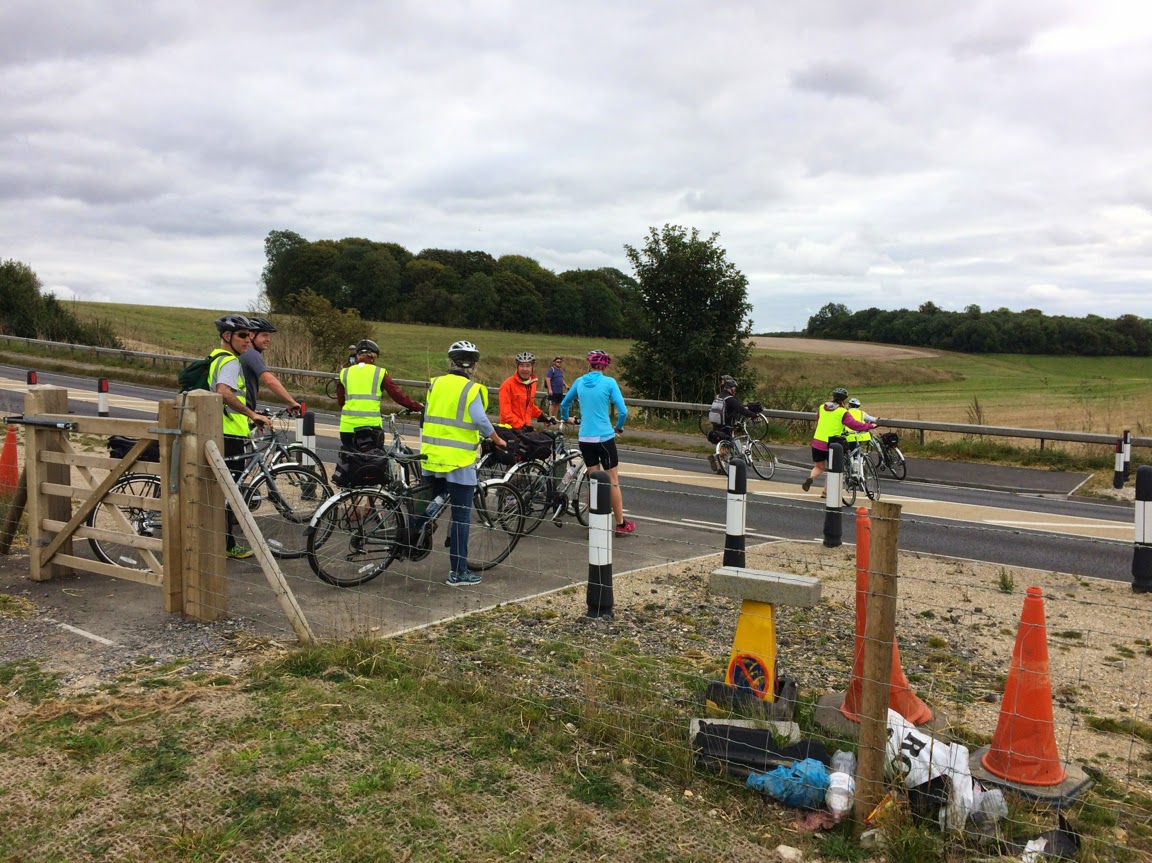
Today wasn't too bad and I was safely across in under a minute.  I rode up to the A344 then onto the temporary permissive path between Byway 12 and Stonehenge Bottom.  As I crested the ridge down to Stonehenge Bottom I was confronted by a veritable gaggle of cyclists heading down towards the A303.


They were a nice friendly bunch and I explained that I was part of STAG and what we were about and please could I take photos of them if they were trying to cross.  They were happy for me to do so, so here is a short vignette of what happened next.

The thought of them all trying to cross made my blood run a bit cold as the traffic here is gravity-assisted in both directions and the westbound traffic is still trying to settle scores with other drivers from the 2 lanes into 1 section of the A303, a few hundred meters to the east.

A few cyclists at the front of the group spotted a small gap and either ran or rode across.

Most of them didn't get the opportunity and there was  steady stream of fast-moving traffic in both directions on what is, at this point a Clearway, not that anyone gives a tuppeny-damn about the Highway Code these days!

They waited, and waited, and waited.
When a westbound gap appeared they moved forward, then back again as it disappeared.

One of them made it to the central strip and an eastbound driver in a grey car slowed and stopped.  Remember, it is a Clearway - no stopping.

The cyclists, not quite sure what to do now, all started to move off the verge towards the centre of the A303,  but did so very hesitantly.  The westbound traffic was still thundering past them with mere inches to spare.  It couldn't have been a very pleasant experience.

White van man from Black Hole Storage Removals clearly didn't give a damn and went roaring through and this carried on for a while until another grey car stopped on the westbound carriageway.
and finally, the whole group got across safely.

It could so easily have been very different.  But why are things so dangerous?

Well, the people who control the World Heritage Site have a policy of making Stonehenge a more bike (and horse and pedestrian) friendly place.  This seemed to be borne-out in the plans for the new visitor's centre submitted by English Heritage.  However, despite their intentions and despite planning conditions that mandated a whole raft of measures that would have improved things for cyclists, English Heritage have singularly failed to deliver.

One of the few things that was largely outside the control of English Heritage was an improved crossing at Stonehenge Bottom.  On the one hand,  increased usage of the crossing point was anticipated by all parties after the closure of the A344, hence the planning requiremnt.  However, a spoke was put in the works by the Highways Agency who produced a report - in the way Government Agencies do when they don't want to take action.  The conclusion of this report reads as follows:


"It is the designer’s view that the current usage of this crossing by pedestrians or by cyclists, on either the A303 or the A344 routes, does not justify the increased risk to motorised users on the A303 of providing refuge islands for this crossing. However it is felt that the opportunity to relocate the crossing to the best location position for NMU visibility and to reduce the crossing width is justified and should be taken.

In taking this view, the designer is taking note of RSA team preference, based on pedestrian rather than cycle use of the crossing, of the do minimum crossing type. The designer is also influenced by the fact that this is far from being the only single carriageway rural at grade crossing of the A303 with no specific NMU facilities, including equestrian crossings. 

The proximity of this crossing to the Stonehenge World Heritage site does not currently attract to it significant NMU usage. It is therefore felt that neither the existing usage of the crossing or the last five year’s accident records warrant a different approach here to that taken at other similar crossing locations where the balance of risks between NMU and Motorised Users, and hence the actual overall risk, dictates the level of provision made. 

It is therefore recommended that the measures in Option 4 proposals, with the refuge islands removed but all the other measures retained is adopted. 

A future scheme for reviewing the crossing arrangements needs to be submitted and approved. The scheme shall have regard to Design Manual for Roads and Bridges HD 19/03 Stage 4 Safety Audit 12 and 36 month post scheme recommendations for any remedial action. 

It is felt that the extensive investigation already under taken into the examination of the safety of and the changes to the crossing here proposed satisfies the requirements of the planning condition."

Just for the record, NMUs are non-motorised units - pedestrians, cyclists and horse riders.  Cutting out all the crap, what they are actually saying is that the body-count at Stonehenge Bottom is too low to warrant making anything more than superficial changes. However, they go on to suggest that a safety audit at 12 and 36 months might change things if the body count increases.

I don't suppose the contribution by Wiltshire Council helped much either:


"...that in relation to cycle usage their preferred route between the A344 to the north and Amesbury for cyclists was via the countess roundabout underpass crossing of the A303 and than via Lark Hill."  (all the typos and grammatical errors are courtesy of the Highways Agency!)

As usual with Wiltshire Council when it comes to anything in the south of the county - thumbs up bums and brains in neutral all the way.  No-one in their right minds, who knew about the local area, would ever choose to get from the centre of Amesbury to Stonehenge by heading north, through the scrofulous Countess Roundabout underpass (on foot - as cycling is forbidden on this bit of the cycle route), up Countess Road, being harassed by rat-running motorists, then head west to Larkhill along the rat-run of choice for coaches and HGVs, before eventually getting to the northern end of Byway 12.

Most sensible folk will simply head out to West Amesbury, up to the A303 and then to Stonehenge Bottom and the A344 - no need to ride with high speed traffic at all - just dice with death crossing the A303.  That's what they've always done, that's what they were doing today and that's what they will do until the A303 issue is resolved once and for all. 

Of course,  there was a fall-back plan to monitor the situation.  Here it is.  Read it carefully and spot the flaw:


STONEHENGE ENVIRONMENTAL IMPROVEMENTS PROJECT Planning Application Reference S/2009/1527 

Scheme required under planning condition 27 for reviewing pedestrian and cycle route access arrangements along the whole of the A344, and crossing arrangements at the A303 (Stonehenge Bottom)

Following approval of the details of the pedestrian and cycle route access arrangements along the whole of the A344 and crossing arrangements at the A303 (Stonehenge Bottom), English Heritage will co-operate with the Local Highways Authority, Highways Agency and the Local Planning Authority in reviewing the arrangements. In particular, should a formal Stage 4 Safety Audit be carried out, and any recommendations for remedial action be made in the 12 and 36 month Stage 4 Reports submitted to English Heritage and the other organisations, then any required remedial works, and arrangements for their implementation and funding, will be considered and agreed between English Heritage, the Local Highways Authority, the Local Planning Authority and the Highways Agency, as appropriate. 

In addition, English Heritage will carry out the following:

  • -  Incorporate questions about the pedestrian and cycle access into the annual visitor survey conducted by the travel and tourism department of market research company TNS. This will comprise face to face interviews with 180 individuals during the months of July, August and September. Likely questions include: whether people have accessed the site on foot or on bicycle, and, if so, where they have travelled from, how satisfactory they have found the route and where they are travelling onto. 

  • -  As part of the ongoing operational management of the site English Heritage staff will, as a matter of course, record, report to the relevant authorities and, if appropriate, take any necessary action in respect of any incidents or accidents along the route of the A344 between Airman's Corner and Stonehenge Bottom. 

    English Heritage 26th April 2012
 
Did you spot it?  Yes, that's right.  Most pedestrians, cyclists and horse riders arriving at Stonehenge don't pitch up at the visitor's centre, as there is (still) no provision for them.  They may arrive from east or west, north or south, but we suspect that few, if any, will be invited to take part in the annual visitor survey, conducted for English Heritage by TNS.  
During my many visits to the WHS this July August and September I've never seen anyone with a clipboard interviewing pedestrians, cyclists and the two riders I have seen, nor have I ever been approached.  Now that's interesting, if true because this safety audit is meant to be looking at the safety of crossing the A303 by any and all users, not just English Heritage's paying customers.
As I say, we don't know for certain that this is the case, but I feel an FOIA request ,or two, coming on! 


Tuesday, 9 September 2014

English Heritage Mess Up on the A344 - Yet Again

Last month we heard from Wiltshire Council, definitively they claim, that the A344 is still the A344 and a highway.  As "A" roads have a legal definition in the UK and that involves joining population centres, carrying motorised traffic, etc, it is patently absurd to continue to list the A344 as an "A" road.  Consequently, this is being taken up with the Secretary of State for resolution.

Meanwhile, on the A344, English Heritage continue to mess up.  As a planning condition for the new visitor's centre, they were obliged to install Kent Carriage Gaps to allow all non-motorised traffic, not banned by the permanent Traffic Regulation Order, to use the A344, unhindered, 24/7.  Like many of the planning conditions imposed on English heritage (around 23 of them) many were supposed to be put in place before the visitor's centre was opened to the public,; the management plan seems to suggest sometinme between October and December 2013.  Yet again, this was a major fail by English Heritage.  Wiltshire Council Planning Department seem to have done little to police these consents, which makes you wonder what they spend their time doing!

Now for those of you who don't know, a Kent Carriage Gap is one of the ways of enforcing a TRO of the sort imposed on the A344.  This is how they should be designed:

Two sizes of post to allow carriages of different sizes to pass along the carriageway.  The separation of the posts and their height is also defined.

The point of these gaps is to allow unhindered access along the carriageway - the operative word here being along.  This is how they should be constructed.

Have English Heritage achieved this?  No, of course not.  Almost 9 months late, this is all they have been able to manage.

Between the new roundabout at Airman's Cross and the entrance to the visitor's centre carpark you have this attempt, photographed by Wiltshire Councillor and Chairman of Winterbourne Stoke Parish Council Ian West and friends,  it certainly doesn't seem fit for purpose, doesn't meet the design of Kent Carriage Gap for which planning consent was given, and wouldn't appear to be able to be used as intended by all the types of carriage it is meant to permit. 

Further along, we come to an even more egregious mess which we photographed last week in the run-up to the presidential visit!

Well, on the plus side, EH have lowered the kerb.  But that is the only positive thing that can be said about it.  The Gap is again to one side of the A344, not across it and there is no clear exit from it back onto the A344.  It's worse than that, bearing in mind that the path running from left to right comes down from the coach park and is the main access for visitors being brought in from that direction.  Now, given these pedestrians are about to cross an open highway, the A344, in very large numbers, you'd think English Heritage would have had the common sense to do a number of things.  First, leading pedestrians onto and across a highway, without warning them they are crossing one is a fairly stupid thing to do; particularly given that many of them are foreign visitors. 

Second, not warning those using the highway that there may be pedestrians about is also pretty lame, so you'd think there might be proper signage on the path and the road, "Look both ways" signs on the footpath, etc, etc, but no such luck.  All in all, when we have our first visitor mown down by a horse rider, horse and carriage or even a cyclist, the negligence on English Heritage's part will be clear.

In writing this, we realise we never actually measured the height and separation of the posts that are there, so we might have to pop up and measure them to be sure.

Ian West and friends also looked at the state of the permissive byway at the other end of the old A344, beyond Byway 12 and towards Stonehenge Bottom.  English Heritage, keen to foster the World Heritage Site's policy of encouraging visits by cyclists have signposted the route:

You've got to admire the lengths they have gone to over the last 9 months to do this!  Of course, if you take the trouble to go down that way,  avoiding the inevitable traffic jam at byway 12...


...you can get a really good view of Stonehenge, without having to pay the extortionate entry charge.  Follow this up with a visit to the museums in Amesbury, Salisbury or Devizes and you will see the best of Wiltshire's archaeology - you don't even need a local resident's pass.

All we can say is that it is a good job President Obama didn't arrive by bike and that Raffles family of Amesbury decided to walk up to Stonehenge from the east, rather than go by car, or else the six of them would never have met and English Heritage couldn't have benefited, however undeservedly, from the global human interest story that broke following the president's visit. 


Saturday, 21 June 2014

Has the Highway Agency Lied To The Public on Twitter?

Back in May, we raised a Freedom of Information Act (FOIA) request with the Highways Agency on the "What Do They Know" website.  As we've said before, we think this is the best way of raising FOIA requests as it usually acts as a spur to keeping the recipients honest and they usually take a bit more care in answering, as mistakes are in the public domain and they risk being humiliated by a public correction, or having downright lies exposed.  This doesn't seem to work in the case of the Highways Agency.


We asked them to list the times and dates of apparent failures of the traffic camera on the A303 at Solstice Park, Amesbury, as it seemed that the camera was frequently out of service when the traffic levels on the A303 were greatest.  Rather than raise this as an unfounded suspicion, we wanted to have factual information (as it turned out, our suspicions about camera failure were unfounded, but we haven't yet established if the camera is ever deliberately turned off!).

Imagine our surprise when we received the following response:

...I refer to your request under the above legislation for information about failure of traffic cameras on the A303.

I can confirm that we do not hold the information. We believe that, as this is a safety camera operated by Wiltshire Police, the information you require may be held by Wiltshire Police. If you have not already done so, you may wish to contact them...


Now, we knew that this was complete cock-and-bull, but we played the game and re-sent the FOIA request to Wiltshire Police, who responded as we expected, pointing out that the police unit responsible for static cameras closed in 2010.  So, back to the Highways Agency we went and asked for an internal review of their original answer.

This time, we got the following response and somewhat half-hearted apology:

"...I am writing to confirm that I have now completed an internal review of our original response to you, which you requested on 30th May.

It appears that we were mistaken in our first response to you and that the Highways Agency has responsibility for the camera in question. Please accept my sincere apologies for the misinformation and any subsequent inconvenience this has caused..."


This isn't the first time that they have answered our FOIA's incorrectly - the level of incompetence for a Government Agency is simply astounding.

Over the last few days, in the run-up to Summer Solstice 2014, we at STAG have been monitoring traffic levels on the A303 and one of the strands of this is to monitor, when possible, the Solstice Park camera.

From midweek, the camera has been out of service and it was definitely out of service last night, showing the typical failure notice:


Imagine our surprise, when we awoke very early on Solstice morning, to see the following Twitter-feed from the Highways Agency:


Poetic, wonderful, atmospheric, the Amesbury webcam was clearly fixed in time for the Solstice dawn.  We are sure the English Heretics would have been delighted by the plug.


Well, actually, no.  The camera was still unavailable the second the tweet was published.  So, are the Highways Agency lying through their teeth about watching the sunrise through the Amesbury webcam, or, are they are lying through their teeth about the camera being available and deliberately suppressing the feed?

Superficially, and in the greater scheme of things, if the Highways Agency are lying, this might seem a fairly trivial untruth.  However, it is information, being put in the public domain on behalf of the Government.  In effect, if true, it's the Government misleading the people.  If they can't be trusted over something as trivial as a webcam feed, how can they be trusted when it comes to something more important regarding the A303 - the current feasibility study for improving it for instance?

Let's just say we are unhappy, a wee bit vexed.


Agencies like the Highways Agency should be answerable to the people and we hope that our MP, John Glen, will seek answers from the Highways Agency on our behalf.


Saturday, 31 May 2014

The Department for Transport Set The Scene

So, what's been happening with the A303/A30/A358 Feasibility Study since January 2014?  There was a meeting on 20th May 2014 in Taunton and the Department for Transport provided some useful background information.   Clearly, not everyone can attend these meetings, but there are an awful lot of people who have an interest in the process that is now underway and in the final outcome.  It seems only sensible to allow people to see the information for themselves and give them the opportunity to question and comment.

Rather than give you our impressions and opinions, here is what the Department of Transport presented.  It's the sort of thing that, given the level of public interest, the DfT really ought to be publishing on their own web-site. Please make your own minds up and let us know what you think.

140429 A303 Feasibility Study Reference Group Meeting Final 200514 v1 by Blonini1

Thursday, 24 April 2014

CPRE Ostrich Has Head Stuck in Sand for A Decade

There's an interesting, though somewhat depressing article in today's (April 24th 2014) Daily Telegraph entitled "Stonehenge tunnel plans could be revived".  The article is by the Telegraph's Transport Correspondent, Nick Collins and is in response to the Department for Transport's  A303/A30/A358 Corridor Feasibility Study Scope Document which you can find here.  I strongly suggest that you read it for yourselves as I fear Mr Collins has misrepresented some of it in his article.


What is more disturbing are the comments of the CPRE below:

"The Campaign to Protect Rural England said several of the spots under examination, including Stonehenge, are only congested at certain times of year and do not merit major development.
Ralph Smyth, senior transport campaigner for the CPRE, said: “The traffic [at Stonehenge] hasn’t increased in the last 10 years and it does not justify the huge cost of a tunnel.”
A long tunnel would at least be preferable to a dual carriageway at the surface, which could cause the historic site to lose its world heritage status, he added".  


I'm not sure where they have been for the last 10 years, but as anyone who lives alongside the A303, or drives along it regularly, to say that the traffic at Stonehenge hasn't increased over the last 10 years is risible.  It's worse than that, it's damned dangerous.  Opinion is one thing and evidence quite another.  I would strongly suggest that Ralph Smyth takes a bit of time to read traffic flow data and projections before he makes any further pronouncements.  In particular, he should take a look at Somerset County Council's excellent Economic Impact Study and the figures contained therein, not to mention the traffic studies conducted on behalf of Wiltshire Council and English Heritage.

If you want to take this up with the CPRE directly, then their contact details are:

National Office
Campaign to Protect Rural England
5-11 Lavington Street
London
SE1 0NZ

Tel: 020 7981 2800
Fax: 020 7981 2899

Email: info@cpre.org.uk


Tuesday, 4 March 2014

Some Positive Rumblings From the House of Commons

After a day of Press interest in the STAG campaign to get the A303 dualled as quickly as possible, with reports on the BBC's South Today this morning, we now have a report from STAG's very own man inside the Palace of Westminster.


Our intrepid correspondent observed:

"In short, a positive session in which all agreed the imperative economic need, but many procedural hoops to jump through before we know what the consultation will bring.

There is a general view that a long bore tunnel is much more achievable/acceptable now than it was 10 years ago: financially, technically, socially and archaeologically."


We hope to have more a detailed review in the morning.

Our correspondent ended with the following point.  "Our MP, John Glen, did us proud today!"  Nice to be able to say something like this.

John also forwarded the following update from the Roads Minister, Robert Goodwill:


It will be interesting to see the metrics they propose to use to measure cost benefits - and how they propose to reconcile purely financial factors with less tangible, but equally relevant ones.

Sunday, 23 February 2014

LHVs and What They Might Mean for the A303 and the West of England

LHVs - Longer, Heavier Vehicles - have been back in the news again this week, with an interesting story in the Western Gazette of Friday 21st February 2014 with the suitably emotive title of "A303 DUAL IT: New Laws Could See Monster Trucks Wreak Havoc on the A303".

The article begins: "...Mega trucks measuring up to 82ft in length could be allowed into Britain under new EU laws. Draft legislation being considered by the European Parliament would permit lorries longer than two double decker buses, and weighing up to 60 tonnes, to cross international borders for the first time..."


We thought we'd better take a look, and then take a position on this story.  Clearly, the A303 as it stands, is already unsuitable for the types of HGV loads already being carried - especially on the single-carriageway sections which despite Highways Agency bleatings, are too narrow to accommodate the current generation of HGVs.  Roundabouts on the A303 regularly have HGVs overturning on them because they fail to negotiate them at speed.

So, what is the truth about these Mega trucks?  We all know the danger of relying on newspapers of accurate information - on just about anything - so we went back to try and find the origins of this story from some more reputable sources.  We found two interesting reports.  The first "Longer and/or Longer and Heavier Goods Vehicles (LHVs) – a Study of the Likely Effects if Permitted in the UK: Final Report" written by the UK's Transport Research Labs in 2008:

This makes clear that this whole story is nothing new.  In fact, two UK companies pressed to be allowed to trial LFVs in the UK as long ago as 2005, but were refused.  As interest in LFVs was growing in the UK and elsewhere in Europe, the DfT commissioned TRL and Herriott-Watt University.  It's a very long report, but if you are interested, it is well worth reading the Executive Summary and the précis of the findings.  As might be expected, the findings are bit of a curates egg, but overall, it seems to come out in favour - but there were problems anticipated by both the length and the weight of these vehicles.

One interesting finding is reproduced here:

"...If LHVs were to be permitted then European legislation would be very likely to substantially constrain the UKs ability to permit only those specific types of LHV with characteristics considered desirable to protect the UK infrastructure. The current European legislation would also be likely to make it difficult to require the fitting of specific additional safety equipment that could mitigate any increased accident risks. Suitable amendments to the European legislation would be required to be certain of the outcome. The UK regulations on speed limits for multi-trailer combinations would also be likely to require amendment, even if such vehicles were to be permitted by Special Order, because their speed would otherwise be limited to 40 mile/h on motorways and 20 mile/h on all other roads..."

Reading between the lines, we think this is really an admission of it being a case of when it happens and not if it happens.

Another concern was that introducing LFVs might precipitate a shift of freight traffic from rail to road.  Given the loss of the main rail link to the West Country in recent weeks, the pressure to provide a credible alternative can only grow.


The second paper, written for the European Commission in 2009, "Longer and Heavier Vehicles for Freight Transport" is also of interest to us as it begins:

"The European Commission is considering the implications of allowing the use of Longer and Heavier Vehicles a for road freight transport (abbreviated as LHVs in this study), measuring up to 25.25 m and weighing up to 60 tons, for the whole of the European Union transport system. Such trucks are already in circulation in Finland and Sweden, while several Member States are considering their introduction".

So, as we suspected, the Western Gazette is hyping this aspect of their story a wee bit; this is far from a new plan and the EU have been considering it for at least 5 years.  As far as the plan to use them, eventually, in the UK as a whole, it really shouldn't be a surprise.

However, where we would agree with the Western Gazette is in the likely impact on the A303/A358/A30 corridor.  It would be an unmitigated disaster with, we suspect, some dire consequences in terms of lives lost and blighted by accident - all the evidence suggests more accidents per km travelled than for existing HGVs.  They would be horrendous on any of the single carriageway sections of the A303 such as that past Stonehenge and through Winterbourne Stoke, but imagine them trying to negotiate the bends and steep climbs of the Blackdown Hills.

Lest anyone believe that no-one would even consider putting these things on West Country roads as they stand, then this diagram from the report should shatter that illusion:


See the little red dots in Cornwall!  Enough said.

So what is our position on LHVs?  Well, in the short term, even with the rail problems that the West Country now faces and is likely to face in the foreseeable future, we should be robust in keeping them off the A303, the A358 and the A30.  The risk to life and limb is simply too great.

In the longer term. the government has to look at an integrated traffic infrastructure plan for the west of England - providing a sustainable rail link to the tip of Cornwall as well as dualling the A303.  If this can be done, then there may be less of a need for LHV's - though we fear the economic and environmental case for doing so may be hard to overturn. 

Sunday, 5 January 2014

What Wiltshire Council Told the Transport Minister in 2011

There have been several comments, here and on the STAG Facebook page, regarding traffic surveys, their findings and what various stakeholders understood.  Several folks are still under the mistaken impression that closure of the A344 wasn't expected to cause traffic chaos. We thought it might be helpful to let everyone see the key reports and documents that should have been taken notice of at the time they were produced, and subsequently, and which have been ignored, or reneged upon.


So here is our first document of 2014.   What Wiltshire Council then told Tom Harris, the the Minister for Transport.


The whole letter is very useful as it lays out the policy of Wiltshire Council in 2011.   The focus is on the improvement of the A303.  The bottom line is shown in the text surrounded by the first red box.  In 2011, Wiltshire Council did not support the closure of the A344 without an improvement to the A303, precisely because of the impact they expected such a move to have on local communities.

It is of considerable concern to us that Wiltshire Council was not being kept informed of the latest traffic surveys being undertaken by the Highways Agency.  Despite this, and with the foreknowledge of the results of earlier traffic studies, Wiltshire Council reinforced their concerns about the consequences of closure of the A344 in isolation.

Then something happened.

Wiltshire Council changed its policy and, seemingly, allowed the A344 closure to go ahead last year without so much as a whimper.  We've been trying to understand why.  Who made the decision to change the policy so strongly expressed in 2011 and who supported that change.  We are also interested in knowing if any of those involved in the about face had, or have, any connections to those stakeholders who have benefited directly, or indirectly, from the A344 closure.

We've asked Wiltshire Council to explain when this policy changed in several ways, but they are proving hard to pin down.   We even invited Cllr Fleur de Rhé-Phillipe, Wiltshire Council's Cabinet Member for Economy, Skills and Transport, to provide an explanation - first in October 2013 by email and then again in early December.  in her first and only response, the good councillor clearly missed this question, so we restated it in a follow-up email. We didn't even get the courtesy of a reply.

Given that we (WiSBAng, STAG and others) are going to be engaging with other stakeholders during the forthcoming A303 feasibility study, we are going to want to know what Wiltshire Council's A303 policy is, and whose word is to be believed.

We also need to understand whether the elected officials of Wiltshire Council and its employees speak with one voice.  Why?  Well this document from 2005 is pretty self-explanatory (click on document to expand it):


We are particularly taken by the author's apparent relish at dividing [local] opposition - turning Larkhill and Shrewton against Winterbourne Stoke for instance.  That's something we are going to be very aware of this time round and why it is encouraging to see the local villages rallying round and pulling together.   It's worth reflecting that some of the officials associated with this document are likely to be involved in 2014-15.  We will be watching them closely.

The problems associated with the A303, the A344 closure and the consequent rat-running are already going on in our back yards.  There can be no room for NIMBY-ism here, we are already IMBYs!

Saturday, 4 January 2014

A Tale of Monkeys and Men - The Need for Good Information

Whilst WiSBANg and STAG are only too happy to poke fun at the authorities at every chance and expose ineptitude wherever we find it in relation to the Highway to Hell  - the A303/A30 corridor (and boy, do they give us so many chances!), the main purpose of our campaign is to try and improve the situation - for locals, businesses and the travelling public.

To do this effectively, we need to be able to engage with other stakeholders during the forthcoming consultations and we can't do that just with public opinion - we need hard facts and figures.  So, over the coming months, we will be collecting our own; either using the methods already employed by the relevant authorities, or in a way that shows the deficiency of the methods that have been used to date.  A good example of this latter case, are the manual traffic censuses undertaken by the Department for Transport that we highlighted in an earlier post.  You should read that original article, because it explains why, even if the DfT methodology is used, the results are skewed in a way that underestimates the traffic problems.  The reason that it is so inappropriate for a road like the A303 is quite simple, the censuses are conducted in the middle of the week and not on public holidays or school holidays - exactly the periods when the Highway to Hell is at its busiest.


So, if the DfT can't be trusted to conduct rigorous traffic censuses, we would like to have a bash ourselves. We would like to do this in the most professional way we can and are seeking to find a few folks with experience of conducting traffic censuses on behalf of DfT in the past - who are familiar with the methods used.

Please let us know if you have such skills, or know of anyone who does and who would be prepared to help us out?


We also learned yesterday that Doug Clifton, a local resident and student at the University of Southampton, is doing a dissertation on the impacts of the developments at Stonehenge between 2009 and 2013.


To achieve this, he has set up a Stonehenge Local Residents Survey on the Survey Monkey web site.  If you are a local resident, please can you follow the link and complete the survey?  We are keen to encourage Doug in his efforts and will be happy to publicise his results once he is free to use them.


Thursday, 5 December 2013

John Glen - Latest Question on the A303 - 4th December 2013

John Glen has passed us a copy of a question he raised in the House of Commons yesterday and wishes to assure us that he is pressing the case for improving the A303 at every possible opportunity:


John Glen (Salisbury) (Con): In welcoming the news about the progress on the feasibility study for the A303, will the Chief Secretary bear in mind my constituents’ concerns about Stonehenge and Winterbourne Stoke? Unless that area is properly unblocked, people will not be able to get down to Devon to enjoy Tiverton and Honiton. This has been going on for several generations, and we need to make sure that it is sorted in any plans that come forward next year.

Danny Alexander: I think Stonehenge has been there for more than several generations, and I do not intend to remodel it at this Dispatch Box or anywhere else. My hon. Friend is absolutely right to draw attention to one of the issues on that route. We are conducting the feasibility study to work out what are the right steps to take at every stage. I am sure that his concerns will have been heard by colleagues in the Department for Transport, and I will certainly make sure that they are taken on board, as the feasibility plan is developed.


Tuesday, 3 December 2013

Cllr Fleur de Rhé-Phillipe, Wiltshire Council's Cabinet Member for Economy, Skills and Transport on Improving the A303

Back in October, I wrote to Cllr Fleur de Rhé-Phillipe, Wiltshire Council's Cabinet Member for Economy, Skills and Transport.  Given her brief, she is someone you might expect to be fully behind plans to upgrade the A303 through Wiltshire in a dynamic, forthcoming and informative way.  I also fully expected that she might be able to clear up something that has puzzled me for some time - Wiltshire Council's about-turn on closure of the A344 without improvement/dualling of the A303 first.


This is the letter:

...I would like to extend an invitation to you to submit a short piece on your views on the need to dual the A303 beyond Stonehenge Bottom to its end near Honiton, the need to bypass villages such as Winterbourne Stoke in a sympathetic manner and the need to develop some short term measures to overcome the chaos and enhanced danger on the roads surrounding Stonehenge since the closure of the A344.

We have extended the same invitation to local, national and international figures and have already published a statement by John Glen MP and hope to have a similar piece from Graham Watson MEP in the next few days.  These will be published on our blog - WiSBAng - Winterbourne Stoke (A303) Bypass Angst  http://bypasswinterbournestoke.blogspot.co.uk/ which works in conjunction with the Stonehenge Traffic Action Group http://staga303.blogspot.co.uk/  (STAG - previously known as the Shrewton Traffic Action Group).

You may also be able to clear up a puzzle for us.  We know that as recently as 11 April 2011, Wiltshire Council wrote to the then Minister of Transport to remind him that the Council was against any plan to close the A344 without an improvement to the A303 because of the likely impact on traffic in local communities - a likely consequence of which Wiltshire Council was well aware since before 2005.  We are keen to understand why, at some point between April 2011 and June this year, Wiltshire Council seemingly reneged on its long held position and acceded to the closure of the A344 - acceded without so much as a whimper?   What pressure was brought to bear on Wiltshire Council by central government and which representatives of Wiltshire Council were involved in agreeing, or at least not resisting, the A344 closure.  It's the sort of thing our readers will like to be aware of when it comes to elections, by-elections and that sort of thing...


It came as something of a surprise to get the following very terse response:

...Wiltshire Council's position in relation to the latest initiative to improve this vital transport infrastructure was captured in the attached prospectus which we produced in partnership with Devon and Somerset County Councils and the Local Economic Partnerships in our area. Since submission of the prospectus to the minister, the government has announced funding for a feasibility study on the whole route and we will be working with Highways Agency and other local authorities to progress the study. We shall also continue to promote the much needed improvements at every opportunity.  We are due to meet the new Transport Minister in December...

We looked at the prospectus and noted it referred to traffic censuses on the A303.  That was a bit of a puzzle as we had just received a response from the Highways Agency, acting as the executive agency for the Department for Transport, to a Freedom of Information Act request on traffic censuses on the A303 - and they claimed that none had ever taken place between 2000 and 2013.  It turns out that the Highways Agency were being spectacularly incompetent and they had failed to realise that an FOIA raised with the DfT needed to be answered on behalf of the DfT and not just the Highways Agency. 

Still, offering us a freely available prospectus seemed a bit, well, half-hearted. 

Cllr de Rhé-Phillipe had also ducked our last question - so we sent her a gentle reminder, by return,

...Thank you very much for your response and the prospectus.  Having read it, it leaves me a little concerned as it refers to traffic figures.  According to a response to an FOIA I received from the Highways Agency today, they “are unaware of any traffic censuses on the A303”  - which if true, may cast doubt on the case that is being made.  It would be interesting to know where the data came from.

I also see that you have not answered the second part of my question regarding the apparent change of heart of Wiltshire Council with respect to closure of the A344 before the A303 was improved.  I am sure that this was merely an oversight on your part in your eagerness to provide me with information relating to the first part of my query.  I will hold any  public comment to your for a few days to give you a reasonable chance to respond....


Sadly, since the end of October we have had no further reply from Cllr de Rhé-Phillipe.  I think we've exceeded the few days grace we extended her by a goodly margin, so that's why we've now published the limited correspondence we have had.

It does make us wonder though why Cllr de Rhé-Phillipe is so seemingly reluctant to explain why Wiltshire Council reversed its position so abruptly and unexpectedly.  Perhaps it's because Cllr de Rhé-Phillipe simply isn't privy to decisions of that level of importance - despite her Cabinet membership? Or, if she was privy to that decision, is there some embarrassment about it within Wiltshire Council circles?  Has something worse taken place? 

If Cllr de Rhé-Phillipe wants to clarify things, or another Wiltshire Councillor, or Cabinet member, knows why the position changed, we would love to hear  from them. If not, rest assured we will keep on digging until we get to the answer.


Friday, 1 November 2013

SH2 - A Proposal For A Very Northerly Route

It is very easy for us to sit here and complain about the problems caused by the lack of dualling of the A303, the lack of bypasses, the idiocy of various bodies - the Highways Agency, the Department for Transport and Wiltshire Council - in closing the A344 before the A303 problems were resolved, despite the excellent advice they were given, in order to pander to the demands of English Heritage and the Stonehenge World Heritage Site.


It is very easy, because they have set themselves up as such easy targets for ridicule and derision - and they will be duly ridiculed and derided. 

However, whilst we must be resolute in learning the lessons of the past, we need to look to the future and ask ourselves how might the problem be solved.  So what is it we want to achieve exactly?  Well, here at WiSBAng, we would offer the following list of key points:

- Dual the entire length of the A303 (and the A358 and A30 to Penzance)
- Bypass villages such as Winterbourne Stoke
- Remove the A303 from the Stonehenge World Heritage Site sight-line
- Minimising the need to damage virgin farmland
- Minimising the cost
- In doing all of the above, eliminating rat-running through local villages.

However, we need to look at some of the limiting factors:

- The location of the World Heritage Site itself
- The location of Parsonage Down site
- The high cost of stuffing the A303 in a tunnel
- The unsuitability of the WHS geology for stuffing the A303 in a tunnel.

There are a few other factors that need to be borne in mind.

-The Armed Forces are retrenching to Wiltshire from Germany and are planning to accommodate a further 3,500-4,000 people, including families, at Larkhill, but:
- The Armed Forces have reduced massively in size since the heyday of activity in the Salisbury Plain training area;
- Not all of the Salisbury Plain Training Area is in use all of the time - so, very simplistically, it can't all be needed.
- The land occupied by the Salisbury Plain Training Area is already in government ownership or leasehold.
- The military population is largely transient - they come, they are posted, they go.
- Whatever route west is taken for the A303 - it is going to destroy/damage some archaeology.
- Most routes that have been proposed to date go through virgin countryside, or go so far south that they will start to have undesirable adverse impacts on the traffic flow in and around Salisbury.
- Whatever route west is taken, it will require some virgin countryside.
- Much of the virgin countryside that would need to be sacrificed to reroute the A303, especially on the routes previously proposed, is owned by rich and influential individuals who can be expected to object a wee bit.
- The Green lobby might also object a little - think 'Winchester Bypass.'

So, is there a route that could possibly deal with all, or most of the above?  We think so, and here it is:


 Just click on the picture to see the enlarged view.  Basically, the proposed route leaves the current A303 at the Parkhouse Roundabout, cuts northwest into MoD land and then heads due west, north of Bulford and Larkhill.  It then continues westwards until it reaches a point on the A360, roughly equidistant between Shrewton and Tilshead, before cutting back to the south west to rejoin the A303 at the Wylye junction.  As I write, I can hear the wringing of hands and gnashing of teeth in MoD - it's going to mess up the small-arms- ranges between Bulford and Tidworth and cut the two camps apart - but there is a helluva lot of training area and rifle/grenade ranges can be resited - how hard is it to build a berm?  Then think of the benefits to MoD - most civilian traffic could be removed from Larkhill - benefiting the newly returned families and making a much clearer distinction between the living area and the training area. Unexploded ordnance along the route- well, there's bound to be some, but what a wonderful training opportunity. 

There is one other huge benefit in going this far north, and that is the possibility of joining into the A36 at Knook Camp, close to the Warminster bypass - and possibly providing some relief to the A36 villages - at least from traffic travelling to or from the east of England.  Like this:


OK, it's far from ideal, but it is the route which requires the minimum purchase of undeveloped countryside and achieves just about everyone's desired outcomes.  The A303 proposal turns a 14.4 mile section of road into one 17 miles long - adding less than 3 minutes to the journey time.  Compare that with the 1-3 hours that 14 mile stretch has taken this summer.

Let the cries of outrage begin!


Sunday, 27 October 2013

Spend Any Money Saved On HS2 on SH2: Dual the A303, the A358 and the A30

The Sunday papers are filled with stories of Labour plans to axe the £42 billion HS2 high-speed rail link from London to the North of England in favour of a £6 billion route along the line of the former Great Central Railway closed by Dr Beeching in the mid 1960s.  Basically, savings can be made by adopting a route that is still largely undeveloped - affecting far fewer people than the proposed route for the HS2 and requiring less unspoilt countryside to be sacrificed. OK, the size of Labour's predicted saving may be an over-estimate, but money could be saved and the North could get a viable high speed link.


Rumours abound that many Tory and Lib-Dem politicians are also hoping to bail out of the HS2 project, but want to spend any money that is saved on sorting out other transport infrastructure problems in the UK.  What could be better than sorting out the main route westward from London - the entire length of the A303, the A358 and the A30?  The most sensible way of doing this would be in overcoming the long-standing sticking point that is the Stonehenge World Heritage Site.   What we need is SH2, not H2S.

So, there you have it, a possible way to achieve 2 major transport infrastructure goals, allow politicians of all flavours to backtrack on the original HS2 plans without any loss of face, and fund SH2, including a dual carriageway bypass for us here in Winterbourne Stoke, with a few bob left over for some other projects.


SH2
The real engine for growth!