One of the things we have always been aware of is just how emotive the whole issue of the A303 and the World Heritage Site is. The positive news (to us) of funding being found for the A303 and a tunnel to get it through the World Heritage Site, as well as the bypass for Winterbourne Stoke and all the other beleaguered communities along its route is seen as an announcement about the end of the world by a few.
Some of them are genuinely concerned but ill-informed, others appear to be one slice short of a sandwich and some appear to be simply malicious. The one thing that many of them have in common is their propensity to spout nonsense and live in a world where financial constraints, employment, health, public opinion and the laws of nature have no meaning.
From the moment we started this blog, our stated intention was to challenge factual inaccuracies, cant or hyperbole when it came to all issues relating to the A303. We've done so without fear, or favour, and have regularly taken to task English Heritage, the Highways Agency and Wiltshire Council.
Given some of the comments that we and other STAG members have received over the last 24 hours it is clear that this sort of effort is going to be needed more than ever now there seems to be a fairly strong possibility of the work going ahead. So today, we announce the start of our "Banish Bypass Bullshit" campaign.
So, every time our attention is drawn to those seeking to halt the A303 improvements by use of bullshit, we will seek out those experts who can provide the facts and hard evidence that will rebut their specious claims and publish it. What we want is evidence and fact, not ill-informed opinion or outright bigotry. Of course, we have a heart and when we come across those who are, quite clearly, in need of professional help of a type we cannot provide, we promise to gently help steer them towards the arms of those who can.
Already we have seen some odd statements from the sort of folk who were against digging the channel tunnel in case the roof caved in and southern England got flooded, or against driving at all because such speeds would stop us breathing. If you qualify as one of these people or organisations, we are on your case!
For far too long Winterbourne Stoke and other villages in the area have been blighted by the A303 traffic problems. Now a bypass seems imminent and the emphasis has shifted to make sure we get the best route preference the village.
Showing posts with label Highways Agency. Show all posts
Tuesday, 2 December 2014
Monday, 1 December 2014
Breakfast With Nick Clegg at Stonehenge
Well, not exactly. It's a bit of hyperbole to say that I actually had breakfast with the Deputy Prime Minister - I was up at Stonehenge this morning for the BIG announcement, as was Nick Clegg, and I was stood fairly close to him with a cup of coffee, which might pass for breakfast, but I never actually got to speak with him. Never mind, we were all around for a common purpose - to give interviews to the Press.
Before getting up to Stonehenge, I had an assignation with a lovely lady called Rebecca Rooney from BBC Wiltshire, for an interview on the A303 funding announcement. We met up on the forecourt of the Bell Inn, Winterbourne Stoke, with the fast-moving, early morning, commuter traffic providing an "interesting" backdrop. We had the usual mix of large HGVs travelling at well over the 40 mph limit to help them get up the hills on either side of the village. We had school kids using the light-controlled crossing with fast moving vehicles bearing down on them with seemingly little realisation that there was a crossing there at all. Then we had the usual nightmare of villagers trying to get out of the village onto the A303 - with one taking almost 10 minutes to find a nearly safe gap into which to pull out.
I'll even forgive Rebecca for calling me Mr Churchill - perhaps I should go into politics after all and give John Glenn MP a run for his money?
So what's the big deal? Well, the Government announced that it was going to be earmarking some £15 billion for important road projects across the UK. Its worth contrasting that sum with the £17 billion earmarked (so far) for the HS2 - and bear in mind that only 10% of goods traffic and a fraction of passenger traffic is shipped by rail.
Of the £15 billion, some £2 billion has been ear-marked for the A303 and £1.3 billion earmarked for a tunnel under Stonehenge - though it isn't clear if the £1.3 billion is separate from the £2 billion, or the major part of it. It sounds a lot of money, but how far will it go? Well lets have some facts and figures:
- dual carriageway cost between £20 million/mile to £25 million/mile to build on average - so £2 billion would buy 80-100 milesof dual carriageway - much more than is needed for the A303. £0.7 billion gets you 28-35 miles - probably about right.
- tunnels cost a darned site more to build than dual carriageway, though I'm not sure £1.3 billion is necessarily realistic.
-to put things in perspective, the A3 Hindhead tunnel at 1.9km long cot the bulk of the £371 million spent on the whole 4km project. However, the "Big Dig" project in Boston (US) cost in excess of £12.5 billion for a tunnel twice the length of the one proposed for Stonehenge.
So, we welcome the news - but with a healthy scepticism. After all, we'vee been here before. Back in the late 1980s, Maggie Thatcher promised A303 widening as a package of road building measures that were claimed to be the biggest since Roman times - they failed to deliver. More recently, the last Labour government promised to do the job, but killed the project on cost grounds. So in some ways, here we go again.
However, there are a few differences this time. Firstly, English Heritage and the National Trust appear to be singing from the same song-sheet and have agreed a plan that minimises impact on the World Heritage Site. Pragmatism is being shown by many other parties too, recognising that the A303 is a strategic route and it has to be dealt with sooner rather than later.
Pragmatism will also be needed here in Winterbourne Stoke - clearly we will benefit from the removal of traffic from the centre of the village, but there are risks - noise from a dual carriageway situated to the north of the village being an obvious issue. So we will need to fight hard to ensure the environmental issues are addressed to our satisfaction and benefit. I am sure there will be other issues.
The best news is the fact that they plan to tie the funding into the Infrastructure Bill that is currently going through parliament. It's all tied into making the Highways Agency a company and ensuring funding certainty in 5-year tranches. It doesn't mean that a future government couldn't stop things going ahead, but they would have to change legislation as well as changing their minds.
So - a healthy scepticism. As I write, Rebecca Rooney is reporting a similar healthy scepticism from Larkhill and other villagers
Up at Stonehenge, lots of positive vibes about the plan. STAGs Janice Hassett seemed to be more in demand from interviewers than did Nick Clegg - but then she is a bit of a straight-talking, fire-brand who calls a spade, a spade.
It was a good opportunity to buttonhole people like the regional head of the Highways Agency to ask about what happens in the meantime about the A303 nightmare. Specifically, we raised the issue of the dangers of Longbarrow Roundabout - as did other STAG members. We'll see if this has any effect.
So - lets see what happens when all the fuss about today's news dies down and the economic realities hit home.
Tuesday, 28 October 2014
The Danger Of Longbarrow Roundabout Suddenly Gets Very Personal
We at the Stonehenge Traffic Action Group (STAG) have been warning for some time about the dangers of the traffic flows around the Longbarrow Roundabout at the junction between the A303 and the A360, just to the west of Stonehenge. We've raised these dangers with the Highways Agency and despite several re-designs, the roundabout is still not fit for purpose and it is impossible to negotiate it sensibly, even at low speed.
A week ago I joined the roundabout travelling westbound on the A303. A fast-moving police 4x4 joined from the northbound A360, turning west onto the A303. For some reason, he drifted way over to the left - too far left to use the right hand of the two A303 exit lanes, then discovered that he was undertaking a car that was in the correct exit lane and almost rear-ending the car ahead of him. If Wiltshire's Finest can't handle Longbarrow Roundabout...???????
Yesterday evening, those dangers got very personal and very real. My wife was involved in a nasty little accident when a car travelling at high-speed westbound on the A303, left that road and collided with two stationary cars waiting to join the A303 from the northbound A360
This is how it unfolded. My wife was travelling north on the A360 and had stopped in the left-hand lane at Longbarrow Roundabout, handbrake on and well behind the white dotted line, waiting for a gap in the traffic so she could pull out, turn left and head down the A303 to Winterbourne Stoke and home.
A silver Skoda estate was also waiting to pull out onto the roundabout in the lane to her right; presumably to either turn right towards Andover or to head up towards Airman's Cross. Again, as with my wife, he was well behind the white line.
It was at this point that a young chap in a 2012-registered VW Golf careened on to Longbarrow Roundabout from the A303, travelling westwards from Andover and seemingly intent on carrying on along the A303 westwards. Whether through poor roundabout design, excessive speed, piss-poor driving or a combination of all three, the westbound driver lost control of his car, which left the A303 and struck the central reservation of the A360. It bounced over the central reservation and hit the Skoda in the drivers door.
The impact was so great that the Skoda spun round through 90 degrees and its nose struck the Yaris, being driven by my wife, just behind the drivers door. A few inches further forward and it could have been so much worse. The cause of the accident bounced back into the centre of the three westbound lanes, causing chaos on the westbound carriageway at the height of the evening rush hour.
My wife did the obvious thing and called Wiltshire Police whilst still trapped in the car - as was the Skoda driver. Let me be charitable, whoever took the call was a complete waste of space. When my wife said she wasn't obviously injured, the person to whom she was speaking said the police weren't interested and didn't need to be informed. That might strictly be the case, but anyone who suggests that emergency services aren't needed to deal with a multi-vehicle smash, on a major trunk road, blocking a roundabout at an accident blackspot, after dusk, is seriously in need of a trip to the job centre to find an occupation more befitting someone of their limited mental capacity.
COMMENT: It seems that it is Wiltshire Police Policy to not get involved in "non-injury" accidents. I have to say that relying on crash victims, who may be in shock, who may have underlying medical complaints like heart conditions, or who may feel themselves to be in reasonable condition but to have life threatening injuries, to decide if they, or other accident victims have been injured is crass in the extreme.
My wife and the Skoda driver managed to get out of their vehicles on the passengers side. Battered, a bit bruised perhaps and, in my wife's case, with a nasty friction burn from the seat-belt across her throat, but thankfully no major injuries.
Eventually, wiser council prevailed and all three emergency services attended the scene. My wife was checked over by a passing hospital consultant, a paramedic and an ambulance was also called up. The Fire Brigade were also needed to check for fuel spills, but also to check the cars to see if the air-bags were in danger of functioning spontaneously - odd things sometimes happen to them in side impacts. They told my wife her car was unsafe to drive. Finally Wiltshire Police turned up and established the chain of events; if not the absolute cause. Thanks though to the policeman who brought my wife home - it made up for the nonsense in the control room!
Here is the policeman looking at the skid marks on the road and central reservation, his torch in the lower one showing just how far the westbound driver had intruded onto the northbound A360.
The Skoda driver had a remarkable escape. The door hasn't been removed, it has been shoved straight into the drivers seat space. He clearly leads a charmed life!
It was a bit too dark to see the side of the Yaris last night, but this morning when we went to pick up the last of our bits and pieces from the car at the recovery yard near Warminster:
Not a massive dent in the greater scheme of things, but the side is intruding into the rear passenger compartment and with no side air bags....
...at least it didn't get rammed through the drivers door. It's not clear whether this is repairable or not. The consensus last night was that it was likely to be a total loss given the age of the car, location of the damage, etc. But it would be nice if it was repairable - we really don't want to have to buy another car this month! Still, at the end of the day it is only metal.
But, I end with a question. How many more completely avoidable accidents must there be before the Highways Agency get of their idle backsides and get this junction sorted out? Even if the go-ahead is given to dual the A303 past Stonehenge tomorrow, we are going to have to deal with this mess at Longbarrow Roundabout for a further 6 -10 years.
As a STAG member observed last night: "A campaigning journalist could have a field day with what's gone on here. " Not only what went on yesterday evening, but what goes on nearly every day of the week at Longbarrow Roundabout. I really don't want to be writing about a fatality there in a day, a week, a month or a year's time with bugger-all having been done.
Wednesday, 1 October 2014
Stonehenge: A Few Scary Moments On The A303 At Stonehenge Bottom
Earlier today, I went for a bike ride to clear my head and for the last part, I rode north-eastwards along Byway 12, to the A303. Crossing the A303 is never easy and you need to have your wits about you. Putting it bluntly, when you cross the A303 here, you have to remember that the great travelling public aren't really thinking that they might encounter people by the roadside. Why on earth would there be people close to one of the wonders of the World; I ask you?
As a consequence of this, anyone attempting to cross the A303 at Byway 12, Byway 11 or Stonehenge Bottom has to regard themselves as a slice of ham about to be sandwiched between two pieces of steel-reinforced "bread" with a closing speed in excess of 120 mph. Get it wrong and it is going to hurt - briefly, bloodily and almost certainly, finally.
At Byway 12, you have to wait until you can't see vehicles in either direction to have enough time to stroll, not run, across the A303. Running isn't advised, as if you were to fall, you simply wouldn't have time to pick yourself up before the Grim Sandwich Maker appeared. On quiet days, you might have to wait a couple of minutes for a safe gap - there aren't many quiet days any more! On a bad day, you might have to wait 10-15 minutes or even longer to cross in reasonable safety, or simply give it up as a bad job and back track. Too many lose patience and take silly risks...
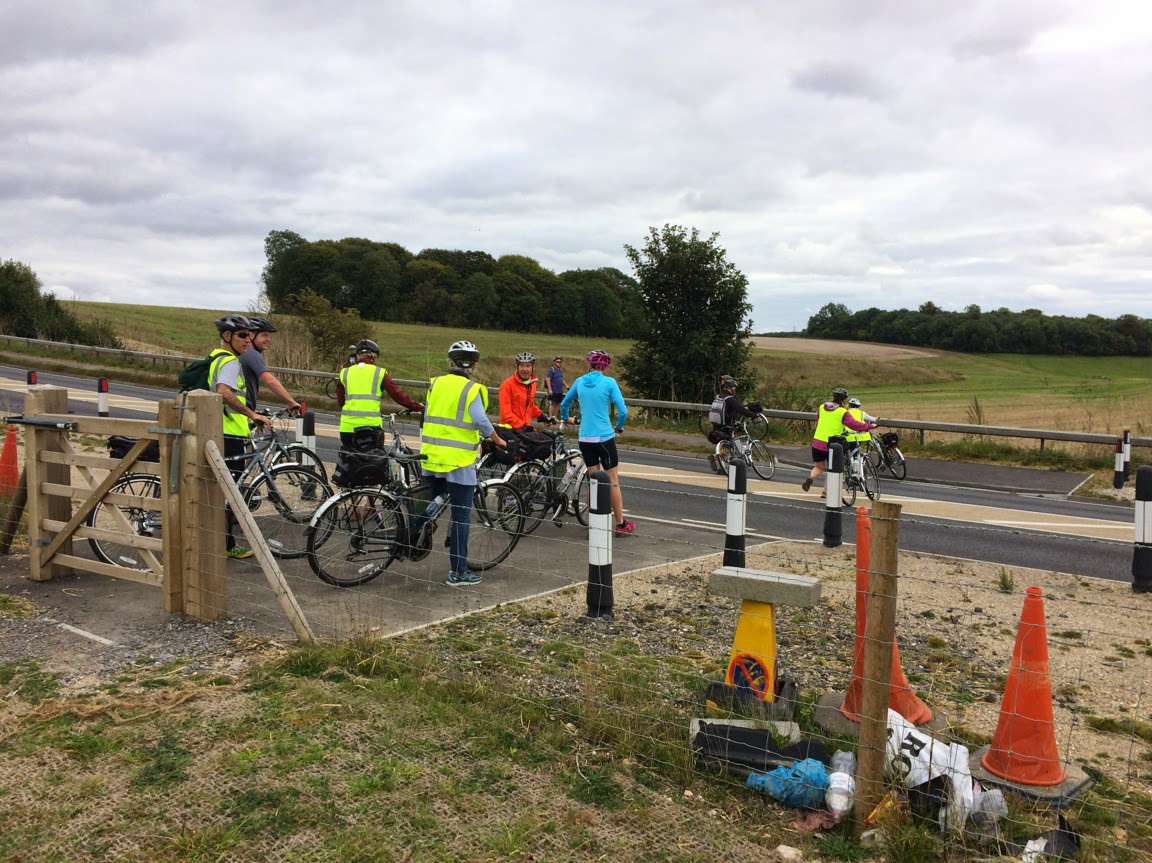
Today wasn't too bad and I was safely across in under a minute. I rode up to the A344 then onto the temporary permissive path between Byway 12 and Stonehenge Bottom. As I crested the ridge down to Stonehenge Bottom I was confronted by a veritable gaggle of cyclists heading down towards the A303.
They were a nice friendly bunch and I explained that I was part of STAG and what we were about and please could I take photos of them if they were trying to cross. They were happy for me to do so, so here is a short vignette of what happened next.
The thought of them all trying to cross made my blood run a bit cold as the traffic here is gravity-assisted in both directions and the westbound traffic is still trying to settle scores with other drivers from the 2 lanes into 1 section of the A303, a few hundred meters to the east.
A few cyclists at the front of the group spotted a small gap and either ran or rode across.
Most of them didn't get the opportunity and there was steady stream of fast-moving traffic in both directions on what is, at this point a Clearway, not that anyone gives a tuppeny-damn about the Highway Code these days!
They waited, and waited, and waited.
When a westbound gap appeared they moved forward, then back again as it disappeared.
One of them made it to the central strip and an eastbound driver in a grey car slowed and stopped. Remember, it is a Clearway - no stopping.
The cyclists, not quite sure what to do now, all started to move off the verge towards the centre of the A303, but did so very hesitantly. The westbound traffic was still thundering past them with mere inches to spare. It couldn't have been a very pleasant experience.
White van man from Black Hole Storage Removals clearly didn't give a damn and went roaring through and this carried on for a while until another grey car stopped on the westbound carriageway.
and finally, the whole group got across safely.
It could so easily have been very different. But why are things so dangerous?
Well, the people who control the World Heritage Site have a policy of making Stonehenge a more bike (and horse and pedestrian) friendly place. This seemed to be borne-out in the plans for the new visitor's centre submitted by English Heritage. However, despite their intentions and despite planning conditions that mandated a whole raft of measures that would have improved things for cyclists, English Heritage have singularly failed to deliver.
One of the few things that was largely outside the control of English Heritage was an improved crossing at Stonehenge Bottom. On the one hand, increased usage of the crossing point was anticipated by all parties after the closure of the A344, hence the planning requiremnt. However, a spoke was put in the works by the Highways Agency who produced a report - in the way Government Agencies do when they don't want to take action. The conclusion of this report reads as follows:
As a consequence of this, anyone attempting to cross the A303 at Byway 12, Byway 11 or Stonehenge Bottom has to regard themselves as a slice of ham about to be sandwiched between two pieces of steel-reinforced "bread" with a closing speed in excess of 120 mph. Get it wrong and it is going to hurt - briefly, bloodily and almost certainly, finally.
At Byway 12, you have to wait until you can't see vehicles in either direction to have enough time to stroll, not run, across the A303. Running isn't advised, as if you were to fall, you simply wouldn't have time to pick yourself up before the Grim Sandwich Maker appeared. On quiet days, you might have to wait a couple of minutes for a safe gap - there aren't many quiet days any more! On a bad day, you might have to wait 10-15 minutes or even longer to cross in reasonable safety, or simply give it up as a bad job and back track. Too many lose patience and take silly risks...
Today wasn't too bad and I was safely across in under a minute. I rode up to the A344 then onto the temporary permissive path between Byway 12 and Stonehenge Bottom. As I crested the ridge down to Stonehenge Bottom I was confronted by a veritable gaggle of cyclists heading down towards the A303.
The thought of them all trying to cross made my blood run a bit cold as the traffic here is gravity-assisted in both directions and the westbound traffic is still trying to settle scores with other drivers from the 2 lanes into 1 section of the A303, a few hundred meters to the east.
A few cyclists at the front of the group spotted a small gap and either ran or rode across.
Most of them didn't get the opportunity and there was steady stream of fast-moving traffic in both directions on what is, at this point a Clearway, not that anyone gives a tuppeny-damn about the Highway Code these days!
They waited, and waited, and waited.
When a westbound gap appeared they moved forward, then back again as it disappeared.
One of them made it to the central strip and an eastbound driver in a grey car slowed and stopped. Remember, it is a Clearway - no stopping.
The cyclists, not quite sure what to do now, all started to move off the verge towards the centre of the A303, but did so very hesitantly. The westbound traffic was still thundering past them with mere inches to spare. It couldn't have been a very pleasant experience.
White van man from Black Hole Storage Removals clearly didn't give a damn and went roaring through and this carried on for a while until another grey car stopped on the westbound carriageway.
and finally, the whole group got across safely.
It could so easily have been very different. But why are things so dangerous?
Well, the people who control the World Heritage Site have a policy of making Stonehenge a more bike (and horse and pedestrian) friendly place. This seemed to be borne-out in the plans for the new visitor's centre submitted by English Heritage. However, despite their intentions and despite planning conditions that mandated a whole raft of measures that would have improved things for cyclists, English Heritage have singularly failed to deliver.
One of the few things that was largely outside the control of English Heritage was an improved crossing at Stonehenge Bottom. On the one hand, increased usage of the crossing point was anticipated by all parties after the closure of the A344, hence the planning requiremnt. However, a spoke was put in the works by the Highways Agency who produced a report - in the way Government Agencies do when they don't want to take action. The conclusion of this report reads as follows:
"It is the designer’s view that the current usage of this crossing by pedestrians or by cyclists, on either the
A303 or the A344 routes, does not justify the increased risk to motorised users on the A303 of providing
refuge islands for this crossing. However it is felt that the opportunity to relocate the crossing to the best
location position for NMU visibility and to reduce the crossing width is justified and should be taken.
In taking this view, the designer is taking note of RSA team preference, based on pedestrian rather than cycle use of the crossing, of the do minimum crossing type. The designer is also influenced by the fact that this is far from being the only single carriageway rural at grade crossing of the A303 with no specific NMU facilities, including equestrian crossings.
The proximity of this crossing to the Stonehenge World Heritage site does not currently attract to it significant NMU usage. It is therefore felt that neither the existing usage of the crossing or the last five year’s accident records warrant a different approach here to that taken at other similar crossing locations where the balance of risks between NMU and Motorised Users, and hence the actual overall risk, dictates the level of provision made.
It is therefore recommended that the measures in Option 4 proposals, with the refuge islands removed but all the other measures retained is adopted.
A future scheme for reviewing the crossing arrangements needs to be submitted and approved. The scheme shall have regard to Design Manual for Roads and Bridges HD 19/03 Stage 4 Safety Audit 12 and 36 month post scheme recommendations for any remedial action.
It is felt that the extensive investigation already under taken into the examination of the safety of and the changes to the crossing here proposed satisfies the requirements of the planning condition."
Just for the record, NMUs are non-motorised units - pedestrians, cyclists and horse riders. Cutting out all the crap, what they are actually saying is that the body-count at Stonehenge Bottom is too low to warrant making anything more than superficial changes. However, they go on to suggest that a safety audit at 12 and 36 months might change things if the body count increases.
I don't suppose the contribution by Wiltshire Council helped much either:
Did you spot it? Yes, that's right. Most pedestrians, cyclists and horse riders arriving at Stonehenge don't pitch up at the visitor's centre, as there is (still) no provision for them. They may arrive from east or west, north or south, but we suspect that few, if any, will be invited to take part in the annual visitor survey, conducted for English Heritage by TNS.
In taking this view, the designer is taking note of RSA team preference, based on pedestrian rather than cycle use of the crossing, of the do minimum crossing type. The designer is also influenced by the fact that this is far from being the only single carriageway rural at grade crossing of the A303 with no specific NMU facilities, including equestrian crossings.
The proximity of this crossing to the Stonehenge World Heritage site does not currently attract to it significant NMU usage. It is therefore felt that neither the existing usage of the crossing or the last five year’s accident records warrant a different approach here to that taken at other similar crossing locations where the balance of risks between NMU and Motorised Users, and hence the actual overall risk, dictates the level of provision made.
It is therefore recommended that the measures in Option 4 proposals, with the refuge islands removed but all the other measures retained is adopted.
A future scheme for reviewing the crossing arrangements needs to be submitted and approved. The scheme shall have regard to Design Manual for Roads and Bridges HD 19/03 Stage 4 Safety Audit 12 and 36 month post scheme recommendations for any remedial action.
It is felt that the extensive investigation already under taken into the examination of the safety of and the changes to the crossing here proposed satisfies the requirements of the planning condition."
Just for the record, NMUs are non-motorised units - pedestrians, cyclists and horse riders. Cutting out all the crap, what they are actually saying is that the body-count at Stonehenge Bottom is too low to warrant making anything more than superficial changes. However, they go on to suggest that a safety audit at 12 and 36 months might change things if the body count increases.
I don't suppose the contribution by Wiltshire Council helped much either:
"...that in relation to cycle usage their
preferred route between the A344 to the north and Amesbury for cyclists was via the countess roundabout
underpass crossing of the A303 and than via Lark Hill." (all the typos and grammatical errors are courtesy of the Highways Agency!)
As usual with Wiltshire Council when it comes to anything in the south of the county - thumbs up bums and brains in neutral all the way. No-one in their right minds, who knew about the local area, would ever choose to get from the centre of Amesbury to Stonehenge by heading north, through the scrofulous Countess Roundabout underpass (on foot - as cycling is forbidden on this bit of the cycle route), up Countess Road, being harassed by rat-running motorists, then head west to Larkhill along the rat-run of choice for coaches and HGVs, before eventually getting to the northern end of Byway 12.
Most sensible folk will simply head out to West Amesbury, up to the A303 and then to Stonehenge Bottom and the A344 - no need to ride with high speed traffic at all - just dice with death crossing the A303. That's what they've always done, that's what they were doing today and that's what they will do until the A303 issue is resolved once and for all.
Of course, there was a fall-back plan to monitor the situation. Here it is. Read it carefully and spot the flaw:
STONEHENGE ENVIRONMENTAL IMPROVEMENTS PROJECT
Planning Application Reference S/2009/1527
Scheme required under planning condition 27 for reviewing pedestrian and cycle route access arrangements along the whole of the A344, and crossing arrangements at the A303 (Stonehenge Bottom)
Following approval of the details of the pedestrian and cycle route access arrangements along the whole of the A344 and crossing arrangements at the A303 (Stonehenge Bottom), English Heritage will co-operate with the Local Highways Authority, Highways Agency and the Local Planning Authority in reviewing the arrangements. In particular, should a formal Stage 4 Safety Audit be carried out, and any recommendations for remedial action be made in the 12 and 36 month Stage 4 Reports submitted to English Heritage and the other organisations, then any required remedial works, and arrangements for their implementation and funding, will be considered and agreed between English Heritage, the Local Highways Authority, the Local Planning Authority and the Highways Agency, as appropriate.
In addition, English Heritage will carry out the following:
-
- Incorporate questions about the pedestrian and cycle access into the annual
visitor survey conducted by the travel and tourism department of market
research company TNS. This will comprise face to face interviews with 180
individuals during the months of July, August and September. Likely questions
include: whether people have accessed the site on foot or on bicycle, and, if so,
where they have travelled from, how satisfactory they have found the route and
where they are travelling onto.
-
- As part of the ongoing operational management of the site English Heritage staff
will, as a matter of course, record, report to the relevant authorities and, if
appropriate, take any necessary action in respect of any incidents or accidents
along the route of the A344 between Airman's Corner and Stonehenge Bottom.
English Heritage 26th April 2012
During my many visits to the WHS this July August and September I've never seen anyone with a clipboard interviewing pedestrians, cyclists and the two riders I have seen, nor have I ever been approached. Now that's interesting, if true because this safety audit is meant to be looking at the safety of crossing the A303 by any and all users, not just English Heritage's paying customers.
As I say, we don't know for certain that this is the case, but I feel an FOIA request ,or two, coming on!
Friday, 25 July 2014
Four Thousand Holes in Blackburn Lancashire, Four Hundred Cameras Around Shrewton, Wiltshire
I do have to apologise to the memory of the late and great John Lennon for abusing the lyrics of "A Day in the Life" but I simply couldn't resist drawing the analogy.
Yesterday, the Salisbury Journal published a very interesting article on the A303 entitled simply: "A303 traffic survey to be carried out"
Basically, the story explains that Atkins, the traffic management consultancy will be placing number plate recognition cameras along the A303 and on surrounding roads as part of a scheme to track vehicle movements on the traffic-choked highway.The Journal article claims that there will be hundreds of these cameras on the surrounding roads, but we suspect that this might be something of an exaggeration and that perhaps 10-20 NPR cameras might be closer to the mark.
Winterbourne Stoke resident, Chairman of the parish council and Wiltshire councillor Ian West observed: "Residents of Shrewton believe the speed and volume of traffic in Shrewton has been made worse by the closure of the A344.
One of the main concerns expressed by local residents is the speed and volume of traffic, it is quoted as one of the main safety factors which people see as a barrier to travelling around their communities on foot or by bicycle or to letting children travel independently. This has very much affected the quality of life in Shrewton.
We very much look forward to the results of the Atkins survey because the increase in traffic is becoming unbearable in Shrewton and the surrounding villages both sides of the A303.”
Of course, it isn't just Shrewton or indeed the residents here in Winterbourne Stoke who are suffering as a result of the A344 closure. We (WiSBAng) and the Stonhenge Traffic Action Group (STAG), regularly hear of problems being caused as far afield as Berwick St James, Larkhill, Durrington, Bulford and Amesbury.
Although we wholeheartedly welcome this new initiative and data-gathering exercise, we feel duty-bound to point out something that some might think verges on negligence on the part of Wiltshire Council. Over the last two decades and more, every bit of traffic modelling undertaken on the A303 corridor, some of it commissioned by Wiltshire Council, predicted that there would be traffic chaos in the surrounding villages if the A344 were to be closed BEFORE the A303 was upgraded. For years, Wiltshire Council resisted the closure of the A344 on those grounds, then in 2010/2011 they did an about face and sided with English Heritage in pushing for the closure.
Surprise, surprise. The A344 was closed and all the traffic models were proved correct.
Now any competent authority would have undertaken a survey such as that being carried out by Atkins between Monday, August 4th and Sunday, August 10th prior to closing the A344, then do the same again after the closure to ensure the changes had had no adverse effects and to be able to quantify the changes with hard data. That would have been far too sensible and of course it might have run the risk of exposing, in irrefutable terms, that a mistake had been made in closing the A344 prematurely. That would never do, would it?
As it is, when Atkins report their findings we will know how bad the situation on all these local roads is, but in the absence of knowing what they were like in quantitative terms before the A344 closure, it is impossible to say how much worse they have become. We can make some estimates based on earlier surveys, but on fewer roads, using somewhat different methodologies; that's far from ideal.
Labels:
A303,
A344,
Amesbury,
Atkins,
Bulford,
Durrington,
Highways Agency,
Larkhill,
Salisbury Journal,
Shrewton,
Shrewton Traffic Action Group,
Wiltshire Council,
Winterbourne Stoke,
WiSBAng
Saturday, 21 June 2014
Has the Highway Agency Lied To The Public on Twitter?
Back in May, we raised a Freedom of Information Act (FOIA) request with the Highways Agency on the "What Do They Know" website. As we've said before, we think this is the best way of raising FOIA requests as it usually acts as a spur to keeping the recipients honest and they usually take a bit more care in answering, as mistakes are in the public domain and they risk being humiliated by a public correction, or having downright lies exposed. This doesn't seem to work in the case of the Highways Agency.
We asked them to list the times and dates of apparent failures of the traffic camera on the A303 at Solstice Park, Amesbury, as it seemed that the camera was frequently out of service when the traffic levels on the A303 were greatest. Rather than raise this as an unfounded suspicion, we wanted to have factual information (as it turned out, our suspicions about camera failure were unfounded, but we haven't yet established if the camera is ever deliberately turned off!).
Imagine our surprise when we received the following response:
...I refer to your request under the above legislation for information about failure of traffic cameras on the A303.
I can confirm that we do not hold the information. We believe that, as this is a safety camera operated by Wiltshire Police, the information you require may be held by Wiltshire Police. If you have not already done so, you may wish to contact them...
Now, we knew that this was complete cock-and-bull, but we played the game and re-sent the FOIA request to Wiltshire Police, who responded as we expected, pointing out that the police unit responsible for static cameras closed in 2010. So, back to the Highways Agency we went and asked for an internal review of their original answer.
This time, we got the following response and somewhat half-hearted apology:
"...I am writing to confirm that I have now completed an internal review of our original response to you, which you requested on 30th May.
It appears that we were mistaken in our first response to you and that the Highways Agency has responsibility for the camera in question. Please accept my sincere apologies for the misinformation and any subsequent inconvenience this has caused..."
This isn't the first time that they have answered our FOIA's incorrectly - the level of incompetence for a Government Agency is simply astounding.
Over the last few days, in the run-up to Summer Solstice 2014, we at STAG have been monitoring traffic levels on the A303 and one of the strands of this is to monitor, when possible, the Solstice Park camera.
From midweek, the camera has been out of service and it was definitely out of service last night, showing the typical failure notice:
Imagine our surprise, when we awoke very early on Solstice morning, to see the following Twitter-feed from the Highways Agency:
Poetic, wonderful, atmospheric, the Amesbury webcam was clearly fixed in time for the Solstice dawn. We are sure the English Heretics would have been delighted by the plug.
Well, actually, no. The camera was still unavailable the second the tweet was published. So, are the Highways Agency lying through their teeth about watching the sunrise through the Amesbury webcam, or, are they are lying through their teeth about the camera being available and deliberately suppressing the feed?
Superficially, and in the greater scheme of things, if the Highways Agency are lying, this might seem a fairly trivial untruth. However, it is information, being put in the public domain on behalf of the Government. In effect, if true, it's the Government misleading the people. If they can't be trusted over something as trivial as a webcam feed, how can they be trusted when it comes to something more important regarding the A303 - the current feasibility study for improving it for instance?
Let's just say we are unhappy, a wee bit vexed.
Agencies like the Highways Agency should be answerable to the people and we hope that our MP, John Glen, will seek answers from the Highways Agency on our behalf.
Thursday, 12 June 2014
Stoned Again - Will Summer Solstice 2014 Cause Additional Chaos on the A303
Yesterday, English Heritage, Wiltshire Police and a host of local stakeholders got together in the Antrobus Hotel in Amesbury to hear the plans for traffic management over the summer solstice period.
For the first time since 2008, the summer Solstice falls on Saturday morning, which means that the crowds might be bigger than in years when the solstice falls during the working week. Last year, about 20,000 folks turned up to watch the sun rise. Back in June 2008, 30,000 people turned up to wait through a cold, wet and misty night for a dawn that proved equally cold, wet and misty. It's a bit early for a weather forecast for the solstice weekend and the Met Office have cocked up the weekend forecasts for this part of the world for the last two weekends running, so I guess the forecast is uncertain. We might expect a bigger crowd than we saw in 2008, simply on the basis that: "Summer 2014 has got to start at some point" and the Solstice weekend is as good a time as any.
The big difference this year is that it is the time the A344 has been closed for the summer Solstice, so the traffic problems that this might cause in the local area are a bit of an unknown, though we can speculate that it isn't going to be pretty. The biggest question of all for us here at WiSBAng is whether it will cause more problems for the A303, where the weekend traffic situation is already nightmarish, and in the surrounding villages where rat-runners are making life even more unpleasant.
The English Heritage and Wiltshire Police traffic management plan for the solstice period is shown on the map below - please click on it to enlarge.
Basically, EH plan to close access to Stonehenge itself at 14:30 on Friday 20th June and then the new Visitor's centre, arrowed in green on the map, will be closed from 15:00. The two Byways (Byway 11 and 12) that are close to the stones have been closed under a temporary Traffic Regulation Order to a point about 500 metres south of the A303.
Apart from a few of the byways, bridleways and footpaths on the MoD ranges which are closed for a live-firing exercise (look out for the red flags), ALL other byways, bridleways, footpaths and roads in the vicinity are open. That is a little contrary to to English Heritage's Summer Solstice 2014 Conditions of Entry and Information document which claims at the top of page 6 that the A344 is closed. That is untrue, the route is still open for walkers, cyclists, horse riders, carriage drivers and invalid carriages, but English Heritage would prefer people not to walk along the route of what once was the A344, as they have provided an off-road route to the stones just for the Solstice.
We expect that motor vehicles stopping and waiting on the A303, the A360 between Longbarrow Roundabout and Airman's Cross and on towards Shrewton will be prevented by the usual coning-off of all likely stopping places. So anyone wanting to stop in the area is going to have to move further afield.
People arriving at Stonehenge Visitor's Centre, after it closes and before the Solstice car parks are opened at 19:00 on Friday 20th of June, are going to be asked to wait on the B3086 that runs north from the new Visitor's Centre towards the Bustard Crossroads. So there is the potential here for a bit of chaos, as this section of road is a favourite part of the Friday evening rat-run when the A303 is jammed. Hopefully, no-one wanting to attend the solstice will turn up until after 19:00. If lots turn up early, then there is a potential for gridlock. At the very least, it's likely to see more traffic heading for Shrewton on the London Road (B3086), though where they might go from there is anyone's guess. They may strike out west on the B390, hoping to rejoin the A303 from the A36, or they could head south on the B3083, here to Winterbourne Stoke. Some, wanting to see Stonehenge, may head back east on the A360 towards Airman's Corner, adding to the confused, bemused and possibly bloody-minded, heading for the Solstice; let alone the locals just heading home for the weekend.
This is all going to happen during the Friday commute home and coinciding with the weekend peak traffic flow on the A303 (16:00 - 21:00). English Heritage are trying to persuade everyone wanting to attend the Solstice to go to Salisbury and take public transport up to the World Heritage site; it might persuade some, but again it's an unknown quantity. Roadside signs, from the M3 westwards, will warn people to stay away from Stonehenge if it gets too crowded. At 19:00, the two new Solstice carparks (marked in blue on the map) will be opened and then people will start to flood in, which has the potential to cause further chaos on all routes in to Airman's Cross as people rush for a parking space. We are told that these two car-parks have a similar capacity to the old Solstice car-park.
So, we have a fair degree of uncertainty about how things will unfold. On the one hand, it may be freezing cold and lashing down with rain. People travelling to the West Country may choose to avoid the Stonehenge area entirely, reducing the back-ground traffic flow on the A303. Solstice-goers may largely choose to take a bus to Stonehenge. Those few that decide to arrive under their own steam may choose to arrive after the evening peak traffic flow and those that arrive early may follow the advice to wait on the B3086. With luck, no one leaves the A303 in a desperate attempt to avoid traffic jams, as it is flowing freely. No-one stops to take a snap of the henge as they pass and no-one crashes their cars having been distracted by the herds of flying pigs, performing synchronised acrobatics overhead at the very thought of such a possibility.
Ah, bliss!
On the other hand, Friday 20th June 2014 may turn out to be a balmy night to be followed by a glorious sunny weekend. Tourist's flood to the West County in their usual droves and follow, lemming-like, their normal routes. Solstice-goers turn up as usual, on foot or in the usual mix of barely legal motor-vehicles and ignore/miss the exhortations on social media and in the Press to use public transport. The B3086 is soon blocked, so this leads to problems in both directions on the A360, which eventually spill out onto the Longbarrow Roundabout. Aging vehicles heading for Stonehenge overheat, blocking the westbound A303 near Stonehenge Bottom and the eastbound traffic just east of Winterbourne Stoke. Westbound, Eastbound and Northbound traffic on the A303 and A360 will converge and collide, probably literally, around the Longbarrow Roundabout as a result of impatience and short-tempers. Longbarrow Roundabout grinds to a standstill by mid afternoon and remains grid-locked for hours, and hours. The last of the broken down and crash-damaged vehicles can't be removed until sometime on Saturday - after the peak of the great slog home has passed. All those who are stuck on the A303 decide to cut their losses and visit Stonehenge as they aren't going anywhere else; the A303 becomes a large carpark.
Of course, it could get even worse. God forbid there is a serious accident on any of the surrounding roads, but it is a Friday, and they are such a regular occurrence...
...then we have the possibility that some of the visitor's decide to make a weekend of it, or an impromptu rave or free-festival kicks off.
The reality is likely to be somewhere between these two extremes, but it would be a brave person who is prepared to put hard cash on the outcome. We will, of course, see what happens in a few days time.
Sunday, 11 May 2014
Road Conditions on the A303 - Some Useful Websites and Apps
We are often asked about what resources are available to help travellers and locals to avoid the worst of the jams on the A303, so we thought we would try and group a few of them together in a single post.
We probably haven't spotted all of them, so you might want to bookmark this particular post as we intend to update it if we find anything else particularly useful.
The two iPhone apps we use most are provided by the AA and the RAC - they are intended for members of each organisation and amongst other things, give live traffic reports. The AA app looks like this:
and the RAC app is very similar.
They don't always show the same problem at the same time, so it's worth having both of them if you are a regular traveller.
The Highways Agency also have their Traffic Map (beta) on the Traffic England website.
It can be a bit slow, but does provide a wealth of information that can be customised to meet your own particular needs. It provides direct links to the traffic cameras that sit alongside the A303 and many other major roads. For us, checking the camera at Solstice Park, Amesbury, is a quick way to check on westbound traffic jams.
The downside is that this camera, useful as it is, has an unfortunate tendency to "fail" when the traffic is particularly heavy. We're sure the Highways Agency would claim that this is pure co-incidence, but it happens way too often for that. It also happens to other A303 cameras when the traffic is bad.
The biggest issue with the cameras on the A303 is that there are so few of them compared to other strategic routes. The nearest one to the west of Stonehenge is several miles away at Mere. There has to be a huge tailback of eastbound traffic for this camera to show anything helpful. One of the most useful sites we have found, and only found recently is Frixo.
They provide some useful daily statistics that give an indication of the average traffic speed along the whole of the A303 and the spot speed at several different locations.
For detailed westbound information look here, and for eastbound information look here. I've included a live feed from Frixo at the very bottom of this page.
If you know of any other resources like these, please let us know!
Saturday, 26 April 2014
Byway 12 - Can Ed Vaizey and English Heritage Be Trusted?
On Wednesday last week Culture Minister Ed Vaizey visited the Stonehenge World Heritage Site to learn more about its traffic problems. According to the Salisbury Journal, the purpose of the meeting was to discuss the closure of Byway 12, or at least the section of it between the A303 and the old A344.
This gives us here at WiSBAng a bit of a headache, as since the closure of the A344, it seems more people have been taking vehicles onto Byway 12 and parking up for a picnic and a quick gawk at Stonehenge. All perfectly above board and legal and, indeed, stopping on a byway for an hour or so for a picnic is a nice thing to do. Although we can't prove Byway 12 existed before Stonehenge, it doesn't take a rocket scientist to realise the some tracks in and around the site of Stonehenge had to pre-date the stones and Byway 12 would be a pretty good contender. Consequently, tracks like Byway 12 are part and parcel of the World Heritage Site landscape and deserve the same level of permanent protection as any other part of that site. Moreover, they are the only feature of that landscape that can be used for their original purpose - transport!
The problem has been that to pull off the A303 onto Byway 12, the traffic has to slow down and that causes a soliton to develop in addition to a second one a few hundred yards east adjacent to the henge and a third soliton just east of Stonehenge Bottom. All of these solitons, contribute to the traffic jams that develop on the A303 near Stonehenge; even in the absence of large volumes of traffic. So, on the one hand, it would make sense to stop traffic turning off the A303 as it would remove one of the three solitons.
What has happened so far has been ill-conceived, disingenuous, and not particularly successful - trying to stop right turns into and out of Byway 12 - using the specious argument of safety. Just how specious the argument is can be demonstrated by a moments thought - how many other right turns are there - roads, tracks, field gates, byways, driveways and roads between Stonehenge Bottom and the start of the next section of dual carriageway west of Winterbourne Stoke?
The answer, if you care to count, might well surprise you. There are dozens and many have narrower entries and exits than Byway 12, with greater levels of vehicular usage. No one is suggesting closing these.
If logic doesn't appeal to you, then look at the Wiltshire Police accident figures for the A303 over the last 5 years.
Yes, that's right, although there have been two accidents close to Byway 12, that was no worse than at the old A344/A303 junction at Stonehenge Bottom. You would be better able to justify banning right turns onto and off the B3083, or even the A360 on safety grounds, than you can for Byway 12 as the accident rates adjacent to both these roads are significantly worse than at Byway 12.
So the argument that has been used to justify banning right turns, by the Highways Agency and Wiltshire Council just doesn't hold water and, rightly, reflects badly on the competence of both organisations and anyone else who supported these measures for the reasons stated. Just because it might have achieved the desired effect doesn't make it good use of the law.
That said, temporary closure of Byway 12 to vehicular traffic, for an honest reason - that it slows the traffic and causes jams - might be justifiable. But, there is a problems, a historic problem, a big problems. English Heritage.
English Heritage have lobbied hard in the past for the complete and permanent closure of Byway 12, and, whatever their stated reasons for doing so it is clear that it would give them pretty close to total control of access to the World Heritage site, by vehicles, cycles, horse riders and pedestrians. We think it is pretty safe to say that they are unlikely to have changed their views. So any request by English Heritage for closure of Byway 12 by English Heritage should call in to question their true motivation. It should be questioned even more closely given the restricted group who met with Ed Vaizey last week.
Back in November, when we met with other stakeholders to discuss measures to prevent traffic chaos on the A303 this summer, we raised our concerns about English Heritage's motives when the suggestion of closing the TRO was made. We also gave English Heritage a means by which they could demonstrate the integrity of their position and honesty of their motives for seeking closure of Byway 12 for vehicular traffic. We will repeat that here.
We at WiSBAng would reluctantly support the temporary closure of Byway 12 to vehicular traffic (not to cyclists, horse riders and pedestrians) until the A303 is improved; simply as an expedient means of improving traffic flow. We will do so ONLY if there is a legal undertaking, by Ed Vaizey, English Heritage and the WHS, to NOT pursue the permanent closure of Byway 12. We would expect that vehicular traffic is again given access to Byway 12, once improvements are made to the A303, or immediately should a decision be taken to NOT improve the A303.
We would suggest that if the parties above are not prepared to give such an undertaking, then even temporary closure of the A303 WILL be actively resisted.
Saturday, 5 April 2014
A Treatise on Not Cutting the Mustard?
Some of the questions that have been puzzling us for a while now are:
How do you go about establishing the cost:benefit of upgrading the A303 to dual carriageway?
How do you determine if the cost is affordable?
What do we actually mean by "cost" and "affordability"?
These are more than just semantic questions because, to a large extent, they should underpin the entire A303 feasibility study now underway.
We would argue that while both "cost" and "affordability" clearly have major financial components, there are many other non-financial issues that need to be taken into consideration when determining the feasibility of any solution to the A303's problems. This is a topic we will be re-examining from time to time over the coming months, but this week, we've had the opportunity to look at a couple of the issues - financial cost and national infrastructure resilience, in a slightly different way. Why? Well, Network Rail were able to reopen the main Exeter to Penzance railway line, through Dawlish, to South Devon and Cornwall after the damage wreaked by the February storms.
The line was closed for 8 weeks and the repairs are said to have costed £35 million - but what does that really mean.
Shortly after the first storm ripped the coastal track apart, two other events happened that impacted on travel to Devon and Cornwall from the rest of the UK. First there was flooding and a crash on the A303. Because of flooding on many of the roads to the north and south of the A303, there were no alternative diversions. The only option for westbound travellers was to backtrack to Wiltshire and head north for the M4.
Then the unthinkable happened - a crash on the westbound M4 closed that as well. We spoke to some fairly senior Highways Agency chaps a couple of weeks ago, who volunteered that the agencies involved in clearing this accident from the carriageway had been put under an immense amount of pressure to do so - and to do it damn quickly. Mother Nature and Murphy's Law had combined to make the point that the national transport infrastucture to the west of England was not exactly resilient. For a couple of hours there was no usable, direct east-west route across the south of England. OK, it was only for a couple of hours, but even that ought to make people sit up and think seriously about transport resilience. Every time the A303 is at a standstill, one third of the strategic routes to the West Country are not operational. The same is true for the rail route and the M4/M5.
So what financial value do these routes have? Is it possible to make a stab at the financial impact the rail closure has had? Well yes, it is and folks in Devon and Cornwall have been doing just that. Visit Devon reckons that the tourist industry in Devon has lost around £31 million over the eight weeks closure. Visit Cornwall reckons the loss to the Cornish tourist industry has been around £18 million.
The financial loss jusst to the city of Plymouth has been estimated at £1 million pounds a day - another £50 million. Plymouth has a population of over quarter of a million. As the population of Devon runs to over a million souls and Cornwall another half a million, then the pro-rata costs of losing the Exeter to Penzance line for 8 weeks has probably been in excess of £400 million, or £50 million a week. So the financial value of 1/3 of the strategic routes into the West of England is £50 million per week - just for Devon and Cornwall.
If each of the three routes is equally valuable, then the same thinking could be applied to the A303 - which also passes through Wiltshire and Somerset and the problems on it affect both those counties too. Lets be conservative though and halve the financial impact of the A303 on the residents of Somerset and Wiltshire, as we have more alternative north/south routes. That would increase the "value" of the A303 to the economy of the West of England to £70 million per week: £10 million per day.
So, as most traffic uses the A303 during the hours of daylight, the working day, that's roughly £1 million per hour. Next time you get delayed or stuck on the A303 for an hour or two, just think of what that delay is costing the economy - and then add in your own and your fellow travellers costs - and a sum to compensate for the inconvenience, the added pollution, the stress, and the list goes on.
Now, let's be honest here. We've taken figures snatched out of the air by others with no idea of their reliability, mixed them up with some fairly accurate demographics and then made a sweeping assumption about relative values of road and rail routes - at best a SWAG ( a scientific, wild-arsed guess). But if decisions are going to be made about the future of the A303 on "cost" grounds, then these are the very types of numbers that we should expect Government to be able to present - but in their case, with a full audit trail.
Anything less won't cut the mustard.
Tuesday, 25 March 2014
On Trying To Make A Silk Purse From A Pig's Ear
It has been apparent, since the closure of the A344 last summer and the opening of English Heritage's new Stonehenge Visitor's Centre back in December 2013, that the summer of 2014 stood a great chance of becoming an annus horribilis; as far as the A303 is concerned. All in all, it's a bit of a pig's ear.
There are several factors that either together, or singly, could prove a nightmare:
1) Closure of the A344 has caused additional westbound traffic on the A303 to pass Stonehenge before having the opportunity to leave the A303 to go and see the stones. Whereas lots of people once stopped on the A344, or in the old Stonehenge carpark for a few minutes for a quick look at the stones before they continued their journey, they now don't have that opportunity. So now they slow down on the A303 as they pass Stonehenge to take a quick photo. All too often it is the driver doing this - dumb people on smart phones. Just take a look on Twitter to see the number of folks who do it.
Here is one taken on March 21st - though we've no idea if this one was taken by a driver or a passenger.
2) The design of Countess Roundabout at Amesbury is still a problem, as east-west traffic still stops on it at peak periods - blocking north-south movement.
3) Frustrated by the A344 closure and egged-on by insistent satnavs, some drivers have taken to turning off the A303, just west of Stonehenge Bottom, on to Byway 12. Signage has been used to discourage right turns, but blow-me-down, some 'enterprising' drivers (including local taxi drivers) have taken to turning left off the A303 and either turning round and crossing the A303, or even reversing across the A303 to comply with the turning restrictions.
4) The Highway Agency A303 diversionary sign on the westbound A303, just before Longbarrow roundabout, has already caused chaos on at least three occasions since Christmas, when the A303 was closed due to flood or accident. The signs take westbound travellers off the A303, onto the A360, towards the Stonehenge Visitor's centre - and there the "follow the black triangle" route vanishes. STAG have rescued a number of lost travellers on the infinite loop between Longbarrow and Airman's Cross in recent months.
5) The design of the new Longbarrow Roundabout is still contributing to westbound and eastbound tailbacks. Too many approach lanes and badly thought out approach and exit corridors. The Highway Agency is already on design 3 and it's still a mess.
6) When too many folks turn up at Stonehenge, traffic backs up onto the A360, blocking it in both directions. This effect could be exacerbated by the new Stonehenge booking system. If jams do occur, then people may miss their booked slots, face not being admitted, and adding to congestion on the A303 before sitting outside Stonehenge on the A360 - eager to vent their spleens in the direction of English Heritage.
7) People are people. Even though English Heritage have introduced a booking system, people are still going to turn up on spec - the English Heritage website even points this out as a possibility for those who haven't booked - so turn up they will. Not to mention the 30,000 locals who are entitled to free entrance and who certainly won't book. What will they all do and where will they go when they find they can't get on to the Stonehenge site? They'll roam the local roads to find anywhere they can dump their cars and walk - creating additional congestion and chaos. A lot of these opportunistic sites are closer to the stones than the Visitor's Centre - and they are free.
8) To avoid the jams on the A303, travellers are trying any and all alternative routes past Stonehenge, placing additional pressures on small country roads and villages never intended for such levels of use. If it continues, the chances are some poor innocent is going to be killed or injured as a result.
9) When we don't have the jams and congestion, we have speeding through the local villages - particularly Shrewton on the A360 and Winterbourne Stoke on the A303.
10) We didn't even mention the additional traffic the new distribution centre at Solstice Park and the Army re-basing exercise are going to throw into the equation - but it isn't going to make life any easier.
We all know the long-term answer - dual the A303 and somehow get it past Stonehenge. All well and good, but it isn't going to happen soon. We need to do something before the summer.
Recognising this, Inspector Christian Lange of Wiltshire Police called a meeting last night to bring together all the stakeholders: English Heritage, the Highways Agency, Wiltshire Council, local Parish Council's, the National Trust, English Nature, STAG and others (apologies to any we haven't mentioned) to try and identify any measures that might alleviate the situation.
A brave idea, given the depth of feeling and one that could have easily been rail-roaded, but Christian chaired a good meeting. At the end of the day though, it is trying to make something of a silk purse out of a pig's ear.
Once we had got beyond the "English Heritage created this mess and it's up to them to sort it out" mentality, we did get a few good ideas and some less good ones. Broadly they were:
Try signage from the A303 exit of the M3, through to Longbarrow, to warn when there are no parking slots at Stonehenge - but these would need to be reactive enough to allow for sudden changes in parking availability at Stonehenge.
Try and sort out the A360 issues as close to the Stonehenge as possible - with English Heritage looking into planning permission for additional overspill car-parking spaces, or renting adjacent fields. The Highways Agency were keen to not move the problem onto the roads, but to deal with it as close to the source - the Stonehenge Visitore's Centre - as possible.
There was a suggestion of using a TRO to close Byway 12. This could be done for up to 18 months. This is one we are dead against without a legal undertaking, by English Heritage and the WHS, to NOT pursue the permanent closure of Byway 12. We also proposed other measures to prevent most vehicular traffic from using the route. A compromise should be possible, but closure by diktat is a recipe for grief.
There was an idea to intentionally route westbound Stonehege traffic towards Durrington at Countess Roundabout and then through Larkhill along the Packway t- o approach Stonehenge from the Bustard junction. As you might imagine, this wasn't at all popular with local councillors. However, it does make you wonder if enough thought is being given to using Woodhenge and Durrington Walls as diversionary holding areas? As it is only intended as an interim measure, could there be compromise here as well?
There has been a suggestion that English Heritage puts up some sort earth bund or sight screen to prevent Stonehenge being seen from the A303 - which might keep the traffic on the A303 flowing a little better. English Heritage have rejected this idea as it conflicts with the World Heritage Site Management Plan to return the area to open downland. Of course, we aren't talking a permanent solution here, just interim measures to solve a short-term (hopefully) problem. Again, some lateral thinking is needed here. If EH aren't prepared to shield the road from Stonehenge, then the Highways Agency should erect sight screens on their side of the fence outside the World Heritage site to shield Stonehenge from the road - giving WHS a legally enforceable assurance that these would be removed, once the A303 issue is resolved. Another opportunity for compromise?
UPDATE 1: We've been advised that as the World Heritage Site encompasses both sides of the fence, unilateral action by the Highways Agency is out of the question.
UPDATE 2: Life, of course, is never simple. Ownership of the land that would need to be screened from the A303 is mainly English Heritage/DCMS. The National Trust would be involved if screening was needed east of Stonehenge Bottom. However, ownership of the A303 -and what constitutes the road, would seem to be the the real issue here. So whilst EH/DCMS own the subsoil under the northern side of the A303 and probably the air above it, the Highways Agency effectively owns the road bed and "the top two spits" down. That's enough to keep the road bed repaired, install drainage under it and signage and safety features (eg. Armco barriers) alongside it. What we are proposing here is another safety feature.
Regardless of the rights and wrongs, we still feel that EH and WHS should be encouraged to compromise on this temporary issue. They could still make an offer to do this before the Area Board meeting on 27th March.
We also looked at solutions for the other problem of slowing the traffic on the A303 - particularly through Winterbourne Stoke. Wiltshire Council and the Police have an initiative for local A roads, but it is the Highways Agency that will need to engage with us and the Police to sort it out on the A303. The Highways Agency insist the A303 at this point is in an "urban setting"' As such, there should be a 20mph max as it passes by the requisite number of dwellings to meet government guidelines for this. Another compromise perhaps - lower the speed limit to 30mph and introduce some traffic calming measures instead?
OK, if we are honest, none of these measures will solve the problem entirely on their own and even if they are all implemented, they are, at best, only going to ease things - and we have no idea by how much. We also need to be realistic about what measures Wiltshire Police has the legal basis, manpower, or even inclination to enforce. But if we don't at least try, at best the local villagers are going to have a horrendous summer. At worst, the road casualty figures may increase.
It's going to take some rapid action, an awful lot of co-operation and, inevitably, compromise by all parties including English Heritage and the World Heritage Site. That's short term compromise to solve immediate issues and compromises that might help provide a longer term solution to the long-term A303 problems and World Heritage Site aspirations.
The next few weeks are going to be very instructive indeed, particularly in view of the A303 feasibility study. If that compromise can be achieved, then Inspector Lange will have achieved a minor miracle. We wish him well.
Subscribe to:
Posts (Atom)