Showing posts with label STAG. Show all posts

Thursday, 6 August 2015

Meeting the Minister - A Positive Step Forward

On Monday 3rd August 2015, Stonehenge Traffic Action Group, together with a raft of other stakeholders, were invited to attend a round-table briefing in Amesbury with Andrew Jones MP on the state of play regarding the A303/A30/A358 corridor upgrade plan.


Andrew, in addition to being the MP for Harrogate and Knaresborough, is a Parliamentary Under Secretary of State in the Department for Transport with the dubious honour of having the brief to deliver the road investment strategy.  He can't help being a Yorkshireman and from the "wrong" side of the Pennines.

The meeting didn't begin to auspiciously.  Before the Minister arrived, I was accosted by a member of Amesbury Council, who pompously announced that this meeting was very much focusing on Amesbury and the Amesbury end of any road improvements.  As I say, he was a member - of the council.

Thankfully, this wasn't the case, with the Minister making quite clear that he was discussing the entirety of the Countess Roundabout to Berwick Down section of the A303 scheme. 

The meeting demonstrated that most parties understand the vital need to improve the A303, that it is part of the larger corridor plan and to fail to deliver the Stonehenge section would mean the whole strategic plan would fail.  Failure, this time, seems not to be an option - but we've heard similar assurances in the past.

A consensus is building that something has to be done, which in a way is a major step forward.  Stakeholders, STAG included, are holding bilateral meetings with each other to ensure that there are no surprises and issues are dealt with early.  

What were the key points emerging from the meeting?  Well, although there has been much talk of tunnels, nothing is yet set in stone.  Highways England are looking at all the options previously considered, eliminating those that have little chance of success and focusing in on the best option.  They will submit this and all the other information as part of the Development Consent Order process, which replaces a Public Inquiry.  The re will be an examination of the facts and figures in public, but their is no adversarial element to the DCO process.  This process has already begun and should take 5 years to complete.  It clearly involves a heck of a lot of work and Highways England expressed a wish to engage with stakeholders throughout this process.

A lot of key issues were raised.  Perhaps the most important for all locally was what happens between now and when any project comes to fruition.  A lot of the discussion focused on the need to improve both the Countess and Longbarrow roundabouts - neither of which are allowing traffic flow during peak periods and the tailbacks encourage rat running.  The minister seemed to take that on board, though time will tell if they achieve anything.

As far as the Longbarrow to Berwick Down section went, they are focusing on the northern route (ie north of the current A303).  Those representing Winterbourne Stoke pointed out that we expected a lot more consideration being given to sound-proofing the section that ran across the Till valley to protect the village from road noise.  It was noted that the previous scheme involved raising the road on a causeway - bizarre given the history of the River Till - which was no longer acceptable.  It had been done to try and get rid of a lot of the spoil from the previously planned tunnel.  We raised the issue of the phosphatic chalk discovered along the possible tunnel route and the suggestion that disturbing it might release radon.  It was clear that both Andrew Jones and Highways England were well aware of this and they commented that appropriate ways of disposing of such material would need to be found.

The only question that Highways England didn't answer, in fact they were told NOT to answer it by Andrew Jones, was one we asked for information.  We asked how deep the tunnel might be, below ground level, at two points:  Stonehenge Bottom and at its closest predicted point to Stonehenge itself.  We indicated that at this early stage, we weren't after specifics; just a general indication of depth - were we talking a metre, 10 metres or 100 metres.   Given that Highways England have been talking about a tunnel 2.9km long - not 2 to 3 km but 2.9km, we do find it a little bit odd that they aren't prepared to give a similarly important estimate on depth at this stage.  At the end of the day, the depth of the excavation for the tunnel roof is going to be the measurement that is going to have to be defended the most in terms of the probability, or not, of damaging as yet undiscovered buried features.  Like the tunnel length, this sort of discussion is best started early, so at least the most specious arguments are rapidly surfaced and dismissed.

The only note of dissent came from Amesbury Abbey, in relation to how Highways England might change the Countess Roundabout as part of the overall scheme.  The suggestion was that the A303 would cross above the A345 at a raised level.  The objection here was that this would increase sound levels experienced by elderly residents of Amesbury Abbey.  A rational concern, but one which could surely be alleviated by careful screening and road surface selection?  Like many of the possible concerns, lets get them out in the open now, identify solutions and move on.  Throwing Teddy's in corners will get us nowhere fast.

We all know it isn't going to be easy; there are a lot of vested interests.  There are some for whom no compromise is acceptable and yet compromise we must have - the transport needs of the living and for generations yet to come have to be balanced with the need for preservation of things built by generations long dead, and quality of life has to be balanced with improved access to part of mankind's rich heritage.  It's a huge, huge ask, but we are prepared to play our part in building the consensus that is needed to make this work.

It rather begs the question, dear reader.  Are YOU?


Wednesday, 1 October 2014

Stonehenge: A Few Scary Moments On The A303 At Stonehenge Bottom

Earlier today, I went for a bike ride to clear my head and for the last part, I rode north-eastwards along Byway 12, to the A303.  Crossing the A303 is never easy and you need to have your wits about you.  Putting it bluntly, when you cross the A303 here, you have to remember that the great travelling public aren't really thinking that they might encounter people by the roadside.  Why on earth would there be people close to one of the wonders of the World; I ask you?

As a consequence of this, anyone attempting to cross the A303 at Byway 12, Byway 11 or Stonehenge Bottom has to regard themselves as a slice of ham about to be sandwiched between two pieces of steel-reinforced "bread" with a closing speed in excess of 120 mph.  Get it wrong and it is going to hurt - briefly, bloodily and almost certainly, finally.

At Byway 12, you have to wait until you can't see vehicles in either direction to have enough time to stroll, not run, across the A303.  Running isn't advised, as if you were to fall, you simply wouldn't have time to pick yourself up before the Grim Sandwich Maker appeared.  On quiet days, you might have to wait a couple of minutes for a safe gap - there aren't many quiet days any more!  On a bad day, you might have to wait 10-15 minutes or even longer to cross in reasonable safety, or simply give it up as a bad job and back track. Too many lose patience and take silly risks...

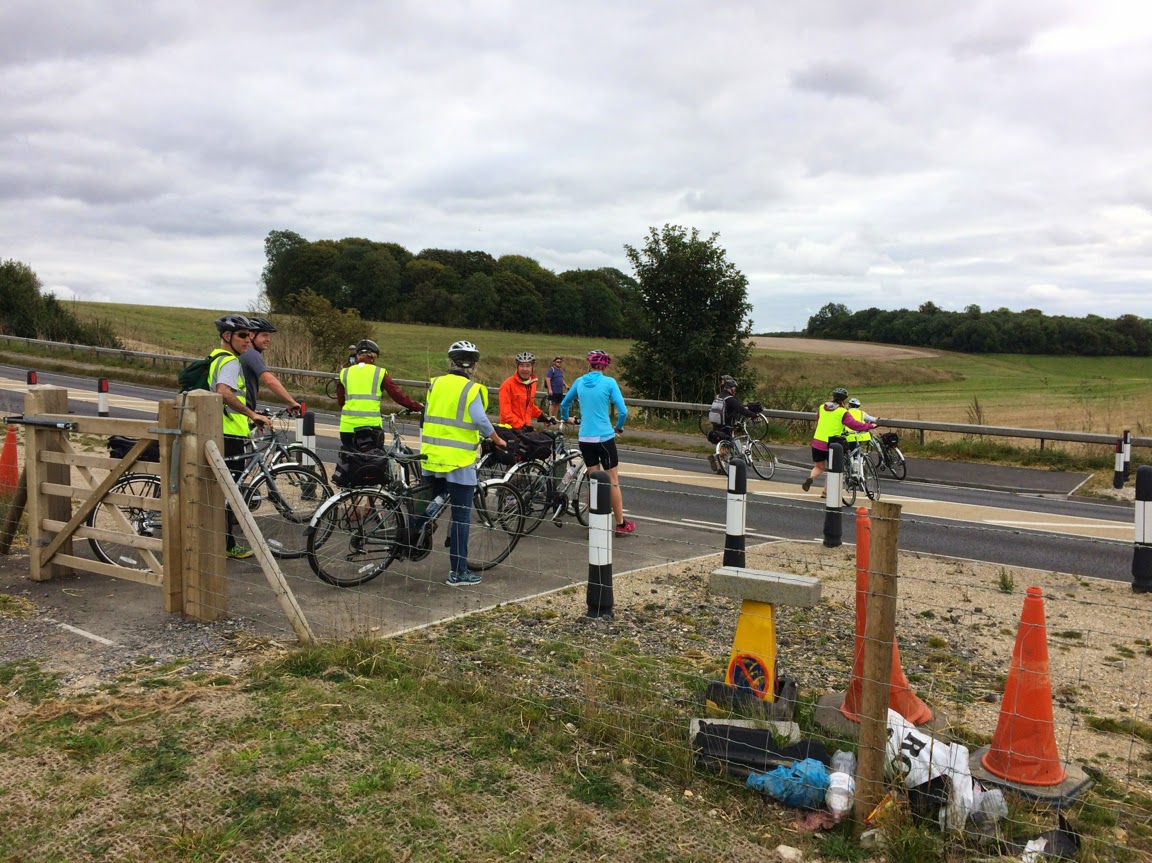
Today wasn't too bad and I was safely across in under a minute.  I rode up to the A344 then onto the temporary permissive path between Byway 12 and Stonehenge Bottom.  As I crested the ridge down to Stonehenge Bottom I was confronted by a veritable gaggle of cyclists heading down towards the A303.


They were a nice friendly bunch and I explained that I was part of STAG and what we were about and please could I take photos of them if they were trying to cross.  They were happy for me to do so, so here is a short vignette of what happened next.

The thought of them all trying to cross made my blood run a bit cold as the traffic here is gravity-assisted in both directions and the westbound traffic is still trying to settle scores with other drivers from the 2 lanes into 1 section of the A303, a few hundred meters to the east.

A few cyclists at the front of the group spotted a small gap and either ran or rode across.

Most of them didn't get the opportunity and there was  steady stream of fast-moving traffic in both directions on what is, at this point a Clearway, not that anyone gives a tuppeny-damn about the Highway Code these days!

They waited, and waited, and waited.
When a westbound gap appeared they moved forward, then back again as it disappeared.

One of them made it to the central strip and an eastbound driver in a grey car slowed and stopped.  Remember, it is a Clearway - no stopping.

The cyclists, not quite sure what to do now, all started to move off the verge towards the centre of the A303,  but did so very hesitantly.  The westbound traffic was still thundering past them with mere inches to spare.  It couldn't have been a very pleasant experience.

White van man from Black Hole Storage Removals clearly didn't give a damn and went roaring through and this carried on for a while until another grey car stopped on the westbound carriageway.
and finally, the whole group got across safely.

It could so easily have been very different.  But why are things so dangerous?

Well, the people who control the World Heritage Site have a policy of making Stonehenge a more bike (and horse and pedestrian) friendly place.  This seemed to be borne-out in the plans for the new visitor's centre submitted by English Heritage.  However, despite their intentions and despite planning conditions that mandated a whole raft of measures that would have improved things for cyclists, English Heritage have singularly failed to deliver.

One of the few things that was largely outside the control of English Heritage was an improved crossing at Stonehenge Bottom.  On the one hand,  increased usage of the crossing point was anticipated by all parties after the closure of the A344, hence the planning requiremnt.  However, a spoke was put in the works by the Highways Agency who produced a report - in the way Government Agencies do when they don't want to take action.  The conclusion of this report reads as follows:


"It is the designer’s view that the current usage of this crossing by pedestrians or by cyclists, on either the A303 or the A344 routes, does not justify the increased risk to motorised users on the A303 of providing refuge islands for this crossing. However it is felt that the opportunity to relocate the crossing to the best location position for NMU visibility and to reduce the crossing width is justified and should be taken.

In taking this view, the designer is taking note of RSA team preference, based on pedestrian rather than cycle use of the crossing, of the do minimum crossing type. The designer is also influenced by the fact that this is far from being the only single carriageway rural at grade crossing of the A303 with no specific NMU facilities, including equestrian crossings. 

The proximity of this crossing to the Stonehenge World Heritage site does not currently attract to it significant NMU usage. It is therefore felt that neither the existing usage of the crossing or the last five year’s accident records warrant a different approach here to that taken at other similar crossing locations where the balance of risks between NMU and Motorised Users, and hence the actual overall risk, dictates the level of provision made. 

It is therefore recommended that the measures in Option 4 proposals, with the refuge islands removed but all the other measures retained is adopted. 

A future scheme for reviewing the crossing arrangements needs to be submitted and approved. The scheme shall have regard to Design Manual for Roads and Bridges HD 19/03 Stage 4 Safety Audit 12 and 36 month post scheme recommendations for any remedial action. 

It is felt that the extensive investigation already under taken into the examination of the safety of and the changes to the crossing here proposed satisfies the requirements of the planning condition."

Just for the record, NMUs are non-motorised units - pedestrians, cyclists and horse riders.  Cutting out all the crap, what they are actually saying is that the body-count at Stonehenge Bottom is too low to warrant making anything more than superficial changes. However, they go on to suggest that a safety audit at 12 and 36 months might change things if the body count increases.

I don't suppose the contribution by Wiltshire Council helped much either:


"...that in relation to cycle usage their preferred route between the A344 to the north and Amesbury for cyclists was via the countess roundabout underpass crossing of the A303 and than via Lark Hill."  (all the typos and grammatical errors are courtesy of the Highways Agency!)

As usual with Wiltshire Council when it comes to anything in the south of the county - thumbs up bums and brains in neutral all the way.  No-one in their right minds, who knew about the local area, would ever choose to get from the centre of Amesbury to Stonehenge by heading north, through the scrofulous Countess Roundabout underpass (on foot - as cycling is forbidden on this bit of the cycle route), up Countess Road, being harassed by rat-running motorists, then head west to Larkhill along the rat-run of choice for coaches and HGVs, before eventually getting to the northern end of Byway 12.

Most sensible folk will simply head out to West Amesbury, up to the A303 and then to Stonehenge Bottom and the A344 - no need to ride with high speed traffic at all - just dice with death crossing the A303.  That's what they've always done, that's what they were doing today and that's what they will do until the A303 issue is resolved once and for all. 

Of course,  there was a fall-back plan to monitor the situation.  Here it is.  Read it carefully and spot the flaw:


STONEHENGE ENVIRONMENTAL IMPROVEMENTS PROJECT Planning Application Reference S/2009/1527 

Scheme required under planning condition 27 for reviewing pedestrian and cycle route access arrangements along the whole of the A344, and crossing arrangements at the A303 (Stonehenge Bottom)

Following approval of the details of the pedestrian and cycle route access arrangements along the whole of the A344 and crossing arrangements at the A303 (Stonehenge Bottom), English Heritage will co-operate with the Local Highways Authority, Highways Agency and the Local Planning Authority in reviewing the arrangements. In particular, should a formal Stage 4 Safety Audit be carried out, and any recommendations for remedial action be made in the 12 and 36 month Stage 4 Reports submitted to English Heritage and the other organisations, then any required remedial works, and arrangements for their implementation and funding, will be considered and agreed between English Heritage, the Local Highways Authority, the Local Planning Authority and the Highways Agency, as appropriate. 

In addition, English Heritage will carry out the following:

  • -  Incorporate questions about the pedestrian and cycle access into the annual visitor survey conducted by the travel and tourism department of market research company TNS. This will comprise face to face interviews with 180 individuals during the months of July, August and September. Likely questions include: whether people have accessed the site on foot or on bicycle, and, if so, where they have travelled from, how satisfactory they have found the route and where they are travelling onto. 

  • -  As part of the ongoing operational management of the site English Heritage staff will, as a matter of course, record, report to the relevant authorities and, if appropriate, take any necessary action in respect of any incidents or accidents along the route of the A344 between Airman's Corner and Stonehenge Bottom. 

    English Heritage 26th April 2012
 
Did you spot it?  Yes, that's right.  Most pedestrians, cyclists and horse riders arriving at Stonehenge don't pitch up at the visitor's centre, as there is (still) no provision for them.  They may arrive from east or west, north or south, but we suspect that few, if any, will be invited to take part in the annual visitor survey, conducted for English Heritage by TNS.  
During my many visits to the WHS this July August and September I've never seen anyone with a clipboard interviewing pedestrians, cyclists and the two riders I have seen, nor have I ever been approached.  Now that's interesting, if true because this safety audit is meant to be looking at the safety of crossing the A303 by any and all users, not just English Heritage's paying customers.
As I say, we don't know for certain that this is the case, but I feel an FOIA request ,or two, coming on! 


Saturday, 13 September 2014

More Mistakes By English Heritage, Or Is It Intentional Rather Than Merely Incompetent?

Purely by chance, there was a veritable rangale of STAGs up at Stonehenge on Thursday 11 September.


It all started first thing in the morning when we received a phone call from Watch Bustard, who had been up at sparrows (for the benefit of our foreign readers, sparrows is a contraction of sparrow-farts, a north of England term for the crack of dawn) and had noticed an unusual amount of activity around the Kent Carriage Gap at the western end of the A344.  He promptly called us here at WiSBAng and his good lady, to let us know something was afoot.

As we had promised to go and measure a few things, we cycled up to Stonehenge, armed with a tape-measure and notebook to take a look see.  Here is what we found.  A week ago, the first gap looked like this.

This week (Courtesy of Watch Bustard) it looked like this.

As far as we can see, the only changes are the removal of the safety fencing and the possible laying down of a few scalpings on the surface - but this may just be a trick of the light.  Any progress has been minimal.

UPDATE: The ever-watchful Watch Bustard noted on Monday 15 September that tarmac appeared to be in the process of being laid around these carriage gaps.  A good way to compound the errors that are highlighted in the following paragraphs.

We really wanted to check to see if the dimensions of the gates were compliant  with the Kent Carriage Gap (KCG) standard that we illustrated in an earlier post.  The idea is to have two sets of posts, the shorter pair in the centre being just wide enough to allow small carriages to pass between them and the outer ones allowing larger ones, with greater axle heights, to pass over the inner posts.


So, what have English Heritage achieved.  Well, the posts are 0.24 metres tall instead of the 0.33 metres tall for a KCG.  The separation of the inner posts is 1.83 metres instead of the KCG standard of 1.52 metres (6 ft in real money) and the distance between the inner post and the kerb edge in the photo above is 36cm and between the inner post and the gate post 41 cm.  This dimension should be 0.6 metres for a KCG.  We won't even mention the suggested second and third rows of posts ).45 metres from the first as EH haven't bothered with at all.


The second KCG on the A344 is somewhat similar to the first.  The gap between the inner posts is 180cm, with a hefty 2.17 metres to the left and a few cm to the right of the inner posts

This all looks a bit amateurish and half-hearted on English Heritage's part.  Almost as if they didn't want to have these here in the first place and that anything will do as a sop to those who might raise the issue. 

To cheer ourselves up, we rode down to the stones and then proceeded eastward on the temporary permissive path over National Trust open-access land (isn't a path a contradiction in terms here?).  Typically, the first sign to tell you what the path is, is only found when you are on the path.  Surely, it would make sense to signpost it from the A344?

On we went, down towards Stonehenge Bottom to see how things were progressing here.  Readers may recall that another planning condition imposed on English Heritage was that a permissive byway be instituted along the course of the stopped-up section of the A344, back to Byway 12.  A few months ago, English Heritage claimed that the reason the permissive byway hadn't been opened was because of bad weather over the winter and it would take over a year for the grass to grow.  Needless to say, the byway should have been opened on the A344 route before the Visitors Centre was opened and the bad weather of winter 2013-24 only struck a few weeks after this point.  Not ones to let facts ruin a tall tale are English Heritage.

Here is the view eastwards from where the diversion meets the intended route towards Stonehenge Bottom.  Another failed planning condition as well - a safe pedestrian route over the A303.

As you will see, the growth of vegetation here has been pretty poor.  Superficially, this might support English Heritage's contention that the climate was responsible for the time that was going to be needed to allow grass, etc to become established.  Here again, as with any statement regarding the A344 by English Heritage, it's always worth taking a closer look.


Now on the left of the picture above, there is a plastic mesh sunk into the ground to prevent heavy traffic from destroying the grass and rutting the surface:

You will see that this is pretty typical soil for this neck of the woods, with large numbers of chalk and flint fragments on the surface.  Between a quarter and half of each segment is taken up by surface rocks and so there isn't a great deal of space for plants to take root and grow - and they haven't.

The right hand side of the byway-to-be is even worse, with even less plant growth - and most of this is made up of weed species.

Here, a hessian mesh has been used to cover the surface.  Whoever dreamt this one up had either not understood the nature of the soil here, or was actively trying to prevent plant growth.  Basically, the holes in the mesh are smaller than the bits of flint and chalk on the surface, so large numbers of the holes are unavailable for even the most persistent plants to grow through as they are blocked by rock.  You can see the consequences. Nice one, English Heritage!

They couldn't get things even more wrong, could they?  Well, we are talking English Heritage aren't we.  Returning to Byway 12, we noticed this, close to the Heel Stone.

It all looks, well, a bit, yellow.  Our first thought was that the dry weather had killed off the growth, but as before, it pays to look closer.


Stunning, they have covered the surface in sand and, surprise, surprise, nothing much is growing.  Nothing much is likely to grow for a long time either.  Yet again, English Heritage appear to have done everything they can to fail to comply with Wiltshire Council's planning requirements and ensure that as few people as possible approach Stonehenge in any way other than going via the Visitor's Centre. 

UPDATE: We wonder if this other bit of English Heritage idiocy is an attempt to lay down a strata to indicate to future archaeologists that everything below the sand is natural and that everything above it is 2013 vintage or later.  If that is the case, then why not seal in the sand layer with a layer of earth, so it won't get disturbed and plants can grow above it.

 This is where WiSBAng met STAG in the shape of Janice Hassett, who had also wandered down to the eastern end of the site to see what was going on.  You can read her account here: http://staga303.blogspot.co.uk/2014/09/eh-letting-us-down-againcontinued.html

There is a worrying and confusing series of signs on the fence as you pass the henge:

Perhaps they have a plan to fit a roof to keep their paying visitors dry in inclement weather? 

It was a lovely afternoon and the STAGs met some smashing folk at both ends of the A344. From the young French couple who had turned up without booking, parked their car at Larkhill and walked in (good to see that someone these days can actually read a map!), to the Welsh primary school kids who were so well-behaved and a credit to their teachers, to the daughter of an archaeologist who had left her to go for a walk around Stonehenge, whilst he went to a Wessex Archeology meeting at Old Sarum.  A good afternoon to get a few more signatories for the STAG petition!

Tuesday, 9 September 2014

English Heritage Mess Up on the A344 - Yet Again

Last month we heard from Wiltshire Council, definitively they claim, that the A344 is still the A344 and a highway.  As "A" roads have a legal definition in the UK and that involves joining population centres, carrying motorised traffic, etc, it is patently absurd to continue to list the A344 as an "A" road.  Consequently, this is being taken up with the Secretary of State for resolution.

Meanwhile, on the A344, English Heritage continue to mess up.  As a planning condition for the new visitor's centre, they were obliged to install Kent Carriage Gaps to allow all non-motorised traffic, not banned by the permanent Traffic Regulation Order, to use the A344, unhindered, 24/7.  Like many of the planning conditions imposed on English heritage (around 23 of them) many were supposed to be put in place before the visitor's centre was opened to the public,; the management plan seems to suggest sometinme between October and December 2013.  Yet again, this was a major fail by English Heritage.  Wiltshire Council Planning Department seem to have done little to police these consents, which makes you wonder what they spend their time doing!

Now for those of you who don't know, a Kent Carriage Gap is one of the ways of enforcing a TRO of the sort imposed on the A344.  This is how they should be designed:

Two sizes of post to allow carriages of different sizes to pass along the carriageway.  The separation of the posts and their height is also defined.

The point of these gaps is to allow unhindered access along the carriageway - the operative word here being along.  This is how they should be constructed.

Have English Heritage achieved this?  No, of course not.  Almost 9 months late, this is all they have been able to manage.

Between the new roundabout at Airman's Cross and the entrance to the visitor's centre carpark you have this attempt, photographed by Wiltshire Councillor and Chairman of Winterbourne Stoke Parish Council Ian West and friends,  it certainly doesn't seem fit for purpose, doesn't meet the design of Kent Carriage Gap for which planning consent was given, and wouldn't appear to be able to be used as intended by all the types of carriage it is meant to permit. 

Further along, we come to an even more egregious mess which we photographed last week in the run-up to the presidential visit!

Well, on the plus side, EH have lowered the kerb.  But that is the only positive thing that can be said about it.  The Gap is again to one side of the A344, not across it and there is no clear exit from it back onto the A344.  It's worse than that, bearing in mind that the path running from left to right comes down from the coach park and is the main access for visitors being brought in from that direction.  Now, given these pedestrians are about to cross an open highway, the A344, in very large numbers, you'd think English Heritage would have had the common sense to do a number of things.  First, leading pedestrians onto and across a highway, without warning them they are crossing one is a fairly stupid thing to do; particularly given that many of them are foreign visitors. 

Second, not warning those using the highway that there may be pedestrians about is also pretty lame, so you'd think there might be proper signage on the path and the road, "Look both ways" signs on the footpath, etc, etc, but no such luck.  All in all, when we have our first visitor mown down by a horse rider, horse and carriage or even a cyclist, the negligence on English Heritage's part will be clear.

In writing this, we realise we never actually measured the height and separation of the posts that are there, so we might have to pop up and measure them to be sure.

Ian West and friends also looked at the state of the permissive byway at the other end of the old A344, beyond Byway 12 and towards Stonehenge Bottom.  English Heritage, keen to foster the World Heritage Site's policy of encouraging visits by cyclists have signposted the route:

You've got to admire the lengths they have gone to over the last 9 months to do this!  Of course, if you take the trouble to go down that way,  avoiding the inevitable traffic jam at byway 12...


...you can get a really good view of Stonehenge, without having to pay the extortionate entry charge.  Follow this up with a visit to the museums in Amesbury, Salisbury or Devizes and you will see the best of Wiltshire's archaeology - you don't even need a local resident's pass.

All we can say is that it is a good job President Obama didn't arrive by bike and that Raffles family of Amesbury decided to walk up to Stonehenge from the east, rather than go by car, or else the six of them would never have met and English Heritage couldn't have benefited, however undeservedly, from the global human interest story that broke following the president's visit. 


Tuesday, 24 June 2014

So Nearly a Tragedy

Early yesterday afternoon we so nearly had a tragedy here in the heart of Winterbourne Stoke on the A303.  I heard the sirens heading along the Berwick road, and more coming up the Devizes road, as I walked on the ridge above the village and it was clear that there had been yet another accident.  The only question was, how bad?

While we are often afflicted with traffic jams, we also suffer from speeding when the road is a little clearer.  Frequently, the culprits are HGV's, racing down the hills on each side of the village, westbound and eastbound though eastbound is worst, to keep up their momentum to let them climb the hill back out of the village.  I don't mean a few miles per hour over the 40 mph speed limit, these HGV's are often travelling at well over 60 and even 70mph, if the Highways Agency's roadside speed monitors are to be believed.

In between times, if the traffic isn't stationary or trying to break the land-speed record, it is merely fast and inconsiderate.  So in every traffic state, trying to turn right onto the A303, out of the one and only access road to the village, can be fraught with danger, or simply incredibly frustrating and time consuming.  When the traffic is stationary, or very slow moving, drivers block the entrance to the village and refuse to let villagers out.  When the traffic is travelling very fast, you can pull out onto a clear road only to have an HGV screaming into view in your rear-view mirror; brakes smoking and horn blaring.  In between these two extremes you get a bit of both.  You can wait for a long, long time for a gap to appear in both lanes of traffic and west-bound drivers, even though they will have had clear site of you waiting patiently for over half a mile, still refuse to let you pull out.  This state of the traffic can be the worst of all and passengers have been known to get out of the car, run down to the crossing in an attempt to create a gap in the traffic.


Then sometimes, just sometimes, you get a nice person who tries to be helpful and let you out of the village onto the A303.  That's what happened yesterday and as a result, an act of kindness so nearly ended in tragedy.

Basically, what happened was this.  A young nanny was trying to leave the village, with two of her young charges in the car.  There was virtually no westbound traffic but a constant stream eastbound.  After waiting some while, a kind eastbound driver in a blue car stopped and beckoned her to pull out.  She made one last check of the road, especially the westbound A303 and when she looked back in preparation to pull out, there was a loud bang and the blue car seemed to have tuned into a silver one and then a big, white HGV, spewing red liquid..  Confused, she hesitated.  Had she pulled out without first checking, things could have ended so differently.  Fortunately, her car was untouched and she was able to reverse back, safely, into the village.

What seems to have happened is this.  The blue car came to a stop and beckoned our driver out of the village.  Further back down the road, and I will make no comment as to the hows and whys of what happened next here,  a large articulated tanker from the Netherlands failed to stop and hit a silver car in the rear.  It was this car that shot forward and into our nanny's field of vision replacing the blue car after hitting it in the rear and, in-turn, being replaced by the HGV.  This is the scene after the emergency services arrived:


The HGV was pretty well beaten up:


The front of the silver car wasn't very pretty either:


However, it was the rear that took the full force of the HGV:


Now, it doesn't seem to have been a very high speed collision,  but whatever combination of speed and distance from the car in front pertained, the lorry driver was unable to stop in time.  The HGV is only three years old, so a relatively new vehicle - unlike many of those that hurtle through.  It doesn't take take much imagination to picture what might have been had one of the leading cars, or the HGV, hit the side of the nanny's car; T-boning it.  Less imagination still to picture the scene if the HGV had been racing into the village as many do - 10mph, 20mph or even 30mph + over the speed limit.

Half-a-dozen people were very lucky yesterday; fortunately with no-one suffering serious injuries.  Yet again, another accident in Winterbourne Stoke shows the unsuitability of the A303 for its purpose as a major strategic route to the West Country and the dangers that the current road poses for the villages that lie alongside the single-carriageway sections of the entire A303/A30/A358 corridor.

This is just one of the reasons why WiSBAng and STAG are campaigning to ensure that the this important road corridor is dualled along its entire length, and as soon as possible.

Thursday, 12 June 2014

Stoned Again - Will Summer Solstice 2014 Cause Additional Chaos on the A303

Yesterday,  English Heritage, Wiltshire Police and a host of local stakeholders got together in the Antrobus Hotel in Amesbury to hear the plans for traffic management over the summer solstice period.


For the first time since 2008, the summer Solstice falls on Saturday morning, which means that the crowds might be bigger than in years when the solstice falls during the working week.  Last year, about 20,000 folks turned up to watch the sun rise.  Back in June 2008, 30,000 people turned up to wait through a cold, wet and misty night for a dawn that proved equally cold, wet and misty.  It's a bit early for a weather forecast for the solstice weekend and the Met Office have cocked up the weekend forecasts for this part of the world for the last two weekends running, so I guess the forecast is uncertain. We might expect a bigger crowd than we saw in 2008, simply on the basis that: "Summer 2014 has got to start at some point" and the Solstice weekend is as good a time as any.

The big difference this year is that it is the time the A344 has been closed for the summer Solstice, so the traffic problems that this might cause in the local area are a bit of an unknown, though we can speculate that it isn't going to be pretty.  The biggest question of all for us here at WiSBAng is whether it will cause more problems for the A303, where the weekend traffic situation is already nightmarish, and in the surrounding villages where rat-runners are making life even more unpleasant.

The English Heritage and Wiltshire Police traffic management plan for the solstice period is shown on the map below - please click on it to enlarge.


Basically, EH plan to close access to Stonehenge itself at 14:30 on Friday 20th June and then the new Visitor's centre, arrowed in green on the map, will be closed from 15:00.  The two Byways (Byway 11 and 12) that are close to the stones have been closed under a temporary Traffic Regulation Order to a point about 500 metres south of the A303.


 Apart from a few of the byways, bridleways and footpaths on the MoD ranges which are closed for a live-firing exercise (look out for the red flags), ALL other byways, bridleways, footpaths and roads in the vicinity are open.  That is a little contrary to to English Heritage's Summer Solstice 2014 Conditions of Entry and Information document which claims at the top of page 6 that the A344 is closed.  That is untrue, the route is still open for walkers, cyclists, horse riders, carriage drivers and invalid carriages, but English Heritage would prefer people not to walk along the route of what once was the A344, as they have provided an off-road route to the stones just for the Solstice. 

We expect that motor vehicles stopping and waiting on the A303, the A360 between Longbarrow Roundabout and Airman's Cross and on towards Shrewton will be prevented by the usual coning-off of all likely stopping places.  So anyone wanting to stop in the area is going to have to move further afield.

People arriving at Stonehenge Visitor's Centre, after it closes and before the Solstice car parks are opened at 19:00 on Friday 20th of June, are going to be asked to wait on the B3086 that runs north from the new Visitor's Centre towards the Bustard Crossroads.  So there is the potential here for a bit of chaos, as this section of road is a favourite part of the Friday evening rat-run when the A303 is jammed.  Hopefully, no-one wanting to attend the solstice will turn up until after 19:00.  If lots turn up early, then there is a potential for gridlock.  At the very least, it's likely to see more traffic heading for Shrewton on the London Road (B3086), though where they might go from there is anyone's guess.  They may strike out west on the B390, hoping to rejoin the A303 from the A36, or they could head south on the B3083, here to Winterbourne Stoke.  Some, wanting to see Stonehenge, may head back east on the A360 towards Airman's Corner, adding to the confused, bemused and possibly bloody-minded, heading for the Solstice; let alone the locals just heading home for the weekend.

This is all going to happen during the Friday commute home and coinciding with the weekend peak traffic flow on the A303 (16:00 - 21:00).  English Heritage are trying to persuade everyone wanting to attend the Solstice to go to Salisbury and take public transport up to the World Heritage site; it might persuade some, but again it's an unknown quantity. Roadside signs, from the M3 westwards, will warn people to stay away from Stonehenge if it gets too crowded.  At 19:00, the two new Solstice carparks (marked in blue on the map) will be opened and then people will start to flood in, which has the potential to cause further chaos on all routes in to Airman's Cross as people rush for a parking space.  We are told that these two car-parks have a similar capacity to the old Solstice car-park.

So, we have a fair degree of uncertainty about how things will unfold.   On the one hand, it may be freezing cold and lashing down with rain. People travelling to the West Country may choose to avoid the Stonehenge area entirely, reducing the back-ground traffic flow on the A303.  Solstice-goers may largely choose to take a bus to Stonehenge.  Those few that decide to arrive under their own steam may choose to arrive after the evening peak traffic flow and those that arrive early may follow the advice to wait on the B3086. With luck, no one leaves the A303 in a desperate attempt to avoid traffic jams, as it is flowing freely.  No-one stops to take a snap of the henge as they pass and no-one crashes their cars having been distracted by the herds of flying pigs, performing synchronised acrobatics overhead at the very thought of such a possibility.


Ah, bliss!

On the other hand, Friday 20th June  2014 may turn out to be a balmy night to be followed by a glorious sunny weekend.  Tourist's flood to the West County in their usual droves and follow, lemming-like, their normal routes.  Solstice-goers turn up as usual, on foot or in the usual mix of barely legal motor-vehicles and ignore/miss the exhortations on social media and in the Press to use public transport.  The B3086 is soon blocked, so this leads to problems in both directions on the A360, which eventually spill out onto the Longbarrow Roundabout.  Aging vehicles heading for Stonehenge overheat, blocking the westbound A303 near Stonehenge Bottom and the eastbound traffic just east of Winterbourne Stoke.  Westbound, Eastbound and Northbound traffic on the A303 and A360 will converge and collide, probably literally, around the Longbarrow Roundabout as a result of impatience and short-tempers.  Longbarrow Roundabout grinds to a standstill by mid afternoon and remains grid-locked for hours, and hours.  The last of the broken down and crash-damaged vehicles can't be removed until sometime on Saturday - after the peak of the great slog home has passed.  All those who are stuck on the A303 decide to cut their losses and visit Stonehenge as they aren't going anywhere else; the A303 becomes a large carpark.

Of course, it could get even worse.  God forbid there is a serious accident on any of the surrounding roads, but it is a Friday, and they are such a regular occurrence...

...then we have the possibility that some of the visitor's decide to make a weekend of it, or an impromptu rave or free-festival kicks off.

The reality is likely to be somewhere between these two extremes, but it would be a brave person who is prepared to put hard cash on the outcome.  We will, of course, see what happens in a few days time.


Monday, 26 May 2014

The Measure of Misery - 4-5 Solitons Solitons Per Hour

Standing by the side of the A303 this Bank Holiday weekend, watching the traffic slow down and eventually grind to a halt, is a good excuse to contemplate the infinite, to ponder those deep philosophical questions that have troubled mankind for years.

I was going to suggest it was an opportunity to contemplate ones own navel, but it was a darned sight too cold for that and, in any event, it may be of uncertain legality and is definitely of dubious taste - at least in my case.

Anyway, the deep question I was pondering, watching all those grey and grim-set faces behind the windscreens was: "How do you measure misery?'

I think I now have an answer.  It's 4-5 Solitons Per Hour.

A few weeks ago, I explained how people slowing at Stonehenge could create a soliton generator near Stonehenge and there were others at Longbarrow Roundabout and Stonehenge Bottom.  

Westbound traffic and eastbound soliton


Basically, vehicles joins a queue of traffic faster than than they can leave it, so the point at which traffic stops on the road, moves backwards,  against the direction of vehicle travel, until it meets another soliton and things jam solid, or it meets a stretch of traffic-free road and simply vanishes.   Today, I was watching traffic in Winterbourne Stoke go east and the soliton travel west, from Longbarrow Roundabout back to Winterbourne Stoke and the dual carriageway at Berwick Down.  People-watching is always fascinating, but even more so today as the traffic slowed to a stop.

I've noticed over the last few weeks that these solitons build and disappear in a fairly systematic way.  The periodicity changes in response to traffic volume, so the more traffic, the shorter the interval between solitons.  You can measure this periodicity in solitons per hour (SPH).  Now the fun thing is that people's demeanour changes in response to this periodicity - the higher the SPH, the deeper the misery of the car occupants.  It also changes their reaction to someone stood at the side of the road with a STAG sign and a video camera.

At 0 solitons per hour, the drivers see you, look sheepish as going 60 mph or more in a 40 mph zone is tearing the arse out of things a wee bit and they worry you might be a speed camera or something.   This effect can be enhanced by wearing a yellow, high-vis, dayglo jacket.  Passengers laugh at driver.

At 1 soliton per hour, the drivers sigh a bit, but they are travelling less than 10 mph over the speed limit, so aren't too worried you are a speed camera.  Drivers sweat a bit when they fail to see stationary car ahead.


At 2 solitons per hour, the drivers know you aren't a speed camera and don't give a stuff about you, as they are being slowed on their way home.  Passengers are busting for a pee and they should have stopped at the last place that had a toilet before Wylye.  Still, it benefits the Bell Inn in Winterbourne Stoke with additional passing trade.

At 3 solitons per hour, drivers glare at you, make obscene gestures and frequently open the window and swear at you. They really do seem to blame you for the fact they are stuck in this traffic jam.   Driver screams at passengers and they scream back.  The A303 becomes a place of learning - that is if you want to learn some of the choicer ways to use expletives.  Some drivers try to drive threateningly at the camera and then fail to notice the crossing lights are on red or a driver is turning in or out of the petrol station or pub - yet another near miss!   Smiling at them doesn't seem to help their mood, though it is cathartic for the traffic-watcher.  Waving is even more fun.


At 4 solitons per hour everything changes.  Drivers are no longer angry and abusive.  Instead they seemed resigned to their fate - like a condemned prisoner in a tumbrel, heading to the gallows, with passengers who seem to relish the prospect of joining them.  They attempt to smile in a thin-lipped, dejected way and will sometimes wind their windows down and engage you in conversation.


As I packed up to go home, another soliton was forming and the drivers reaction seemed to be the same.  On the basis of this, then I reckon the Measure of Misery is about 4-5 solitons per hour.

I trundled home to write this piece and then I had a flash of inspiration.  I had finally understood the true meaning of the answer and thus had finally got to grips with the nature of the question.   Hitchhikers Guide to the Galaxy fans will recall that "42" was the answer to life, the universe and everything and that, according to the book, the earth was created to determine what the ultimate question actually was.


Now, I'm beginning to think that the answer wasn't 42, as a numeral, but the first part of a statement "4 to"  as in "4 to 5" or "4 to 400" or even "4 to Infinity"   Of course, as infinity is big, really big, so it wouldn't all fit onto a computer screen.  Consequently, it seems adamantly (even Douglas Adamantly) reasonable to output just the first bit  - "4 to".

Now if that's the real answer, the question now becomes obvious.  "What is the Measure of Misery".

Clearly, Stonehenge is simply the on-off switch for the computer created by the multi-dimensional creatures who resemble white mice.  Experts in the field will see the problem here.  Whilst we are pushing to get the A303 dualled as a means of eliminating traffic misery, the blasted Vogons are intent on eliminating us entirely to construct a new hyperspace bypass.

SWMBO reckons I've been out playing with the traffic for waaaaaaaaaay to long!


Saturday, 17 May 2014

Does "A Degree Of Success" Amount To Abject Failure?

On Thursday, the Western Morning News ran a story on comments from Roads Minister, Robert Goodwill under the headline: "Minister promises 'success' in A303 funding campaign."  The same story ran in the Western Daily Press yesterday and this was featured in our sister blog STAG Stonehenge Traffic Action Group.   But was the story really such good news?

What Robert Goodwill seems to have actually said, in response to a question specifically about funding for the A47 improvement plan was:

"I should like to make it clear that this is not a competition in which there can only be one winner,"

"I hazard to suggest that there will be a degree of success in all six areas that we have identified."

OK, so he is merely suggesting that all 6 schemes might have a degree of success - at best maybe an unsubtle hint, at worst a face-saving expedient to give the impression of substance where in reality, there is only a wisp of smoke.

Even if he is correct, what benefit is a "degree of success?"  I would argue very little, four-fifths of bugger-all, not a lot, nothing of any real value. 

Why?  Well, isn't it obvious?   Simply improving a few bits of the A303/A358/A30 isn't anything more than window-dressing - it might make a bit of the road look prettier, but isn't going to have any major impact on journey times along the whole length of the road.  In fact, a "degree of success" is probably a more PC way to describe an abject failure. 

My fear is that this is the first stage of a British government saying, yet again, that they haven't the collective wit, wisdom, or motivation to solve the problem of getting the A303 past Stonehenge and the Blackdown Hills.

Never forget:


"Under every stone lurks a politician!"
                              Aristophanes


Friday, 16 May 2014

Wooly Thinking on the A303 And Stonehenge From Tom Corbin

In a letter to the Salisbury Journal of 14th May 20214, Tom Corbin, Labour's parliamentary candidate for the Salisbury constituency demonstrates some particularly woolly thinking on the future of the A303 past Stonehenge. 


Tom Corbin

In fact, as woolliness goes, it outdoes many of the sheep that wander round the stones from time to time.

Sheep
 Having mentioned his support for HS2, oh, and the fact that he is a rail-worker who might just have a vested interest in railways, he begins his comments on the A303 with:

"The argument is about the importance of improving national infrastructure based on value for money and economic returns whilst competing for funding against other national roads projects".

We wouldn't disagree with that, providing of course that value for money was determined on a fair basis and one that didn't unduly favour urban projects more than rural ones because of the distorted way in which government data has been collected.  For instance, road usage data is collected on any days that aren't: weekends, public holidays, school holidays, etc, etc.  Just the times when the A303 traffic flow is minimal and that on urban roads is maximal.

Mr Corbin then shoots his value for money argument in the foot by writing:

"Taking in some of the arguments for a tunnel or cutting as part of A303 improvements, if passing traffic can no longer enjoy the views of Stonehenge then aside from a fall in drop in visitor numbers everyone will miss out on seeing the iconic stones in the varying daylight conditions year round, something we should be able to enjoy just as we do with other scenic views."

Poppycock Mr Corbin.   Strangely, I can't see Blackpool Tower from the A303.  It's clearly my unalienable right to look at Blackpool Tower, but if I can't see it from the A303, it's up to me to make the effort and get a bit closer.  The same goes for Stonehenge.   If it is shoved in a tunnel, lowered in a cutting, or moved a few miles north or south of its present route, then people will need to make a bit of an effort to see it - like we do for any other scenic view.

"Only a few people would pay to see the stones several times a year". 

"This treasure should not be isolated from view, or it will slip from our consciousness."

Almost certainly true, but pretty disingenuous.  Even without seeing Stonehenge from the A303, no-one needs to pay to see Stonehenge at all.  Everyone, with or without their bikes, horses and carriages, are able to freely wander past the stones, along the course of the A344, Byway 12, or across the open-access National Trust land to the north. OK, English Heritage would be happier if you ransomed your granny and got a little bit closer to the stones, or even sacrificed your first-born for the privilege of a special visit within the stone circle itself, but for most people, if you can't touch actually touch the stones, then whether you are 50 metres away or 200 is somewhat academic. 

As we have demonstrated unequivocally in recent weeks,  passers-by slowing to look at Stonehenge are the root cause of many of the A303 traffic jams, not just the volume of traffic.  The best way to ensure this problem stops in the short and long term is by removing the ability to see the stones from the A303.

In the short term, sight-screens might help a little on the stretch of the A303 closest to Stonehenge.  In the long term, the solution will be to move the road, vertically or horizontally, a sufficient depth or distance such that the stones can no longer be seen from the road. Tom Corbin would have made a great deal more sense had he said something along the lines of:

"This treasure should be isolated from the view of motorists to ENSURE it will slip from their consciousness and not encourage them to slow unnecessarily; thereby hindering other road users, increasing travelling time to the south west of England, burning additional fuel, delaying workers, enraging locals and tourists alike, wasting money, increasing chemical and noise pollution." 


Thursday, 24 April 2014

CPRE Ostrich Has Head Stuck in Sand for A Decade

There's an interesting, though somewhat depressing article in today's (April 24th 2014) Daily Telegraph entitled "Stonehenge tunnel plans could be revived".  The article is by the Telegraph's Transport Correspondent, Nick Collins and is in response to the Department for Transport's  A303/A30/A358 Corridor Feasibility Study Scope Document which you can find here.  I strongly suggest that you read it for yourselves as I fear Mr Collins has misrepresented some of it in his article.


What is more disturbing are the comments of the CPRE below:

"The Campaign to Protect Rural England said several of the spots under examination, including Stonehenge, are only congested at certain times of year and do not merit major development.
Ralph Smyth, senior transport campaigner for the CPRE, said: “The traffic [at Stonehenge] hasn’t increased in the last 10 years and it does not justify the huge cost of a tunnel.”
A long tunnel would at least be preferable to a dual carriageway at the surface, which could cause the historic site to lose its world heritage status, he added".  


I'm not sure where they have been for the last 10 years, but as anyone who lives alongside the A303, or drives along it regularly, to say that the traffic at Stonehenge hasn't increased over the last 10 years is risible.  It's worse than that, it's damned dangerous.  Opinion is one thing and evidence quite another.  I would strongly suggest that Ralph Smyth takes a bit of time to read traffic flow data and projections before he makes any further pronouncements.  In particular, he should take a look at Somerset County Council's excellent Economic Impact Study and the figures contained therein, not to mention the traffic studies conducted on behalf of Wiltshire Council and English Heritage.

If you want to take this up with the CPRE directly, then their contact details are:

National Office
Campaign to Protect Rural England
5-11 Lavington Street
London
SE1 0NZ

Tel: 020 7981 2800
Fax: 020 7981 2899

Email: info@cpre.org.uk