This is the first post on the blog for over two years and we have just come to the end of the public phase of the DCO Inquiry. It's not that I have lost interest in events, or that nothing has been going on with regard to the A303 Stonehenge to Berwick Down Scheme; nothing could be further from the truth. It's just that there has been so much going on that I've had to prioritise my efforts on those things that have demanded immediate responses and my blogging has suffered - others things in life have greater importance than a mere road scheme.
I don't intend to try and catch-up now, just reflect on some of the things I have noted over the last few years. If my observations cause offence - tough!
Bear in mind, before reading on, that this blog has long advocated a bypass for Winterbourne Stoke and an improvement of the traffic situation past Stonehenge. My preferred option, as often stated, would have been a very log tunnel from east of Solstice Park and emeging somewhere west of Yarnbury Castle. Tht was never going to fly, so a credible alternative, was a "far" northern route that ran mainly across the Salisbury Plain Training Area, north of Durrington, Larkhill, Shrewton and then cutting back to rejoin the existing A303 at Deptford. Not popular with the Army, to be sure, but very hard for them to justify hanging on to a piece of real estate acquired for an army of more than 2.5 million men and now used for 110,000 regulars and reserves and unsuitable for training with much of their long-range ordnance. Interestingly, the Examining Authority asked to see details of this route during the inquiry.
We were offered two poor alternatives by Highways England and we were left with the lesser of two poor choices - the northern route past Winterbourne Stoke and a tunnel that is as short as they felt they could get away with. That said, it will solve the traffic problems in the village, so I reluctantly have to support it. The alternative for us is traffic hell in perpetuity and for the rest of you the prospect of direct action on high days and holidays that will prevent you using the A303 and traversing the World Heritage Site.
What have we learned from the DCO process? Many things we anticipated and some we didn't.
Highways England, much as expected, have been pretty much immovable on any of their more nonsensical ideas. Whenever confronted with hard facts and rebuttals of their approach will fudge and prevaricate rather than change what they want to do.
They have, seemingly unwittingly, demonstrated beyond any reasonable doubt, that only one of the many models they have used in devising the scheme is up to HMG standards. If the scheme is accepted, that should make claims for compensation for noise, pollution and visual damage so much easier.
We have been impressed by the impartiality of the independent chair of the Community Forum, set up by Highways England, who has guided many of us through the DCO process with sage words.
We have been impressed by the Planning Inspectorate and the DCO process itself.
Sadly, I've been disappointed by the activities of the Stonehenge Alliance and some of their more outspoken supporters on social media. I'm not sure that the level of hyperbole and in some cases downright lies (disappearing views!) they have used are justifiable. Whilst they may have conned some of the more gullible members of the British and International public to support their misguided cause, it's likely that the Planning Inspectorate have seen straight through it.
Wednesday, 23 October 2019

Wednesday, 19 July 2017
Government Slopes Shoulders On Stonehenge Bypass
We've been wondering how HMG would fund the Stonehenge to Berwick Down Scheme for the A303. The reassurances that the money "would be found and ring-fenced" have always sounded a bit hollow and very fuzzy and it seems our concerns were justified.

Take a look on the Winterbourne Stoke Parish Council website at their latest story.
So, HMG are now looking to private finance to design, build fund and maintain this section of road. Given the record of PFI's in the past, this prospect fills us with a rising sense of dread. Worse still, the projected timescales will certainly be missed - leading to many more years of rat-running and congestion.
The alternative, of course, is to go for a lower cost above ground route...
Tuesday, 6 June 2017
It's In Your Best Interests...
Whenever I hear someone tell me that: "It's in your best interests to do X, or Y," alarm bells ring very loudly indeed. In my experience, true philanthropy is a very rare quality and what these individuals really mean is: "It's in my best interests for you to do X or Y. Selfish self-interest is a powerful driver indeed.
When such a statement is made by a politician, then the alarm bells ring more loudly than ever. That's what is going on at the moment; a cacophony of alarm bells, whistles and sirens are sounding off. A great deal of effort is being made to persuade many of those with an interest in doing something about the untenable situation of the A303 to pull together to support the tunnel under Stonehenge and the northern bypass of Winterbourne Stoke and to put pressure on Highways England to adopt that solution.
Bearing in mind the opening to this post, whose best interests are served by this? It would certainly provide a solution to the traffic problems, but would it provide the best solution; particularly for Winterbourne Stoke? What would benefit Winterbourne Stoke the most? Forgetting for a moment the options on offer, I would suggest the denizens of Winterbourne Stoke want some or all of the following:
- a reduction in traffic volumes within the village;
- a reduction of traffic noise within the village;
- a reduction in traffic pollution across the village
- no more damage to the environment
- no more damage to the known and unknown archaeology of the area.
The best way to achieve that is to remove the A303 from the equation. Remove it entirely, absolutely and unequivocally from the equation. To do that there would seem only two alternatives. Dig a tunnel from east (NOT west) of Countess Roundabout and emerge, blinking into the daylight, having bankrupted the nation, somewhere between Yarnbury Castle and the A303 Deptford interchange, or simply re-route the A303 south of Amesbury past Boscombe Down, through the Woodford Valley on a couple of magnificent and architecturally inspiring viaducts, then rejoining the route of the current A36 towards the Deptford interchange. Whilst the super-long tunnel option is unaffordable in anyone's book, even Highways England admit the southern route would be a substantially cheaper than either of the tunnel-based proposals on the table.
Now given that many of the archaeological community, locally, nationally and internationally, are against the proposed tunnel option and bypasses for Winterbourne Stoke, would want to expand the boundaries of the current World Heritage Site to accommodate both known and suspected archaeology and want to remove the A303 from the entirety of the area, then clearly, we have something in common. Whilst we have never been natural bed-fellows in the past, perhaps now is the time for those immediately affected to cosy-up with each other? Our selfish self-interest is best served by removing the A303 in it's entirety. A tunnel with a northern bypass or a tunnel with a southern bypass are very much secondary and tertiary options which satisfy few, if any, of the desires and aspirations of Winterbourne Stoke.
Now the politicos will tell you that this isn't on the agenda. Accept what you are being offered and let us get on with it! They would, wouldn't they. Don't forget though, that when considering traffic issue, nothing has a better turning circle than a politician - especially ones trying to balance the books.
Sunday, 5 February 2017
Some of the Daftest Things Heard at the A303 Consultation Presentations
Most folk who have been along to the A303 Stonehenge Scheme Public Consultations went to find out more, to learn of the proposals and to ask questions of Highways England. So, I guess you would have hoped, expected really, that the people fronted up by Highways England would be fully up to speed with the documentation and underpinning information. You would also have hoped they would be familiar with the current situation on the A303 and know why some of the jams occur, even though the overall flow of traffic would suggest it shouldn't be happening.
What got us thinking about this in the first place was overhearing one of the presenters/hosts telling a visitor, who was not from the immediate area, and telling them quite authoritatively, that the speed limit on the A303 past Stonehenge was 50 mph! That's right, 50 mph! Certainly news to us locals who have been driving it for decades.
Another example was a local who was interested in the phosphatic chalk issue. This is the reportedly 15 metre thick band of an unusual (for the UK and Europe) form of chalk that underlies Stonehenge. It was reported back in 2014 and Highways England are, as this is being written, taking samples to establish how far it extends and how much of a problem it is actually going to present. You see, it's consistency is not at all rock-like and it seems that it gives off what have been described as high levels of radon gas - just like the granite rocks in Cornwall. It's a bit of a problem when it comes to disposal of the spoil from the tunnel as you don't really want the phosphatic chalk leaching into the water table, nor do you want the decay products of the radon, known as radon daughters, or, in these politically correct times radon progeny, which are the decay products of radon-222.
"Don't worry!" said the nice man from Highways England, the problem will only last for 3 days. Oh really! The decay of radon looks like this:
 So, another error of fact. The half-life of radon is 3.8 days, but that doesn't mean its all gone after this time, just that half the radioactivity has decayed. He also forgot to mention that radon is produced by the decay of elements in the thorium and uranium series - and these have a half-life measured in billions of years. Oh, he forgot to mention the nastiness of the radon progeny. Unlike radon, which is a gas, the progeny - Lead-210, Bismuth-210 and Polonium-210 can be deposited on dust particles that blow around in the wind or get deposited in soil and water and then taken up plants, animals and people. Of course, this is only a hypothetical issue at the moment and the levels of radon and radon progeny might turn out to be insignificant in the greater scheme of things, but that doesn't excuse misleading people.
One of the daftest things we have heard, and heard in this context is perfectly accurate, was the "sound booth". Just about everyone we've spoken to thought this was something of a joke. Listen to the recorded sound of the A303 taken a couple of meters from the edge of the carriageway and then walk 5 paces to the door of Manor Barn and listen to the sound of the real A303 about 25 times further away. Guess what, the real A303 sounded much, much louder, even when the real sound level should have been between 9dB(A) and 12dB(A) lower by virtue of distance. We would have thought it not too difficult to have had the volume on the earphones turned up to a level that recreated reality - but would that have made the bypass options, and the new Countess Roundabout flyover in Amesbury, sound unpleasantly, but maybe realistically loud?
By far the daftest, yet most worrying thing heard, goes to the Highways England oft-repeated mantra that "you can't expect the level of detail you are asking for at this stage of the project when there are two alternative bypass routes". Really? Bear in mind the whole A303 Stonehenge Scheme has been lauded as one of the most expensive road schemes ever undertaken in the UK, it may come as a surprise to some to take a look at the Highways England website Pre-Consultation documents for the Lower Thames Crossing at Dartford a scheme that even at the pre-consultation stage, had all the detail and information we have been asking for with respect to the A303 - but there it was done for 4 routes. No doubt Highways England will come out with some fatuous comment to the effect that the Thames Crossing was atypical, somehow different, anomalous. Baloney!
What the Lower Thames Crossing was, even if it wasn't perfect, was "best practise" and that is something everyone needs to reflect upon.
What got us thinking about this in the first place was overhearing one of the presenters/hosts telling a visitor, who was not from the immediate area, and telling them quite authoritatively, that the speed limit on the A303 past Stonehenge was 50 mph! That's right, 50 mph! Certainly news to us locals who have been driving it for decades.
Another example was a local who was interested in the phosphatic chalk issue. This is the reportedly 15 metre thick band of an unusual (for the UK and Europe) form of chalk that underlies Stonehenge. It was reported back in 2014 and Highways England are, as this is being written, taking samples to establish how far it extends and how much of a problem it is actually going to present. You see, it's consistency is not at all rock-like and it seems that it gives off what have been described as high levels of radon gas - just like the granite rocks in Cornwall. It's a bit of a problem when it comes to disposal of the spoil from the tunnel as you don't really want the phosphatic chalk leaching into the water table, nor do you want the decay products of the radon, known as radon daughters, or, in these politically correct times radon progeny, which are the decay products of radon-222.
"Don't worry!" said the nice man from Highways England, the problem will only last for 3 days. Oh really! The decay of radon looks like this:

One of the daftest things we have heard, and heard in this context is perfectly accurate, was the "sound booth". Just about everyone we've spoken to thought this was something of a joke. Listen to the recorded sound of the A303 taken a couple of meters from the edge of the carriageway and then walk 5 paces to the door of Manor Barn and listen to the sound of the real A303 about 25 times further away. Guess what, the real A303 sounded much, much louder, even when the real sound level should have been between 9dB(A) and 12dB(A) lower by virtue of distance. We would have thought it not too difficult to have had the volume on the earphones turned up to a level that recreated reality - but would that have made the bypass options, and the new Countess Roundabout flyover in Amesbury, sound unpleasantly, but maybe realistically loud?
By far the daftest, yet most worrying thing heard, goes to the Highways England oft-repeated mantra that "you can't expect the level of detail you are asking for at this stage of the project when there are two alternative bypass routes". Really? Bear in mind the whole A303 Stonehenge Scheme has been lauded as one of the most expensive road schemes ever undertaken in the UK, it may come as a surprise to some to take a look at the Highways England website Pre-Consultation documents for the Lower Thames Crossing at Dartford a scheme that even at the pre-consultation stage, had all the detail and information we have been asking for with respect to the A303 - but there it was done for 4 routes. No doubt Highways England will come out with some fatuous comment to the effect that the Thames Crossing was atypical, somehow different, anomalous. Baloney!
What the Lower Thames Crossing was, even if it wasn't perfect, was "best practise" and that is something everyone needs to reflect upon.
Thursday, 2 February 2017
On Ignoring The Obvious and Pulling The Wool Over People's Eyes
The last couple of weeks have been rather surreal, ever since Highways England launched their plans for a tunnel under Stonehenge and a bypass for our beleaguered village of Winterbourne Stoke - and added a sting in the tail by offering a southern bypass route as an option. Although Highways England claim not to have a preference for either route, it is clear from their presentation material, from general reactions and to be honest, from verbal comments made by their own staff at several of the consultation events that there is a degree of bias towards the southern route.
Now we here at WiSBANG prefer the northern route for a couple of very simple reasons: lower levels of noise and pollution. Figure 1 below shows exactly why this is. The prevailing wind, as is easily confirmed by recourse to the UK Met Office is from the south west, at lower levels, within the village there are 5 years-worth of readings that show the wind at ground level comes from the south-south-east - there is a wind-rose in the bottom right hand corner of Fig 1 that shows this clearly.
 Consequently, noise and pollution would be blown from the southern route into the heart of the village. Now, leaving aside those members of the community whose business interests would be best served by not having the northern route, you have to ask who in their right mind would opt for the southern route?
So, putting the bypass to the south of Winterbourne Stoke is quite simply, on environmental grounds alone, a crass idea for Winterbourne Stoke. The genius who had this brainstorm doubled the environmental impact by stuffing the route midway between Winterbourne Stoke and Berwick St James to the south; doubling the numbers of folk affected by additional road noise at a stroke.
In the case of the northern route, the noise and pollution is helped on its way by the prevailing wind, up into the Salisbury Plain Training Area where it might annoy the odd rabbit that isn't already stone deaf from listening to the Army AS-90s and whose sense of smell has been dulled by screening smokes.
Oddly, Highways England reckon, in the turgid depths of their Technical Appraisal Review that there is little to choose between these two routes on environmental grounds. Really? How can this be so?
Let's be charitable and call it "pulling the wool over people's eyes." This is how it seems to work. Rather than considering the impact of each route just from the A360 to Berwick Down and the people directly affected by it - say 80 or so households in Winterbourne Stoke and 70 or so in Berwick St James, why not consider the whole route from Amesbury to Berwick Down and aggregate all those affected in Amesbury as well (about a 1000) with the numbers from Winterbourne Stoke or Winterbourne Stoke + Berwick St James. Then apply a crude level of granularity, by considering only blocks of 100 houses in your evaluations.
So if you consider the first case and look at each route and those households directly affected within 1km of it, then the northern route affects around 80 households. On the other hand, the southern route affects 80 + 70 = 150 households. So again, no right thinking person would ever opt for the southern route - it affects nearly twice the number of households as does the northern route.
However, if you live in the brave new world of Highways England, the equation is like this: the northern route affects 1000 + 100 (because 80 is nearly 100) = 1100 households. On the other hand, the southern route affects 1000 + 100 (because 80 +70 = 150 which isn't near enough to 200 to be counted as 200) = 1100. QED!
Both routes have the same environmental impact? Well I'm blowed. Highways England have just proved black is white. Whoever came up with this way of 'selling' the bypass should hang their head(s) in shame.
Highways England would clearly like us to take their assessments as articles of faith. Getting any real information out of them is hideously painful and is following an all to predictable course. The rules of the game are simple, the more you already know, the more you will get. You first get a flat denial that information exists. When you apply a little pressure you are told that they wouldn't normally collect that sort of data at this stage . Some may falter now, but don't. Grab them by their metaphorical testicles and squeeze - please do not do so for real, no matter how tempting things get!
The third stage is confession and confession they say is good for the soul - it isn't quite as good for our blood pressure though. They admit to having got the data, but suggest that "you probably wouldn't understand it" and when you point out that "yes you would." the pantomime descends into its final stage of obfuscation. "The data is available, but you have to go through official channels to get it!" But this isn't a game! It is our future!
Well, the channels have been gone through and the silence from Highways England is positively deafening!

Call us cynical, but you get the feeling that the prime driver for route selection, at least as far as Highways England is concerned, is to pick the route that helps them get rid of all the spoil dug out from under Stonehenge for the tunnel and that happens to be the southern route That's the elephant in the room, the spoil. That might go some way to explain why Highways England are reluctant to share information with the public - they might spot the 2 million ton elephant.
Now don't get me wrong, we need a bypass, badly. But not a bypass at any price, not a bypass route that isn't the best option for the most households, not a bypass route that we have to accept as an article of faith. We want to be able to make our preference known on the basis of evidence and not the smoke and mirrors that sems to be the mainstay of the Highways England approach.
Now we here at WiSBANG prefer the northern route for a couple of very simple reasons: lower levels of noise and pollution. Figure 1 below shows exactly why this is. The prevailing wind, as is easily confirmed by recourse to the UK Met Office is from the south west, at lower levels, within the village there are 5 years-worth of readings that show the wind at ground level comes from the south-south-east - there is a wind-rose in the bottom right hand corner of Fig 1 that shows this clearly.

So, putting the bypass to the south of Winterbourne Stoke is quite simply, on environmental grounds alone, a crass idea for Winterbourne Stoke. The genius who had this brainstorm doubled the environmental impact by stuffing the route midway between Winterbourne Stoke and Berwick St James to the south; doubling the numbers of folk affected by additional road noise at a stroke.
In the case of the northern route, the noise and pollution is helped on its way by the prevailing wind, up into the Salisbury Plain Training Area where it might annoy the odd rabbit that isn't already stone deaf from listening to the Army AS-90s and whose sense of smell has been dulled by screening smokes.
Oddly, Highways England reckon, in the turgid depths of their Technical Appraisal Review that there is little to choose between these two routes on environmental grounds. Really? How can this be so?
Let's be charitable and call it "pulling the wool over people's eyes." This is how it seems to work. Rather than considering the impact of each route just from the A360 to Berwick Down and the people directly affected by it - say 80 or so households in Winterbourne Stoke and 70 or so in Berwick St James, why not consider the whole route from Amesbury to Berwick Down and aggregate all those affected in Amesbury as well (about a 1000) with the numbers from Winterbourne Stoke or Winterbourne Stoke + Berwick St James. Then apply a crude level of granularity, by considering only blocks of 100 houses in your evaluations.
So if you consider the first case and look at each route and those households directly affected within 1km of it, then the northern route affects around 80 households. On the other hand, the southern route affects 80 + 70 = 150 households. So again, no right thinking person would ever opt for the southern route - it affects nearly twice the number of households as does the northern route.
However, if you live in the brave new world of Highways England, the equation is like this: the northern route affects 1000 + 100 (because 80 is nearly 100) = 1100 households. On the other hand, the southern route affects 1000 + 100 (because 80 +70 = 150 which isn't near enough to 200 to be counted as 200) = 1100. QED!
Both routes have the same environmental impact? Well I'm blowed. Highways England have just proved black is white. Whoever came up with this way of 'selling' the bypass should hang their head(s) in shame.
Highways England would clearly like us to take their assessments as articles of faith. Getting any real information out of them is hideously painful and is following an all to predictable course. The rules of the game are simple, the more you already know, the more you will get. You first get a flat denial that information exists. When you apply a little pressure you are told that they wouldn't normally collect that sort of data at this stage . Some may falter now, but don't. Grab them by their metaphorical testicles and squeeze - please do not do so for real, no matter how tempting things get!
The third stage is confession and confession they say is good for the soul - it isn't quite as good for our blood pressure though. They admit to having got the data, but suggest that "you probably wouldn't understand it" and when you point out that "yes you would." the pantomime descends into its final stage of obfuscation. "The data is available, but you have to go through official channels to get it!" But this isn't a game! It is our future!
Well, the channels have been gone through and the silence from Highways England is positively deafening!

Call us cynical, but you get the feeling that the prime driver for route selection, at least as far as Highways England is concerned, is to pick the route that helps them get rid of all the spoil dug out from under Stonehenge for the tunnel and that happens to be the southern route That's the elephant in the room, the spoil. That might go some way to explain why Highways England are reluctant to share information with the public - they might spot the 2 million ton elephant.
Now don't get me wrong, we need a bypass, badly. But not a bypass at any price, not a bypass route that isn't the best option for the most households, not a bypass route that we have to accept as an article of faith. We want to be able to make our preference known on the basis of evidence and not the smoke and mirrors that sems to be the mainstay of the Highways England approach.
Wednesday, 11 January 2017
Rumours and Little All Else
The announcement of the Public Consultation on the A303 Stonehenge Scheme is a long time coming. The Winterbourne Stoke Parish Council website is being helpful in publishing what factual information it can find, but there are increasing rumours circulating of what is, or what is not going to happen.
We are not certain that blame for the delay can be laid at the door of little green men, UFO's, or crop circles, the "go-to" scapegoat for most unexplained phenomena in Wiltshire. Nor do we accept that Brexit or Donald Trump are to blame - in the case of the latter, we think the suggestion is simply taking the p$££; but whatever turns the Donald on!
Winterbourne Stoke Parish Council website has just provided a link to a Highways England document that outlines the process that is being followed and its certainly worth taking a look before the public consultation kicks off.
Friday, 6 January 2017
A Very Strange Day Indeed
Yesterday was one of those days. First, some sort of post New Year
brainstorm had affected several people in relation to the A303. Back on
the 16th of December, Highways England had posted a Tweet on their A303 Twitter
feed showing that it was quicker to leave the A303 at Countess
Roundabout, travel north to the Packway, then west through Larkhill;
finally turning South at Rollestone Crossroads, over the Airnman's
Cross roundabout at the entrance to the Stonehenge visitor centre before
finally rejoining the A303 at Longbarrow Roundabout.

As far as we are aware, this is a very long-standing diversionary route for when the A303 comes to a standstill; particularly in the case of accidents. It's also a fact of life that most modern and up to date SatNavs would offer this alternative, when traffic delays on the A303 exceed a certain level.
In fact, this route was the only possible route west a few days later on 23rd December, following a dreadful fatal accident. So the reality is that Highways England was, unwittingly perhaps, doing a great service by pointing out the diversion. Moreover, the diversion offered goes through no local villages, touching only the outskirts of Durrington and passing through the military town of Larkhill. In particular, it goes nowhere near the village of Shrewton
What happened next was rather bizarre and surprising as BBC Wiltshire ran a story conflating the Highways England Tweet, with the results of a traffic census run in Shrewton a couple of months earlier. The clear thrust of this radio news item and subsequent newspaper articles was that the Highways Agency Tweet had driven traffic into and through Shrewton and other local villages - utter baloney.
Only people leaving the A303 and disregarding the Highways Agency alternative could have ended up in Shrewton - most likely these were either folks relying on out of date SatNavs or locals avoiding the A303.
So the articles have been disingenuous in the extreme and by being so have actively detracted from the real problem of rat-running in Shrewton - the need to re-engineer Rollestone Crossroads to deter the majority of those now using the B3086 west of Rollestone from doing so, and to encourage them to follow the route shown above. Traffic calming measures into Shrewton on the B3086 are also desperately needed. Now that really would reduce rat running in local villages and these measiures are needed NOW. If only Wiltshire Council would de-digitate!

Second, after all this idiocy we did get a bit of real news at a STAG meeting yesterday evening. The A303 consultation is about to begin.
Wednesday, 13 April 2016
Those That Walk Amongst Us
We predicted, some time ago, that the announcement that the Government wished to push ahead with improving the A303/A30/A358 corridor to the West Country would flush out every failed and ill-considered proposal that has ever seen the light of day over the last half century or so. Sadly, but all too predictably, we have not been disappointed.
We've said, all along, that our goal is to dual the A303, bypass the beleaguered village of Winterbourne Stoke and improve the traffic situation on local roads, particularly those in and around Shrewton to our north. However, in achieving our goal, our second aim is to ensure the best possible environment for the whole of the World Heritage Site; much of which lies within our Parish boundaries - almost certainly making us the most visited village in England, on a per capita basis, as English Heritage's Stonehenge Visitor's Centre lies within our boundaries. Also lying within our perimeter lies what is arguably the most important feature of the World Heritage Site - not Stonehenge, which is something of a "Jonny Come Lately", but the Longbarrow which pre-dates even the earliest phase of Stonehenge by half a millennium.

Actually, only the left hand side of the Longbarrow lies within the parish of Winterbourne Stoke, the right hand (south eastern) side lies in the parish of Wilsford Cum Lake.

You'd have thought that there would be a common view, locally, to enhance this landscape. Not a bit of it, it seems. Though to be fair, no-one has yet, in recent times, sought the views of the locals in any consistent way. That said, there seem to be several favoured alternatives locally:
A - Any solution that gets rid of the traffic jams;
B - A tunnel of 2.9km;
C - An even longer tunnel;
D - Dualling along the existing route, but sinking it in a ditch;
E - Putting the road way to the north, across the southern edge of the Salisbury Plain training area - to the north of Larkhill;
F - Putting the road south of Amesbury on any one of half a dozen routes.
The first solution (A) is borne of desperation by those who live along the A303 - understandable, but it may not help preserve our heritage. (B) and (C) achieve the aims of dualling the A303 and taking the road out of the World Heritage Site. The longer the tunnel the better, in environmental and heritage terms, but it comes at a cost. Perhaps the biggest advantage is that it would enable ALL vehicles, including most of the coaches used by English Heritage and the risible Land Train, to be excluded from the environment. Of course, you would need to provide some mechanised transport for the disabled and elderly, but every other bugger could walk into the landscape from the Visitor's Centre, Larkhill, Amesbury, etc. The route of the A303 could be returned to a green Bridleway throughout the WHS
(E) is an interesting option. The Armed Forces would kick and scream, but even with the current re-basing exercise, it's hard to justify still needing as much space to exercise our much diminished Forces as we did at the height of WWI and WWII. It would be an inexpensive route, with few landowners to deal with and would remove the A303 from the WHS. Far too sensible an option to be considered.
(F) looks superficially promising, until you get stuck into the detail. There are way too many vested interests that would help kill it off. It may have been a viable option 50 years ago when the idea of improving things was first mooted, but the world has moved on - unlike many of the proponents of this schemes.
Finally, we have option (D). About the only positive thing that can be said about this option is that it is cheap and cheerful. It does nothing to enhance the environment of the World Heritage site - and here it is important to stress one thing - whether or not the landscape around Stonehenge remains as a World Heritage site is immaterial to the argument of how the area is crossed. It comes down to whether WE as a region, WE as a nation, want to leave something valuable to posterity - or simply want to bung in a cheap and nasty road and to hell with the consequences. Those that are pushing for this option are doing so on the basis of simple cost (certainly not cost in the broader sense, or else they would soon realise how utterly indefensible their position is).
So, do they have a point when it comes to pounds shillings and pence? Lets look at just a couple of hard facts. Even the 2.9 km tunnel is going to cost at least £2billion. Now that is a big number and I can't imagine what it would look like as a pile of fivers, but is it really excessive in the greater scheme of things? Well let's compare it with something else equally controversial.
Now I could choose the cost of membership of the EU as the comparator, but the booklet of facts on staying in the EU, or leaving, dropped through the door the other day and when I opened this piece of Tory propaganda, I found all the facts were missing from my copy - and the same was true in every other copy I've looked at, so that isn't going to be overly helpful. What else might be a good comparator? Something else that is expensive and controversial - like the UK's Foreign Aid budget.
In 2013, the UK spent 0.7% of GDP, £11.4bn on foreign aid - money spent that does not benefit the UK directly and some would argue is often misspent, maladministered and way to much. We can point the finger of blame at the Lib-Dems for pushing the 0.7% of GDP target in Parliament. The Tories and Labour seem happy with the spend, through the Greens would like to increase it to 1% of GDP. UKIP on the other hand, want to reduce the Foreign Aid budget to 0.2% of GDP and spend the rest within the UK. In a time of austerity, it's hard to justify spending anything not of direct benefit to UK citizens, but I digress...

Back to a fact or two. Back in 2014, we gave India £279 million in Foreign Aid and that was 40% down on 2011. India has its own space program, it has a planned mission to Mars, and the whole program costs £500 million to run per year. So, in bald terms, the money we put into the Indian economy was equivalent to more than 50% of the cost of their entire space program or could have funded 7-8 missions to Mars. We may have been funding it entirely prior to 2011.
Now DfID will argue that the money was targeted on things the Indian's wouldn't have spent their own money on anyway, but the bottom line was that India had a choice on how to spend its money and chose a space program over health and education. I'm sure a little digging would uncover even more egregious examples, but this one will do for the moment.
So, the 2.9 km Stonehenge tunnel option might cost £2bn at December 2014 prices, but over the 40 years (more like 50, but lets be conservative) that there has been talk of improving the A303, we've probably ploughed a demonstrably un-needed £11.6 billion into Indian Foreign Aid. During the same period, we've probably ploughed close to half a trillion pounds into Foreign Aid in total.
Well, there you have it. A one-off spend of £2bn on a tunnel for Stonehenge is peanuts in the greater scheme of things and can easily be afforded by cutting the Foreign Aid budget from those countries, like India, that can well-afford to look after their own population's interests, but choose to ignore them. Of course, digressing again, there are real emergencies and situations that call for Foreign Aid and I wouldn't want to stop that, but we need to spend more wisely.
We have those that walk amongst us who believe a £2 billion tunnel is an extravagance, whilst their political bed-fellows were responsible for the concept of blowing 0.7% of GDP on Foreign Aid without any clear demonstration of need. I would beg you to treat these people gently; their sanity is surely in question.
Thursday, 14 January 2016
Contract awarded for the A303 between Amesbury and Berwick Down (Stonehenge)
There hasn't been a great deal of new information to write about on the A303 improvement scheme in recent months. That isn't to say that nothing has been going, far from it. It's a bit like watching swans on a dark, glassy pool. They move gently and with supreme grace, but you don't see the furious paddling underneath. So it has been with the A303, with much work and consultation going on in the background. So it is a great pleasure to be able to record another step forward in the shape of an annoncement from Highways England:
 "As part of the £15 billion five year Road Investment Strategy the
government has pledged to improve this section of the A303, including a
tunnel near Stonehenge and a bypass of the village of Winterbourne
Stoke.
Highways England today announced that a package of work with an estimated value of £17.5m has been awarded to Atkins/Arup joint venture to develop options to take to public consultation and ultimately a preferred route announcement. Subject to statutory procedures, the proposed scheme is on target for construction work to start by April 2020.
Project Manager, Andrew Alcorn, leading the A303 Amesbury to Berwick Down scheme, said:
The A303 trunk road links London with the South West and is a key route for long distance commercial and holiday traffic. The scheme will unlock a pinch-point that has restricted the economy of the South West while enhancing the world heritage site at Stonehenge. This scheme is an integral part for creating a A303 ‘expressway’ to the South West region."
We will await further developments with great interest and report them as and when they arise.

Highways England today announced that a package of work with an estimated value of £17.5m has been awarded to Atkins/Arup joint venture to develop options to take to public consultation and ultimately a preferred route announcement. Subject to statutory procedures, the proposed scheme is on target for construction work to start by April 2020.
Project Manager, Andrew Alcorn, leading the A303 Amesbury to Berwick Down scheme, said:
This award takes us another step closer to our commitment to deliver the A303 Amesbury to Berwick Down Improvement Scheme.Tony Marshall, Global Highways Business Leader, Arup said:
Now we have Atkins/Arup on board to help with developing options for the scheme and pre-construction planning, we will be able to take the next step towards making this scheme a reality.
Lesley Waud, Strategic Highways Market Director, Atkins added:We are delighted to be a part of the team tasked with helping to relieve congestion and improving the setting of a world renowned heritage site. By working collaboratively we can produce a transport solution that is sensitive to an area that is of immense cultural and environmental importance.
The contract has been awarded under Highways England’s Collaborative Delivery Framework (CDF). Following the preferred route announcement Highways England will draw up a development consent order application, which will be examined in public by the Planning Inspectorate, before a final decision by the Transport Secretary.This is a much needed scheme that will play a pivotal role in relieving congestion and improving journey times. We are delighted to work in partnership with Arup in delivering this vital project that will not only generate major benefits to better meet the needs of the travelling public, but will also support local economic growth in the long term.
The A303 trunk road links London with the South West and is a key route for long distance commercial and holiday traffic. The scheme will unlock a pinch-point that has restricted the economy of the South West while enhancing the world heritage site at Stonehenge. This scheme is an integral part for creating a A303 ‘expressway’ to the South West region."
We will await further developments with great interest and report them as and when they arise.
Thursday, 6 August 2015
Meeting the Minister - A Positive Step Forward
On Monday 3rd August 2015, Stonehenge Traffic Action Group, together with a raft of other stakeholders, were invited to attend a round-table briefing in Amesbury with Andrew Jones MP on the state of play regarding the A303/A30/A358 corridor upgrade plan.

Andrew, in addition to being the MP for Harrogate and Knaresborough, is a Parliamentary Under Secretary of State in the Department for Transport with the dubious honour of having the brief to deliver the road investment strategy. He can't help being a Yorkshireman and from the "wrong" side of the Pennines.
The meeting didn't begin to auspiciously. Before the Minister arrived, I was accosted by a member of Amesbury Council, who pompously announced that this meeting was very much focusing on Amesbury and the Amesbury end of any road improvements. As I say, he was a member - of the council.
Thankfully, this wasn't the case, with the Minister making quite clear that he was discussing the entirety of the Countess Roundabout to Berwick Down section of the A303 scheme.
The meeting demonstrated that most parties understand the vital need to improve the A303, that it is part of the larger corridor plan and to fail to deliver the Stonehenge section would mean the whole strategic plan would fail. Failure, this time, seems not to be an option - but we've heard similar assurances in the past.
A consensus is building that something has to be done, which in a way is a major step forward. Stakeholders, STAG included, are holding bilateral meetings with each other to ensure that there are no surprises and issues are dealt with early.
What were the key points emerging from the meeting? Well, although there has been much talk of tunnels, nothing is yet set in stone. Highways England are looking at all the options previously considered, eliminating those that have little chance of success and focusing in on the best option. They will submit this and all the other information as part of the Development Consent Order process, which replaces a Public Inquiry. The re will be an examination of the facts and figures in public, but their is no adversarial element to the DCO process. This process has already begun and should take 5 years to complete. It clearly involves a heck of a lot of work and Highways England expressed a wish to engage with stakeholders throughout this process.
A lot of key issues were raised. Perhaps the most important for all locally was what happens between now and when any project comes to fruition. A lot of the discussion focused on the need to improve both the Countess and Longbarrow roundabouts - neither of which are allowing traffic flow during peak periods and the tailbacks encourage rat running. The minister seemed to take that on board, though time will tell if they achieve anything.
As far as the Longbarrow to Berwick Down section went, they are focusing on the northern route (ie north of the current A303). Those representing Winterbourne Stoke pointed out that we expected a lot more consideration being given to sound-proofing the section that ran across the Till valley to protect the village from road noise. It was noted that the previous scheme involved raising the road on a causeway - bizarre given the history of the River Till - which was no longer acceptable. It had been done to try and get rid of a lot of the spoil from the previously planned tunnel. We raised the issue of the phosphatic chalk discovered along the possible tunnel route and the suggestion that disturbing it might release radon. It was clear that both Andrew Jones and Highways England were well aware of this and they commented that appropriate ways of disposing of such material would need to be found.
The only question that Highways England didn't answer, in fact they were told NOT to answer it by Andrew Jones, was one we asked for information. We asked how deep the tunnel might be, below ground level, at two points: Stonehenge Bottom and at its closest predicted point to Stonehenge itself. We indicated that at this early stage, we weren't after specifics; just a general indication of depth - were we talking a metre, 10 metres or 100 metres. Given that Highways England have been talking about a tunnel 2.9km long - not 2 to 3 km but 2.9km, we do find it a little bit odd that they aren't prepared to give a similarly important estimate on depth at this stage. At the end of the day, the depth of the excavation for the tunnel roof is going to be the measurement that is going to have to be defended the most in terms of the probability, or not, of damaging as yet undiscovered buried features. Like the tunnel length, this sort of discussion is best started early, so at least the most specious arguments are rapidly surfaced and dismissed.
The only note of dissent came from Amesbury Abbey, in relation to how Highways England might change the Countess Roundabout as part of the overall scheme. The suggestion was that the A303 would cross above the A345 at a raised level. The objection here was that this would increase sound levels experienced by elderly residents of Amesbury Abbey. A rational concern, but one which could surely be alleviated by careful screening and road surface selection? Like many of the possible concerns, lets get them out in the open now, identify solutions and move on. Throwing Teddy's in corners will get us nowhere fast.
We all know it isn't going to be easy; there are a lot of vested interests. There are some for whom no compromise is acceptable and yet compromise we must have - the transport needs of the living and for generations yet to come have to be balanced with the need for preservation of things built by generations long dead, and quality of life has to be balanced with improved access to part of mankind's rich heritage. It's a huge, huge ask, but we are prepared to play our part in building the consensus that is needed to make this work.
It rather begs the question, dear reader. Are YOU?
Monday, 30 March 2015
Easter Hell Predicted For the A303
Oh great British travelling public. Consider yourselves warned. Just don't come this way this Easter. The A303 is predicted to be the number one traffic blackspot in the UK.
If you do ignore all the advice, then be prepared to camp in your cars for the holiday.

If you do ignore all the advice, then be prepared to camp in your cars for the holiday.
Thursday, 19 March 2015
Dan Snow, The History Man, Spouting Nonsense As Fast As He Can!
Oh dear, what a performance. Back on Tuesday, 17th March 2015, the Stonehenge Alliance (aka the Stonehenge Aliens), a somewhat befuddled collective of the well-meaning, but easily confused, pitched up at Byway 12, near to Stonehenge, to launch their campaign and showcase their tame celebrity - Dan Snow, the History Man.

Now whilst there were a few journalists around to witness events, the biggest Press presence was that of the BBC in the form of Paul Clifton, BBC South Today's traffic correspondent and local resident with a camera crew. Now it must be said that Paul has been scrupulously impartial in his reporting of issues surrounding the A303 at Stonehenge; often to the frustration of us members of STAG.

I was curious to understand the ethics of the BBC interviewing Dan Snow - who seems to do rather a lot of TV and book work for them. That's perhaps a point for others, particularly BBC management, to ponder. Perhaps, to restore confidence in their impartiality, they might want to consider getting Jeremy Clarkson and the Top Gear team to do a bit of off-roading through the World Heritage Site (WHS)? Then again, given the current fuss about Jezza, perhaps not...

...but Captain Slow and the Hamster would suffice!
If you want to read a bit more about the nonsense Dan Snow and the Stonehenge Aliens were putting forward during his interviews, you can read it here on our sister blog for the Stonehenge Traffic Action Group. The key message seems to be that they want to persuade UNESCO to put pressure on the government to abandon plans for a tunnel under Stonehenge. Indeed, Dan Snow was, apparently, pushing the line that he would prefer to leave the A303 in its current undualed state past Stonehenge rather than put it into a tunnel that might at least remove a view of the road from a large part of the WHS and achieve one of UNESCO's aims for the WHS.

Part of the problem when talking to the Stonehenge Aliens is that they can't seem to come up with a collective story about what they actually want. Some want to remove the A303 entirely from the WHS landscape, others want to ban a tunnel at all costs for fear it would: alter the water table, cause Stonehenge to sink into the ground/fall over, attract aliens, cause Salisbury Cathedral to flood, add to global warming and increase the cost of cheese. Please delete or add to these scare stories as appropriate. A few of them seem to support the idea of a dual-carriageway tunnel, providing it starts and ends outside the WHS. However, few of the latter have thought through their argument. Whilst the present WHS has clear boundaries, some leeway should be given to the possibility of further, related, archaeological discoveries beyond the present confines of the WHS; particularly between the two geographical features that define the sitelines to the east and the west - Beacon Hill on the Hampshire/Wiltshire border and Little Down, west of Yarnbury Castle where Salisbury Plain falls away towards Deptford - we'll come back to this a bit later.
Living in Winterbourne Stoke, the NIMBY in me says that I too would prefer to remove the A303 from the landscape - either by routing it miles to the north, or stuffing it into a very long tunnel that goes under the village and Stonehenge. Unfortunately, many in the Stonehenge Alliance are so fixated on preserving the past, that they cannot entertain the needs of the present or the future. Nor can may of them contemplate the need for pragmatism and compromise - nor cost. Whilst the Chancellor might have announced that austerity was over in yesterday's budget, he didn't mean he had a bottomless purse to improve the A303.
It's perhaps worth raising a few key points here. First, the Stonehenge Alliance are objecting to a plan that doesn't yet exist in any real detail. All we know so far is that the government have set aside £1.3 billion for a tunnel, which they suggest would be a minimum of 2.8km (1.8 miles) long. That sounds a lot of money, but when you consider the Lærdal Tunnel in Norway, currently the World's longest road tunnel at 24.5km , cost only £150 million between 1995 and 2000 - then £1.3 billion might buy a bit more than 2.9 km of tunnel!

Second, UNESCO love tunnels - Fact. Only two sites in the world have ever lost WHS status. One in Oman which was de-listed at the request of the Omani government and the second was in Dresden in relation to a site near the River Elbe. The Dresden authorities wanted to improve the flow of traffic over the Elbe, UNESCO were against a bridge and proposed a tunnel instead, the Dresden authoriies stuck two fingers in the air and built the bridge anyway. As a consequence, UNESCO finally delisted the WHS in June 2009. So, the good news is, it's hard to see how UNESCO could possibly favour leaving the current A303 in the WHS, when even a short tunnel could improve the landscape.

Third, if by some chance Stonehenge Alliance kick up enough of a fuss to gain UNESCO attention and overturn UNESCO's preference for hiding obtrusive roads underground, then UNESCO may choose to make the threat of removal of WHS status - it could happen. The next UK government, sniffing the prospect of a massive cash saving, may be tempted to call UNESCO's bluff and get the Stonehenge WHS de-listed. A massive own-goal for the Stonehenge Alliance and a slap in the face of STAG and the local population who wish to both improve the current road situation and conserve the WHS. No doubt the Aliens will point out that the land either side of the A303 is owned by the National Trust and is inviolate. That is true. It is equally true that a determined government, even a coalition, could overturn such protection for the greater good of the nation and build an on-line dual carriageway. Now whilst such a cheap and cheerful option would be very popular to some in the local community and those who travel the route daily from further afield, I would find the prospect horrific. Whilst I don't believe this is a credible or realistic option, it is possible. To my mind, it is also the worst possible outcome for the WHS.
Fourth, whilst I and others might share the wish that the A303 could be re-routed outside the WHS (as it is now, now or as it might one day be expanded to be), that isn't on offer. Period, full-stop.It is NOT on offer.
There is another option which might just achieve everyone's aims. Indeed, I suggested it to Dan Snow just before his interview with Paul Clifton. Dan had, quite rightly in my view, expressed the most sensible thing he said all morning. That was his belief that the Stonehenge WHS had a unique national, indeed global, significance and value and should be protected. I suggested that we could test this shared view in a very pragmatic way: set up a public subscription, as the Victorians used to do to fund major works. The international response to the subscription appeal would prove once and for all whether the concept of the Stonehenge WHS had any value at all. Do people really value their heritage? If not' let's just proceed as has been proposed.
Of course, let's not forget the fact that last August, Dan Snow and his wife, the heiress Lady Edwina Grosvenor, the second child of the Duke of Westminster, intimated that they don't want any possible inheritance to be a burden to their children and might give it away to charity. Admirable stuff that. Now, the Duke of Westminster is pretty high up the UK rich list and has a bob or two, an estimated fortune of about £8.5 billion. That would buy an awful lot of tunnel - about 17.5 km. Perhaps the idea of a "Duke of WestminsterGlobal Heritage Tunnel" might be an appealing legacy - especially to someone who made their fortune because of land?

Going back to my earlier point of a long tunnel that crossed the current and any probable future sitelines of an expanded WHS, then the Duke of Westminster's legacy could easily pay for the 13.5 km of tunnel needed to cross the obvious geographical features and still leave some pocket money for the children and grandchildren. It's just a suggestion and I wouldn't want the Westminster's to feel under any obligation...
I think, however, it is only fair to leave the last word to the "opposition" - the Stonehenge Alliance...
 ...as they clearly suggest here. Please contact UNESCO and show your support for dualling the A303 - preferably in a tunnel! You should also sign up to the STAG campaign!
Now whilst there were a few journalists around to witness events, the biggest Press presence was that of the BBC in the form of Paul Clifton, BBC South Today's traffic correspondent and local resident with a camera crew. Now it must be said that Paul has been scrupulously impartial in his reporting of issues surrounding the A303 at Stonehenge; often to the frustration of us members of STAG.
I was curious to understand the ethics of the BBC interviewing Dan Snow - who seems to do rather a lot of TV and book work for them. That's perhaps a point for others, particularly BBC management, to ponder. Perhaps, to restore confidence in their impartiality, they might want to consider getting Jeremy Clarkson and the Top Gear team to do a bit of off-roading through the World Heritage Site (WHS)? Then again, given the current fuss about Jezza, perhaps not...
...but Captain Slow and the Hamster would suffice!
If you want to read a bit more about the nonsense Dan Snow and the Stonehenge Aliens were putting forward during his interviews, you can read it here on our sister blog for the Stonehenge Traffic Action Group. The key message seems to be that they want to persuade UNESCO to put pressure on the government to abandon plans for a tunnel under Stonehenge. Indeed, Dan Snow was, apparently, pushing the line that he would prefer to leave the A303 in its current undualed state past Stonehenge rather than put it into a tunnel that might at least remove a view of the road from a large part of the WHS and achieve one of UNESCO's aims for the WHS.
Part of the problem when talking to the Stonehenge Aliens is that they can't seem to come up with a collective story about what they actually want. Some want to remove the A303 entirely from the WHS landscape, others want to ban a tunnel at all costs for fear it would: alter the water table, cause Stonehenge to sink into the ground/fall over, attract aliens, cause Salisbury Cathedral to flood, add to global warming and increase the cost of cheese. Please delete or add to these scare stories as appropriate. A few of them seem to support the idea of a dual-carriageway tunnel, providing it starts and ends outside the WHS. However, few of the latter have thought through their argument. Whilst the present WHS has clear boundaries, some leeway should be given to the possibility of further, related, archaeological discoveries beyond the present confines of the WHS; particularly between the two geographical features that define the sitelines to the east and the west - Beacon Hill on the Hampshire/Wiltshire border and Little Down, west of Yarnbury Castle where Salisbury Plain falls away towards Deptford - we'll come back to this a bit later.
Living in Winterbourne Stoke, the NIMBY in me says that I too would prefer to remove the A303 from the landscape - either by routing it miles to the north, or stuffing it into a very long tunnel that goes under the village and Stonehenge. Unfortunately, many in the Stonehenge Alliance are so fixated on preserving the past, that they cannot entertain the needs of the present or the future. Nor can may of them contemplate the need for pragmatism and compromise - nor cost. Whilst the Chancellor might have announced that austerity was over in yesterday's budget, he didn't mean he had a bottomless purse to improve the A303.
It's perhaps worth raising a few key points here. First, the Stonehenge Alliance are objecting to a plan that doesn't yet exist in any real detail. All we know so far is that the government have set aside £1.3 billion for a tunnel, which they suggest would be a minimum of 2.8km (1.8 miles) long. That sounds a lot of money, but when you consider the Lærdal Tunnel in Norway, currently the World's longest road tunnel at 24.5km , cost only £150 million between 1995 and 2000 - then £1.3 billion might buy a bit more than 2.9 km of tunnel!
Second, UNESCO love tunnels - Fact. Only two sites in the world have ever lost WHS status. One in Oman which was de-listed at the request of the Omani government and the second was in Dresden in relation to a site near the River Elbe. The Dresden authorities wanted to improve the flow of traffic over the Elbe, UNESCO were against a bridge and proposed a tunnel instead, the Dresden authoriies stuck two fingers in the air and built the bridge anyway. As a consequence, UNESCO finally delisted the WHS in June 2009. So, the good news is, it's hard to see how UNESCO could possibly favour leaving the current A303 in the WHS, when even a short tunnel could improve the landscape.
Third, if by some chance Stonehenge Alliance kick up enough of a fuss to gain UNESCO attention and overturn UNESCO's preference for hiding obtrusive roads underground, then UNESCO may choose to make the threat of removal of WHS status - it could happen. The next UK government, sniffing the prospect of a massive cash saving, may be tempted to call UNESCO's bluff and get the Stonehenge WHS de-listed. A massive own-goal for the Stonehenge Alliance and a slap in the face of STAG and the local population who wish to both improve the current road situation and conserve the WHS. No doubt the Aliens will point out that the land either side of the A303 is owned by the National Trust and is inviolate. That is true. It is equally true that a determined government, even a coalition, could overturn such protection for the greater good of the nation and build an on-line dual carriageway. Now whilst such a cheap and cheerful option would be very popular to some in the local community and those who travel the route daily from further afield, I would find the prospect horrific. Whilst I don't believe this is a credible or realistic option, it is possible. To my mind, it is also the worst possible outcome for the WHS.
Fourth, whilst I and others might share the wish that the A303 could be re-routed outside the WHS (as it is now, now or as it might one day be expanded to be), that isn't on offer. Period, full-stop.It is NOT on offer.
There is another option which might just achieve everyone's aims. Indeed, I suggested it to Dan Snow just before his interview with Paul Clifton. Dan had, quite rightly in my view, expressed the most sensible thing he said all morning. That was his belief that the Stonehenge WHS had a unique national, indeed global, significance and value and should be protected. I suggested that we could test this shared view in a very pragmatic way: set up a public subscription, as the Victorians used to do to fund major works. The international response to the subscription appeal would prove once and for all whether the concept of the Stonehenge WHS had any value at all. Do people really value their heritage? If not' let's just proceed as has been proposed.
Of course, let's not forget the fact that last August, Dan Snow and his wife, the heiress Lady Edwina Grosvenor, the second child of the Duke of Westminster, intimated that they don't want any possible inheritance to be a burden to their children and might give it away to charity. Admirable stuff that. Now, the Duke of Westminster is pretty high up the UK rich list and has a bob or two, an estimated fortune of about £8.5 billion. That would buy an awful lot of tunnel - about 17.5 km. Perhaps the idea of a "Duke of WestminsterGlobal Heritage Tunnel" might be an appealing legacy - especially to someone who made their fortune because of land?
Going back to my earlier point of a long tunnel that crossed the current and any probable future sitelines of an expanded WHS, then the Duke of Westminster's legacy could easily pay for the 13.5 km of tunnel needed to cross the obvious geographical features and still leave some pocket money for the children and grandchildren. It's just a suggestion and I wouldn't want the Westminster's to feel under any obligation...
I think, however, it is only fair to leave the last word to the "opposition" - the Stonehenge Alliance...
Saturday, 20 December 2014
Tutt Tutt - Blinkered Views and Lack of Academic Rigour
In the last post, we suggested that the fruit-loops were coming out to play, as indeed some did. This month has seen a bunch of academics and antiquarians pushing the most egregious example of illogical thinking I have seen in a long time.
Today, the Daily Telegraph carried an article about three such individuals, Mr David Jacques of the University of Buckingham, Prof Tim Darvill of Bournemouth University and Andy Rhind-Tutt of the Amesbury Museum and Heritage Trust spouting an awful lot of claptrap-dressed up as science regarding the discovery of the latest-dated Mesolithic encampment ever found in the UK at a site a mile and a half to the south of Stonehenge at a place called Blick Mead. Indeed, if I was a Vice Chancellor at either of these universities I would be asking some serious questions about the logical reasoning abilities and lack of academic rigour of some of my staff.
There is no doubt that the discovery at Blick Mead is interesting, it certainly is, but the arguments put forward by the academics are facile and disingenuous in the extreme. Firstly. they posit that the proposed A303 tunnel, a mile and half away, is going to have an instant and massive detrimental effect to the archaeology, whereas the 6,000 years of development much closer to the Blick Mead site, and also impacting on the local water table - such as construction and redevelopment of the town of Amesbury itself, the massive developments at Solstice Park the runway at Boscombe Down (to be fair, 2 miles from Blick Mead) and even the A303 itself - have had no discernible impact on the archaeology.
Second, even if a tunnel were to adversely impact on this new archaeology, does it matter? Well, only if the periods of history and pre-history favoured by Jacques, Darvill and Rhind-Tutt are the be-all-and-end-all of archaeology; which of course they are not. The reality is very different of course, as everything that happened prior to you reading this line, happened in the past - whether it it was 10,000 years ago or 10 femtoseconds ago - it is all worthy of study by archaeologists. All of it is important and all of it valuable, but to suggest one element is more important than another is arrogance in the extreme. Importance is purely a matter of opinion - not fact.
Third, as someone with an interest in more recent history, I could equally argue that the role of the World Heritage Site and its environs, from 1914 to the present day, is of much greater national and international importance because of its involvement in WWI and WWII and thus national survival and the preservation of the free-world, than are any other events or structures in the area. I could argue that, but my argument would be as irrelevant and ill-considered as the arguments of Jacques, Darvill and Rhind Tutt.
You could look at all this another way - and perhaps we should. Things that are planned and built today become the archaeological sites of tomorrow. That would, of course, include any tunnel to bypass Stonehenge. It's fame is already global and it isn't yet built. Picture a time several thousand years past when someone had the inspiration to build something unique in wood on a greenfield site north west of Amesbury. There were probably a bunch of naysayers complaining about loss of open-space amenities such as grazing or hunting, and their descendants millennia later were still bitching on about the evils of change when the wood was replaced with stone and the stones were re-arranged. Change never suits everyone.
However, if it wasn't for change, for man shaping his environment to meet his current and future needs, there would be no science of archaeology at all. Ironic that isn't it; the obsession with preserving the past prevents change and the creation of history.
It also means that, no matter where you were to stuff the A303 - along, its current line, or north, or south of it, it is going to affect some archaeology, all of it important to someone - unless it goes through somewhere that has never felt the touch of the hand of man. To be honest, the only place where this can be pretty much guaranteed in the WHS is - yes - underground. A tunnel of such magnificent proportions that it dwarfs its antecedents - a man-made wonder of the 21st century and piece of premier archaeology of the future. What better legacy for a World Heritage Site.
Now, how about the red algae, Hildenbrandia rivularis, found at Blick Mead that gives the flint a pink appearance. It's unusual in the UK, but it is found throughout Europe and beyond, most frequently, it would seem, in countries and regions with a high degree of forestation and little farming. That rather begs the question if the reason it is so unusual in the UK is simply down to the level of deforestation and agriculture. When you dig a little deeper into the story, yet again, there is a degree of selectivity in the facts that are presented. Yes, Hildenbrandia rivularis is very dependent on warmish hard water, but it is also very, very sensitive to phosphate levels in the water, phosphates that are applied to farmland all around Stonehenge, phosphates that arise from human and animal waste across the catchment area, phosphates that leach out of graveyards often located close to streams and rivers. Perhaps we should replant Salisbury Plain with trees, depopulate the whole area, disinter the dead and ban all forms of farming?
There is an even more bizarre possible explanation for Hildenbrandia rivularis being at Blick Mead - the building of Stonehenge itself. How is that possible? Well, when you look at the distribution of this algae round the UK, it is most common in Yorkshire and the east and west of Wales. The map below shows the distribution, though apologies for the small size of the dots. I'm sure you will note that the sites in west Wales are very close to Carn Goedog, the site of origin of Stonehenge's Blue stones. So, there is a chance that the Hildenbrandia rivularis hitched a ride on the stones as they made their way the 160 miles to Stonehenge. That would, of course, mean they are an introduced species and, some would say, ought to be exterminated.

As for Mr Rhind-Tutt and his tall tale of a "tunnel with one exit lane." It exists only in the convoluted recesses of his imagination. But if the government could construct the the tunnel 4 lanes in each direction instead of the proposed 2, for the same £1.3bn, most of the folks in the local area will be well-pleased.
Today, the Daily Telegraph carried an article about three such individuals, Mr David Jacques of the University of Buckingham, Prof Tim Darvill of Bournemouth University and Andy Rhind-Tutt of the Amesbury Museum and Heritage Trust spouting an awful lot of claptrap-dressed up as science regarding the discovery of the latest-dated Mesolithic encampment ever found in the UK at a site a mile and a half to the south of Stonehenge at a place called Blick Mead. Indeed, if I was a Vice Chancellor at either of these universities I would be asking some serious questions about the logical reasoning abilities and lack of academic rigour of some of my staff.
Second, even if a tunnel were to adversely impact on this new archaeology, does it matter? Well, only if the periods of history and pre-history favoured by Jacques, Darvill and Rhind-Tutt are the be-all-and-end-all of archaeology; which of course they are not. The reality is very different of course, as everything that happened prior to you reading this line, happened in the past - whether it it was 10,000 years ago or 10 femtoseconds ago - it is all worthy of study by archaeologists. All of it is important and all of it valuable, but to suggest one element is more important than another is arrogance in the extreme. Importance is purely a matter of opinion - not fact.
Third, as someone with an interest in more recent history, I could equally argue that the role of the World Heritage Site and its environs, from 1914 to the present day, is of much greater national and international importance because of its involvement in WWI and WWII and thus national survival and the preservation of the free-world, than are any other events or structures in the area. I could argue that, but my argument would be as irrelevant and ill-considered as the arguments of Jacques, Darvill and Rhind Tutt.
You could look at all this another way - and perhaps we should. Things that are planned and built today become the archaeological sites of tomorrow. That would, of course, include any tunnel to bypass Stonehenge. It's fame is already global and it isn't yet built. Picture a time several thousand years past when someone had the inspiration to build something unique in wood on a greenfield site north west of Amesbury. There were probably a bunch of naysayers complaining about loss of open-space amenities such as grazing or hunting, and their descendants millennia later were still bitching on about the evils of change when the wood was replaced with stone and the stones were re-arranged. Change never suits everyone.
However, if it wasn't for change, for man shaping his environment to meet his current and future needs, there would be no science of archaeology at all. Ironic that isn't it; the obsession with preserving the past prevents change and the creation of history.
It also means that, no matter where you were to stuff the A303 - along, its current line, or north, or south of it, it is going to affect some archaeology, all of it important to someone - unless it goes through somewhere that has never felt the touch of the hand of man. To be honest, the only place where this can be pretty much guaranteed in the WHS is - yes - underground. A tunnel of such magnificent proportions that it dwarfs its antecedents - a man-made wonder of the 21st century and piece of premier archaeology of the future. What better legacy for a World Heritage Site.
Now, how about the red algae, Hildenbrandia rivularis, found at Blick Mead that gives the flint a pink appearance. It's unusual in the UK, but it is found throughout Europe and beyond, most frequently, it would seem, in countries and regions with a high degree of forestation and little farming. That rather begs the question if the reason it is so unusual in the UK is simply down to the level of deforestation and agriculture. When you dig a little deeper into the story, yet again, there is a degree of selectivity in the facts that are presented. Yes, Hildenbrandia rivularis is very dependent on warmish hard water, but it is also very, very sensitive to phosphate levels in the water, phosphates that are applied to farmland all around Stonehenge, phosphates that arise from human and animal waste across the catchment area, phosphates that leach out of graveyards often located close to streams and rivers. Perhaps we should replant Salisbury Plain with trees, depopulate the whole area, disinter the dead and ban all forms of farming?
There is an even more bizarre possible explanation for Hildenbrandia rivularis being at Blick Mead - the building of Stonehenge itself. How is that possible? Well, when you look at the distribution of this algae round the UK, it is most common in Yorkshire and the east and west of Wales. The map below shows the distribution, though apologies for the small size of the dots. I'm sure you will note that the sites in west Wales are very close to Carn Goedog, the site of origin of Stonehenge's Blue stones. So, there is a chance that the Hildenbrandia rivularis hitched a ride on the stones as they made their way the 160 miles to Stonehenge. That would, of course, mean they are an introduced species and, some would say, ought to be exterminated.
As for Mr Rhind-Tutt and his tall tale of a "tunnel with one exit lane." It exists only in the convoluted recesses of his imagination. But if the government could construct the the tunnel 4 lanes in each direction instead of the proposed 2, for the same £1.3bn, most of the folks in the local area will be well-pleased.
Tuesday, 2 December 2014
Banish Bypass Bullshit
One of the things we have always been aware of is just how emotive the whole issue of the A303 and the World Heritage Site is. The positive news (to us) of funding being found for the A303 and a tunnel to get it through the World Heritage Site, as well as the bypass for Winterbourne Stoke and all the other beleaguered communities along its route is seen as an announcement about the end of the world by a few.
Some of them are genuinely concerned but ill-informed, others appear to be one slice short of a sandwich and some appear to be simply malicious. The one thing that many of them have in common is their propensity to spout nonsense and live in a world where financial constraints, employment, health, public opinion and the laws of nature have no meaning.
From the moment we started this blog, our stated intention was to challenge factual inaccuracies, cant or hyperbole when it came to all issues relating to the A303. We've done so without fear, or favour, and have regularly taken to task English Heritage, the Highways Agency and Wiltshire Council.
Given some of the comments that we and other STAG members have received over the last 24 hours it is clear that this sort of effort is going to be needed more than ever now there seems to be a fairly strong possibility of the work going ahead. So today, we announce the start of our "Banish Bypass Bullshit" campaign.

So, every time our attention is drawn to those seeking to halt the A303 improvements by use of bullshit, we will seek out those experts who can provide the facts and hard evidence that will rebut their specious claims and publish it. What we want is evidence and fact, not ill-informed opinion or outright bigotry. Of course, we have a heart and when we come across those who are, quite clearly, in need of professional help of a type we cannot provide, we promise to gently help steer them towards the arms of those who can.
Already we have seen some odd statements from the sort of folk who were against digging the channel tunnel in case the roof caved in and southern England got flooded, or against driving at all because such speeds would stop us breathing. If you qualify as one of these people or organisations, we are on your case!
Some of them are genuinely concerned but ill-informed, others appear to be one slice short of a sandwich and some appear to be simply malicious. The one thing that many of them have in common is their propensity to spout nonsense and live in a world where financial constraints, employment, health, public opinion and the laws of nature have no meaning.
From the moment we started this blog, our stated intention was to challenge factual inaccuracies, cant or hyperbole when it came to all issues relating to the A303. We've done so without fear, or favour, and have regularly taken to task English Heritage, the Highways Agency and Wiltshire Council.
Given some of the comments that we and other STAG members have received over the last 24 hours it is clear that this sort of effort is going to be needed more than ever now there seems to be a fairly strong possibility of the work going ahead. So today, we announce the start of our "Banish Bypass Bullshit" campaign.
So, every time our attention is drawn to those seeking to halt the A303 improvements by use of bullshit, we will seek out those experts who can provide the facts and hard evidence that will rebut their specious claims and publish it. What we want is evidence and fact, not ill-informed opinion or outright bigotry. Of course, we have a heart and when we come across those who are, quite clearly, in need of professional help of a type we cannot provide, we promise to gently help steer them towards the arms of those who can.
Already we have seen some odd statements from the sort of folk who were against digging the channel tunnel in case the roof caved in and southern England got flooded, or against driving at all because such speeds would stop us breathing. If you qualify as one of these people or organisations, we are on your case!
Monday, 1 December 2014
...and Afternoon Tea with the Prime Minister
...and that is even more of an exaggeration as there was no tea and David Cameron was whisked straight down to the stones for his interviews and he came nowhere near the general public down at the Stonehenge Visitors centre.
Apparently, his security detail over-reacted to the sight of two STAG tabards and thought there was a mass demo waiting for him. They had to be told that STAG was supporting the dualing of the A303 and a tunnel past Stonehenge - not objecting to it.
As a total aside, you do have to question the logic behind spending so much on security for elected representatives. It's not as if we don't have a bottomless well of those who would be only to happy to succeed the current PM - if he were to fall foul of an intolerant electorate - impeachment with extreme prejudice if you like. Politicians are, after all, a bit like London buses - you never see them unless there is a photo-opportunity, then a whole bunch of them come along together. You can generally spot them as they are frequently red, and often wheeze like a clapped-out diesel engine.
Perhaps his security folk had heard what STAGs do those who annoy them?
Anyway, the PM came, had his Stonehenge photo opportunity - which is no doubt now off his bucket list - and then buggered off back to London.
Perhaps the most important thing he is (alleged) to have said in conversation with Simon Thurley of English Heritage is:
"and now the money can be spent on dualing the A303"
We will see, we will see.
Breakfast With Nick Clegg at Stonehenge
Well, not exactly. It's a bit of hyperbole to say that I actually had breakfast with the Deputy Prime Minister - I was up at Stonehenge this morning for the BIG announcement, as was Nick Clegg, and I was stood fairly close to him with a cup of coffee, which might pass for breakfast, but I never actually got to speak with him. Never mind, we were all around for a common purpose - to give interviews to the Press.

Before getting up to Stonehenge, I had an assignation with a lovely lady called Rebecca Rooney from BBC Wiltshire, for an interview on the A303 funding announcement. We met up on the forecourt of the Bell Inn, Winterbourne Stoke, with the fast-moving, early morning, commuter traffic providing an "interesting" backdrop. We had the usual mix of large HGVs travelling at well over the 40 mph limit to help them get up the hills on either side of the village. We had school kids using the light-controlled crossing with fast moving vehicles bearing down on them with seemingly little realisation that there was a crossing there at all. Then we had the usual nightmare of villagers trying to get out of the village onto the A303 - with one taking almost 10 minutes to find a nearly safe gap into which to pull out.
I'll even forgive Rebecca for calling me Mr Churchill - perhaps I should go into politics after all and give John Glenn MP a run for his money?
So what's the big deal? Well, the Government announced that it was going to be earmarking some £15 billion for important road projects across the UK. Its worth contrasting that sum with the £17 billion earmarked (so far) for the HS2 - and bear in mind that only 10% of goods traffic and a fraction of passenger traffic is shipped by rail.
Of the £15 billion, some £2 billion has been ear-marked for the A303 and £1.3 billion earmarked for a tunnel under Stonehenge - though it isn't clear if the £1.3 billion is separate from the £2 billion, or the major part of it. It sounds a lot of money, but how far will it go? Well lets have some facts and figures:
- dual carriageway cost between £20 million/mile to £25 million/mile to build on average - so £2 billion would buy 80-100 milesof dual carriageway - much more than is needed for the A303. £0.7 billion gets you 28-35 miles - probably about right.
- tunnels cost a darned site more to build than dual carriageway, though I'm not sure £1.3 billion is necessarily realistic.
-to put things in perspective, the A3 Hindhead tunnel at 1.9km long cot the bulk of the £371 million spent on the whole 4km project. However, the "Big Dig" project in Boston (US) cost in excess of £12.5 billion for a tunnel twice the length of the one proposed for Stonehenge.
So, we welcome the news - but with a healthy scepticism. After all, we'vee been here before. Back in the late 1980s, Maggie Thatcher promised A303 widening as a package of road building measures that were claimed to be the biggest since Roman times - they failed to deliver. More recently, the last Labour government promised to do the job, but killed the project on cost grounds. So in some ways, here we go again.
However, there are a few differences this time. Firstly, English Heritage and the National Trust appear to be singing from the same song-sheet and have agreed a plan that minimises impact on the World Heritage Site. Pragmatism is being shown by many other parties too, recognising that the A303 is a strategic route and it has to be dealt with sooner rather than later.
Pragmatism will also be needed here in Winterbourne Stoke - clearly we will benefit from the removal of traffic from the centre of the village, but there are risks - noise from a dual carriageway situated to the north of the village being an obvious issue. So we will need to fight hard to ensure the environmental issues are addressed to our satisfaction and benefit. I am sure there will be other issues.
The best news is the fact that they plan to tie the funding into the Infrastructure Bill that is currently going through parliament. It's all tied into making the Highways Agency a company and ensuring funding certainty in 5-year tranches. It doesn't mean that a future government couldn't stop things going ahead, but they would have to change legislation as well as changing their minds.
So - a healthy scepticism. As I write, Rebecca Rooney is reporting a similar healthy scepticism from Larkhill and other villagers
Up at Stonehenge, lots of positive vibes about the plan. STAGs Janice Hassett seemed to be more in demand from interviewers than did Nick Clegg - but then she is a bit of a straight-talking, fire-brand who calls a spade, a spade.
It was a good opportunity to buttonhole people like the regional head of the Highways Agency to ask about what happens in the meantime about the A303 nightmare. Specifically, we raised the issue of the dangers of Longbarrow Roundabout - as did other STAG members. We'll see if this has any effect.
So - lets see what happens when all the fuss about today's news dies down and the economic realities hit home.
Tuesday, 28 October 2014
The Danger Of Longbarrow Roundabout Suddenly Gets Very Personal
We at the Stonehenge Traffic Action Group (STAG) have been warning for some time about the dangers of the traffic flows around the Longbarrow Roundabout at the junction between the A303 and the A360, just to the west of Stonehenge. We've raised these dangers with the Highways Agency and despite several re-designs, the roundabout is still not fit for purpose and it is impossible to negotiate it sensibly, even at low speed.
A week ago I joined the roundabout travelling westbound on the A303. A fast-moving police 4x4 joined from the northbound A360, turning west onto the A303. For some reason, he drifted way over to the left - too far left to use the right hand of the two A303 exit lanes, then discovered that he was undertaking a car that was in the correct exit lane and almost rear-ending the car ahead of him. If Wiltshire's Finest can't handle Longbarrow Roundabout...???????
Yesterday evening, those dangers got very personal and very real. My wife was involved in a nasty little accident when a car travelling at high-speed westbound on the A303, left that road and collided with two stationary cars waiting to join the A303 from the northbound A360
This is how it unfolded. My wife was travelling north on the A360 and had stopped in the left-hand lane at Longbarrow Roundabout, handbrake on and well behind the white dotted line, waiting for a gap in the traffic so she could pull out, turn left and head down the A303 to Winterbourne Stoke and home.
A silver Skoda estate was also waiting to pull out onto the roundabout in the lane to her right; presumably to either turn right towards Andover or to head up towards Airman's Cross. Again, as with my wife, he was well behind the white line.
It was at this point that a young chap in a 2012-registered VW Golf careened on to Longbarrow Roundabout from the A303, travelling westwards from Andover and seemingly intent on carrying on along the A303 westwards. Whether through poor roundabout design, excessive speed, piss-poor driving or a combination of all three, the westbound driver lost control of his car, which left the A303 and struck the central reservation of the A360. It bounced over the central reservation and hit the Skoda in the drivers door.
The impact was so great that the Skoda spun round through 90 degrees and its nose struck the Yaris, being driven by my wife, just behind the drivers door. A few inches further forward and it could have been so much worse. The cause of the accident bounced back into the centre of the three westbound lanes, causing chaos on the westbound carriageway at the height of the evening rush hour.
My wife did the obvious thing and called Wiltshire Police whilst still trapped in the car - as was the Skoda driver. Let me be charitable, whoever took the call was a complete waste of space. When my wife said she wasn't obviously injured, the person to whom she was speaking said the police weren't interested and didn't need to be informed. That might strictly be the case, but anyone who suggests that emergency services aren't needed to deal with a multi-vehicle smash, on a major trunk road, blocking a roundabout at an accident blackspot, after dusk, is seriously in need of a trip to the job centre to find an occupation more befitting someone of their limited mental capacity.
COMMENT: It seems that it is Wiltshire Police Policy to not get involved in "non-injury" accidents. I have to say that relying on crash victims, who may be in shock, who may have underlying medical complaints like heart conditions, or who may feel themselves to be in reasonable condition but to have life threatening injuries, to decide if they, or other accident victims have been injured is crass in the extreme.
My wife and the Skoda driver managed to get out of their vehicles on the passengers side. Battered, a bit bruised perhaps and, in my wife's case, with a nasty friction burn from the seat-belt across her throat, but thankfully no major injuries.
Eventually, wiser council prevailed and all three emergency services attended the scene. My wife was checked over by a passing hospital consultant, a paramedic and an ambulance was also called up. The Fire Brigade were also needed to check for fuel spills, but also to check the cars to see if the air-bags were in danger of functioning spontaneously - odd things sometimes happen to them in side impacts. They told my wife her car was unsafe to drive. Finally Wiltshire Police turned up and established the chain of events; if not the absolute cause. Thanks though to the policeman who brought my wife home - it made up for the nonsense in the control room!

 Here is the policeman looking at the skid marks on the road and central reservation, his torch in the lower one showing just how far the westbound driver had intruded onto the northbound A360.
 The Skoda driver had a remarkable escape. The door hasn't been removed, it has been shoved straight into the drivers seat space. He clearly leads a charmed life!
 It was a bit too dark to see the side of the Yaris last night, but this morning when we went to pick up the last of our bits and pieces from the car at the recovery yard near Warminster:


 Not a massive dent in the greater scheme of things, but the side is intruding into the rear passenger compartment and with no side air bags....
...at least it didn't get rammed through the drivers door. It's not clear whether this is repairable or not. The consensus last night was that it was likely to be a total loss given the age of the car, location of the damage, etc. But it would be nice if it was repairable - we really don't want to have to buy another car this month! Still, at the end of the day it is only metal.
But, I end with a question. How many more completely avoidable accidents must there be before the Highways Agency get of their idle backsides and get this junction sorted out? Even if the go-ahead is given to dual the A303 past Stonehenge tomorrow, we are going to have to deal with this mess at Longbarrow Roundabout for a further 6 -10 years.
As a STAG member observed last night: "A campaigning journalist could have a field day with what's gone on here. " Not only what went on yesterday evening, but what goes on nearly every day of the week at Longbarrow Roundabout. I really don't want to be writing about a fatality there in a day, a week, a month or a year's time with bugger-all having been done.
A week ago I joined the roundabout travelling westbound on the A303. A fast-moving police 4x4 joined from the northbound A360, turning west onto the A303. For some reason, he drifted way over to the left - too far left to use the right hand of the two A303 exit lanes, then discovered that he was undertaking a car that was in the correct exit lane and almost rear-ending the car ahead of him. If Wiltshire's Finest can't handle Longbarrow Roundabout...???????
Yesterday evening, those dangers got very personal and very real. My wife was involved in a nasty little accident when a car travelling at high-speed westbound on the A303, left that road and collided with two stationary cars waiting to join the A303 from the northbound A360
This is how it unfolded. My wife was travelling north on the A360 and had stopped in the left-hand lane at Longbarrow Roundabout, handbrake on and well behind the white dotted line, waiting for a gap in the traffic so she could pull out, turn left and head down the A303 to Winterbourne Stoke and home.
A silver Skoda estate was also waiting to pull out onto the roundabout in the lane to her right; presumably to either turn right towards Andover or to head up towards Airman's Cross. Again, as with my wife, he was well behind the white line.
It was at this point that a young chap in a 2012-registered VW Golf careened on to Longbarrow Roundabout from the A303, travelling westwards from Andover and seemingly intent on carrying on along the A303 westwards. Whether through poor roundabout design, excessive speed, piss-poor driving or a combination of all three, the westbound driver lost control of his car, which left the A303 and struck the central reservation of the A360. It bounced over the central reservation and hit the Skoda in the drivers door.
The impact was so great that the Skoda spun round through 90 degrees and its nose struck the Yaris, being driven by my wife, just behind the drivers door. A few inches further forward and it could have been so much worse. The cause of the accident bounced back into the centre of the three westbound lanes, causing chaos on the westbound carriageway at the height of the evening rush hour.
My wife did the obvious thing and called Wiltshire Police whilst still trapped in the car - as was the Skoda driver. Let me be charitable, whoever took the call was a complete waste of space. When my wife said she wasn't obviously injured, the person to whom she was speaking said the police weren't interested and didn't need to be informed. That might strictly be the case, but anyone who suggests that emergency services aren't needed to deal with a multi-vehicle smash, on a major trunk road, blocking a roundabout at an accident blackspot, after dusk, is seriously in need of a trip to the job centre to find an occupation more befitting someone of their limited mental capacity.
COMMENT: It seems that it is Wiltshire Police Policy to not get involved in "non-injury" accidents. I have to say that relying on crash victims, who may be in shock, who may have underlying medical complaints like heart conditions, or who may feel themselves to be in reasonable condition but to have life threatening injuries, to decide if they, or other accident victims have been injured is crass in the extreme.
My wife and the Skoda driver managed to get out of their vehicles on the passengers side. Battered, a bit bruised perhaps and, in my wife's case, with a nasty friction burn from the seat-belt across her throat, but thankfully no major injuries.
Eventually, wiser council prevailed and all three emergency services attended the scene. My wife was checked over by a passing hospital consultant, a paramedic and an ambulance was also called up. The Fire Brigade were also needed to check for fuel spills, but also to check the cars to see if the air-bags were in danger of functioning spontaneously - odd things sometimes happen to them in side impacts. They told my wife her car was unsafe to drive. Finally Wiltshire Police turned up and established the chain of events; if not the absolute cause. Thanks though to the policeman who brought my wife home - it made up for the nonsense in the control room!
...at least it didn't get rammed through the drivers door. It's not clear whether this is repairable or not. The consensus last night was that it was likely to be a total loss given the age of the car, location of the damage, etc. But it would be nice if it was repairable - we really don't want to have to buy another car this month! Still, at the end of the day it is only metal.
But, I end with a question. How many more completely avoidable accidents must there be before the Highways Agency get of their idle backsides and get this junction sorted out? Even if the go-ahead is given to dual the A303 past Stonehenge tomorrow, we are going to have to deal with this mess at Longbarrow Roundabout for a further 6 -10 years.
As a STAG member observed last night: "A campaigning journalist could have a field day with what's gone on here. " Not only what went on yesterday evening, but what goes on nearly every day of the week at Longbarrow Roundabout. I really don't want to be writing about a fatality there in a day, a week, a month or a year's time with bugger-all having been done.
Wednesday, 1 October 2014
Stonehenge: A Few Scary Moments On The A303 At Stonehenge Bottom
Earlier today, I went for a bike ride to clear my head and for the last part, I rode north-eastwards along Byway 12, to the A303. Crossing the A303 is never easy and you need to have your wits about you. Putting it bluntly, when you cross the A303 here, you have to remember that the great travelling public aren't really thinking that they might encounter people by the roadside. Why on earth would there be people close to one of the wonders of the World; I ask you?
As a consequence of this, anyone attempting to cross the A303 at Byway 12, Byway 11 or Stonehenge Bottom has to regard themselves as a slice of ham about to be sandwiched between two pieces of steel-reinforced "bread" with a closing speed in excess of 120 mph. Get it wrong and it is going to hurt - briefly, bloodily and almost certainly, finally.
At Byway 12, you have to wait until you can't see vehicles in either direction to have enough time to stroll, not run, across the A303. Running isn't advised, as if you were to fall, you simply wouldn't have time to pick yourself up before the Grim Sandwich Maker appeared. On quiet days, you might have to wait a couple of minutes for a safe gap - there aren't many quiet days any more! On a bad day, you might have to wait 10-15 minutes or even longer to cross in reasonable safety, or simply give it up as a bad job and back track. Too many lose patience and take silly risks...
Today wasn't too bad and I was safely across in under a minute. I rode up to the A344 then onto the temporary permissive path between Byway 12 and Stonehenge Bottom. As I crested the ridge down to Stonehenge Bottom I was confronted by a veritable gaggle of cyclists heading down towards the A303.

They were a nice friendly bunch and I explained that I was part of STAG and what we were about and please could I take photos of them if they were trying to cross. They were happy for me to do so, so here is a short vignette of what happened next.
The thought of them all trying to cross made my blood run a bit cold as the traffic here is gravity-assisted in both directions and the westbound traffic is still trying to settle scores with other drivers from the 2 lanes into 1 section of the A303, a few hundred meters to the east.
A few cyclists at the front of the group spotted a small gap and either ran or rode across.
 Most of them didn't get the opportunity and there was steady stream of fast-moving traffic in both directions on what is, at this point a Clearway, not that anyone gives a tuppeny-damn about the Highway Code these days!
They waited, and waited, and waited.
 When a westbound gap appeared they moved forward, then back again as it disappeared.
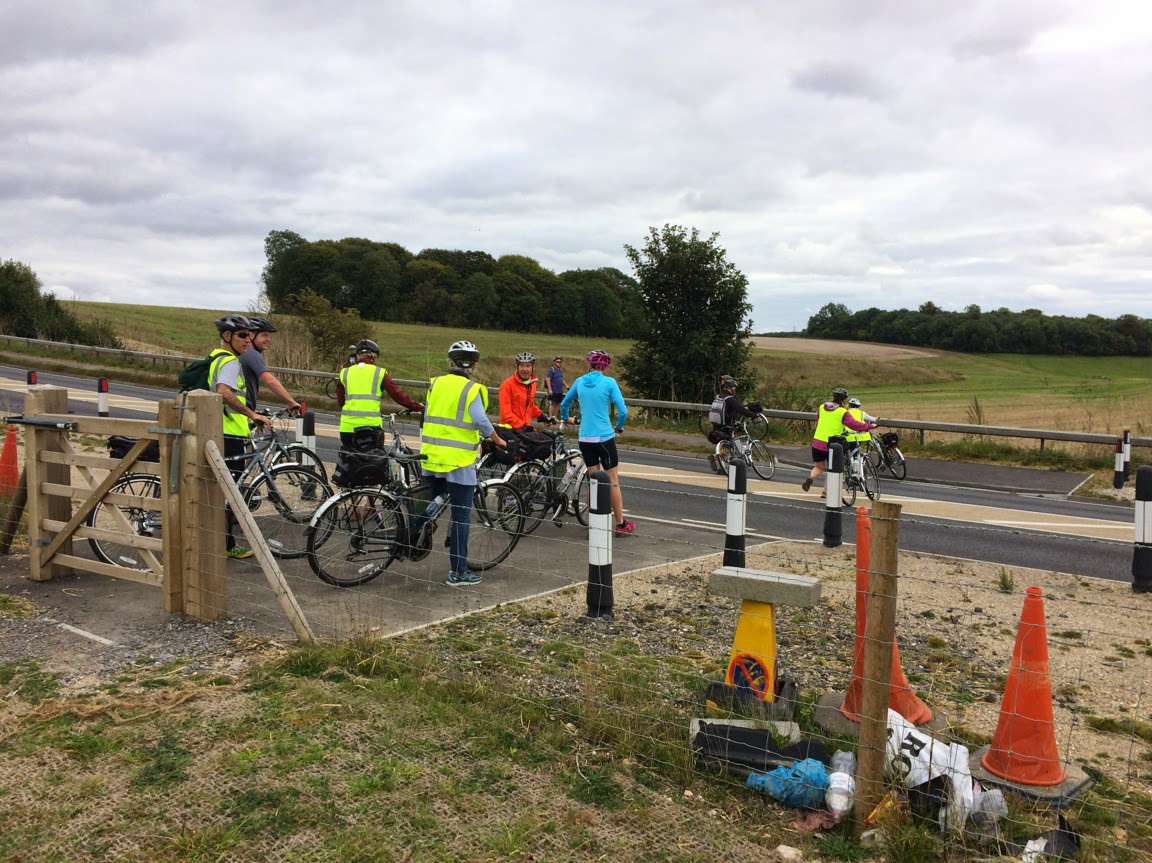 One of them made it to the central strip and an eastbound driver in a grey car slowed and stopped. Remember, it is a Clearway - no stopping.

The cyclists, not quite sure what to do now, all started to move off the verge towards the centre of the A303, but did so very hesitantly. The westbound traffic was still thundering past them with mere inches to spare. It couldn't have been a very pleasant experience.
 White van man from Black Hole Storage Removals clearly didn't give a damn and went roaring through and this carried on for a while until another grey car stopped on the westbound carriageway.
 and finally, the whole group got across safely.
 It could so easily have been very different. But why are things so dangerous?
Well, the people who control the World Heritage Site have a policy of making Stonehenge a more bike (and horse and pedestrian) friendly place. This seemed to be borne-out in the plans for the new visitor's centre submitted by English Heritage. However, despite their intentions and despite planning conditions that mandated a whole raft of measures that would have improved things for cyclists, English Heritage have singularly failed to deliver.
One of the few things that was largely outside the control of English Heritage was an improved crossing at Stonehenge Bottom. On the one hand, increased usage of the crossing point was anticipated by all parties after the closure of the A344, hence the planning requiremnt. However, a spoke was put in the works by the Highways Agency who produced a report - in the way Government Agencies do when they don't want to take action. The conclusion of this report reads as follows:
As a consequence of this, anyone attempting to cross the A303 at Byway 12, Byway 11 or Stonehenge Bottom has to regard themselves as a slice of ham about to be sandwiched between two pieces of steel-reinforced "bread" with a closing speed in excess of 120 mph. Get it wrong and it is going to hurt - briefly, bloodily and almost certainly, finally.
At Byway 12, you have to wait until you can't see vehicles in either direction to have enough time to stroll, not run, across the A303. Running isn't advised, as if you were to fall, you simply wouldn't have time to pick yourself up before the Grim Sandwich Maker appeared. On quiet days, you might have to wait a couple of minutes for a safe gap - there aren't many quiet days any more! On a bad day, you might have to wait 10-15 minutes or even longer to cross in reasonable safety, or simply give it up as a bad job and back track. Too many lose patience and take silly risks...
Today wasn't too bad and I was safely across in under a minute. I rode up to the A344 then onto the temporary permissive path between Byway 12 and Stonehenge Bottom. As I crested the ridge down to Stonehenge Bottom I was confronted by a veritable gaggle of cyclists heading down towards the A303.
The thought of them all trying to cross made my blood run a bit cold as the traffic here is gravity-assisted in both directions and the westbound traffic is still trying to settle scores with other drivers from the 2 lanes into 1 section of the A303, a few hundred meters to the east.
A few cyclists at the front of the group spotted a small gap and either ran or rode across.
They waited, and waited, and waited.
The cyclists, not quite sure what to do now, all started to move off the verge towards the centre of the A303, but did so very hesitantly. The westbound traffic was still thundering past them with mere inches to spare. It couldn't have been a very pleasant experience.
Well, the people who control the World Heritage Site have a policy of making Stonehenge a more bike (and horse and pedestrian) friendly place. This seemed to be borne-out in the plans for the new visitor's centre submitted by English Heritage. However, despite their intentions and despite planning conditions that mandated a whole raft of measures that would have improved things for cyclists, English Heritage have singularly failed to deliver.
One of the few things that was largely outside the control of English Heritage was an improved crossing at Stonehenge Bottom. On the one hand, increased usage of the crossing point was anticipated by all parties after the closure of the A344, hence the planning requiremnt. However, a spoke was put in the works by the Highways Agency who produced a report - in the way Government Agencies do when they don't want to take action. The conclusion of this report reads as follows:
"It is the designer’s view that the current usage of this crossing by pedestrians or by cyclists, on either the
A303 or the A344 routes, does not justify the increased risk to motorised users on the A303 of providing
refuge islands for this crossing. However it is felt that the opportunity to relocate the crossing to the best
location position for NMU visibility and to reduce the crossing width is justified and should be taken.
In taking this view, the designer is taking note of RSA team preference, based on pedestrian rather than cycle use of the crossing, of the do minimum crossing type. The designer is also influenced by the fact that this is far from being the only single carriageway rural at grade crossing of the A303 with no specific NMU facilities, including equestrian crossings.
The proximity of this crossing to the Stonehenge World Heritage site does not currently attract to it significant NMU usage. It is therefore felt that neither the existing usage of the crossing or the last five year’s accident records warrant a different approach here to that taken at other similar crossing locations where the balance of risks between NMU and Motorised Users, and hence the actual overall risk, dictates the level of provision made.
It is therefore recommended that the measures in Option 4 proposals, with the refuge islands removed but all the other measures retained is adopted.
A future scheme for reviewing the crossing arrangements needs to be submitted and approved. The scheme shall have regard to Design Manual for Roads and Bridges HD 19/03 Stage 4 Safety Audit 12 and 36 month post scheme recommendations for any remedial action.
It is felt that the extensive investigation already under taken into the examination of the safety of and the changes to the crossing here proposed satisfies the requirements of the planning condition."
Just for the record, NMUs are non-motorised units - pedestrians, cyclists and horse riders. Cutting out all the crap, what they are actually saying is that the body-count at Stonehenge Bottom is too low to warrant making anything more than superficial changes. However, they go on to suggest that a safety audit at 12 and 36 months might change things if the body count increases.
I don't suppose the contribution by Wiltshire Council helped much either:
Did you spot it? Yes, that's right. Most pedestrians, cyclists and horse riders arriving at Stonehenge don't pitch up at the visitor's centre, as there is (still) no provision for them. They may arrive from east or west, north or south, but we suspect that few, if any, will be invited to take part in the annual visitor survey, conducted for English Heritage by TNS.
In taking this view, the designer is taking note of RSA team preference, based on pedestrian rather than cycle use of the crossing, of the do minimum crossing type. The designer is also influenced by the fact that this is far from being the only single carriageway rural at grade crossing of the A303 with no specific NMU facilities, including equestrian crossings.
The proximity of this crossing to the Stonehenge World Heritage site does not currently attract to it significant NMU usage. It is therefore felt that neither the existing usage of the crossing or the last five year’s accident records warrant a different approach here to that taken at other similar crossing locations where the balance of risks between NMU and Motorised Users, and hence the actual overall risk, dictates the level of provision made.
It is therefore recommended that the measures in Option 4 proposals, with the refuge islands removed but all the other measures retained is adopted.
A future scheme for reviewing the crossing arrangements needs to be submitted and approved. The scheme shall have regard to Design Manual for Roads and Bridges HD 19/03 Stage 4 Safety Audit 12 and 36 month post scheme recommendations for any remedial action.
It is felt that the extensive investigation already under taken into the examination of the safety of and the changes to the crossing here proposed satisfies the requirements of the planning condition."
Just for the record, NMUs are non-motorised units - pedestrians, cyclists and horse riders. Cutting out all the crap, what they are actually saying is that the body-count at Stonehenge Bottom is too low to warrant making anything more than superficial changes. However, they go on to suggest that a safety audit at 12 and 36 months might change things if the body count increases.
I don't suppose the contribution by Wiltshire Council helped much either:
"...that in relation to cycle usage their
preferred route between the A344 to the north and Amesbury for cyclists was via the countess roundabout
underpass crossing of the A303 and than via Lark Hill." (all the typos and grammatical errors are courtesy of the Highways Agency!)
As usual with Wiltshire Council when it comes to anything in the south of the county - thumbs up bums and brains in neutral all the way. No-one in their right minds, who knew about the local area, would ever choose to get from the centre of Amesbury to Stonehenge by heading north, through the scrofulous Countess Roundabout underpass (on foot - as cycling is forbidden on this bit of the cycle route), up Countess Road, being harassed by rat-running motorists, then head west to Larkhill along the rat-run of choice for coaches and HGVs, before eventually getting to the northern end of Byway 12.
Most sensible folk will simply head out to West Amesbury, up to the A303 and then to Stonehenge Bottom and the A344 - no need to ride with high speed traffic at all - just dice with death crossing the A303. That's what they've always done, that's what they were doing today and that's what they will do until the A303 issue is resolved once and for all.
Of course, there was a fall-back plan to monitor the situation. Here it is. Read it carefully and spot the flaw:
STONEHENGE ENVIRONMENTAL IMPROVEMENTS PROJECT
Planning Application Reference S/2009/1527
Scheme required under planning condition 27 for reviewing pedestrian and cycle route access arrangements along the whole of the A344, and crossing arrangements at the A303 (Stonehenge Bottom)
Following approval of the details of the pedestrian and cycle route access arrangements along the whole of the A344 and crossing arrangements at the A303 (Stonehenge Bottom), English Heritage will co-operate with the Local Highways Authority, Highways Agency and the Local Planning Authority in reviewing the arrangements. In particular, should a formal Stage 4 Safety Audit be carried out, and any recommendations for remedial action be made in the 12 and 36 month Stage 4 Reports submitted to English Heritage and the other organisations, then any required remedial works, and arrangements for their implementation and funding, will be considered and agreed between English Heritage, the Local Highways Authority, the Local Planning Authority and the Highways Agency, as appropriate.
In addition, English Heritage will carry out the following:
-
- Incorporate questions about the pedestrian and cycle access into the annual
visitor survey conducted by the travel and tourism department of market
research company TNS. This will comprise face to face interviews with 180
individuals during the months of July, August and September. Likely questions
include: whether people have accessed the site on foot or on bicycle, and, if so,
where they have travelled from, how satisfactory they have found the route and
where they are travelling onto.
-
- As part of the ongoing operational management of the site English Heritage staff
will, as a matter of course, record, report to the relevant authorities and, if
appropriate, take any necessary action in respect of any incidents or accidents
along the route of the A344 between Airman's Corner and Stonehenge Bottom.
English Heritage 26th April 2012
During my many visits to the WHS this July August and September I've never seen anyone with a clipboard interviewing pedestrians, cyclists and the two riders I have seen, nor have I ever been approached. Now that's interesting, if true because this safety audit is meant to be looking at the safety of crossing the A303 by any and all users, not just English Heritage's paying customers.
As I say, we don't know for certain that this is the case, but I feel an FOIA request ,or two, coming on!
Subscribe to:
Posts (Atom)