Yesterday was one of those days. First, some sort of post New Year
brainstorm had affected several people in relation to the A303. Back on
the 16th of December, Highways England had posted a Tweet on their A303 Twitter
feed showing that it was quicker to leave the A303 at Countess
Roundabout, travel north to the Packway, then west through Larkhill;
finally turning South at Rollestone Crossroads, over the Airnman's
Cross roundabout at the entrance to the Stonehenge visitor centre before
finally rejoining the A303 at Longbarrow Roundabout.
As far as we are aware, this
is a very long-standing diversionary route for when the A303 comes to a
standstill; particularly in the case of accidents. It's also a fact of life that most modern and up to date SatNavs would offer this alternative, when traffic delays on the A303 exceed a certain level.
In fact, this route
was the only possible route west a few days later on 23rd December,
following a dreadful fatal accident. So the reality is that Highways
England was, unwittingly perhaps, doing a great service by pointing out
the diversion. Moreover, the diversion offered goes through no local
villages, touching only the outskirts of Durrington and passing through
the military town of Larkhill. In particular, it goes nowhere near the
village of Shrewton
What happened next was rather
bizarre and surprising as BBC Wiltshire ran a story conflating the
Highways England Tweet, with the results of a traffic census run in
Shrewton a couple of months earlier. The clear thrust of this radio
news item and subsequent newspaper articles was that the Highways Agency
Tweet had driven traffic into and through Shrewton and other local
villages - utter baloney.
Only people leaving the A303 and disregarding
the Highways Agency alternative could have ended up in Shrewton - most
likely these were either folks relying on out of date SatNavs or locals
avoiding the A303.
So the articles have been
disingenuous in the extreme and by being so have actively detracted from
the real problem of rat-running in Shrewton - the need to re-engineer
Rollestone Crossroads to deter the majority of those now using the B3086
west of Rollestone from doing so, and to encourage them to follow the
route shown above. Traffic calming measures into Shrewton on the B3086 are also desperately needed. Now that really would reduce rat running in local villages and these measiures are needed NOW. If only Wiltshire Council would de-digitate!
Second, after all this idiocy we did get a bit of real news at a STAG meeting yesterday evening. The A303 consultation is about to begin.
For far too long Winterbourne Stoke and other villages in the area have been blighted by the A303 traffic problems. Now a bypass seems imminent and the emphasis has shifted to make sure we get the best route preference the village.
Showing posts with label Larkhill. Show all posts
Friday, 6 January 2017
Wednesday, 1 October 2014
Stonehenge: A Few Scary Moments On The A303 At Stonehenge Bottom
Earlier today, I went for a bike ride to clear my head and for the last part, I rode north-eastwards along Byway 12, to the A303. Crossing the A303 is never easy and you need to have your wits about you. Putting it bluntly, when you cross the A303 here, you have to remember that the great travelling public aren't really thinking that they might encounter people by the roadside. Why on earth would there be people close to one of the wonders of the World; I ask you?
As a consequence of this, anyone attempting to cross the A303 at Byway 12, Byway 11 or Stonehenge Bottom has to regard themselves as a slice of ham about to be sandwiched between two pieces of steel-reinforced "bread" with a closing speed in excess of 120 mph. Get it wrong and it is going to hurt - briefly, bloodily and almost certainly, finally.
At Byway 12, you have to wait until you can't see vehicles in either direction to have enough time to stroll, not run, across the A303. Running isn't advised, as if you were to fall, you simply wouldn't have time to pick yourself up before the Grim Sandwich Maker appeared. On quiet days, you might have to wait a couple of minutes for a safe gap - there aren't many quiet days any more! On a bad day, you might have to wait 10-15 minutes or even longer to cross in reasonable safety, or simply give it up as a bad job and back track. Too many lose patience and take silly risks...
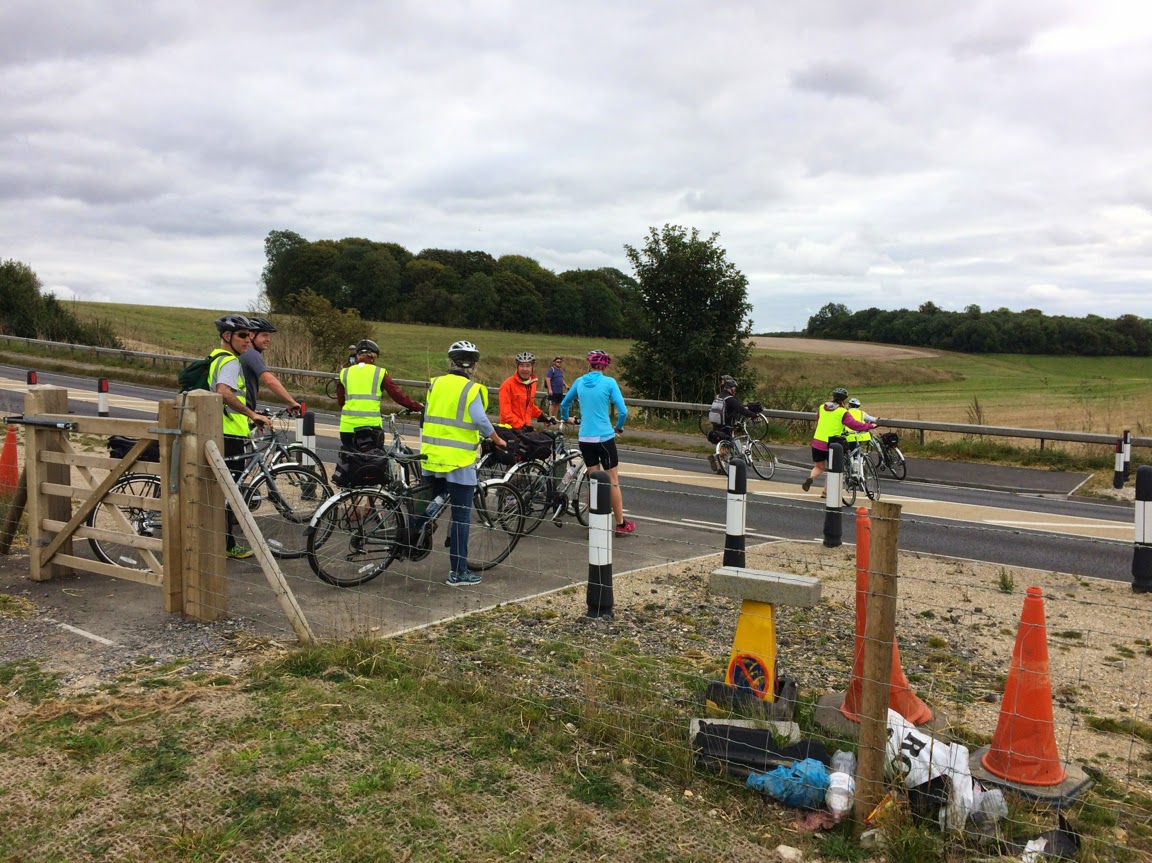
Today wasn't too bad and I was safely across in under a minute. I rode up to the A344 then onto the temporary permissive path between Byway 12 and Stonehenge Bottom. As I crested the ridge down to Stonehenge Bottom I was confronted by a veritable gaggle of cyclists heading down towards the A303.
They were a nice friendly bunch and I explained that I was part of STAG and what we were about and please could I take photos of them if they were trying to cross. They were happy for me to do so, so here is a short vignette of what happened next.
The thought of them all trying to cross made my blood run a bit cold as the traffic here is gravity-assisted in both directions and the westbound traffic is still trying to settle scores with other drivers from the 2 lanes into 1 section of the A303, a few hundred meters to the east.
A few cyclists at the front of the group spotted a small gap and either ran or rode across.
Most of them didn't get the opportunity and there was steady stream of fast-moving traffic in both directions on what is, at this point a Clearway, not that anyone gives a tuppeny-damn about the Highway Code these days!
They waited, and waited, and waited.
When a westbound gap appeared they moved forward, then back again as it disappeared.
One of them made it to the central strip and an eastbound driver in a grey car slowed and stopped. Remember, it is a Clearway - no stopping.
The cyclists, not quite sure what to do now, all started to move off the verge towards the centre of the A303, but did so very hesitantly. The westbound traffic was still thundering past them with mere inches to spare. It couldn't have been a very pleasant experience.
White van man from Black Hole Storage Removals clearly didn't give a damn and went roaring through and this carried on for a while until another grey car stopped on the westbound carriageway.
and finally, the whole group got across safely.
It could so easily have been very different. But why are things so dangerous?
Well, the people who control the World Heritage Site have a policy of making Stonehenge a more bike (and horse and pedestrian) friendly place. This seemed to be borne-out in the plans for the new visitor's centre submitted by English Heritage. However, despite their intentions and despite planning conditions that mandated a whole raft of measures that would have improved things for cyclists, English Heritage have singularly failed to deliver.
One of the few things that was largely outside the control of English Heritage was an improved crossing at Stonehenge Bottom. On the one hand, increased usage of the crossing point was anticipated by all parties after the closure of the A344, hence the planning requiremnt. However, a spoke was put in the works by the Highways Agency who produced a report - in the way Government Agencies do when they don't want to take action. The conclusion of this report reads as follows:
As a consequence of this, anyone attempting to cross the A303 at Byway 12, Byway 11 or Stonehenge Bottom has to regard themselves as a slice of ham about to be sandwiched between two pieces of steel-reinforced "bread" with a closing speed in excess of 120 mph. Get it wrong and it is going to hurt - briefly, bloodily and almost certainly, finally.
At Byway 12, you have to wait until you can't see vehicles in either direction to have enough time to stroll, not run, across the A303. Running isn't advised, as if you were to fall, you simply wouldn't have time to pick yourself up before the Grim Sandwich Maker appeared. On quiet days, you might have to wait a couple of minutes for a safe gap - there aren't many quiet days any more! On a bad day, you might have to wait 10-15 minutes or even longer to cross in reasonable safety, or simply give it up as a bad job and back track. Too many lose patience and take silly risks...
Today wasn't too bad and I was safely across in under a minute. I rode up to the A344 then onto the temporary permissive path between Byway 12 and Stonehenge Bottom. As I crested the ridge down to Stonehenge Bottom I was confronted by a veritable gaggle of cyclists heading down towards the A303.
The thought of them all trying to cross made my blood run a bit cold as the traffic here is gravity-assisted in both directions and the westbound traffic is still trying to settle scores with other drivers from the 2 lanes into 1 section of the A303, a few hundred meters to the east.
A few cyclists at the front of the group spotted a small gap and either ran or rode across.
Most of them didn't get the opportunity and there was steady stream of fast-moving traffic in both directions on what is, at this point a Clearway, not that anyone gives a tuppeny-damn about the Highway Code these days!
They waited, and waited, and waited.
When a westbound gap appeared they moved forward, then back again as it disappeared.
One of them made it to the central strip and an eastbound driver in a grey car slowed and stopped. Remember, it is a Clearway - no stopping.
The cyclists, not quite sure what to do now, all started to move off the verge towards the centre of the A303, but did so very hesitantly. The westbound traffic was still thundering past them with mere inches to spare. It couldn't have been a very pleasant experience.
White van man from Black Hole Storage Removals clearly didn't give a damn and went roaring through and this carried on for a while until another grey car stopped on the westbound carriageway.
and finally, the whole group got across safely.
It could so easily have been very different. But why are things so dangerous?
Well, the people who control the World Heritage Site have a policy of making Stonehenge a more bike (and horse and pedestrian) friendly place. This seemed to be borne-out in the plans for the new visitor's centre submitted by English Heritage. However, despite their intentions and despite planning conditions that mandated a whole raft of measures that would have improved things for cyclists, English Heritage have singularly failed to deliver.
One of the few things that was largely outside the control of English Heritage was an improved crossing at Stonehenge Bottom. On the one hand, increased usage of the crossing point was anticipated by all parties after the closure of the A344, hence the planning requiremnt. However, a spoke was put in the works by the Highways Agency who produced a report - in the way Government Agencies do when they don't want to take action. The conclusion of this report reads as follows:
"It is the designer’s view that the current usage of this crossing by pedestrians or by cyclists, on either the
A303 or the A344 routes, does not justify the increased risk to motorised users on the A303 of providing
refuge islands for this crossing. However it is felt that the opportunity to relocate the crossing to the best
location position for NMU visibility and to reduce the crossing width is justified and should be taken.
In taking this view, the designer is taking note of RSA team preference, based on pedestrian rather than cycle use of the crossing, of the do minimum crossing type. The designer is also influenced by the fact that this is far from being the only single carriageway rural at grade crossing of the A303 with no specific NMU facilities, including equestrian crossings.
The proximity of this crossing to the Stonehenge World Heritage site does not currently attract to it significant NMU usage. It is therefore felt that neither the existing usage of the crossing or the last five year’s accident records warrant a different approach here to that taken at other similar crossing locations where the balance of risks between NMU and Motorised Users, and hence the actual overall risk, dictates the level of provision made.
It is therefore recommended that the measures in Option 4 proposals, with the refuge islands removed but all the other measures retained is adopted.
A future scheme for reviewing the crossing arrangements needs to be submitted and approved. The scheme shall have regard to Design Manual for Roads and Bridges HD 19/03 Stage 4 Safety Audit 12 and 36 month post scheme recommendations for any remedial action.
It is felt that the extensive investigation already under taken into the examination of the safety of and the changes to the crossing here proposed satisfies the requirements of the planning condition."
Just for the record, NMUs are non-motorised units - pedestrians, cyclists and horse riders. Cutting out all the crap, what they are actually saying is that the body-count at Stonehenge Bottom is too low to warrant making anything more than superficial changes. However, they go on to suggest that a safety audit at 12 and 36 months might change things if the body count increases.
I don't suppose the contribution by Wiltshire Council helped much either:
Did you spot it? Yes, that's right. Most pedestrians, cyclists and horse riders arriving at Stonehenge don't pitch up at the visitor's centre, as there is (still) no provision for them. They may arrive from east or west, north or south, but we suspect that few, if any, will be invited to take part in the annual visitor survey, conducted for English Heritage by TNS.
In taking this view, the designer is taking note of RSA team preference, based on pedestrian rather than cycle use of the crossing, of the do minimum crossing type. The designer is also influenced by the fact that this is far from being the only single carriageway rural at grade crossing of the A303 with no specific NMU facilities, including equestrian crossings.
The proximity of this crossing to the Stonehenge World Heritage site does not currently attract to it significant NMU usage. It is therefore felt that neither the existing usage of the crossing or the last five year’s accident records warrant a different approach here to that taken at other similar crossing locations where the balance of risks between NMU and Motorised Users, and hence the actual overall risk, dictates the level of provision made.
It is therefore recommended that the measures in Option 4 proposals, with the refuge islands removed but all the other measures retained is adopted.
A future scheme for reviewing the crossing arrangements needs to be submitted and approved. The scheme shall have regard to Design Manual for Roads and Bridges HD 19/03 Stage 4 Safety Audit 12 and 36 month post scheme recommendations for any remedial action.
It is felt that the extensive investigation already under taken into the examination of the safety of and the changes to the crossing here proposed satisfies the requirements of the planning condition."
Just for the record, NMUs are non-motorised units - pedestrians, cyclists and horse riders. Cutting out all the crap, what they are actually saying is that the body-count at Stonehenge Bottom is too low to warrant making anything more than superficial changes. However, they go on to suggest that a safety audit at 12 and 36 months might change things if the body count increases.
I don't suppose the contribution by Wiltshire Council helped much either:
"...that in relation to cycle usage their
preferred route between the A344 to the north and Amesbury for cyclists was via the countess roundabout
underpass crossing of the A303 and than via Lark Hill." (all the typos and grammatical errors are courtesy of the Highways Agency!)
As usual with Wiltshire Council when it comes to anything in the south of the county - thumbs up bums and brains in neutral all the way. No-one in their right minds, who knew about the local area, would ever choose to get from the centre of Amesbury to Stonehenge by heading north, through the scrofulous Countess Roundabout underpass (on foot - as cycling is forbidden on this bit of the cycle route), up Countess Road, being harassed by rat-running motorists, then head west to Larkhill along the rat-run of choice for coaches and HGVs, before eventually getting to the northern end of Byway 12.
Most sensible folk will simply head out to West Amesbury, up to the A303 and then to Stonehenge Bottom and the A344 - no need to ride with high speed traffic at all - just dice with death crossing the A303. That's what they've always done, that's what they were doing today and that's what they will do until the A303 issue is resolved once and for all.
Of course, there was a fall-back plan to monitor the situation. Here it is. Read it carefully and spot the flaw:
As usual with Wiltshire Council when it comes to anything in the south of the county - thumbs up bums and brains in neutral all the way. No-one in their right minds, who knew about the local area, would ever choose to get from the centre of Amesbury to Stonehenge by heading north, through the scrofulous Countess Roundabout underpass (on foot - as cycling is forbidden on this bit of the cycle route), up Countess Road, being harassed by rat-running motorists, then head west to Larkhill along the rat-run of choice for coaches and HGVs, before eventually getting to the northern end of Byway 12.
Most sensible folk will simply head out to West Amesbury, up to the A303 and then to Stonehenge Bottom and the A344 - no need to ride with high speed traffic at all - just dice with death crossing the A303. That's what they've always done, that's what they were doing today and that's what they will do until the A303 issue is resolved once and for all.
Of course, there was a fall-back plan to monitor the situation. Here it is. Read it carefully and spot the flaw:
STONEHENGE ENVIRONMENTAL IMPROVEMENTS PROJECT
Planning Application Reference S/2009/1527
Scheme required under planning condition 27 for reviewing pedestrian and cycle route access arrangements along the whole of the A344, and crossing arrangements at the A303 (Stonehenge Bottom)
Following approval of the details of the pedestrian and cycle route access arrangements along the whole of the A344 and crossing arrangements at the A303 (Stonehenge Bottom), English Heritage will co-operate with the Local Highways Authority, Highways Agency and the Local Planning Authority in reviewing the arrangements. In particular, should a formal Stage 4 Safety Audit be carried out, and any recommendations for remedial action be made in the 12 and 36 month Stage 4 Reports submitted to English Heritage and the other organisations, then any required remedial works, and arrangements for their implementation and funding, will be considered and agreed between English Heritage, the Local Highways Authority, the Local Planning Authority and the Highways Agency, as appropriate.
In addition, English Heritage will carry out the following:
Scheme required under planning condition 27 for reviewing pedestrian and cycle route access arrangements along the whole of the A344, and crossing arrangements at the A303 (Stonehenge Bottom)
Following approval of the details of the pedestrian and cycle route access arrangements along the whole of the A344 and crossing arrangements at the A303 (Stonehenge Bottom), English Heritage will co-operate with the Local Highways Authority, Highways Agency and the Local Planning Authority in reviewing the arrangements. In particular, should a formal Stage 4 Safety Audit be carried out, and any recommendations for remedial action be made in the 12 and 36 month Stage 4 Reports submitted to English Heritage and the other organisations, then any required remedial works, and arrangements for their implementation and funding, will be considered and agreed between English Heritage, the Local Highways Authority, the Local Planning Authority and the Highways Agency, as appropriate.
In addition, English Heritage will carry out the following:
-
- Incorporate questions about the pedestrian and cycle access into the annual
visitor survey conducted by the travel and tourism department of market
research company TNS. This will comprise face to face interviews with 180
individuals during the months of July, August and September. Likely questions
include: whether people have accessed the site on foot or on bicycle, and, if so,
where they have travelled from, how satisfactory they have found the route and
where they are travelling onto.
-
- As part of the ongoing operational management of the site English Heritage staff
will, as a matter of course, record, report to the relevant authorities and, if
appropriate, take any necessary action in respect of any incidents or accidents
along the route of the A344 between Airman's Corner and Stonehenge Bottom.
English Heritage 26th April 2012
During my many visits to the WHS this July August and September I've never seen anyone with a clipboard interviewing pedestrians, cyclists and the two riders I have seen, nor have I ever been approached. Now that's interesting, if true because this safety audit is meant to be looking at the safety of crossing the A303 by any and all users, not just English Heritage's paying customers.
As I say, we don't know for certain that this is the case, but I feel an FOIA request ,or two, coming on!
Friday, 25 July 2014
Four Thousand Holes in Blackburn Lancashire, Four Hundred Cameras Around Shrewton, Wiltshire
I do have to apologise to the memory of the late and great John Lennon for abusing the lyrics of "A Day in the Life" but I simply couldn't resist drawing the analogy.
Yesterday, the Salisbury Journal published a very interesting article on the A303 entitled simply: "A303 traffic survey to be carried out"
Basically, the story explains that Atkins, the traffic management consultancy will be placing number plate recognition cameras along the A303 and on surrounding roads as part of a scheme to track vehicle movements on the traffic-choked highway.The Journal article claims that there will be hundreds of these cameras on the surrounding roads, but we suspect that this might be something of an exaggeration and that perhaps 10-20 NPR cameras might be closer to the mark.
Winterbourne Stoke resident, Chairman of the parish council and Wiltshire councillor Ian West observed: "Residents of Shrewton believe the speed and volume of traffic in Shrewton has been made worse by the closure of the A344.
One of the main concerns expressed by local residents is the speed and volume of traffic, it is quoted as one of the main safety factors which people see as a barrier to travelling around their communities on foot or by bicycle or to letting children travel independently. This has very much affected the quality of life in Shrewton.
We very much look forward to the results of the Atkins survey because the increase in traffic is becoming unbearable in Shrewton and the surrounding villages both sides of the A303.”
Of course, it isn't just Shrewton or indeed the residents here in Winterbourne Stoke who are suffering as a result of the A344 closure. We (WiSBAng) and the Stonhenge Traffic Action Group (STAG), regularly hear of problems being caused as far afield as Berwick St James, Larkhill, Durrington, Bulford and Amesbury.
Although we wholeheartedly welcome this new initiative and data-gathering exercise, we feel duty-bound to point out something that some might think verges on negligence on the part of Wiltshire Council. Over the last two decades and more, every bit of traffic modelling undertaken on the A303 corridor, some of it commissioned by Wiltshire Council, predicted that there would be traffic chaos in the surrounding villages if the A344 were to be closed BEFORE the A303 was upgraded. For years, Wiltshire Council resisted the closure of the A344 on those grounds, then in 2010/2011 they did an about face and sided with English Heritage in pushing for the closure.
Surprise, surprise. The A344 was closed and all the traffic models were proved correct.
Now any competent authority would have undertaken a survey such as that being carried out by Atkins between Monday, August 4th and Sunday, August 10th prior to closing the A344, then do the same again after the closure to ensure the changes had had no adverse effects and to be able to quantify the changes with hard data. That would have been far too sensible and of course it might have run the risk of exposing, in irrefutable terms, that a mistake had been made in closing the A344 prematurely. That would never do, would it?
As it is, when Atkins report their findings we will know how bad the situation on all these local roads is, but in the absence of knowing what they were like in quantitative terms before the A344 closure, it is impossible to say how much worse they have become. We can make some estimates based on earlier surveys, but on fewer roads, using somewhat different methodologies; that's far from ideal.
Yesterday, the Salisbury Journal published a very interesting article on the A303 entitled simply: "A303 traffic survey to be carried out"
Basically, the story explains that Atkins, the traffic management consultancy will be placing number plate recognition cameras along the A303 and on surrounding roads as part of a scheme to track vehicle movements on the traffic-choked highway.The Journal article claims that there will be hundreds of these cameras on the surrounding roads, but we suspect that this might be something of an exaggeration and that perhaps 10-20 NPR cameras might be closer to the mark.
Winterbourne Stoke resident, Chairman of the parish council and Wiltshire councillor Ian West observed: "Residents of Shrewton believe the speed and volume of traffic in Shrewton has been made worse by the closure of the A344.
One of the main concerns expressed by local residents is the speed and volume of traffic, it is quoted as one of the main safety factors which people see as a barrier to travelling around their communities on foot or by bicycle or to letting children travel independently. This has very much affected the quality of life in Shrewton.
We very much look forward to the results of the Atkins survey because the increase in traffic is becoming unbearable in Shrewton and the surrounding villages both sides of the A303.”
Of course, it isn't just Shrewton or indeed the residents here in Winterbourne Stoke who are suffering as a result of the A344 closure. We (WiSBAng) and the Stonhenge Traffic Action Group (STAG), regularly hear of problems being caused as far afield as Berwick St James, Larkhill, Durrington, Bulford and Amesbury.
Although we wholeheartedly welcome this new initiative and data-gathering exercise, we feel duty-bound to point out something that some might think verges on negligence on the part of Wiltshire Council. Over the last two decades and more, every bit of traffic modelling undertaken on the A303 corridor, some of it commissioned by Wiltshire Council, predicted that there would be traffic chaos in the surrounding villages if the A344 were to be closed BEFORE the A303 was upgraded. For years, Wiltshire Council resisted the closure of the A344 on those grounds, then in 2010/2011 they did an about face and sided with English Heritage in pushing for the closure.
Surprise, surprise. The A344 was closed and all the traffic models were proved correct.
Now any competent authority would have undertaken a survey such as that being carried out by Atkins between Monday, August 4th and Sunday, August 10th prior to closing the A344, then do the same again after the closure to ensure the changes had had no adverse effects and to be able to quantify the changes with hard data. That would have been far too sensible and of course it might have run the risk of exposing, in irrefutable terms, that a mistake had been made in closing the A344 prematurely. That would never do, would it?
As it is, when Atkins report their findings we will know how bad the situation on all these local roads is, but in the absence of knowing what they were like in quantitative terms before the A344 closure, it is impossible to say how much worse they have become. We can make some estimates based on earlier surveys, but on fewer roads, using somewhat different methodologies; that's far from ideal.
Labels:
A303,
A344,
Amesbury,
Atkins,
Bulford,
Durrington,
Highways Agency,
Larkhill,
Salisbury Journal,
Shrewton,
Shrewton Traffic Action Group,
Wiltshire Council,
Winterbourne Stoke,
WiSBAng
Sunday, 5 January 2014
What Wiltshire Council Told the Transport Minister in 2011
There have been several comments, here and on the STAG Facebook page, regarding traffic surveys, their findings and what various stakeholders understood. Several folks are still under the mistaken impression that closure of the A344 wasn't expected to cause traffic chaos. We thought it might be helpful to let everyone see the key reports and documents that should have been taken notice of at the time they were produced, and subsequently, and which have been ignored, or reneged upon.
So here is our first document of 2014. What Wiltshire Council then told Tom Harris, the the Minister for Transport.
The whole letter is very useful as it lays out the policy of Wiltshire Council in 2011. The focus is on the improvement of the A303. The bottom line is shown in the text surrounded by the first red box. In 2011, Wiltshire Council did not support the closure of the A344 without an improvement to the A303, precisely because of the impact they expected such a move to have on local communities.
It is of considerable concern to us that Wiltshire Council was not being kept informed of the latest traffic surveys being undertaken by the Highways Agency. Despite this, and with the foreknowledge of the results of earlier traffic studies, Wiltshire Council reinforced their concerns about the consequences of closure of the A344 in isolation.
Then something happened.
Wiltshire Council changed its policy and, seemingly, allowed the A344 closure to go ahead last year without so much as a whimper. We've been trying to understand why. Who made the decision to change the policy so strongly expressed in 2011 and who supported that change. We are also interested in knowing if any of those involved in the about face had, or have, any connections to those stakeholders who have benefited directly, or indirectly, from the A344 closure.
We've asked Wiltshire Council to explain when this policy changed in several ways, but they are proving hard to pin down. We even invited Cllr Fleur de Rhé-Phillipe, Wiltshire Council's Cabinet Member for Economy, Skills and Transport, to provide an explanation - first in October 2013 by email and then again in early December. in her first and only response, the good councillor clearly missed this question, so we restated it in a follow-up email. We didn't even get the courtesy of a reply.
Given that we (WiSBAng, STAG and others) are going to be engaging with other stakeholders during the forthcoming A303 feasibility study, we are going to want to know what Wiltshire Council's A303 policy is, and whose word is to be believed.
We also need to understand whether the elected officials of Wiltshire Council and its employees speak with one voice. Why? Well this document from 2005 is pretty self-explanatory (click on document to expand it):
We are particularly taken by the author's apparent relish at dividing [local] opposition - turning Larkhill and Shrewton against Winterbourne Stoke for instance. That's something we are going to be very aware of this time round and why it is encouraging to see the local villages rallying round and pulling together. It's worth reflecting that some of the officials associated with this document are likely to be involved in 2014-15. We will be watching them closely.
The problems associated with the A303, the A344 closure and the consequent rat-running are already going on in our back yards. There can be no room for NIMBY-ism here, we are already IMBYs!
So here is our first document of 2014. What Wiltshire Council then told Tom Harris, the the Minister for Transport.
The whole letter is very useful as it lays out the policy of Wiltshire Council in 2011. The focus is on the improvement of the A303. The bottom line is shown in the text surrounded by the first red box. In 2011, Wiltshire Council did not support the closure of the A344 without an improvement to the A303, precisely because of the impact they expected such a move to have on local communities.
It is of considerable concern to us that Wiltshire Council was not being kept informed of the latest traffic surveys being undertaken by the Highways Agency. Despite this, and with the foreknowledge of the results of earlier traffic studies, Wiltshire Council reinforced their concerns about the consequences of closure of the A344 in isolation.
Then something happened.
Wiltshire Council changed its policy and, seemingly, allowed the A344 closure to go ahead last year without so much as a whimper. We've been trying to understand why. Who made the decision to change the policy so strongly expressed in 2011 and who supported that change. We are also interested in knowing if any of those involved in the about face had, or have, any connections to those stakeholders who have benefited directly, or indirectly, from the A344 closure.
We've asked Wiltshire Council to explain when this policy changed in several ways, but they are proving hard to pin down. We even invited Cllr Fleur de Rhé-Phillipe, Wiltshire Council's Cabinet Member for Economy, Skills and Transport, to provide an explanation - first in October 2013 by email and then again in early December. in her first and only response, the good councillor clearly missed this question, so we restated it in a follow-up email. We didn't even get the courtesy of a reply.
Given that we (WiSBAng, STAG and others) are going to be engaging with other stakeholders during the forthcoming A303 feasibility study, we are going to want to know what Wiltshire Council's A303 policy is, and whose word is to be believed.
We also need to understand whether the elected officials of Wiltshire Council and its employees speak with one voice. Why? Well this document from 2005 is pretty self-explanatory (click on document to expand it):
We are particularly taken by the author's apparent relish at dividing [local] opposition - turning Larkhill and Shrewton against Winterbourne Stoke for instance. That's something we are going to be very aware of this time round and why it is encouraging to see the local villages rallying round and pulling together. It's worth reflecting that some of the officials associated with this document are likely to be involved in 2014-15. We will be watching them closely.
The problems associated with the A303, the A344 closure and the consequent rat-running are already going on in our back yards. There can be no room for NIMBY-ism here, we are already IMBYs!
Subscribe to:
Posts (Atom)