Saturday, 20 December 2014

Tutt Tutt - Blinkered Views and Lack of Academic Rigour

In the last post, we suggested that the fruit-loops were coming out to play, as indeed some did.  This month has seen a bunch of academics and antiquarians pushing the most egregious example of illogical thinking I have seen in a long time.

Today, the Daily Telegraph carried an article about three such individuals, Mr David Jacques of the University of Buckingham, Prof Tim Darvill of Bournemouth University and Andy Rhind-Tutt of the Amesbury Museum and Heritage Trust spouting an awful lot of claptrap-dressed up as science regarding the discovery of the latest-dated Mesolithic encampment ever found in the UK at a site a mile and a half to the south of Stonehenge at a place called Blick Mead.  Indeed, if I was a Vice Chancellor at either of these universities I would be asking some serious questions about the logical reasoning abilities and lack of academic rigour of some of my staff.

There is no doubt that the discovery at Blick Mead is interesting, it certainly is, but the arguments put forward by the academics are facile and disingenuous in the extreme.  Firstly. they posit that the proposed A303 tunnel, a mile and half away, is going to have an instant and massive detrimental effect to the archaeology, whereas the 6,000 years of development much closer to the Blick Mead site, and also impacting on the local water table - such as construction and redevelopment of the town of Amesbury itself, the massive developments at Solstice Park the runway at Boscombe Down (to be fair, 2 miles from Blick Mead) and even the A303 itself - have had no discernible impact on the archaeology.

Second, even if a tunnel were to adversely impact on this new archaeology, does it matter?  Well, only if the periods of history and pre-history favoured by Jacques, Darvill and Rhind-Tutt are the be-all-and-end-all of archaeology; which of course they are not.  The reality is very different of course, as everything that happened prior to you reading this line, happened in the past - whether it it was 10,000 years ago or 10 femtoseconds ago - it is all worthy of study by archaeologists.  All of it is important and all of it valuable, but to suggest one element is more important than another is arrogance in the extreme.  Importance is purely a matter of opinion - not fact.

Third, as someone with an interest in more recent history, I could equally argue that the role of the World Heritage Site and its environs, from 1914 to the present day, is of much greater national and international importance because of its involvement in WWI and WWII and thus national survival and the preservation of the free-world, than are any other events or structures in the area. I could argue that, but my argument would be as irrelevant and ill-considered as the arguments of Jacques, Darvill and Rhind Tutt.

You could look at all this another way - and perhaps we should.  Things that are planned and built today become the archaeological sites of tomorrow.  That would, of course, include any tunnel to bypass Stonehenge.  It's fame is already global and it isn't yet built.  Picture a time several thousand years past when someone had the inspiration to build something unique in wood on a greenfield site north west of Amesbury.  There were probably a bunch of naysayers complaining about loss of open-space amenities such as grazing or hunting, and their descendants millennia later were still bitching on about the evils of change when the wood was replaced with stone and the stones were re-arranged.  Change never suits everyone.

However, if it wasn't for change, for man shaping his environment to meet his current and future needs, there would be no science of archaeology at all.  Ironic that isn't it; the obsession with preserving the past prevents change and the creation of history.

It also means that, no matter where you were to stuff the A303 - along, its current line, or north, or south of it, it is going to affect some archaeology, all of it important to someone - unless it goes through somewhere that has never felt the touch of the hand of man.  To be honest, the only place where this can be pretty much guaranteed in the WHS is - yes - underground.  A tunnel of such magnificent proportions that it dwarfs its antecedents - a man-made wonder of the 21st century and piece of premier archaeology of the future.  What better legacy for a World Heritage Site.

Now, how about the red algae, Hildenbrandia rivularis, found at Blick Mead that gives the flint a pink appearance.  It's unusual in the UK, but it is found throughout Europe and beyond, most frequently, it would seem, in countries and regions with a high degree of forestation and little farming.  That rather begs the question if the reason it is so unusual in the UK is simply down to the level of deforestation and agriculture.  When you dig a little deeper into the story, yet again, there is a degree of selectivity in the facts that are presented.  Yes, Hildenbrandia rivularis is very dependent on warmish hard water, but it is also very, very sensitive to phosphate levels in the water, phosphates that are applied to farmland all around Stonehenge, phosphates that arise from human and animal waste across the catchment area, phosphates that leach out of graveyards often located close to streams and rivers.  Perhaps we should replant Salisbury Plain with trees,  depopulate the whole area, disinter the dead and ban all forms of farming?

There is an even more bizarre possible explanation for Hildenbrandia rivularis being at Blick Mead - the building of Stonehenge itself.  How is that possible?  Well, when you look at the distribution of this algae round the UK, it is most common in Yorkshire and the east and west of Wales.  The map below shows the distribution, though apologies for the small size of the dots.  I'm sure you will note that the sites in west Wales are very close to Carn Goedog, the site of origin of Stonehenge's Blue stones.  So, there is a chance that the Hildenbrandia rivularis hitched a ride on the stones as they made their way the 160 miles to Stonehenge.  That would, of course, mean they are an introduced species and, some would say, ought to be exterminated.


As for Mr Rhind-Tutt and his tall tale of a "tunnel with one exit lane."  It exists only in the convoluted recesses of his imagination.  But if the government could construct the the tunnel 4 lanes in each direction instead of the proposed 2, for the same £1.3bn, most of the folks in the local area will be well-pleased.

Tuesday, 2 December 2014

Banish Bypass Bullshit

One of the things we have always been aware of is just how emotive the whole issue of the A303 and the World Heritage Site is.  The positive news (to us) of funding being found for the A303 and a tunnel to get it through the World Heritage Site, as well as the bypass for Winterbourne Stoke and all the other beleaguered communities along its route is seen as an announcement about the end of the world by a few.

Some of them are genuinely concerned but ill-informed, others appear to be one slice short of a sandwich and some appear to be simply malicious.  The one thing that many of them have in common is their propensity to spout nonsense and live in a world where financial constraints, employment, health, public opinion and the laws of nature have no meaning.

From the moment we started this blog, our stated intention was to challenge factual inaccuracies, cant or hyperbole when it came to all issues relating to the A303.  We've done so without fear, or favour, and have regularly taken to task English Heritage, the Highways Agency and Wiltshire Council.

Given some of the comments that we and other STAG members have received over the last 24 hours it is clear that this sort of effort is going to be needed more than ever now there seems to be a fairly strong possibility of the work going ahead.  So today, we announce the start of our "Banish Bypass Bullshit" campaign.


So, every time our attention is drawn to those seeking to halt the A303 improvements by use of bullshit, we will seek out those experts who can provide the facts and hard evidence that will rebut their specious claims and publish it.  What we want is evidence and fact, not ill-informed opinion or outright bigotry.  Of course, we have a heart and when we come across those who are, quite clearly, in need of professional help of a type we cannot provide, we promise to gently help steer them towards the arms of those who can.

Already we have seen some odd statements from the sort of folk who were against digging the channel tunnel in case the roof caved in and southern England got flooded, or against driving at all because such speeds would stop us breathing.  If you qualify as one of these people or organisations, we are on your case!


Monday, 1 December 2014

...and Afternoon Tea with the Prime Minister

...and that is even more of an exaggeration as there was no tea and David Cameron was whisked straight down to the stones for his interviews and he came nowhere near the general public down at the Stonehenge Visitors centre.

Apparently, his security detail over-reacted to the sight of two STAG tabards and thought there was a mass demo waiting for him.  They had to be told that STAG was supporting the dualing of the A303 and a tunnel past Stonehenge - not objecting to it. 

As a total aside, you do have to question the logic behind spending so much on security for elected representatives.  It's not as if we don't have a bottomless well of those who would be only to happy to succeed the current PM -  if he were to fall foul of an intolerant electorate - impeachment with extreme prejudice if you like.  Politicians are, after all, a bit like London buses - you never see them unless there is a photo-opportunity, then a whole bunch of them come along together.  You can generally spot them as they are frequently red, and often wheeze like a clapped-out diesel engine.


Perhaps his security folk had heard what STAGs do those who annoy them?

Anyway, the PM came, had his Stonehenge photo opportunity - which is no doubt now off his bucket list - and then buggered off back to London.

Perhaps the most important thing he is (alleged) to have said in conversation with Simon Thurley of English Heritage is:

"and now the money can be spent on dualing the A303"

We will see, we will see.

Breakfast With Nick Clegg at Stonehenge

Well, not exactly.  It's a bit of hyperbole to say that I actually had breakfast with the Deputy Prime Minister - I was up at Stonehenge this morning for the BIG announcement, as was Nick Clegg, and I was stood fairly close to him with a cup of coffee, which might pass for breakfast, but I never actually got to speak with him.  Never mind, we were all around for a common purpose - to give interviews to the Press.


Before getting up to Stonehenge, I had an assignation with a lovely lady called Rebecca Rooney from BBC Wiltshire, for an interview on the A303 funding announcement.  We met up on the forecourt of the Bell Inn, Winterbourne Stoke, with the fast-moving, early morning, commuter traffic providing an "interesting" backdrop.  We had the usual mix of large HGVs travelling at well over the 40 mph limit to help them get up the hills on either side of the village.  We had school kids using the light-controlled crossing with fast moving vehicles bearing down on them with seemingly little realisation that there was a crossing there at all.  Then we had the usual nightmare of villagers trying to get out of the village onto the A303 - with one taking almost 10 minutes to find a nearly safe gap into which to pull out.

I'll even forgive Rebecca for calling me Mr Churchill - perhaps I should go into politics after all and give John Glenn MP a run for his money?

So what's the big deal?  Well, the Government announced that it was going to be earmarking some £15 billion for important road projects across the UK.  Its worth contrasting that sum with the £17 billion earmarked (so far) for the HS2 - and bear in mind that only 10% of goods traffic and a fraction of passenger traffic is shipped by rail.

Of the £15 billion, some £2 billion has been ear-marked for the A303 and £1.3 billion earmarked for a tunnel under Stonehenge - though it isn't clear if the £1.3 billion is separate from the £2 billion, or the major part of it.  It sounds a lot of money, but how far will it go?  Well lets have some facts and figures:

- dual carriageway cost between £20 million/mile to £25 million/mile to build on average - so £2 billion would buy 80-100 milesof dual carriageway - much more than is needed for the A303.   £0.7 billion gets you 28-35 miles - probably about right.
- tunnels cost a darned site more to build than dual carriageway, though I'm not sure £1.3 billion is necessarily realistic.  
-to put things in perspective, the A3 Hindhead tunnel at 1.9km long cot the bulk of the £371 million spent on the whole 4km project.  However, the "Big Dig" project in Boston (US) cost in excess of £12.5 billion for a tunnel twice the length of the one proposed for Stonehenge.

So, we welcome the news - but with a healthy scepticism.  After all, we'vee been here before.  Back in the late 1980s, Maggie Thatcher promised A303 widening as a package of road building measures that were claimed to be the biggest since Roman times - they failed to deliver.  More recently, the last Labour government promised to do the job, but killed the project on cost grounds.  So in some ways, here we go again.

However, there are a few differences this time.  Firstly, English Heritage and the National Trust appear to be singing from the same song-sheet and have agreed a plan that minimises impact on the World Heritage Site.  Pragmatism is being shown by many other parties too, recognising that the A303 is a strategic route and it has to be dealt with sooner rather than later.

Pragmatism will also be needed here in Winterbourne Stoke - clearly we will benefit from the removal of traffic from the centre of the village, but there are risks - noise from a dual carriageway situated to the north of the village being an obvious issue. So we will need to fight hard to ensure the environmental issues are addressed to our satisfaction and benefit.  I am sure there will be other issues.

The best news is the fact that they plan to tie the funding into the Infrastructure Bill that is currently going through parliament.  It's all tied into making the Highways Agency a company and ensuring funding certainty in 5-year tranches.  It doesn't mean that a future government couldn't stop things going ahead, but they would have to change legislation as well as changing their minds.

So - a healthy scepticism.  As I write, Rebecca Rooney is reporting a similar healthy scepticism from Larkhill and other villagers

Up at Stonehenge, lots of positive vibes about the plan. STAGs Janice Hassett seemed to be more in demand from interviewers than did Nick Clegg - but then she is a bit of a straight-talking, fire-brand who calls a spade, a spade.

It was a good opportunity to buttonhole people like the regional head of the Highways Agency to ask about what happens in the meantime about the A303 nightmare.  Specifically, we raised the issue of the dangers of Longbarrow Roundabout - as did other STAG members.  We'll see if this has any effect.

So - lets see what happens when all the fuss about today's news dies down and the economic realities hit home. 


Tuesday, 28 October 2014

The Danger Of Longbarrow Roundabout Suddenly Gets Very Personal

We at the Stonehenge Traffic Action Group (STAG) have been warning for some time about the dangers of the traffic flows around the Longbarrow Roundabout at the junction between the A303 and the A360, just to the west of Stonehenge.  We've raised these dangers with the Highways Agency and despite several re-designs, the roundabout is still not fit for purpose and it is impossible to negotiate it sensibly, even at low speed.

A week ago I joined the roundabout travelling westbound on the A303. A fast-moving police 4x4 joined from the northbound A360, turning west onto the A303.  For some reason, he drifted way over to the left - too far left to use the right hand of the two A303 exit lanes, then discovered that he was undertaking a car that was in the correct exit lane and almost rear-ending the car ahead of him.  If Wiltshire's Finest can't handle Longbarrow Roundabout...???????

Yesterday evening, those dangers got very personal and very real. My wife was involved in a nasty little accident when a car travelling at high-speed westbound on the A303, left that road and collided with two stationary cars waiting to join the A303 from the northbound A360

This is how it unfolded.  My wife was travelling north on the A360 and had stopped in the left-hand lane at Longbarrow Roundabout, handbrake on and well behind the white dotted line, waiting for a gap in the traffic so she could pull out, turn left and head down the A303 to Winterbourne Stoke and home.

A silver Skoda estate was also waiting to pull out onto the roundabout in the lane to her right; presumably to either turn right towards Andover or to head up towards Airman's Cross.  Again, as with my wife, he was well behind the white line.

It was at this point that a young chap in a 2012-registered VW Golf careened on to Longbarrow Roundabout from the A303, travelling westwards from Andover and seemingly intent on carrying on along the A303 westwards.  Whether through poor roundabout design, excessive speed, piss-poor driving or a combination of all three, the westbound driver lost control of his car, which left the A303 and struck the central reservation of the A360.  It bounced over the central reservation and hit the Skoda in the drivers door.

The impact was so great that the Skoda spun round through 90 degrees and its nose struck the Yaris, being driven by my wife, just behind the drivers door.  A few inches further forward and it could have been so much worse.  The cause of the accident bounced back into the centre of the three westbound lanes, causing chaos on the westbound carriageway at the height of the evening rush hour.

My wife did the obvious thing and called Wiltshire Police whilst still trapped in the car - as was the Skoda driver.  Let me be charitable, whoever took the call was a complete waste of space.  When my wife said she wasn't obviously injured, the person to whom she was speaking said the police weren't interested and didn't need to be informed.  That might strictly be the case, but anyone who suggests that emergency services aren't needed to deal with a multi-vehicle smash, on a major trunk road,  blocking a roundabout at an accident blackspot, after dusk, is seriously in need of a trip to the job centre to find an occupation more befitting someone of their limited mental capacity.

COMMENT: It seems that it is Wiltshire Police Policy to not get involved in "non-injury" accidents.  I have to say that relying on crash victims, who may be in shock, who may have underlying medical complaints like heart conditions, or who may feel themselves to be in reasonable condition but to have life threatening injuries, to decide if they, or other accident victims have been injured is crass in the extreme.

My wife and the Skoda driver managed to get out of their vehicles on the passengers side.  Battered, a bit bruised perhaps and, in my wife's case, with a nasty friction burn from the seat-belt across her throat, but thankfully no major injuries.

Eventually, wiser council prevailed and all three emergency services attended the scene.  My wife was checked over by a passing hospital consultant,  a paramedic and an ambulance was also called up.  The Fire Brigade were also needed to check for fuel spills, but also to check the cars to see if the air-bags were in danger of functioning spontaneously - odd things sometimes happen to them in side impacts.  They told my wife her car was unsafe to drive.  Finally Wiltshire Police turned up and established the chain of events; if not the absolute cause.  Thanks though to the policeman who brought my wife home - it made up for the nonsense in the control room!


Here is the policeman looking at the skid marks on the road and central reservation, his torch in the lower one showing just how far the westbound driver had intruded onto the northbound A360.

The Skoda driver had a remarkable escape.  The door hasn't been removed, it has been shoved straight into the drivers seat space.  He clearly leads a charmed life!

It was a bit too dark to see the side of the Yaris last night, but this morning when we went to pick up the last of our bits and pieces from the car at the recovery yard near Warminster:


Not a massive dent in the greater scheme of things, but the side is intruding into the rear passenger compartment and with no side air bags....


...at least it didn't get rammed through the drivers door.  It's not clear whether this is repairable or not.  The consensus last night was that it was likely to be a total loss given the age of the car, location of the damage, etc.  But it would be nice if it was repairable - we really don't want to have to buy another car this month!  Still, at the end of the day it is only metal.

But, I end with a question.  How many more completely avoidable accidents must there be before the Highways Agency get of their idle backsides and get this junction sorted out?  Even if the go-ahead is given to dual the A303 past Stonehenge tomorrow, we are going to have to deal with this mess at Longbarrow Roundabout for a further 6 -10 years.

As a STAG member observed last night: "A campaigning journalist could have a field day with what's gone on here. "  Not only what went on yesterday evening, but what goes on nearly every day of the week at Longbarrow Roundabout.  I really don't want to be writing about a fatality there in a day, a week, a month or a year's time with bugger-all having been done.


Wednesday, 1 October 2014

Stonehenge: A Few Scary Moments On The A303 At Stonehenge Bottom

Earlier today, I went for a bike ride to clear my head and for the last part, I rode north-eastwards along Byway 12, to the A303.  Crossing the A303 is never easy and you need to have your wits about you.  Putting it bluntly, when you cross the A303 here, you have to remember that the great travelling public aren't really thinking that they might encounter people by the roadside.  Why on earth would there be people close to one of the wonders of the World; I ask you?

As a consequence of this, anyone attempting to cross the A303 at Byway 12, Byway 11 or Stonehenge Bottom has to regard themselves as a slice of ham about to be sandwiched between two pieces of steel-reinforced "bread" with a closing speed in excess of 120 mph.  Get it wrong and it is going to hurt - briefly, bloodily and almost certainly, finally.

At Byway 12, you have to wait until you can't see vehicles in either direction to have enough time to stroll, not run, across the A303.  Running isn't advised, as if you were to fall, you simply wouldn't have time to pick yourself up before the Grim Sandwich Maker appeared.  On quiet days, you might have to wait a couple of minutes for a safe gap - there aren't many quiet days any more!  On a bad day, you might have to wait 10-15 minutes or even longer to cross in reasonable safety, or simply give it up as a bad job and back track. Too many lose patience and take silly risks...

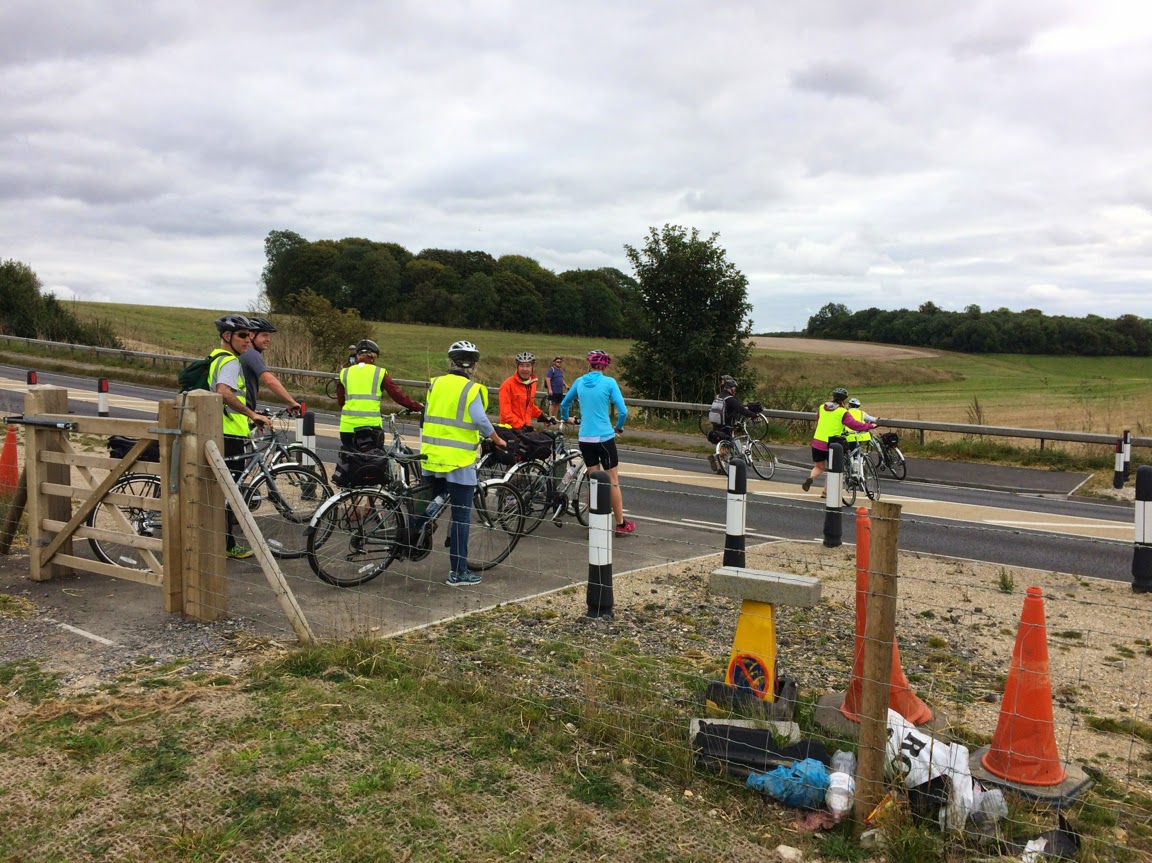
Today wasn't too bad and I was safely across in under a minute.  I rode up to the A344 then onto the temporary permissive path between Byway 12 and Stonehenge Bottom.  As I crested the ridge down to Stonehenge Bottom I was confronted by a veritable gaggle of cyclists heading down towards the A303.


They were a nice friendly bunch and I explained that I was part of STAG and what we were about and please could I take photos of them if they were trying to cross.  They were happy for me to do so, so here is a short vignette of what happened next.

The thought of them all trying to cross made my blood run a bit cold as the traffic here is gravity-assisted in both directions and the westbound traffic is still trying to settle scores with other drivers from the 2 lanes into 1 section of the A303, a few hundred meters to the east.

A few cyclists at the front of the group spotted a small gap and either ran or rode across.

Most of them didn't get the opportunity and there was  steady stream of fast-moving traffic in both directions on what is, at this point a Clearway, not that anyone gives a tuppeny-damn about the Highway Code these days!

They waited, and waited, and waited.
When a westbound gap appeared they moved forward, then back again as it disappeared.

One of them made it to the central strip and an eastbound driver in a grey car slowed and stopped.  Remember, it is a Clearway - no stopping.

The cyclists, not quite sure what to do now, all started to move off the verge towards the centre of the A303,  but did so very hesitantly.  The westbound traffic was still thundering past them with mere inches to spare.  It couldn't have been a very pleasant experience.

White van man from Black Hole Storage Removals clearly didn't give a damn and went roaring through and this carried on for a while until another grey car stopped on the westbound carriageway.
and finally, the whole group got across safely.

It could so easily have been very different.  But why are things so dangerous?

Well, the people who control the World Heritage Site have a policy of making Stonehenge a more bike (and horse and pedestrian) friendly place.  This seemed to be borne-out in the plans for the new visitor's centre submitted by English Heritage.  However, despite their intentions and despite planning conditions that mandated a whole raft of measures that would have improved things for cyclists, English Heritage have singularly failed to deliver.

One of the few things that was largely outside the control of English Heritage was an improved crossing at Stonehenge Bottom.  On the one hand,  increased usage of the crossing point was anticipated by all parties after the closure of the A344, hence the planning requiremnt.  However, a spoke was put in the works by the Highways Agency who produced a report - in the way Government Agencies do when they don't want to take action.  The conclusion of this report reads as follows:


"It is the designer’s view that the current usage of this crossing by pedestrians or by cyclists, on either the A303 or the A344 routes, does not justify the increased risk to motorised users on the A303 of providing refuge islands for this crossing. However it is felt that the opportunity to relocate the crossing to the best location position for NMU visibility and to reduce the crossing width is justified and should be taken.

In taking this view, the designer is taking note of RSA team preference, based on pedestrian rather than cycle use of the crossing, of the do minimum crossing type. The designer is also influenced by the fact that this is far from being the only single carriageway rural at grade crossing of the A303 with no specific NMU facilities, including equestrian crossings. 

The proximity of this crossing to the Stonehenge World Heritage site does not currently attract to it significant NMU usage. It is therefore felt that neither the existing usage of the crossing or the last five year’s accident records warrant a different approach here to that taken at other similar crossing locations where the balance of risks between NMU and Motorised Users, and hence the actual overall risk, dictates the level of provision made. 

It is therefore recommended that the measures in Option 4 proposals, with the refuge islands removed but all the other measures retained is adopted. 

A future scheme for reviewing the crossing arrangements needs to be submitted and approved. The scheme shall have regard to Design Manual for Roads and Bridges HD 19/03 Stage 4 Safety Audit 12 and 36 month post scheme recommendations for any remedial action. 

It is felt that the extensive investigation already under taken into the examination of the safety of and the changes to the crossing here proposed satisfies the requirements of the planning condition."

Just for the record, NMUs are non-motorised units - pedestrians, cyclists and horse riders.  Cutting out all the crap, what they are actually saying is that the body-count at Stonehenge Bottom is too low to warrant making anything more than superficial changes. However, they go on to suggest that a safety audit at 12 and 36 months might change things if the body count increases.

I don't suppose the contribution by Wiltshire Council helped much either:


"...that in relation to cycle usage their preferred route between the A344 to the north and Amesbury for cyclists was via the countess roundabout underpass crossing of the A303 and than via Lark Hill."  (all the typos and grammatical errors are courtesy of the Highways Agency!)

As usual with Wiltshire Council when it comes to anything in the south of the county - thumbs up bums and brains in neutral all the way.  No-one in their right minds, who knew about the local area, would ever choose to get from the centre of Amesbury to Stonehenge by heading north, through the scrofulous Countess Roundabout underpass (on foot - as cycling is forbidden on this bit of the cycle route), up Countess Road, being harassed by rat-running motorists, then head west to Larkhill along the rat-run of choice for coaches and HGVs, before eventually getting to the northern end of Byway 12.

Most sensible folk will simply head out to West Amesbury, up to the A303 and then to Stonehenge Bottom and the A344 - no need to ride with high speed traffic at all - just dice with death crossing the A303.  That's what they've always done, that's what they were doing today and that's what they will do until the A303 issue is resolved once and for all. 

Of course,  there was a fall-back plan to monitor the situation.  Here it is.  Read it carefully and spot the flaw:


STONEHENGE ENVIRONMENTAL IMPROVEMENTS PROJECT Planning Application Reference S/2009/1527 

Scheme required under planning condition 27 for reviewing pedestrian and cycle route access arrangements along the whole of the A344, and crossing arrangements at the A303 (Stonehenge Bottom)

Following approval of the details of the pedestrian and cycle route access arrangements along the whole of the A344 and crossing arrangements at the A303 (Stonehenge Bottom), English Heritage will co-operate with the Local Highways Authority, Highways Agency and the Local Planning Authority in reviewing the arrangements. In particular, should a formal Stage 4 Safety Audit be carried out, and any recommendations for remedial action be made in the 12 and 36 month Stage 4 Reports submitted to English Heritage and the other organisations, then any required remedial works, and arrangements for their implementation and funding, will be considered and agreed between English Heritage, the Local Highways Authority, the Local Planning Authority and the Highways Agency, as appropriate. 

In addition, English Heritage will carry out the following:

  • -  Incorporate questions about the pedestrian and cycle access into the annual visitor survey conducted by the travel and tourism department of market research company TNS. This will comprise face to face interviews with 180 individuals during the months of July, August and September. Likely questions include: whether people have accessed the site on foot or on bicycle, and, if so, where they have travelled from, how satisfactory they have found the route and where they are travelling onto. 

  • -  As part of the ongoing operational management of the site English Heritage staff will, as a matter of course, record, report to the relevant authorities and, if appropriate, take any necessary action in respect of any incidents or accidents along the route of the A344 between Airman's Corner and Stonehenge Bottom. 

    English Heritage 26th April 2012
 
Did you spot it?  Yes, that's right.  Most pedestrians, cyclists and horse riders arriving at Stonehenge don't pitch up at the visitor's centre, as there is (still) no provision for them.  They may arrive from east or west, north or south, but we suspect that few, if any, will be invited to take part in the annual visitor survey, conducted for English Heritage by TNS.  
During my many visits to the WHS this July August and September I've never seen anyone with a clipboard interviewing pedestrians, cyclists and the two riders I have seen, nor have I ever been approached.  Now that's interesting, if true because this safety audit is meant to be looking at the safety of crossing the A303 by any and all users, not just English Heritage's paying customers.
As I say, we don't know for certain that this is the case, but I feel an FOIA request ,or two, coming on! 


Thursday, 25 September 2014

Stonehenge: What English Heritage Told Wiltshire Council They Would Do To Discharge Planning Conditions - Then What They Failed To Do!

Over the last few weeks we have highlighted our concerns that English Heritage might have failed to discharge their obligations in relation to the planning conditions imposed on them by Wiltshire Council, in allowing the construction of the new visitor's centre at Stonehenge, which opened in December 2013.

Suspicion is one thing, having evidence is something else entirely.  Consequently, we submitted a FOIA request to Wiltshire Council using the What Do They Know website to make life easier.   Basically, in granting planning consent, Wiltshire Council had imposed 27 separate conditions that English Heritage were required to adhere to, covering a wide variety of topics associated with the new buldings, the environment and the A344.  It would have been unreasonable for us to have asked about them all given our interests, so we restricted ourselves to those conditions that dealt directly with the use of the A344 by pedestrians and other users.

Wiltshire Council had told English Heritage to provide detailed plans for how they were going to ensure the planning conditions were met.  Wiltshire Council would then approve these proposals before they were instituted.  All very sensible and logical.

The information we got back from Wiltshire Council was a bit of revelation.  You can download it and study it yourself from here.  Wiltshire Council also indicated that they would put the same information on their website to aid its easy retrieval in the future.  So here, in a nutshell, is what we discovered.


In early 2012, CBA Associates, acting for English Heritage, proposed to Wiltshire Council that the outstanding planning conditions be discharged.  In reply, in two separate letters on 13th and 25th June 2012, Adam Madge of Wiltshire Council Planning Department responded to this proposal, agreeing to the measures English Heritage had put forward to comply with these obligations and in both letters stating:

"I would confirm that the details sent to us in relation to these conditions are acceptable to the local planning authority. The conditions will have been fully discharged when the development is carried out in accordance with these details as submitted.”

In other words, providing English Heritage complied with what they themselves had proposed, they would have satisfied Wiltshire Council.

So let's take a look at a few of the details, using English Heritage's own timetable:


PHASE 1 – STONEHENGE BOTTOM – MARCH 2013 – JUNE 2013


A new permissible route for pedestrians and cyclists is to be installed with the section that crosses the A344 being reinforced with a plastic ground reinforcement grid and defined by a low barrier, such as a rope barrier to stop visitors walking on the establishing areas of grass.


FAILED: Although the ground reinforcement was installed as planned, no route was marked until late summer 2014.  Even now, the route marking is all a bit half-hearted and may be incorrect.


PHASE 2B – ENTRANCE CONFIGURATION – LATE SEPTEMBER 2013


On the A344 west of Byway 12 a section of the A344 is removed and reinforced hardwearing turf established. Site hording, such as Heras fencing is erected prior to the works beginning and is replaced by a temporary barrier/fence on its completion. These areas of hardwearing grass will be released in Sumer 2016.

New gates, Kent carriage gap and fences are to be installed at the intersection of Byway 12 and the A344.


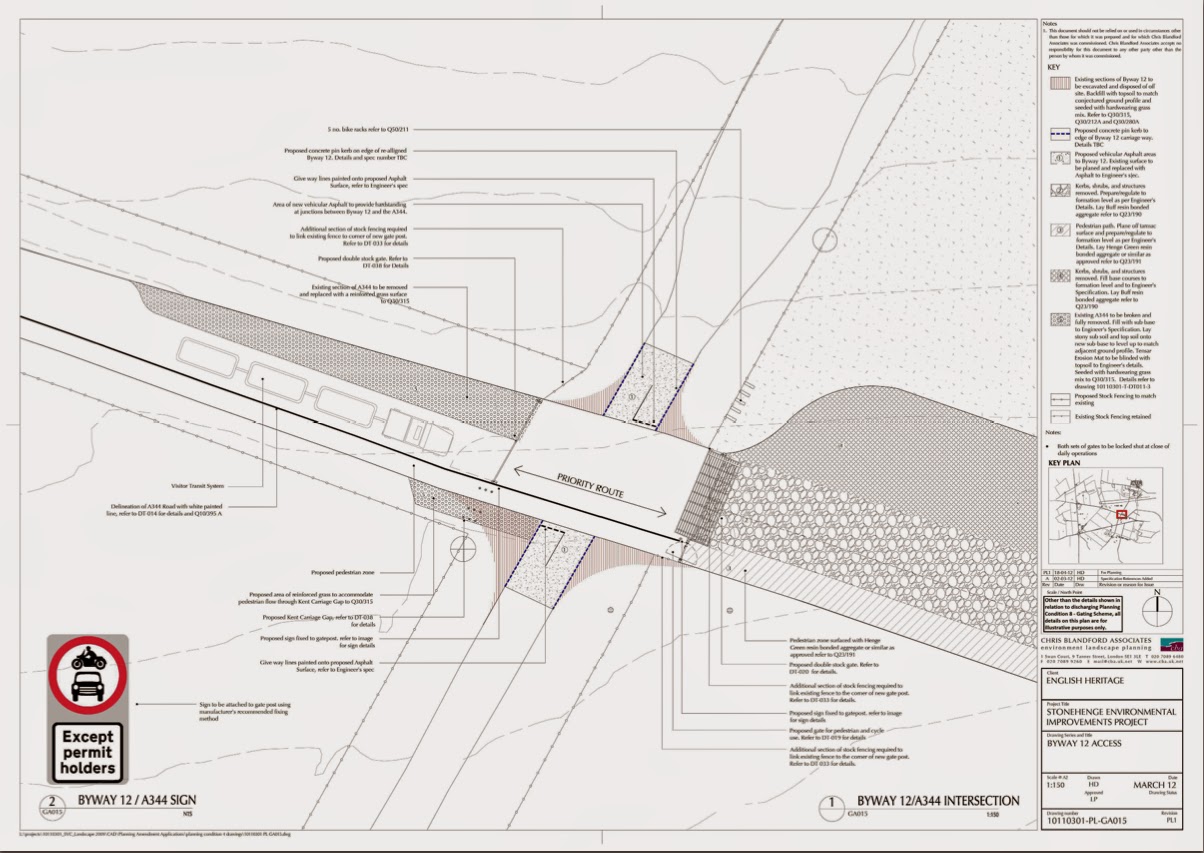
FAILED:  The following diagram shows what EH said they would install - Kent Carriage Gaps of the dimensions we have harped on about several times:


This is a bit hard to see, so here is the detail:


The design of the Kent Carriage Gaps, proposed by EH and accepted by Wiltshire Council, was:


You may also note in the plan above, that EH were supposed to provide cycle racking by certain deadlines they themselves had proposed:


Cycle Parking and Storage Provision at the Western End of the retained A344

10 no. bicycle racks to accommodate the parking/storage of 20 cycles will be provided in the location shown on drawing 10110301-T-GA003. These will be installed during works to the A344 in a 12 week construction period currently scheduled to commence on 06/03/2013 and complete on 05/06/2013.


FAILED


 Cycle Parking Provision at the Eastern End of the retained A344

5 no. bicycle racks to accommodate the parking of 10 cycles will be provided in the location shown on drawing 10110301-T-GA005. These will be installed during the construction of the Hub Building and Visitor Transit System Drop-Off/Pick Up area in a 24 week construction period currently scheduled to commence on 09/10/2013 and complete on 08/04/2014.


FAILED

Work should have also been carried out last year at the intersection of Byway 12 with the A344

The intersection of the A344 and Byway 12 and road surfaces of both the north and south approaches of Byway 12 will be planed and resurfaced with tarmac. A traffic management programme will be carried out while these works are being completed to allow traffic along the A344 as needed.


FAILED: EH have failed to install Kent Carriage Gaps, gates and cattle grids at the intersection.  Anyone would think they were holding back in case Byway 12 was closed!
Where things get really confusing is in relation to the permissive path for cyclists and pedestrians between Byway 12 and Stonehenge Bottom.  English Heritage, in proposing to discharge planning condition 11 noted to Wiltshire Council in a general statement:


A permissive path (for pedestrians and cyclists) will be available on National Trust land immediately north of the Stonehenge monument running along the line of the former A344 between Byway 12 and Stonehenge Bottom.

Completely unambiguous, what was reported by the Press at the time, completely reasonable, but NOT what English Heritage actually intended.  Between now and 2016, the temporary permissive route will follow its current course:


It follows the northern side of the stopped-up A344 to a new gate in the northern stock fence, crosses through the stock fence into the National Trust open access land.  Now here is the idiocy.  Once you are through the gate, you don't need to stick to the path and indeed one of the points the National Trust often make about this type of open access land is that they prefer people didn't all keep to one path, as it does less damage to the terrain.  So having permission to use a path over land over which you have permission to roam does seem a wee bit superfluous.  But it is, allegedly, only a temporary arrangement.


PHASE 4 – STONEHENGE BOTTOM – SUMMER 2016

The existing/temporary stock fence and gates to the north of the original A344 are to be removed and turf used to patch any resulting disturbances in the grass surface. The areas of the permissible route that are formed using the ground reinforcement system are to be removed and patched using turf grown off site.

The permissible route is now along the northern edge of the re-vegetated A344.


PARTIAL FAIL: The unambiguous brief answer provided by EH was highly misleading.  The detailed answer may turn out to be correct, but we wont know until 2016.

We said at the outset that we had only asked about a few of the planning conditions that were imposed by Wiltshire Council, but our findings are worrying as it suggests there may be a systematic problem with the way these have been dealt with by English Heritage.  It also highlights what some might perceive as a lack of diligence on the part of Wiltshire Council's Planning Department.  The question has to be asked as to why they haven't been closely monitoring work at what must be one of Wiltshire Council's most prestigious locations and one of national and international importance.

We've now fed this back to Wiltshire Council.  They need to put their house in order - and do it quickly.  Only then might we see the quality of development at Stonehenge that English Heritage promised and that so farm they have singularly failed to deliver.